


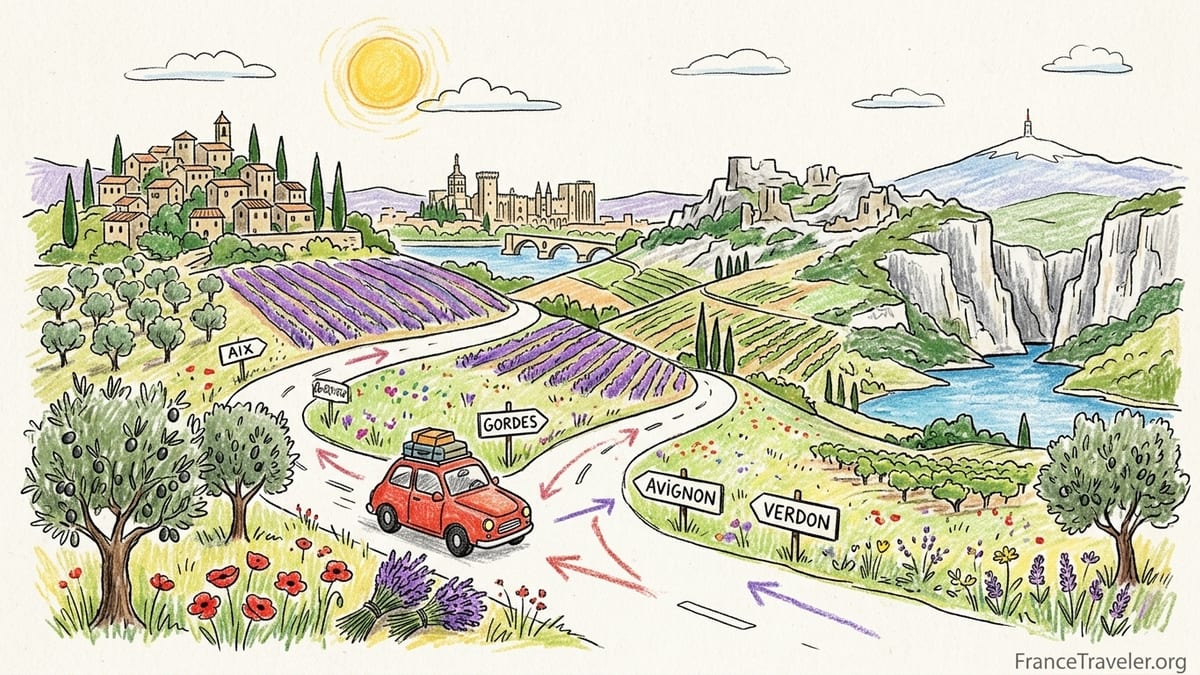
Provence is made for slow road trips: ochre villages perched on hills, weekly markets filling cobbled squares, Roman amphitheaters still in use, and in season, lavender fields running to the horizon. With a rental car and 5 to 7 days, you can link Aix en Provence, the Luberon villages, Avignon, Saint Rémy and Les Baux, Arles and, in season, the Valensole plateau and Verdon Gorge, without turning your vacation into an endurance test behind the wheel. This guide distills what current Provence road trip itineraries actually recommend and shows you how to build a realistic loop using a few smart bases, short drives and well chosen hotel changes.
How many days you really need in Provence
Most current Provence road trip itineraries cluster around 5, 6 or 7 days, not two week epics. Recent six day and seven day loops published by independent planners and regional sites show a clear pattern: about three hotel bases and daily drives of one to two hours, with only one longer transfer to reach Valensole or the Verdon Gorge if you decide to include them. With 5 days you can comfortably cover Aix, the Luberon and the Alpilles around Saint Rémy and Les Baux, plus either Avignon or Arles. With 6 or 7 days you can add both cities and a lavender or Verdon day.
Think of your time in Provence in blocks rather than a rigid checklist. A 5 day trip might be split into 2 nights in Aix and 3 nights around Saint Rémy, with the Luberon as a day trip. A 6 day version could keep Aix for 2 nights, then 2 in a Luberon village such as Gordes or Lourmarin, and 2 in Avignon or Arles. With 7 days, you can keep those three bases and add a long but worthwhile day to Valensole and the Verdon Gorge from Aix or the Luberon, or shift one night to a small hotel near Moustiers Sainte Marie on the edge of the gorge to avoid a long out and back drive.
Season also affects how far you want to range. In July, heavy lavender season traffic around Valensole and on the D952 towards Verdon means a day trip can easily stretch to 8 to 10 hours out and back. In shoulder months such as May and late September that same loop feels relaxed. Outside lavender season, many recent itineraries drop Valensole entirely and focus on a tighter triangle between Aix, the Luberon, Avignon and the Alpilles, which keeps drives short and avoids changing hotels unnecessarily.
Smart bases: where to sleep to cut driving
Choosing the right overnight bases is the single biggest factor in how your Provence road trip feels. Current 5 to 7 day itineraries tend to favor three hubs: Aix en Provence for a small city base, one village in the Luberon hills, and either Avignon, Arles or Saint Rémy for the Roman and Alpilles sights. Basing smartly lets you loop out on scenic roads and be back at your hotel in time for an aperitif rather than checking into a new place every night.
Aix en Provence works well as a first or last base because it has frequent TGV, domestic flight and highway connections, and big rental car agencies near Aix TGV and Marseille Provence Airport. In town, hotels such as Hôtel de France on Cours Mirabeau or the more contemporary Hôtel de Gantelet just off the ring road allow you to park once in an underground garage and explore on foot. From Aix you can reach Avignon in about 1 hour 15 minutes via the A7, the Luberon villages like Lourmarin in around 45 minutes over the D973 and D943, and Valensole in roughly 1 hour 30 minutes by the A51 and D6.
For a countryside base, many repeat itineraries pick a Luberon village such as Gordes, Roussillon, Bonnieux or Lourmarin. Gordes has views and hotels like La Bastide de Gordes at luxury prices, while Roussillon offers mid range guesthouses and an easy walk to the ochre cliffs. If you prefer a slightly larger town with more restaurants, L’Isle sur la Sorgue and its canals sit on the northern edge of the Luberon and give easy access to both Avignon and the hill towns. A third base in Avignon, Arles or Saint Rémy lets you reach the Alpilles, Roman ruins and the Camargue without long returns to the Luberon after dinner.
Changing bases is worth it when it cuts daily drives dramatically. For example, shifting from Aix to a Luberon base after 2 nights trims your round trip drives to Gordes and Roussillon from almost 3 hours total each day to short 20 to 30 minute hops. Likewise, moving from a Luberon village to Avignon or Saint Rémy means Arles is around 30 to 45 minutes away, rather than 1 hour 30 minutes each way. That is where packing up once more starts to make sense, especially on a 6 or 7 day itinerary.
Sample 5, 6 and 7 day Provence road trip frameworks
Think of the following sample plans as frameworks you can adapt around flight times, market days and your own pace. Distances are kept realistic, mirroring what many 2026 itineraries are actually recommending rather than idealized wish lists that require dawn to dark driving.
A 5 day loop might look like this: Day 1 arrive in Aix en Provence, walk Cours Mirabeau, overnight in Aix. Day 2 pick up your rental car in the morning, drive a Luberon loop via Lourmarin, Bonnieux, Roussillon and Gordes, then continue 1 hour to Saint Rémy de Provence for 3 nights. Day 3 explore Saint Rémy, the Roman site of Glanum and the monastery where Van Gogh stayed, then continue to Les Baux and the Carrières de Lumières art show before returning to Saint Rémy. Day 4 visit Arles for the Roman amphitheater and historic center, with a possible late afternoon detour to Avignon. Day 5 return to your departure point, optionally stopping in Aix if flying out of Marseille.
For 6 days, keep 2 nights in Aix, 2 in the Luberon and 2 in Avignon or Arles. After an arrival evening in Aix, use Day 2 for a full Luberon loop by car, overnighting in Gordes or Roussillon. Day 3 can focus on deeper Luberon stops such as Ménerbes or Oppède le Vieux, then continue to Avignon in the late afternoon. Day 4 is for Avignon’s Palais des Papes and Pont d’Avignon. Day 5 covers Saint Rémy and Les Baux as a day trip from Avignon. Day 6 spends several hours in Arles before you continue to your next destination or circle back to Aix or Marseille.
With 7 days you can add either a lavender and Verdon day or more time in the Alpilles and Camargue. One common structure is 2 nights in Aix, 2 in the Luberon, 2 in Avignon or Saint Rémy and 1 near Moustiers Sainte Marie or Lac de Sainte Croix. From Aix, reserve one full day in July for the Valensole plateau and Verdon scenic drives, leaving before 8 am to reach the D6 and D8 lavender fields before tour buses and harsh midday light. If you prefer to avoid longer drives, keep all 7 nights within the triangle of Aix, Luberon and Avignon and use the extra time for a Camargue day from Arles or a second Luberon loop including smaller villages like Saignon and Cucuron.
Driving times, scenic roads and where to park
Most of the core Provence road trip drives are under 90 minutes. Aix to Avignon is roughly 90 kilometers and usually around 1 hour 15 minutes via the A7 toll motorway, longer if you opt for the slower D7n through countryside. Avignon to Saint Rémy or Les Baux is about 30 to 40 minutes on the D570 and D99 through olive groves and low hills, while Avignon to Arles is around 45 minutes using the N570. The Luberon villages are closer together: Gordes to Roussillon is only about 15 minutes via the D2 and D104, and Gordes to Bonnieux takes roughly 30 minutes depending on season traffic.
For scenic driving, the D900 and D943 across the northern Luberon offer broad views of vineyards and stone villages, while the climb up to Gordes from the D2 gives you the iconic viewpoint across the village. The D6 and D8 grid around Valensole plateau snakes between lavender and wheat fields, and on summer evenings you will see tripods lining the roadside. If you reach the Verdon Gorge, the Route des Crêtes on the north rim offers jaw dropping drop offs and belvederes but is narrow and not ideal for drivers who dislike heights. Outside the main season, country roads can be empty enough that you feel you have the landscape to yourself, but in July and August expect slower progress and occasional delays behind campervans.
Parking is relatively straightforward if you avoid trying to drive into medieval cores. In Aix, large underground car parks on the ring road around the old center are clearly signposted, with typical daytime rates around 20 to 25 euros for several hours. In Avignon the Parking du Palais and Parking des Halles structures are walking distance from the historic district. Saint Rémy, Les Baux and Gordes all operate paid lots at the edge of the villages, often charging a flat fee of a few euros for several hours, and in many cases you can pay by card at machines. Arles has surface lots near the amphitheater and train station, though spaces fill quickly on Saturday market days, so many road trippers aim to arrive before 9 am.
Market days, timing and seasonal nuances
Scheduling your route around Provence’s markets can transform your trip. Aix en Provence holds a large produce and flower market several days a week around Place Richelme and along Cours Mirabeau, with Tuesdays, Thursdays and Saturdays typically the most atmospheric. Avignon’s covered Les Halles market is busiest on weekend mornings, while Saint Rémy’s Wednesday market is a highlight that spills through the old streets with food, fabrics and antiques. L’Isle sur la Sorgue is famous for its Sunday antiques market, which road trip itineraries often build a day around, combining browsing with a late lunch by the canals.
Season impacts what you will find on those stalls. In late spring you see strawberries, asparagus and fresh goat cheese, while July and August bring tomatoes, peaches and olives. Olive oil and lavender products are sold year round, but if you are hoping for those classic purple field photos around Valensole, most years the peak bloom falls from the last week of June to around mid July, with harvesting starting in many fields by late July. That is why many 7 day itineraries timed for lavender season dedicate a full day to Valensole, accepting the longer drive as a trade off for those views.
Market days also influence where you should sleep. If your 5 or 6 day itinerary includes a Wednesday in Provence, it makes sense to base in or very near Saint Rémy so you can walk to the stalls early without needing to hunt for parking. Similarly, anchoring a Saturday in Aix or a Sunday in L’Isle sur la Sorgue allows you to enjoy the full energy of the markets while leaving your car in a hotel lot or nearby garage. When dates do not align perfectly, prioritize avoiding long cross region drives on peak market mornings, when roads into village centers can be jammed.
Choosing between Avignon, Saint Rémy and Arles as bases
Avignon, Saint Rémy and Arles all sit within 45 minutes of one another but offer different atmospheres and logistical pros and cons. Avignon is the largest and most connected, with direct TGV links to Paris and Lyon and frequent regional trains. Staying inside the walls puts you steps from the Palais des Papes and the famous bridge, and gives you many restaurant options. Parking inside the center is structured and relatively expensive, but multiple garages ring the walls, and park and ride lots on the outskirts can reduce stress if you are driving in on a busy day.
Saint Rémy de Provence is a smaller, more polished town often chosen as a countryside chic base. Its Wednesday market is one of the most talked about in current traveler reports, and from Saint Rémy you can reach Les Baux in around 20 minutes, Arles in roughly 30 to 40, and the Luberon villages in under an hour. Accommodation leans toward boutique hotels and bed and breakfasts in converted farmhouses just outside the center, with on site parking and pools. This makes Saint Rémy an efficient base if your focus is the Alpilles, Roman sites like Glanum and the Van Gogh trail, plus day trips to Avignon and the Luberon.
Arles suits travelers who care most about Roman history and photography, and who may want to dip into the Camargue wetlands. The city’s amphitheater and Roman theater anchor the old town, and recent itineraries often recommend one full day here to combine the main sights with a long lunch on a shaded square. From Arles, it is about 45 minutes to Saintes Maries de la Mer in the Camargue, and just under an hour to Avignon. Street parking near the center can be tight in high season, so some visitors choose hotels on the edge of the old town with small private lots, or use the paid surface lots near the railway station and walk in.
When to add Valensole and the Verdon Gorge
Valensole and the Verdon Gorge sit to the northeast of Aix and the Luberon, beautiful but more remote. Many current 7 day Provence itineraries treat them as an add on rather than a core stop, and that is a good way to think about them in your own planning. From Aix, the drive to Valensole village is about 1 hour 30 minutes each way via the A51 and D6, and from Gordes or Roussillon it can be closer to 2 hours 15 minutes one way, which makes for a very long day if you try to include both lavender fields and a full Verdon Gorge circuit.
If you visit in late June or early July and want that lavender experience, it is worth dedicating a full day. One realistic pattern is to leave Aix or a Luberon village early, reach Valensole plateau around 9 am, spend several hours stopping at roadside pullouts and small farm stands, then continue another 1 hour 15 minutes to Moustiers Sainte Marie for a late lunch. In the afternoon you can drive part of the Verdon rim road or rent a paddleboat on Lac de Sainte Croix for an hour or two before looping back. That day can easily run 10 to 12 hours including photo stops, so having a hotel in Aix or near the lake to return to is important.
Outside lavender season, consider whether the extra driving fits your trip. Many short itineraries skip Valensole entirely in September or October and spend that extra day walking in the Luberon, wine tasting near Châteauneuf du Pape north of Avignon, or visiting smaller Roman sites such as Pont du Gard. On a tight 5 day schedule, it often makes more sense to keep your loop compact and avoid the temptation to push all the way to Verdon unless you are comfortable with long hours on narrow mountain roads.
The Takeaway
A Provence road trip does not need to be a two week marathon. The bulk of up to date itineraries show that 5, 6 and 7 day loops linking Aix, the Luberon villages, Avignon, Saint Rémy and Les Baux, Arles and, optionally, Valensole and the Verdon Gorge can feel rich without being rushed. The key is choosing two or three smart bases, accepting one or two longer drives only when the payoff is high, and aligning your nights with market days and the type of atmosphere you enjoy, whether that is a lively small city like Aix or a stone village in the Alpilles.
Build your plan around real driving times, not ideal conditions, and leave space in each day for a slow lunch, a swim at your hotel pool, or an unplanned stop at a roadside viewpoint. Provence rewards travelers who move at its own pace. With a well considered 5 to 7 day framework, your road trip becomes less about checking off towns and more about soaking up light, food and landscape along some of France’s most evocative back roads.
FAQ
Q1. Is it better to start a Provence road trip in Aix en Provence or Avignon?
Aix en Provence works well if you are flying into Marseille or arriving by TGV and want a soft landing in a walkable small city before driving. Avignon is more central to the Luberon, Alpilles and Roman sites, so it is often the most efficient base if you have only 5 days and plan to spend every night in one place.
Q2. Do I really need a car, or can I rely on trains and buses?
You can reach Aix, Avignon and Arles by train, but a car makes it far easier to visit hilltop villages like Gordes and Roussillon, the Alpilles around Saint Rémy and Les Baux, and rural lavender fields on the Valensole plateau. Public transport between small villages is limited and often infrequent, especially in the evening.
Q3. How expensive is parking in Provence towns and villages?
In cities such as Aix and Avignon, expect to pay around 20 to 25 euros for a full day in an underground garage near the center. Smaller towns and villages typically charge a few euros for several hours in edge of village lots, and some offer free parking slightly farther out if you are willing to walk 10 to 15 minutes into the center.
Q4. When is the best time to see lavender near Valensole?
Bloom varies slightly each year, but late June to around mid July is usually the most reliable period for full lavender fields around the Valensole plateau. By late July many farmers begin harvesting, and by early August a lot of the fields have already been cut, even though you will still find lavender products for sale at markets.
Q5. Which village makes the best Luberon base for first time visitors?
Gordes and Roussillon are the most popular for their views and atmosphere, while Lourmarin and Bonnieux feel a bit quieter but still have good restaurant options. L’Isle sur la Sorgue suits travelers who want more shops and an antiques market, plus quicker access to Avignon.
Q6. Is it worth changing hotels to stay in both the Luberon and the Alpilles?
If you have 6 or 7 days, spending a few nights in a Luberon village and a few in Saint Rémy or Arles can significantly cut daily drive times and let you enjoy evenings without long returns. On a 5 day trip you might prefer one countryside base and day trip in both directions to avoid packing and unpacking too often.
Q7. Are Provence roads difficult or stressful to drive?
Major routes such as the A7 and A51 are modern motorways that are easy to drive if you are comfortable with European highways. Smaller roads in the Luberon, Alpilles and around the Verdon Gorge are often narrow and winding, with occasional tight village streets, so it helps to rent a compact car and allow extra time for slower traffic in high season.
Q8. How should I plan around market days?
Check which days major markets fall in the towns you plan to visit and, where possible, align your overnight stays so you can walk to at least one or two of them. For example, sleeping in Saint Rémy on a Wednesday or in L’Isle sur la Sorgue on a Sunday lets you enjoy the market without fighting for parking or driving in heavy morning traffic.
Q9. Can I visit the Verdon Gorge as a day trip from Aix or the Luberon?
It is possible but makes for a very long day, often 8 to 10 hours including driving and stops. Many travelers leave before 8 am, visit Valensole fields on the way, have lunch around Moustiers Sainte Marie, then spend a few hours on the lake or scenic rim roads before returning. If you dislike long drives, consider staying one night near the lake instead.
Q10. Is a 5 day Provence road trip enough to see the main sights?
Five days is enough for a satisfying first taste if you keep your loop compact. Focus on Aix or Avignon as your main base, add either a Luberon or Saint Rémy stay, and accept that Valensole and the Verdon Gorge may be better saved for a future longer trip.