


Every Provence itinerary eventually runs into the same question: do you really need a rental car, or can you rely on trains and buses? The answer depends less on how long you are staying and more on where you want to go. This guide uses current, on-the-ground information to walk you through that decision and, if you choose to drive, how to rent and use a car efficiently from Marseille Airport, Avignon TGV and Aix TGV.
Do You Need a Car in Provence?
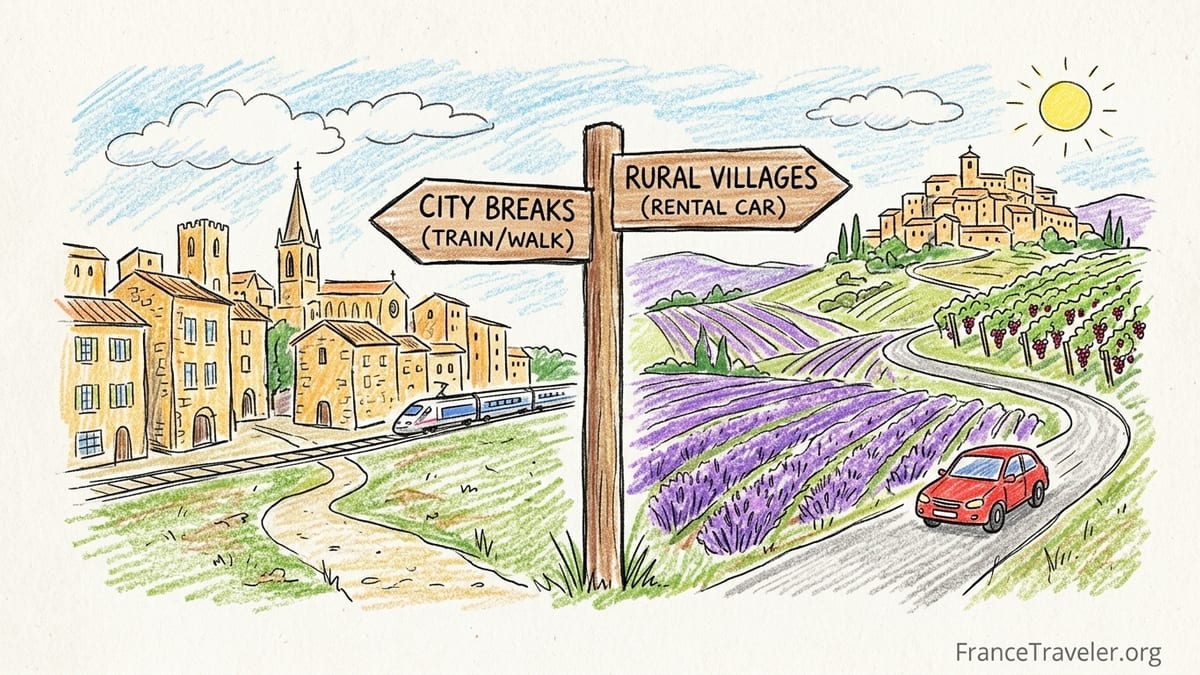
For city breaks focused on Avignon, Arles, Aix en Provence and Marseille, you can manage well without a car. High speed and regional trains link these cities in around 30 to 90 minutes, and each has a compact, walkable historic center. For example, you can travel by TGV from Paris to Avignon TGV in about 2 hours 40 minutes, then hop on a 5 to 10 minute local shuttle into the walled old town, never needing a car at all.
The equation changes as soon as you add hilltop villages, vineyards and lavender plateaus. Current regional guidance on the Luberon explicitly describes car free travel as limited, especially for smaller villages and rural walks. Buses exist but are infrequent, may not run on Sundays or late evenings, and often connect only a few larger market towns. Reaching perched villages like Gordes or Bonnieux, or lavender areas around Valensole or Saignon, is significantly easier and more flexible with a rental car.
A useful way to decide is to separate your trip into two zones. Zone one covers the cities and larger towns on main rail lines: Marseille, Aix en Provence, Avignon, Arles and Nîmes. Zone two covers the countryside: the Luberon villages, vineyards around Bonnieux or Lourmarin, the Alpilles around Saint Rémy and Les Baux, and the high plateaus of lavender. If your plan is mostly zone one, trains and buses are fine. If zone two is central to your trip, renting a car for at least part of your stay will save you considerable time and logistical stress.
Many travelers now choose a hybrid approach. They arrive by TGV into Avignon or Aix, spend a few car free days exploring by train and on foot, then pick up a rental car mid trip for three or four days in the countryside. Returning the car to a TGV station or the airport before heading back to Paris often lowers the overall cost and avoids city parking headaches.
Where to Pick Up: Marseille Airport vs Avignon TGV vs Aix TGV
Most Provence visitors arriving from abroad land at Marseille Provence Airport, while many arriving from Paris or Lyon prefer the TGV stations at Avignon or Aix. All three are practical pickup points, but they suit different itineraries and driving comfort levels.
Marseille Provence Airport has one of the largest selections of rental companies in the region, including major brands clustered in car rental areas directly opposite the terminal buildings. Desk hours are typically long, and you will find more automatic cars and larger vehicles here than at smaller stations. Driving out from the airport puts you quickly onto main roads and motorways heading toward Aix, Avignon, Arles and the Luberon. This is ideal if you are comfortable driving soon after a flight and plan to head straight into the countryside without first staying in Marseille city.
Avignon TGV station is a strong choice if you are coming by high speed train from Paris or the north and want to start near the Luberon or the Alpilles. Rental desks are located inside or immediately adjacent to the station, with signposted walkways to the rental car park. From Avignon TGV, you can be driving toward L’Isle sur la Sorgue, Saint Rémy or Gordes within minutes. The roads around the station are generally less hectic than Marseille’s urban ring roads, which can be reassuring for drivers unused to French traffic.
Aix en Provence TGV is a smaller high speed station in the countryside between Aix and Marseille. Car rental offices are located in a dedicated parking area signposted from the station. This can be a convenient pickup if you plan to base yourself in Aix, the South Luberon or toward Manosque, and it avoids driving through Marseille entirely. Shuttle buses link Aix TGV with Aix city center and Marseille Airport, so some travelers take the bus into central Aix for a car free city stay, then return to the TGV station later just to pick up a car for a rural segment.
Car Free Travel: What Works Well by Train and Bus
The rail network in Provence is excellent for connecting the main cities and a handful of mid sized towns. For instance, regular trains run between Marseille Saint Charles and Avignon Centre, and between Avignon and Arles. Journeys are typically under an hour and tickets can be inexpensive when bought in advance or at off peak times. This makes it very feasible to spend a week splitting your time between Avignon, Arles and Marseille without ever renting a car.
Within these cities, historic centers are compact. Avignon’s old town is enclosed by intact medieval walls, with most sights within a 15 minute walk of each other. Arles is similarly walkable, with Roman arenas, forums and museums clustered close together. Aix en Provence has a dense old town of fountains, markets and the Cours Mirabeau, where a car would only slow you down. Marseille’s Vieux Port, Panier district and coastal corniche can be explored using the metro, tram and local buses combined with walking.
Regional bus networks fill some gaps. From Avignon, buses run to Saint Rémy de Provence and some Alpilles villages; from Aix and Marseille, regional coaches connect to Salon de Provence, Manosque and other towns. However, services often run only a few times per day and may stop early in the evening. Timetables can also change between seasons. For a traveler content with one or two carefully planned day trips, this can work. For those hoping to hop between multiple remote villages in a single day, it quickly becomes impractical without a car.
Many recent visitor reports and regional tourism materials now underline the same point: the main weakness of car free travel in Provence is rural access, not city access. If your ambitions extend beyond the larger rail linked towns, you will either need to join organized minivan tours, pay for private drivers, or rent a car for at least a portion of your stay.
Why Rural Provence Is So Much Easier With a Car
The villages and landscapes that many people picture when they think of Provence are often far from train stations. Hilltop villages in the Luberon, like Gordes, Roussillon, Bonnieux and Ménerbes, sit on ridges and hills reached by winding local roads. Vineyards and olive groves are spread along small departmental roads, and the most photogenic lavender fields near places such as Valensole or around the Plateau de Sault are in open countryside. Public buses sometimes pass nearby, but stops can be several kilometers from the viewpoints or villages you actually want to visit.
Consider a day exploring the northern Luberon. With a car, you can leave a base in L’Isle sur la Sorgue around 9:00, be in Gordes by 9:30 for the morning light, continue to Roussillon for lunch, then drive the short distances to Bonnieux and Lacoste in the afternoon before returning for dinner. Without a car, even reaching two of these villages in one day can involve carefully sequenced buses, limited departure times and long waits, with almost no flexibility if you decide to linger at a market or café.
Lavender season illustrates the contrast even more clearly. Peak bloom is usually from late June to mid July, and the most open, cinematic fields are often between villages rather than right beside them. A car allows you to pull into small farm tracks and laybys, visit distilleries that are not on main bus routes, and adjust your plans based on weather or crowds. Travelers relying solely on public transport often find that they can see lavender only at the edges of bus routes or during organized coach excursions with fixed itineraries.
Rural access matters in the evening too. A car lets you stay in small guesthouses or farm stays outside town centers, dine in village restaurants that may have no late bus services, and return at your own pace. For many, this flexibility and the ability to follow back roads and scenic viewpoints is the main argument in favor of renting a car in Provence, at least for several days.
Choosing and Booking Your Rental Car
In France, manual transmission cars are still more common and usually cheaper than automatics. Many rental searches show compact manual cars as the base category, with automatics often priced higher and available in slightly larger models. If you can only drive an automatic, reserve as early as possible, especially for peak months like June and September when demand from international visitors is strong. Booking late can leave you with limited choice or higher prices.
For most Provence itineraries, a compact or intermediate sized car is ideal. Streets in historic centers such as Avignon, Arles and Aix are narrow, and village lanes in the Luberon or Alpilles can be tight, with stone walls and parked cars. A smaller vehicle is easier to maneuver and park, and is usually more fuel efficient. Large SUVs or vans are best reserved for families or groups who genuinely need the space and are comfortable handling wider vehicles on small roads.
When comparing prices, pay attention not only to the daily rate but also to what is included. Many French rentals include basic liability insurance and a limited collision damage waiver, but often with a high excess, meaning the amount you must pay toward any damage. Check whether your credit card or travel insurance offers primary or secondary rental car coverage in France, as this can influence whether you buy extra coverage from the rental company.
Booking to pick up at Marseille Airport usually offers the broadest fleet and longest opening hours, which helps if your flight is delayed or you need a one way rental to another city. Avignon TGV and Aix TGV have smaller fleets but are very convenient for those already in the rail system. In all cases, reserving in advance rather than walking up on arrival gives you more control over transmission type, car size and total price.
Deposits, Insurance and One Way Rentals
All major rental companies in Provence will place a security deposit or temporary hold on your credit card at pickup. The amount varies by provider and vehicle category, but it is common for it to be several hundred euros on top of the estimated rental charge. This means you need sufficient credit limit on the card used at the counter. Debit cards are sometimes accepted, but often with stricter rules, such as proof of return flight and higher deposits, and are less widely accepted for premium vehicles.
Standard rentals usually come with a collision damage waiver and theft protection with an excess. To reduce or eliminate this excess, rental firms sell additional coverage at the desk. Alternatively, some travelers rely on separate policies purchased from third party insurers before the trip, which reimburse the excess if damage occurs. If you plan to rely on a credit card’s insurance, check in advance that France is covered and that you understand any exclusions, such as for luxury cars or off road driving.
One way rentals within Provence, such as picking up at Marseille Airport and dropping at Avignon TGV, are typically allowed but may incur an additional fee. The exact amount can depend on car size, route and date. For travelers arriving by air at Marseille and departing by TGV from Avignon or Aix, this can still be cost effective when compared with extra train tickets or airport transfers. If you plan to cross borders, for example driving into Italy or Spain, always confirm that international travel is permitted with your chosen car type and that any necessary documentation is provided.
Fuel policies also matter. Many agreements in France operate on a full to full basis, meaning you receive the car with a full tank and must return it full. Failing to refill can lead to refueling charges at rates notably higher than local petrol stations. Before leaving the rental lot, note the nearest fuel station on your route for an easy top up at the end of your trip.
Parking, Tolls and Driving Practicalities
Parking is one of the main downsides of having a car in Provence’s cities. In central Avignon, Arles and Aix, street spaces are often controlled and time limited, and multi storey car parks fill up in summer. A practical strategy is to choose accommodation that includes parking, or to use peripheral car parks and walk into the historic center. For example, staying just outside the walls of Avignon or a short walk from the Cours Mirabeau in Aix often provides better parking options than staying directly in pedestrianized cores.
In small villages, parking can be in shared lots at the edge of the settlement, sometimes free, sometimes paid, especially in very popular places during peak season. Hilltop villages such as Gordes and Les Baux de Provence often have dedicated visitor car parks below the old streets, with a short uphill walk into the center. Arriving early in the morning or later in the afternoon helps secure a space and avoids the busiest midday window.
On major routes, Provence has tolled motorways that offer fast, well maintained connections between cities. Toll booths accept credit cards and cash, and charges are based on distance. For example, driving between Marseille and Avignon or between Aix and Nice typically involves toll sections. If you plan many motorway journeys, these costs can add up, so incorporate them into your budget. When time allows, national and departmental roads offer more scenic, toll free alternatives, though journeys will be longer.
Driving etiquette in Provence is similar to the rest of France: drive on the right, seat belts are mandatory, and speed limits vary between motorways, main roads and village streets. Roundabouts are frequent at the edges of towns and on access roads to TGV stations and the airport. A compact car and patient driving style make these straightforward. Use your rental company’s navigation system or a smartphone app to avoid inadvertently entering pedestrian zones or restricted access streets in older centers.
The Takeaway
The core question for Provence travel remains straightforward: if your plans focus on Marseille, Avignon, Arles and Aix, you can build an enjoyable, efficient itinerary using trains, trams and buses, and skip renting a car altogether. Pick a central hotel or apartment and treat the cities as walkable destinations connected by rail. In this scenario, the expense and stress of parking are rarely worth it.
As soon as you start dreaming of multiple hilltop villages, quiet vineyard roads and unhurried lavender field stops, a car becomes less a luxury and more a practical tool. Current regional advice consistently highlights limited rural public transport as the main constraint for car free visitors. Renting a compact automatic or manual car for three to five days, ideally from Marseille Airport, Avignon TGV or Aix TGV, unlocks that countryside while still allowing you to keep city segments car free.
A balanced approach suits many travelers best. Arrive by train or plane, enjoy a couple of nights in one or two rail linked cities without a car, then pick up a rental for the rural middle of your trip before dropping it back at a TGV station or the airport. This structure keeps driving times manageable, lowers parking costs, and leaves room for both Provence’s lively urban culture and its quieter villages and landscapes.
With realistic expectations about driving, insurance, deposits, tolls and parking, renting a car in Provence is straightforward. The key is to match the choice to your actual route rather than to an abstract idea of “seeing everything.” Decide what matters most to you, plan accordingly, and let either the trains or the back roads of Provence carry you there.
FAQ
Q1. Do I really need a car to visit Provence?
For a trip focused on Marseille, Avignon, Arles and Aix, you can rely on trains and local transport. If your plans include several Luberon villages, rural vineyards or lavender plateaus, having a car for at least a few days will make your trip far easier and more flexible.
Q2. Is it better to pick up a rental at Marseille Airport or a TGV station?
Marseille Airport offers the widest choice of vehicles, especially automatics, and long opening hours. Avignon TGV and Aix TGV are excellent if you arrive by train and want to start driving directly toward the Luberon or Alpilles without entering big city traffic.
Q3. Can I combine Avignon, Arles, Aix and Marseille without renting a car?
Yes. These cities are linked by regular trains and, in the case of Marseille, by metro and tram within the city. Many travelers spend a week moving between them by rail and on foot, using occasional buses or taxis for specific outings.
Q4. How hard is it to drive in Provence if I am not used to manual cars?
Manual cars are common and usually cheaper, but if you do not drive manual regularly, it is safer to book an automatic even at a higher price. Reserve early, as automatic stock is more limited, especially in summer.
Q5. What kind of deposit should I expect when renting a car?
Most rental companies place a hold of several hundred euros on your credit card, on top of the estimated rental charge. The exact amount depends on car category and company. Ensure your card limit comfortably covers the rental and deposit.
Q6. Is rural public transport really that limited in the Luberon?
Buses do serve some towns, but services are often infrequent, may not run late in the day or on Sundays, and rarely connect multiple small villages in a convenient loop. That is why regional advice now consistently points out rural access as the main weakness of car free travel in the Luberon and similar areas.
Q7. Are one way rentals within Provence expensive?
One way rentals, such as pickup at Marseille Airport and drop off at Avignon TGV, usually involve a fee, which varies by route and car type. For many itineraries it is still worthwhile when you factor in saved train fares or transfers and the convenience of aligning pickup and drop off with your flights or trains.
Q8. Where should I park in historic centers like Avignon or Aix?
Street parking in historic cores is limited. It is often better to use public car parks at the edge of the old town or choose accommodation that includes parking a short walk away. In very small villages, use the main visitor car park and walk into the center.
Q9. Are toll roads in Provence unavoidable?
No, but they are often the fastest option between major cities. You can choose slower national roads to avoid tolls, which can be more scenic but increase driving time. Mixing toll and toll free routes usually offers a good balance of speed and experience.
Q10. What is a good strategy if I want some days with a car and some without?
A popular approach is to arrive by train or plane, enjoy two or three nights in a city like Avignon or Aix without a car, then pick up a rental from Marseille Airport, Avignon TGV or Aix TGV for three to five days in the countryside before returning it and continuing your journey by rail.