


Planning a first trip to Provence quickly turns into a game of "where should I stay". Search results and social media feeds are full of the same names over and over again: Aix-en-Provence, Avignon, Arles, Gordes, Roussillon, Moustiers-Sainte-Marie, Les Baux-de-Provence and the shimmering lavender plateau of Valensole. They all look irresistible, but they are not interchangeable. Some are real towns with train stations and year-round markets. Others are tiny hill villages that fall quiet after dinner, or hamlets that you really should not attempt without a car. This guide compares the main choices, so you can match the right base to your priorities: first-time overview, historic sights, postcard villages, lavender, wine, scenery and travel without a car.
How to Think About Provence Bases and Day Trips
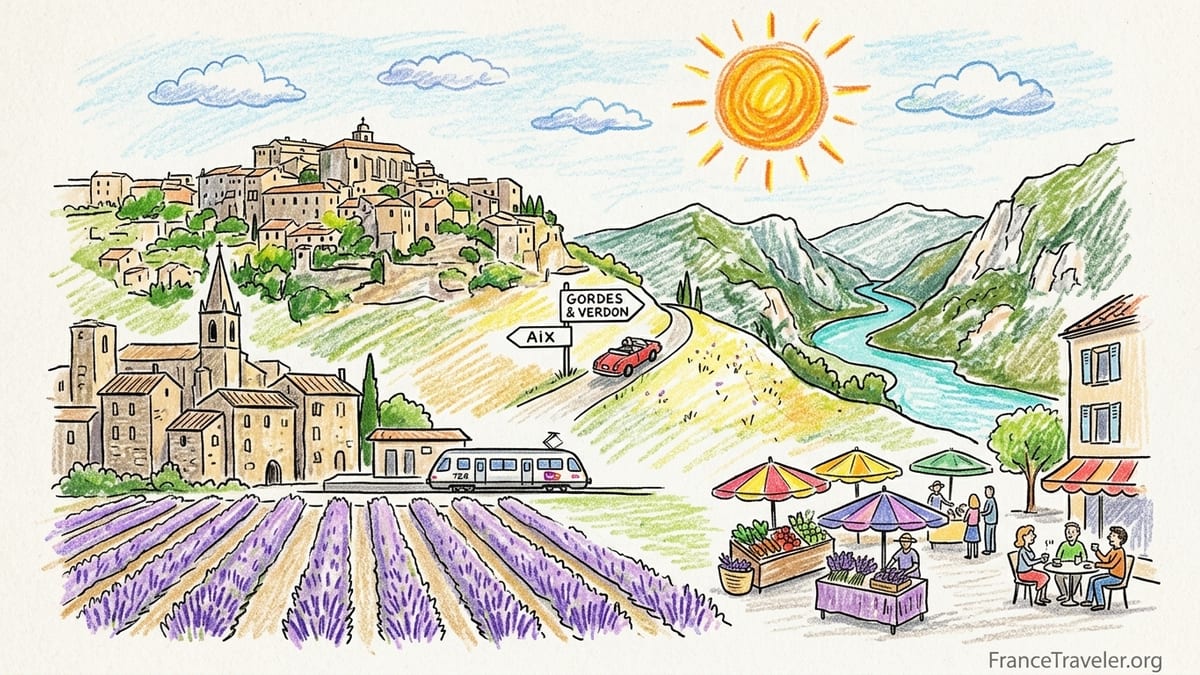
The first decision is whether you want an urban base with easy transport, or a hilltop village where you will trade convenience for atmosphere. Aix-en-Provence, Avignon and Arles are small cities with train connections, busy markets and plenty of places to eat every night. You can arrive by TGV from Paris, walk to your hotel, and rely on regional trains and buses. By contrast, Gordes, Roussillon, Les Baux-de-Provence, Lourmarin, Valensole and Moustiers-Sainte-Marie are villages surrounded by countryside. Public transport is limited or seasonal, and many visitors arrive by rental car or on a guided tour.
It also helps to separate the famous images of Provence from the places that are most practical to sleep. The lavender stripes you see on postcards are usually from the Valensole plateau, a patch of countryside about an hour’s drive from Aix rather than a town in itself. The turquoise canyon views of the Verdon are on rural roads between cliffside lookouts, not in a big resort. In practice, many travelers split their time: a few nights in a city such as Aix, Avignon or Arles, then a village stay in the Luberon or near the Verdon once they have picked up a car.
Season matters more here than in many parts of France. Lavender around Valensole typically peaks between mid June and mid July, with the most vivid colour often in late June or the first days of July, depending on weather. Outside that short window, the same villages are still beautiful, but you will be walking through vineyards, wheat and sunflowers, not purple fields. Summer also brings intense heat, so sightseeing on foot in July will feel very different from a shoulder season visit in May or October.
Finally, consider your appetite for driving. A compact rental car opens up the Luberon hill villages, Les Baux and the Verdon, and allows you to cover three or four stops in a day. Without a car, the pace is slower and you will need to accept that some names on your list become day tours rather than independent excursions. For many travelers, especially on a first trip, that is a worthwhile trade-off for avoiding parking stress on medieval streets.
Aix-en-Provence vs Avignon vs Arles: Best for First Trips and Travelers Without a Car
Aix-en-Provence, Avignon and Arles are the three strongest bases if this is your first trip and you will not be driving. All three have direct or easy TGV access, walkable historic centres and enough restaurants and evening life that you do not feel stranded after dark. They also host excellent markets that appear several times a week, so even a short stay is likely to include at least one market morning.
Aix-en-Provence suits visitors who want a polished, walkable town with a café culture and light, elegant architecture. The plane tree lined Cours Mirabeau forms the city’s central promenade, with fountains, café terraces and 18th century townhouses. In the old town just behind it, daily food stalls on Place Richelme and regular produce and flower markets bring a local feel. Hotels in the centre start around moderate mid range prices outside peak months, and you can spend three or four days here without a car, exploring Cézanne’s studio, nearby Montagne Sainte-Victoire on an organized hike, and taking day tours to Cassis or the Luberon.
Avignon is the practical choice if medieval history and train trips are your priorities. The walled centre is compact, focused on the Popes’ Palace and the famous truncated Pont d’Avignon. You can walk from the central station to most hotels and be in your room within 10 or 15 minutes of stepping off the train. From here, regional trains or buses link to Arles, Nîmes, Orange and l’Isle-sur-la-Sorgue, so you can see Roman arenas, vineyards and riverside markets without a car, especially outside the August holiday peak when schedules are fuller.
Arles offers a slightly different atmosphere: smaller than Avignon, with a Roman amphitheatre still used for events, narrow streets, and deep links to Van Gogh. It is an excellent base if you want both Roman history and access to the Camargue wetlands, where guided tours can take you to see flamingos and salt flats. The weekly Saturday market runs along the main boulevards and is one of the most extensive in the region, with everything from goat’s cheese and olives to woven baskets and cotton dresses. For a first trip without a car, many travelers choose between Aix for its café life and day tours, or Avignon for medieval drama and rail links, then add a night in Arles for variety.
Market Towns and Classic Villages: Saint-Rémy, Les Baux, L’Isle-sur-la-Sorgue, Lourmarin
Saint-Rémy-de-Provence and nearby Les Baux-de-Provence sit on the edge of the Alpilles hills and combine village charm with rich history. Saint-Rémy has one of the region’s best loved weekly markets, typically on Wednesday mornings, when stalls fill the boulevards with cheese, olives, textiles, soaps and ceramics. On a practical level it works well as a base if you have a car: you can be in Avignon, Arles or Les Baux in under an hour’s drive, then return to a quieter village atmosphere in the evening.
Les Baux-de-Provence is not an overnight hub so much as a spectacular day trip. The ruined medieval fortress crowns a rocky outcrop, looking out over olive groves and vineyards. The Carrières de Lumières digital art show in a former quarry at the foot of the village has become a headline attraction, so expect coach groups in peak season. Roads are narrow and parking lots can fill by late morning, which is why many travelers now arrive early, around opening time, or late in the afternoon to avoid crowds and the brightest heat.
L’Isle-sur-la-Sorgue is a small town built around canals of clear green water, particularly famous for its Sunday antiques and brocante market. On a typical Sunday in spring you will find linen tablecloths, vintage posters, armoires and bric-a-brac alongside food stalls. It is reachable from Avignon by regional train in around half an hour, which makes it one of the rare small-town markets that travelers can visit without a car. Accommodation ranges from simple guesthouses above shopfronts to riverfront boutique hotels, so you can either stay overnight or treat it purely as a day trip.
Lourmarin, at the southern fringe of the Luberon, offers a gentler hill village experience than Gordes or Roussillon. Its Friday market draws both locals and visitors, and the village has enough year round cafés and restaurants to support a multi night stay. If you are staying in Aix without a car, buses connect Aix and Lourmarin on most days, although schedules are limited outside school term time. That makes it one of the few Luberon villages that can work as a no-car excursion, even if you will still see far fewer buses than in coastal areas.
The Luberon Icons: Gordes and Roussillon for Scenery and Village Stays
Gordes appears on almost every Provence inspiration list, and for good reason. Perched on a hillside, its stone houses and church seem to grow out of the rock. The postcard view you see on search results comes from a bend on the road as you approach from the west, where there is a small pull out that functions as an unofficial photo stop. Within the village, steep cobbled lanes and a central square hold a handful of hotels, restaurants and art galleries. Prices reflect its fame, especially in June and September when photographers and wedding parties arrive for softer light and slightly cooler days.
Nearby Roussillon is known for its ochre cliffs and orange red facades, created by centuries of quarrying the local pigment. Just outside the village center, the Ochre Trail is a short, signposted walking loop through former quarries and pine woods, with viewpoints over rust-colored rock formations. In high season you pay a modest entry fee and can expect to share the path with families and photo shoots, but the colors are so striking that it remains a highlight for many visitors. As a base, Roussillon has a more intimate feel than Gordes, with fewer rooms and quieter evenings once day trippers leave.
From a practical standpoint, both Gordes and Roussillon are best tackled with a car. The road between them is an easy half day circuit that you can extend to include villages such as Bonnieux or Ménerbes, stopping for a long lunch on a terrace. Public transport is limited and often geared to local school and work commutes rather than tourism. Some visitors based in Avignon or Aix solve this by booking a small group minivan tour that includes Gordes, Roussillon and sometimes the Abbaye de Sénanque, so they can see the famous panoramas in one long day without worrying about navigation.
If you picture yourself waking up in a stone house and watching the light change over terraced hillsides rather than attending museums or nightlife, then a two or three night stay in Gordes or Roussillon makes sense. Bring a good book, accept that you will eat dinner in the same few restaurants, and use your days to walk between the villages or drive quiet backroads through vineyards and lavender fields.
Lavender and the Valensole Plateau: When to Go and Where to Stay
The Plateau de Valensole is where many of the internet’s most dramatic lavender photos are taken. It is a wide, open plateau at around 500 to 600 meters in altitude, planted with thousands of hectares of lavender and lavandin. In a typical year, fields begin to colour in mid June. The most intense purple shades usually appear between late June and early July, and by mid July harvesting can start, especially in warmer years. Because timing varies with weather, local tourism offices and dedicated lavender websites now publish bloom updates, and many photographers treat dates as a range rather than a fixed week.
Valensole itself is a small village with a few cafés, bakeries and simple hotels or guesthouses. Many visitors, especially on a first trip, choose to stay instead in a larger base such as Aix-en-Provence, Manosque or Moustiers-Sainte-Marie and visit the plateau as a long half day by car. From Aix, you can expect around an hour to ninety minutes of driving to reach the heart of the fields, depending on traffic and exact route. Once there, small farm tracks split off the main road so you can park on gravel verges and walk a short distance between rows. Signs at some fields remind visitors not to trample plants or pick flowers, and a few farms have stands selling lavender oil, soaps and honey.
There is effectively no useful public transport once you get onto the plateau itself, which is why organized day tours have become popular in peak season. A typical tour from Aix or Marseille might cost roughly the price of a moderate dinner per person, and include stops at several viewpoints, a village coffee break, and time to photograph sunrise or sunset if conditions allow. If you self drive, aim to visit early in the morning or after 6 pm, when the sun is lower, light is softer, and daytime heat has eased.
If lavender is a non negotiable priority, be realistic about dates. Trips in early June or late July can still be rewarding, but you might see green plants or partly harvested fields rather than endless purple. In that case, it can make sense to emphasize other elements of Provence in your planning, such as markets in Aix and Saint-Rémy, Roman sites in Arles and Avignon, or the village scenery of the Luberon.
Verdon Gorge and Moustiers-Sainte-Marie: Dramatic Scenery and Outdoor Time
The Gorges du Verdon are often described as Europe’s most beautiful river canyon, carved by the turquoise Verdon River between limestone cliffs that rise hundreds of meters. The area sits inland from the Riviera, roughly between Castellane and the Lac de Sainte-Croix reservoir. Two main scenic driving routes follow the rims: one on the north side via the D952, another on the south via the D71 and linking roads. Along both, you will find outlooks where you can pull over to photograph bends in the river far below.
Moustiers-Sainte-Marie is the classic base for exploring the western end of the gorge. The village clings to a steep ravine, with stone houses stacked around a central square and a small waterfall. A star suspended on a chain high above the rooftops is one of its best known sights. From Marseille, driving to Moustiers typically takes around two hours in light traffic, and slightly less from Aix. Once based here, you can spend one day circling part of the Verdon by car, stopping at viewpoints, then another day renting a kayak or paddle boat on Lac de Sainte-Croix and drifting toward the opening of the canyon.
The Verdon is strongly geared to visitors with cars and a taste for outdoor activities. Well marked hiking routes of various lengths start near Moustiers and other small villages, and in season local providers offer canyoning, climbing and rafting trips. Accommodation runs from basic campsites and simple rooms above restaurants to small hotels with pools, often priced more gently than coastal resorts in high summer. If your main goal in Provence is to combine hiking, swimming and scenic drives, then a three or four night stay around Moustiers can be more rewarding than adding a third city.
Without a car, the Verdon is difficult. A few seasonal buses connect larger towns to gateway villages, but services are infrequent, and reaching trailheads or lake rentals will usually still require taxis. For most travelers relying on trains and buses, it is more realistic to visit the Verdon on a single long day tour from Aix or Marseille, or to postpone it to a future trip when renting a car is possible.
Wine, Food and How Long to Spend in Each Place
Provence is better known for rosé than for grand châteaux visits, but wine and food experiences can still shape where you stay. Around Aix, vineyard routes wind through the Coteaux d’Aix-en-Provence appellation and toward the Sainte-Victoire mountain. Many estates are reachable in a 20 to 40 minute drive and offer tastings for a modest fee, either as a simple counter tasting or as a more formal visit with a vineyard walk. Organized half day tours typically fold in two or three wineries and time for a countryside photo stop.
Near Avignon and L’Isle-sur-la-Sorgue, the Rhône valley opens access to reds and whites from villages such as Châteauneuf-du-Pape, Gigondas and Vacqueyras. From Avignon, you can either rent a car for the day or join a small group minivan tour. Expect to pay roughly the same as an organized lavender or Luberon excursion for an afternoon among the vines. In Saint-Rémy and Les Baux, olive oil mills often welcome visitors, with tastings of different oils and tapenades.
As for timing, many first time visitors split a week as three or four nights in a city base plus three or four nights in the countryside. For example, you might spend four nights in Aix without a car, taking day tours to the Luberon and perhaps Cassis, then pick up a rental car and spend three nights between Gordes and Moustiers-Sainte-Marie. Alternatively, you could stay three nights in Avignon for access to Arles and L’Isle-sur-la-Sorgue by train, then four nights in Saint-Rémy or the Luberon for slower village days.
Shorter trips of three or four nights are best kept simple. Choose either Aix, Avignon or Arles as your only base, focus on nearby sights and one or two guided day trips, and accept that you will not see every famous village. Provence rewards repeat visits, and having reasons to return is part of its appeal.
The Takeaway
There is no single “best” place to stay in Provence. Instead, the right base depends on whether you care more about medieval squares or cliffside roads, markets or lavender, museums or kayaking. Aix-en-Provence is ideal if you want an elegant, walkable introduction with organized tours taking you as far as the Luberon and Valensole. Avignon and Arles suit travelers who like strong historic centres and the freedom of regional trains. Saint-Rémy, Gordes, Roussillon and Lourmarin are for those who dream of stone villages, slower evenings and waking up to birdsong rather than traffic.
Valensole and the Verdon add drama and scale, but they demand a car or a willingness to book day tours that involve long hours on the road. Moustiers-Sainte-Marie may not appear in every search at first, yet it is one of the most rewarding bases for combining lavender fields, canyon viewpoints and lake swims in a single stay. Whichever combination you choose, planning around markets, season and transport will make the difference between simply ticking off famous names and actually feeling how Provence lives from morning coffee to the last glass of rosé at dusk.
FAQ
Q1. Which base is best for a first trip to Provence?
Aix-en-Provence is usually the easiest first base, especially if you do not plan to drive. It combines a handsome historic centre, daily food markets, plenty of restaurants and good day tour options to the Luberon, Cassis and Valensole. Avignon is a strong alternative if you prefer medieval history and want to use regional trains to visit Arles, Nîmes or L’Isle-sur-la-Sorgue.
Q2. Where should I stay if I will not have a car?
Pick a rail connected town such as Aix-en-Provence, Avignon or Arles, and then add one small town that has at least some bus or train access, such as L’Isle-sur-la-Sorgue or Lourmarin. From these bases you can join guided minivan tours to Gordes, Roussillon, Les Baux or Valensole. The Luberon villages, Les Baux-de-Provence and the Verdon are not practical to explore independently without a car.
Q3. When is the best time to see lavender around Valensole?
In a typical year, fields around the Valensole plateau begin to bloom in mid June, reach their most intense colour from late June to around the first half of July, and are partly harvested by the second half of July. Exact timing varies with weather, so it is wise to treat these as approximate windows and check local updates as your trip approaches.
Q4. Which villages are best if I want the classic hilltop scenery?
Gordes, Roussillon and Les Baux-de-Provence are the most famous for dramatic hilltop or cliffside settings. Gordes looks out over terraced hillsides, Roussillon is wrapped in ochre cliffs, and Les Baux crowns a rocky spur above olive groves. All three are easiest to reach with a car or on a small group tour.
Q5. Is Moustiers-Sainte-Marie a good base for the Verdon Gorge?
Yes, Moustiers-Sainte-Marie is one of the best bases for exploring the western end of the Gorges du Verdon. From the village you can drive to viewpoints on both sides of the canyon, reach the lake at Sainte-Croix for kayaking and swimming, and start several marked hikes. Plan on arriving with a rental car, as public transport in the area is limited.
Q6. Which places are best for markets and food lovers?
Aix-en-Provence, Avignon, Arles, Saint-Rémy-de-Provence and L’Isle-sur-la-Sorgue are especially strong for markets. Aix has daily food stalls and larger markets several days a week. Saint-Rémy’s weekly market fills the town with food and textiles. L’Isle-sur-la-Sorgue is famous for its Sunday antiques and brocante market combined with produce stalls.
Q7. Where should I focus if I care more about history than scenery?
Base yourself in Avignon or Arles and allow time for side trips. Avignon offers the Popes’ Palace and city walls, while Arles has a Roman amphitheatre and other ancient remains plus strong Van Gogh connections. From Avignon you can reach Orange, Nîmes or the Pont du Gard for additional Roman sites by regional train or organized excursion.
Q8. How many nights should I spend in Provence to see both cities and villages?
A week allows a balanced mix. Many travelers spend three or four nights in a city such as Aix, Avignon or Arles, then three or four nights in the countryside, perhaps split between a Luberon village and Moustiers-Sainte-Marie. With only three or four nights total, it is better to choose a single base and see nearby highlights well than to move too often.
Q9. Are Gordes and Roussillon suitable bases without a car?
In practice, no. Both villages have limited public transport and are surrounded by small roads without pavements, so it is difficult and sometimes unsafe to move between them on foot. Most visitors either stay there with a car, or visit them on a Luberon tour from Aix, Avignon or Saint-Rémy rather than sleeping there on a car free trip.
Q10. If I have to choose between Valensole and the Luberon, which should I pick?
If your dates align with peak lavender season and you are happy to rent a car or join a long guided tour, Valensole delivers the most iconic lavender landscapes. If you are traveling outside that window or prefer shorter drives and village life, focus on the Luberon instead. Gordes, Roussillon, Lourmarin and nearby villages offer beautiful scenery, stone architecture and good walking at any time of year.