


I arrived in Bayeux the night before with a single intention for the next day: to see, as thoughtfully as possible, a small part of the coastline where 6 June 1944 unfolded. Less than 24 hours later I would be standing in craters at Pointe du Hoc, walking the tide line at Omaha Beach and watching the flag lowering ceremony at the Normandy American Cemetery, trying to reconcile the calm of modern Normandy with the violence that once defined it.
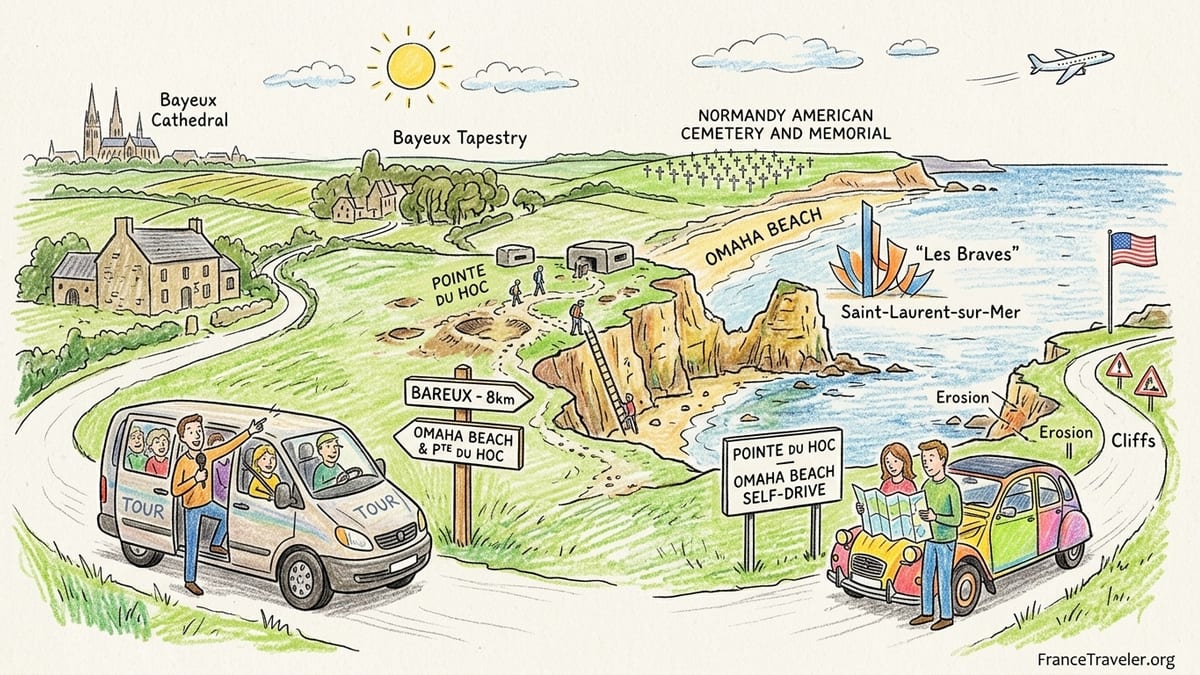
Starting From Bayeux: Choosing a Way to See the Beaches
My day began just after 8:00 a.m. on Place de Québec in central Bayeux, which functions as an unofficial hub for D-Day excursions. Several companies stage their departures from the same square, including Bayeux Shuttle and other small local operators that run minivans out to the American sector beaches. I had debated renting a car, but winter bus services to the coast are thin and I wanted to hear the stories while I was actually looking at the terrain. In the end I booked a small-group tour focused on Omaha, Pointe du Hoc and the Normandy American Cemetery.
The tour I joined cost just under 140 euros per person for a full day in 2026, roughly in line with similar American-sector tours that run between about 130 and 180 euros depending on season and group size. That felt like a commitment, especially once you multiply it by two or three travelers. But it included transport in an eight-seat van, hotel pick-up within central Bayeux, and a guide who spent the entire day connecting specific hedgerows, farm lanes and draws with the units that moved through them.
From a practical standpoint, starting in Bayeux made everything far more manageable. Driving time from Bayeux to Pointe du Hoc is about 45 minutes in normal traffic, and from Pointe du Hoc on to Omaha Beach and Colleville-sur-Mer it is another 20 to 30 minutes. Trying to do this comfortably as a day trip from Paris would have meant at least six hours on the road, much of it on the autoroute, and far less time at the sites themselves. Several travelers I met at breakfast were on a big-coach Paris excursion that would visit one beach and the cemetery before heading straight back.
The guide, a local in his forties, introduced himself simply by first name. He had grown up in a village less than 10 kilometers from the coast and had grandparents who lived through the landings and the weeks of fighting that followed. Within the first half hour in the van he already made clear that his focus would not be on hardware and timelines alone, but on individual stories and the way the battle is still written into the fields, farm buildings and villages.
Pointe du Hoc: Craters, Cliffs and an Uneasy Quiet
Our first major stop was Pointe du Hoc, the headland that the U.S. 2nd Ranger Battalion scaled under fire to silence a German battery threatening both Utah and Omaha. The drive up from Bayeux winds through dairy country, past small stone farmhouses and roadside memorials. As we approached the coast, the guide pointed out temporary traffic restrictions and work areas. Access to Pointe du Hoc has been under close review in recent years because erosion continues to gnaw at the cliff line, and sections of the coastal path have been periodically closed for safety.
We arrived around 9:30 a.m., just as the first larger coaches were pulling in. Our group had just over 90 minutes on site. That was enough to follow the official path across the lunar-looking field of shell craters, into several of the surviving German bunkers and observation posts, and along the cliff edge above the English Channel. The guide carried a tablet of wartime aerial photographs and explained how the Rangers had expected to find a battery of 155 mm guns in the massive casemates that still dominate the site. Instead they found the guns moved inland to a field a short distance away, where a small detachment later disabled them.
Two things struck me at Pointe du Hoc that do not fully come across in photographs. The first was the scale of the bombardment. Some of the craters are several meters deep and wide enough to swallow a small house. They overlap in places, an uneven landscape that makes walking feel like crossing a frozen sea. The second was the way bunkers, now surrounded by manicured grass and interpretive signs, still feel heavy and oppressive once you step inside. Our guide invited us to pause for a moment in one of the observation posts to imagine the view on the morning of 6 June: fog, smoke, the flashes of naval gunfire and landing craft edging closer.
If anything felt tight at Pointe du Hoc, it was the time. Another half hour would have allowed a slower circuit and more moments simply to stand by the cliff and watch the empty horizon. On a self-guided visit with a rental car you could easily spend two to three hours here following every bunker and side path. On a one-day circuit that also aims to include Omaha and the cemetery, the roughly 90 minutes we had felt like a reasonable compromise.
Omaha Beach: Walking the Sand Where the Tide Came In
From Pointe du Hoc we followed the coastal road east toward Omaha Beach. Our guide chose to enter the sector near Vierville-sur-Mer, not far from the draw associated with some of the heaviest American casualties. Today, the road runs past vacation houses, a few small restaurants and rental apartments. On a gray winter weekday it was almost empty, but there were still dog walkers and a handful of surfers out in the waves. The ordinariness of it makes the photographs the guide passed around during the drive feel all the more jarring.
We parked just behind the seawall and spent about an hour and 15 minutes on the beach itself. The guide oriented us using a simple sketch map of the five principal landing sectors on Omaha, explaining where units of the 1st and 29th Infantry Divisions came ashore. He pointed to the bluffs behind us, where German defensive positions once overlooked the sand, and then encouraged us to walk out toward the tideline on our own. At low tide, the distance from the waterline back to the shingle and seawall is long. Wading through shallow surf and wet sand even on a calm morning gave only the faintest sense of what it must have felt like under fire and with full kit.
There are several memorials and small monuments spaced along the length of Omaha, including the sculpture near Saint-Laurent-sur-Mer that rises from the sand. Our stop focused on the western end, closer to Vierville, which meant we did not try to visit every marker. The guide was candid that in a single day something has to give. Trying to tick off every monument along the 8-kilometer sweep of Omaha would leave little time to simply be present on the beach.
Emotionally, Omaha was the place where the scale of loss began to land. The guide did not overload us with numbers, but he took care to talk through two or three personal stories, including a soldier whose grave he would later point out among the rows at Colleville. Several people in our group had relatives who fought in Normandy. One man carried a photocopy of his grandfather’s picture from 1944 and quietly walked a little farther along the beach to stand alone. The guide gave him that space without comment, then checked in as we walked back toward the van.
Normandy American Cemetery: Time Among the Crosses
After a short drive up the bluff we reached the Normandy American Cemetery and Memorial at Colleville-sur-Mer. Operated by the American Battle Monuments Commission, the cemetery holds the graves of more than 9,000 U.S. service members and sits on ground directly overlooking Omaha Beach. There is no admission fee, but visitor hours are controlled, with last entry typically half an hour before closing so people are not rushed through their visits.
Our guide handled the formalities at the reception building and then gave us just under two hours on site, including both the visitor center and the cemetery grounds. He suggested that anyone particularly interested in the exhibits spend about 40 minutes in the visitor center and reserve at least an hour outside. That proved wise. The exhibit space is compact compared with a large city museum, but the personal stories, artifacts and film clips take time to absorb. I lingered in front of a display that paired a soldier’s letters home with photographs of the Normandy landscape he crossed.
Outside, rows of white marble crosses and Stars of David stretch across a gentle slope toward the sea. The symmetry and scale are overwhelming at first. Our guide brought us to a section near the grave of a Medal of Honor recipient he often uses to illustrate the cost of small-unit actions on D-Day. He then stepped back and encouraged us to walk on our own. I followed one of the side paths out toward the edge of the cemetery, where trees cast longer shadows and the sound of the surf below is clearer. Even with several tour groups present, there were pockets of quiet where you could hear little but wind and waves.
We were fortunate to arrive in time for the late-afternoon flag lowering ceremony, which remains one of the most moving rituals at the cemetery. Visitors are invited, though not required, to gather near the central flagpole. Staff fold the flag with formal precision while a recording of Taps plays. Our guide did not speak during the ceremony. He simply stood slightly behind the group, cap in hand. It would have been easy for this moment to feel theatrical, but it did not. When the last note faded there was no immediate rush for the exit, only a slow, quiet dispersal back among the rows.
How the New UNESCO World Heritage Status Shapes a Visit
In July 2026, the D-Day landing beaches were inscribed on the UNESCO World Heritage List under the title “Beaches of the D-Day Landings, Normandy, 1944.” The listing recognizes a serial property spanning about 80 kilometers of coastline along the Baie de Seine, including Utah, Omaha, Gold, Juno and Sword Beaches as well as Pointe du Hoc. The focus is on their association with the landings themselves and the beginning of the liberation of Western Europe.
On the ground, this new status was already visible in small but noticeable ways. At several sites, including Omaha and Pointe du Hoc, new interpretive panels refer to the UNESCO designation and explain the broader context of the beaches within the allied campaign. Our guide mentioned that local authorities are under pressure to balance coastal development with preservation, particularly as erosion and climate change place additional stress on bunkers and cliff paths. UNESCO recognition is expected to strengthen funding and coordination for conservation projects across the different sectors.
For travelers, the most immediate effect is likely to be in planning. The World Heritage label has a way of drawing new visitors, and 2026 also marked the 82nd anniversary of the landings. Our guide said that on key June dates and peak summer weeks, advance booking for small-group tours has become even more important, with some American-sector itineraries selling out several weeks ahead. Accommodation in Bayeux, Arromanches and Carentan also books earlier than in the past. While my January visit was relatively quiet, signs at several parking areas made clear that capacity limits apply when crowds swell.
At the same time, the UNESCO listing reinforces something that careful travelers already feel: these are not theme parks or generalized “war attractions.” They are places of memory embedded in ordinary communities, farms and fishing harbors. Many visitors now treat a day on the beaches as part of a longer exploration of Normandy that might also include the Bayeux Tapestry, Mont-Saint-Michel or the port of Honfleur. The challenge is to keep enough space in the day so that the D-Day sites do not become just another stop on a check-list of famous names.
Guides, Context and Whether the Tour Cost Was Worth It
By the time we drove back into Bayeux around 6:00 p.m., I had spent close to nine hours in the company of our guide and group. Looking back, the single biggest difference his presence made was the way he linked places that might otherwise feel like disconnected points on a map. Standing in a hedgerow sunken lane above Omaha, he described how the shape of these fields slowed the American advance for weeks after D-Day, long after the famous beachhead photographs. At Pointe du Hoc he pointed out subtle details such as shrapnel scars on interior walls that most visitors would walk past without noticing.
From a value perspective, the roughly 140 euros I paid felt justified for this particular day. Renting a car for one person would technically have been cheaper, especially outside peak season. Daily rental rates from Caen or Bayeux in 2026 can fall in the range of 60 to 90 euros before fuel and insurance, and you would have full freedom to linger where you like. A self-drive day also suits travelers who already know the history well and simply want to match maps and memoirs to the landscape.
For me, as someone with a solid but not specialist understanding of the landings, the tour fee bought more than convenience. It provided context at the moment I needed it: when looking at a specific re-entrant in the bluff, a particular memorial inscription, or a seemingly anonymous farmhouse that had served as an aid station. It also removed the stress of navigation on narrow country lanes and allowed everyone in the van to look out of the window instead of down at a GPS screen.
Guided experiences do vary, and it is fair to acknowledge that not all tours are equal. Some larger-bus operations cover longer distances from Paris, include only brief photo stops at the beaches and focus heavily on logistics rather than interpretation. Smaller operators based in Normandy itself, particularly those that limit groups to eight people in a van, often build their reputations on in-depth storytelling and the ability to adapt the day if a traveler has a specific family connection or interest. Talking to other visitors that evening in Bayeux, the consensus was that a dedicated American-sector day, run by a local company, offers a better balance of time and context than a long-haul Paris excursion that tries to do too much in one sweep.
What Felt Rushed, and What Deserved More Time
Even with almost nine hours between departure and return, some parts of the day felt compressed. Pointe du Hoc was the most obvious example. With only around an hour and a half there, I had time to follow the main circular path, explore several bunkers and spend a short while at the cliff edge, but not to wander every spur trail or sit quietly for more than a few minutes. On a future visit I would seriously consider returning on my own, perhaps earlier in the morning or later in the afternoon, to experience the site in a different light and without needing to watch the clock.
Omaha Beach itself could also easily absorb more time, especially if you want to explore both the western and eastern ends and visit smaller monuments and plaques spread along the shore road. We stayed primarily in one sector, which meant the experience was deep but geographically narrow. I did not feel shortchanged, but I was aware that we were seeing only a slice of an 8-kilometer front that looked and felt very different from place to place on D-Day.
Conversely, the timing at the Normandy American Cemetery felt close to ideal. Having about two hours allowed a measured visit to the visitor center, a slow walk through the rows and participation in the flag ceremony without rushing. Several fellow travelers mentioned that on previous coach tours from Paris they had experienced the cemetery as a twenty or thirty minute stop, barely enough to walk from the bus to the central monument and back. If there is one non-negotiable recommendation I would make, it is to protect at least an hour and a half for the cemetery alone, whatever itinerary you choose.
The one element missing from my single-day circuit was a dedicated museum outside the cemetery itself. The region contains several significant institutions, including the Utah Beach Museum, the Airborne Museum at Sainte-Mère-Église and the museum in Bayeux that focuses on the Battle of Normandy. To add even one of those properly would have turned the day into a race. In that sense, the greatest lesson was that the D-Day beaches are not a one-day destination so much as a landscape worth several days of slow attention if you can spare the time.
The Takeaway
Spending a day moving from Pointe du Hoc to Omaha Beach and on to the Normandy American Cemetery is not an easy experience, but it is an essential one for many visitors to France. The physical distances are short, yet the emotional and historical depth at each site is considerable. Any attempt to “do” the D-Day beaches in a single sweep will involve compromise. My own circuit, starting and ending in Bayeux with a small-group guide, provided a thoughtful balance between movement and stillness, explanation and silence.
In purely practical terms, the arrangement solved problems of transport, parking and timing, especially in a season when public buses to the coast ran infrequently. More importantly, it offered a framework in which strands of personal memory, archival photographs and local stories could be woven into the fields and shorelines outside the van window. The cost was significant, but compared with the overall expense of a European trip it felt proportionate to the depth of what we saw and learned.
The new UNESCO World Heritage status of the D-Day beaches adds an additional layer of recognition to places already weighted with meaning. It will likely bring more visitors and more attention, but it may also help secure the resources necessary to protect fragile bunkers, eroding cliffs and the integrity of a lived landscape where farmers still work fields that were once battlefields. Travelers who approach the area with patience and respect, whether on a guided tour or under their own steam, will find that these are not static memorials but places where history, community and memory continue to intersect.
As we drove back into Bayeux in the fading winter light, the van fell quiet. The guide turned off his microphone. Church bells sounded somewhere beyond the stone houses. It struck me that the real measure of a day on the D-Day beaches is not how many sites you can list that evening, but how long the images stay with you afterward: the curve of the sand at low tide, the echo of footsteps in a bunker, the rows of white markers against the grass and the sea.
FAQ
Q1. Can I visit Omaha Beach, Pointe du Hoc and the Normandy American Cemetery in one day from Bayeux?
Yes, it is realistic to see all three in one full day from Bayeux, especially with a small-group tour or rental car. Expect roughly eight to nine hours including driving, and plan on at least 60 to 90 minutes at each major site so the day does not feel rushed.
Q2. Is a guided D-Day tour worth the cost compared with renting a car?
For travelers who are not already very familiar with the history, a good guide can add significant value by interpreting terrain, bunkers and memorials as you see them. A full-day small-group tour in 2026 often costs between about 130 and 180 euros per person, while a one-day car rental from Caen or Bayeux may range from around 60 to 90 euros plus fuel. The choice depends on whether you prefer flexibility and lower cost or structured context and no need to drive.
Q3. How much time should I plan to spend at the Normandy American Cemetery?
Allow at least 90 minutes, and closer to two hours if you want to see both the visitor center exhibits and the cemetery grounds without hurrying. This should give time to walk among the graves, view the memorial, look out over Omaha Beach and, if timing permits, attend the daily flag raising or lowering ceremony.
Q4. Are there entrance fees for Pointe du Hoc, Omaha Beach or the Normandy American Cemetery?
The main D-Day sites in the American sector described here do not charge admission. Pointe du Hoc and Omaha Beach are open coastal and memorial areas, and the Normandy American Cemetery is operated without an entry fee. Some nearby museums, such as the Utah Beach Museum or the Battle of Normandy museum in Bayeux, do charge modest ticket prices, so it is wise to check current rates directly when planning.
Q5. How has the UNESCO World Heritage listing changed visits to the D-Day beaches?
The 2026 UNESCO inscription formally recognizes the D-Day beaches and Pointe du Hoc as a World Heritage site. On the ground, travelers may notice updated interpretive signs, increased attention to conservation and, during peak periods, larger visitor numbers. It also means authorities are likely to coordinate more closely on managing erosion, infrastructure and access along the 80-kilometer stretch of coast included in the listing.
Q6. What is the best time of year to visit the D-Day sites to avoid crowds?
Outside the anniversary period around 6 June and the main July and August holiday weeks, the beaches and cemeteries are generally quieter. Late spring and early autumn often provide a balance of milder weather with fewer large tour groups. Winter visits can be very peaceful, though days are shorter and some services and bus routes operate on limited schedules.
Q7. Can I visit the D-Day beaches as a day trip from Paris?
It is physically possible, but it involves a long day with significant time spent in transit. Coach tours from Paris often leave early, visit one or two key sites and return late in the evening. If you have a strong interest in D-Day history, staying at least one night in Bayeux or another nearby town allows more time on the ground and a less rushed experience.
Q8. Is it appropriate to take photos at the cemetery and on the beaches?
Photography is generally allowed at the Normandy American Cemetery, Pointe du Hoc and on the beaches, but visitors are expected to behave with discretion and respect. That means avoiding loud behavior, posed novelty shots among the graves and the use of drones or tripods where they are not permitted. Many travelers choose to take some photos and then put the camera away to spend time simply observing.
Q9. What should I wear and bring for a full day on the D-Day beaches?
Weather on the Normandy coast can change quickly, so layered clothing, a waterproof jacket and comfortable walking shoes are important, even in summer. Wind on the bluffs and beaches can make it feel cooler than inland. Bringing water, a small snack and sun protection in warmer months is sensible, as is a compact umbrella outside high summer.
Q10. How accessible are the main D-Day sites for travelers with limited mobility?
Accessibility varies. The Normandy American Cemetery has paved paths, ramps and facilities that make large parts of the site reachable by wheelchair or with limited mobility. Pointe du Hoc and sections of Omaha Beach include uneven ground, slopes and, at Pointe du Hoc, cratered terrain that can be challenging. Travelers with mobility concerns may wish to consult site information in advance and consider a private tour that can adapt stops and walking distances.