


I thought I knew what to expect from Étretat. I had seen the photographs a hundred times: the white cliffs cut like sugar cubes, the stone arches stepping out into the Channel, the needle of rock that looks as if someone dropped it there by hand. What I did not understand until I walked those cliffs myself, twice in different seasons and at different times of day, was how much the practical details of arrival, parking, timing and even footwear would shape the experience far more than the postcard views.
Arriving in Étretat: Trains, Buses and That First Glimpse of the Cliffs
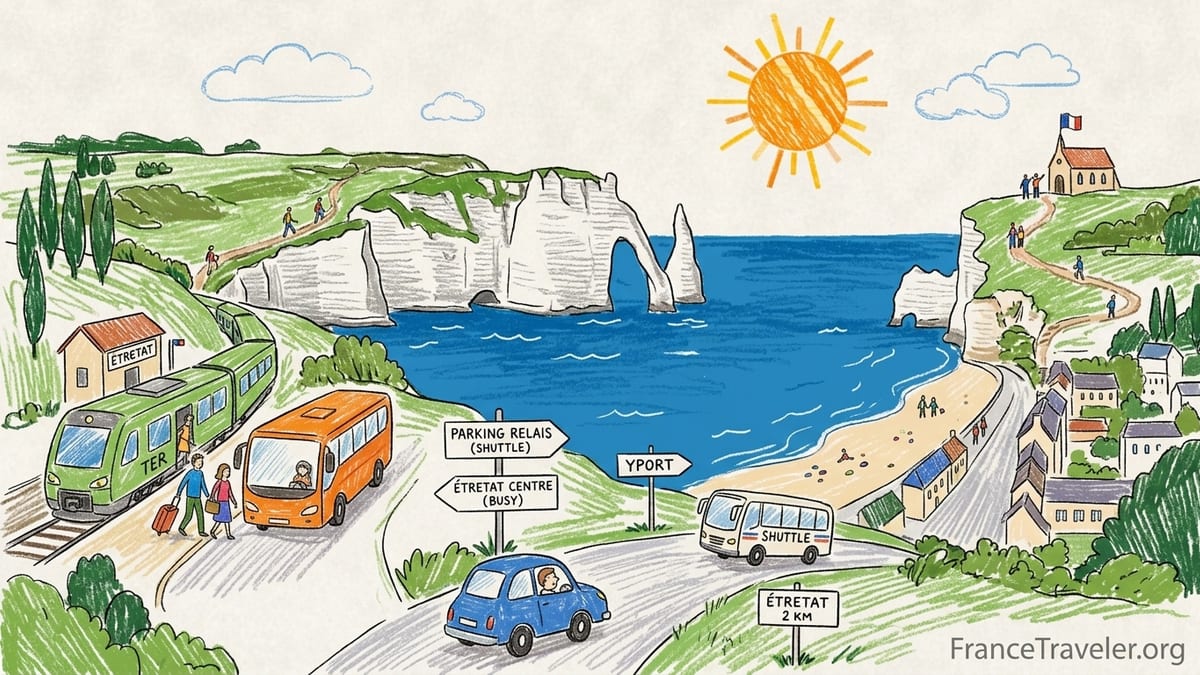
On my first visit I arrived in Étretat the way many visitors from Paris do, by train and bus. I left Paris Saint-Lazare in the early morning, just after 7 am, on a regional TER service towards Bréauté-Beuzeville. From there, a waiting coach connected to Étretat, dropping us at the small Etretat Normandie train stop on the edge of town. The whole trip took around three hours, long enough to feel like an escape but not so long that a day trip felt unreasonable. By the time the bus rounded the last bend and the cliffs suddenly appeared at the end of the main street, almost everyone on board had their phone out.
I repeated the journey a year later but chose a later departure, arriving around lunchtime instead of mid-morning. The contrast was immediate. The early arrival meant walking down into town alongside a handful of locals and overnight guests, past shuttered souvenir shops and the smell of baking croissants. Arriving close to noon meant stepping off the same bus into a line of people waiting for public toilets, tour groups already gathering under umbrellas and the first coaches of the day edging into the parking lots.
If you are staying elsewhere on the Alabaster Coast, such as Fécamp or Le Havre, driving will be the most flexible option. On my second visit I rented a compact car in Le Havre and followed the inland D940 and D11 through the Pays de Caux plateau, a landscape of open fields and small villages that gives no hint of the cliffs until you are almost at the sea. This route allowed me to stop overnight in Yport, Étretat’s quieter “little sister” village, and to approach Étretat in the morning via the back roads rather than funneling in with the midday traffic.
Parking Lessons: Where I Left the Car and What I’d Do Differently
Étretat has spent the last few years rethinking where visitors leave their cars, partly to protect the fragile cliffs and partly because the town center simply does not have space. On my first driving visit I arrived at 8:15 am on a September weekday and followed the “P” signs straight into town. I found a space in the central car park near the seafront without circling more than once, paid at the meter and walked to the beach in under five minutes. By 10:30 am, when I came back briefly to drop off a jacket, the same car park was completely full and a municipal officer was turning drivers away.
Since then, the focus has shifted even more firmly toward using car parks at the entrance to Étretat and at nearby Les Loges. On my most recent trip I left the car shortly after 7:30 am at the free park-and-ride area in Les Loges, a small village about 6 kilometers inland on the former railway line. A clearly marked area had been set aside as a “parking relais” with signs towards a shuttle stop. Around 8 am, a small shuttle bus rolled in and took a dozen of us directly to Étretat in about ten minutes, dropping us by the old station on the edge of town.
Using this system changed the feel of the day. Instead of worrying about beating other cars into the center or calculating how much time I would need on the meter, I left the car once and forgot about it. The price of fuel and car rental in France is not insignificant, so avoiding the stop-start crawl into the town center and back out again probably saved as much stress as money. On the return, in the late afternoon, the shuttle queue at the same stop was comfortably short, a mixture of tired walkers and a few families loaded with beach bags.
If you do choose to park in town, be realistic. By late morning in fine weather, especially from spring to early autumn and during school holidays, central spaces close to the beach are saturated. On a sunny Saturday in May I watched cars circle for 20 minutes at a time, hoping to catch someone pulling out. Several eventually gave up and headed back uphill, presumably to look for spaces on the streets above or to return to the entrance car parks. If your schedule is tight, treating central parking as a bonus rather than something you can rely on is wise.
Crowds, Viewpoints and the Difference an Early Start Makes
Normandy’s tourism board openly advises people to come in the early morning or late evening, and to avoid July, August, school holidays and busy fine-weather weekends when possible. Walking the cliffs at different times of day, I understood why. On my first visit in late September, I stepped onto the pebbles just after 8:30 am. The beach was almost empty apart from two dog walkers and a trio of local swimmers pulling on neoprene caps. The sound of the waves over the pebbles was loud enough to drown out the small talk behind me. By 11 am the same beach felt like a different place entirely, with rows of deckchairs unfolding and a steady ribbon of people pacing up and down the seafront promenade.
The classic viewpoints on both sides of town tell the same story. On the north side, the path up to the Falaise d’Amont begins with a concrete ramp and a set of steps near the church. At 9 am I had the short, steep climb almost to myself and reached the viewpoint above the chapel of Notre-Dame-de-la-Garde with only a couple of other visitors around. We took turns at the edge of the fence to photograph the arch and needle of rock from above. When I returned there on a warm Sunday in June at 3 pm, the railing was lined two or three people deep, selfie sticks arcing into each other’s frames, and it took patience to find the same clear shot.
On the south side, the Falaise d’Aval and the trail that leads over the arch of the Porte d’Aval and on towards the Manneporte were similarly transformed by timing. On an October evening, I started up just after 5 pm with the light already softening, crossing paths with people coming back down after a full day outside. By the time the sun slipped towards the horizon, the crowd had thinned to a few photographers, couples and solo walkers. The orange glow on the chalk made the path feel almost private. By contrast, around midday in early summer, this section was where the crowds felt most intense, with queues forming for the photo spot directly above the arch and some sections of the narrow path feeling uncomfortably busy.
Over two visits at different seasons, the pattern stayed consistent. Early morning meant space, especially before 9:30 am, even on weekends in shoulder season. Late evening, after most day-trippers had left for Rouen, Le Havre or Paris, brought back the same calm. In between, from roughly late morning to mid-afternoon on bright days, the experience contracted around the most famous viewpoints, which felt more like busy city squares than wild headlands.
Walking the Cliffs: Gradients, Wind and Footwear That Actually Works
The cliff walks at Étretat are not mountaineering, but they are not a gentle seaside promenade either. Both sides begin with short, stiff climbs that gain around 70 to 90 meters of elevation over a relatively small horizontal distance. The Falaise d’Amont side has a series of steps and ramps that felt similar in effort to climbing several flights of stairs in a row. The Falaise d’Aval side begins more gradually with a wide, sloping path, then narrows and undulates as it moves away from town.
On my first visit I wore standard city sneakers with relatively smooth soles, the kind that feel fine on Paris pavements. They handled the hard-packed main paths in dry weather, but I was more cautious than I would have liked on the steeper dirt sections, especially where dust and small stones made the surface loose. On the second trip, after a night of intermittent rain, I switched to light trail shoes with a grippier sole. The difference was obvious the moment I hit the first muddy stretch near the top of the Aval path. I watched more than one person in flat-soled fashion trainers slip just enough to look rattled.
The wind is the other invisible factor that shapes the walk. The Alabaster Coast is essentially a high, exposed plateau where the land meets the English Channel, and the cliffs at Étretat take the full force of whatever weather is moving up or down the coast. On a calm autumn morning, the upper paths felt like a breezy city park. On a blustery April afternoon, gusts shoved at my backpack and sent fine spray up the faces of the cliffs, drifting over the path like mist. Several official signs along the route repeat the same instruction not to get too close to the edge, and that advice is easy to understand when a crosswind hits you mid-step.
In practice, this means dressing as if you were heading onto a low mountain plateau rather than a sheltered beach resort. On the windiest day I visited, many people on the cliffs were zipped into light waterproof jackets, and those with a simple fleece underlayer looked comfortable. Those in T-shirts and fashion coats tended to cut their walk short. I carried a thin beanie and lightweight gloves in my daypack in April and used them both when the combination of wind and cloud made the ridge feel surprisingly cold compared with the town below.
Beach Access, Tides and How Close You Really Get to the Arches
The pebble beach at Étretat sits directly between the two main cliff systems, with the town pressed into the narrow valley behind it. Access is easy: level from the seafront promenade onto the pebbles, which slope quickly towards the water. The lack of sand surprises some visitors, and on my first morning I watched more than one person in smooth-soled sandals struggle down the loose, shifting stones as if walking on marbles. Water shoes or sturdy sandals with a band at the heel make paddling and swimming far more enjoyable than bare feet or flimsy flip-flops.
Low tide opens a different perspective. On a mid-tide, calm day, I followed local families along the pebbles under the Aval cliff towards the base of the Porte d’Aval arch. The closer I went, the more the structure turned from postcard image into solid geology, streaked with flint. Tide times are displayed locally, and it is important to pay attention. Sections of the shoreline are cut off as the water rises, and both local authorities and Normandy tourism repeat the same message about not walking too close to the cliff base, where rockfalls and collapses are a real risk.
Swimming conditions vary with the weather. In late September, several hardy locals swam in the early morning, entering from the lifeguard-supervised area marked out in summer months. In April, with a cold offshore wind, the water felt icy on my ankles and I was content with a brisk paddle. Facilities behind the beach include public toilets and a line of cafés and restaurants where a coffee, a bowl of moules-frites or a crêpe provide an excuse to warm up before or after a walk.
One small but important rule applies to the entire Alabaster Coast and is signposted clearly in Étretat. Picking up pebbles from the beach is forbidden, with fines advertised that can reach into the hundreds or even around a thousand euros because the pebbles help to protect the coastline from erosion. The smooth, grey stones are tempting as souvenirs, but it is better to leave them where they are.
Staying Overnight vs Day-tripping: Two Very Different Étretats
Most people still visit Étretat as a day trip, either by car or on a combination of train and bus from Rouen, Le Havre or Paris. I did this on my first visit, arriving mid-morning and leaving around 6 pm to catch an evening train. It was a satisfying day, but I left with the feeling that I had shared the cliffs at their busiest hours and missed their quieter moods. The beach, the central square and the lower sections of the paths never really emptied between late morning and late afternoon. Even coffee breaks felt synchronized; queues formed at the same times in front of the boulangerie and the ice cream stands.
On the second trip I booked a simple guesthouse room in Yport, a small fishing village between Fécamp and Étretat, and experienced the area as an overnight guest instead. I drove to Yport in the late afternoon, walked its small pebble beach as the sun went down, and had dinner in a local restaurant where the menu focused on grilled fish and the clientele were mostly French-speaking families and couples. The next morning I left my car in the village and reached Étretat before 8 am. Once again, the difference in atmosphere was striking. I walked onto the beach just as the first rays of sunlight lit the top of the Aval cliff. The town itself felt half asleep; delivery vans were unloading crates of vegetables and boxes of pastries while café chairs were still stacked.
Spending the night nearby also freed me from watching the clock for return transport. On the day-trip, I cut my late afternoon cliff walk short to make sure I did not miss my bus back to Bréauté-Beuzeville and the connection to Paris. With a car parked inland and no fixed departure time, I stayed up on the cliffs into the blue hour and watched the town lights come on one by one, then drove back to Yport in under half an hour on quiet country roads. For travelers who can spare the time and budget, even a single night somewhere along the coast turns Étretat from a checklist stop into the centerpiece of a longer coastal experience.
Étretat on the Alabaster Coast: Beyond a Single Postcard View
Étretat is the most famous point on the Alabaster Coast, but it is only one piece of a 130-kilometer stretch of chalk cliffs and small valleys that runs between Le Havre and Le Tréport. Driving or taking local buses along this shore reveals a chain of fishing ports, seaside towns and rural “valleuses” where the plateau opens suddenly to the sea. Fécamp, to the northeast, spreads around a long pebble beach and working harbor. It blends a history of cod fishing and Benedictine liqueur with a newer role as a yachting port and coastal resort, and its headlands give panoramic views over the cliffs.
Further along, Veules-les-Roses sits in a green valley where a small river, often described as one of the shortest in France, runs from inland springs to the sea. Timber-framed houses, watermills and small bridges line the footpath that follows the stream to a pebble beach backed by a promenade. I visited on a cloudy afternoon and found a completely different rhythm to Étretat. There were visitors, but no crush at a single viewpoint, and the appeal was as much about wandering through the village streets as looking out to sea.
Smaller beaches like Les Petites Dalles and Veulettes-sur-Mer, and quiet valleys such as Saint-Jouin-Bruneval nearer to Le Havre, offer chances to experience the same mix of sheer cliffs and pebbled shore with fewer people. On one April evening at Saint-Jouin-Bruneval I parked near the foot of the cliffs, climbed a set of steps to a viewpoint and watched a local surfer brace against cold waves. In high season these spots are not empty, but they tend to attract more regional visitors and fewer large tour groups than Étretat.
Thinking about Étretat in this wider context changes how you plan your time. Instead of devoting a single frantic day to one world-famous viewpoint, you can spread your walks and cliff experiences across multiple stops over two or three days. Étretat then becomes the dramatic highlight in the middle of a continuous coastline, not an isolated spectacle that has to carry the entire trip.
Practical Tips From the Path: Food, Facilities and Small Details That Matter
Spending long days on the cliffs made me appreciate some very ordinary details. Water, for one. There are cafés and restaurants at sea level, but once you are on the higher paths there are no shops or kiosks, and in warm weather the combination of sun and wind can dehydrate you faster than you expect. On my first visit I underestimated this and found myself rationing the last few mouthfuls of water two hours into a walk. The second time I filled a reusable one-liter bottle in my guesthouse and finished it slowly over the course of the morning.
Snacks are another small thing that can improve the day. I bought a bag of local apples and a pack of simple butter biscuits at a supermarket in Le Havre before driving up the coast. On the second morning in Étretat, they became impromptu picnic supplies on a bench above the cliffs, turning a viewpoint into a pause rather than a photo stop. In town, boulangeries sell baguette sandwiches, quiches and pastries that travel well in a daypack. This is more than a matter of budget. It lets you avoid coming down off the cliffs just because your stomach starts to growl at noon.
Toilets and changing facilities cluster around the seafront and car parks rather than on the cliffs, so thinking ahead makes life easier. Before each longer walk I made a point of using the facilities near the beach. In summer, queues can build here around the same times tour buses arrive; in shoulder season they were shorter but still noticeable in the late morning. For swimmers, simple changing on the beach behind a towel is normal practice, though there are also cabins and showers near the supervised swimming area in peak season.
Finally, I found that slowing down improved almost everything. It is tempting to rush from one famous viewpoint to another, checking the Falaise d’Amont, Falaise d’Aval, the arches and the beach off a mental list. On my second visit I deliberately spent several minutes simply sitting on the grass back from the edge, watching seabirds and the movement of small boats along the coast, and the cliffs began to feel less like a backdrop and more like a living landscape that belongs as much to the people of Normandy as to passing visitors.
The Takeaway
Étretat’s cliffs are extraordinary, but they are not a remote wilderness. They are part of a living, working coastline within easy reach of major cities, and that accessibility brings crowds, traffic and wear on a fragile landscape. What I learned from visiting at different times, in different seasons and by different means is that you have more control over your own experience than you might think. Arriving early or staying nearby shifts you out of the midday peak and reveals quieter versions of the same views. Using entrance car parks and shuttles reduces stress around parking and lightens the pressure on the town center.
Choosing solid footwear, packing a windproof layer and carrying enough water and snacks turn the cliff paths from a hurried outing into a comfortable walk. Paying attention to local rules about pebbles, cliff edges and tide times shows basic respect for a landscape that has already given more than its share of beauty to visitors. Above all, seeing Étretat as one highlight on the broader Alabaster Coast encourages you to look beyond a single iconic arch and explore the string of villages, ports and beaches that share the same white cliffs and grey pebbles.
If you come ready for wind, gradients and crowds at certain hours, Étretat will still surprise you, not just with its form but with its changing moods. And if you give it the gift of early mornings, late evenings or an unhurried overnight stay, the cliffs repay you with a sense of space and light that no photograph, including your own, can fully capture.
FAQ
Q1. Is Étretat realistic as a day trip from Paris?
Yes, but it is a long day. By combining a morning train from Paris Saint-Lazare with a regional connection and bus, you can be on the beach late morning and back in Paris later that evening. You will, however, share the cliffs at the busiest hours and have less flexibility if weather or crowds make you want to adjust your plans.
Q2. Where is the best place to park for visiting the cliffs?
Entrance car parks on the edge of Étretat and the park-and-ride area at Les Loges connected by shuttle buses are the most practical choices, especially from late morning onwards. Central car parks near the beach can fill quickly on fine days, so treating them as a bonus rather than a guarantee is wise.
Q3. How difficult are the walks on the cliffs?
The main paths involve short but fairly steep climbs of around 70 to 90 meters from sea level to the top of the cliffs, similar in effort to climbing several long flights of stairs. Most reasonably fit visitors manage them without technical difficulty, but the gradients, loose surfaces in places and exposure to wind mean they should not be underestimated.
Q4. What kind of shoes should I wear in Étretat?
Closed shoes with a good grip are strongly recommended. Light hiking or trail shoes work well on the combination of hard paths, grass and occasional mud. Smooth-soled fashion trainers and flat sandals can feel insecure on loose gravel, especially when paths are busy or wet.
Q5. When is the best time of year and day to visit?
Spring and autumn outside school holidays are often ideal, balancing longer daylight with fewer crowds. Within any season, early morning before around 9:30 am and late evening after most day-trippers leave usually offer the quietest conditions on the main viewpoints.
Q6. Can I swim at Étretat?
Yes, swimming is possible from the pebble beach, with a supervised area in the main summer season. Water temperatures in the Channel are cool even in summer, so many people limit themselves to short dips. Water shoes or sturdy sandals can make entering and exiting over the pebbles more comfortable.
Q7. Are the cliffs safe to walk with children?
Families walk the main paths regularly, but the edges of the cliffs are unguarded in many places and rockfalls do occur. Keeping children close, following marked paths, staying well back from the edge and paying attention to signs are essential. For younger children, limiting walks to the wider, better-fenced sections near the main viewpoints is sensible.
Q8. How much time should I allow to see the main viewpoints?
If you start from the beach, you can climb to a major viewpoint on each side of town and return in around two to three hours of unhurried walking. Adding time to continue along the plateau paths, picnic, photograph and spend time on the beach easily turns the visit into a full day.
Q9. Is Étretat accessible in bad weather?
Étretat is open year-round, but strong winds, heavy rain or fog can make cliff walks unpleasant or inadvisable. On very windy days, staying lower in town or limiting yourself to short walks on the wider paths is more comfortable and safer. Checking the forecast before committing to long walks on the exposed plateau is important.
Q10. What other places on the Alabaster Coast are worth visiting?
Fécamp, with its harbor and long beach, Yport with its sheltered cove, and Veules-les-Roses with its riverside lanes and pebble shore all offer contrasting ways to experience the same chalk cliffs and Channel light. Visiting one or more of these in addition to Étretat gives a richer sense of the coastline as a whole.