


I went to Normandy expecting that visiting without a car would be a compromise. I pictured standing at windswept bus stops, missing key sights because there was no way to reach them, and dragging luggage across town in the rain. What I found instead was more nuanced. Normandy today is actively trying to make low carbon travel work. Trains branded NOMAD, regional NOMAD Car buses, seasonal coastal lines and bike routes all fit together surprisingly well in some places, and frustratingly poorly in others. Here is what I learned moving around the region entirely on public transport in 2026, using only trains, buses, my feet and the occasional bike rental.
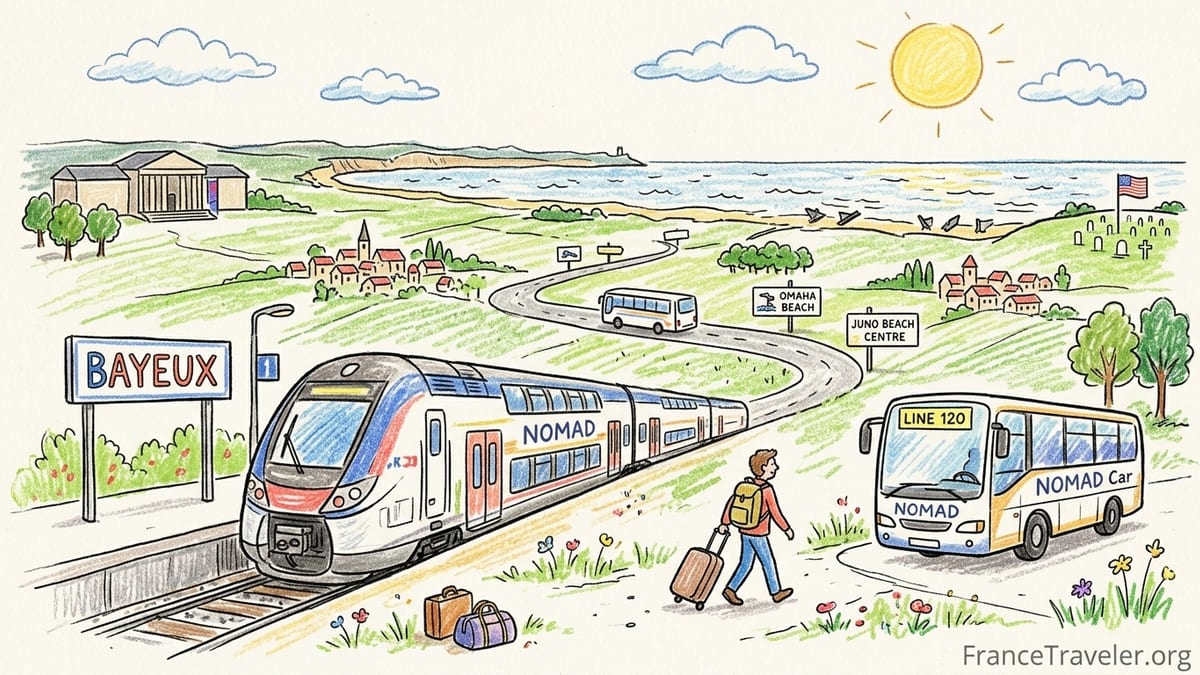
Arriving in Normandy by Train and Learning the Basics
My car free trip started in Paris with a direct train to Caen. Normandy’s regional trains now run under the NOMAD Train brand, but you still book through the national rail system. On a June weekday, I paid just under 25 euros for a non refundable advance ticket from Paris Saint Lazare to Caen in second class, with a journey time of about 2 hours. The trains were modern double deck sets with wide doors and decent luggage racks, closer to a suburban express than an intercity, but perfectly comfortable for the distance.
From Caen, I continued to Bayeux, the small town that has become a favorite base for D Day visitors. Regional trains between Caen and Bayeux typically run at least once per hour during the day and take around 15 to 20 minutes. I bought these legs as separate tickets using the SNCF app so I could keep the flexibility to stop in Caen if I wanted. The fare on my specific train was just under 6 euros one way. Buying on the day at a ticket machine in Caen station would have cost a few euros more, but not dramatically so.
Caen and Bayeux stations are well set up for travelers carrying luggage. In Caen, lifts connect the underpass to each platform and there is a staffed ticket hall plus machines that accept foreign credit cards. Outside, the city bus hub run by Twisto and the regional NOMAD Car stops are right in front of the station building, so I did not have to cross any big roads with a suitcase. Bayeux is smaller and simpler: one main building, two platforms, a single underpass with ramps, and a short, level walk of around 10 minutes into the medieval center where many hotels and guesthouses cluster.
What became obvious from the first day is that luggage is easier to manage by train than by car if you pack light. On NOMAD trains there are overhead racks for small bags and open shelf style racks near the doors for larger suitcases. I traveled with a carry on sized roller and a daypack and never struggled to find space. People boarding with enormous hard suitcases were the ones blocking aisles and stairs. If you plan a similar trip, aim for one medium soft sided suitcase and one backpack, which you can lift easily into the racks.
Understanding the NOMAD Bus Network on the Ground
Normandy’s regional bus system is now unified under the NOMAD Car brand, and for a car free visitor this matters more than it might sound. In practice it means that in Calvados, Manche and the other departments you see the same blue NOMAD branding, similar ticket machines on board, and a shared website and app with timetables. When you are juggling multiple lines to reach a remote museum, that consistency removes a layer of stress.
In Bayeux, three key NOMAD routes matter for D Day visitors. Line 114 connects Bayeux with Caen, line 120 runs west toward Grandcamp Maisy and the Omaha Beach area, and line 121 runs north toward Arromanches and Courseulles sur Mer. Normandy’s tourism board explicitly highlights these lines as the backbone for visiting the D Day beaches without a car. When I arrived at Bayeux station, printed timetables for lines 120 and 121 were available at the small ticket office, although I still double checked everything on the NOMAD Car app because seasonal adjustments are common.
Tickets on NOMAD buses are straightforward. I paid my fares in cash and by card directly to the driver, who issued a printed ticket. On the coastal lines around Bayeux, a single ride for an adult in 2026 was just a few euros. Normandy has been standardising tariffs region wide, so prices are now clearly displayed inside the buses and on the official materials. There is no need to buy in advance for ordinary interurban lines, and seats are not reserved. On some popular commuter runs leaving Caen in the late afternoon, buses did fill up, but on the coastal sections I never saw anyone turned away.
The cultural adjustment if you are used to urban metros is the timetable structure. Frequencies on lines 120 and 121 are limited, often to every two hours, and timetables are designed around school and commuter patterns. That means more buses around 7 to 9 in the morning and again around 16 to 18 in the afternoon, with a noticeable dip in the middle of the day and early evening. Sundays have significantly reduced service or, on some stretches, no service outside of the peak summer period. If you want to rely on these buses as your only way to reach a beach or museum, you must build your day around their fixed departure times.
Reaching D Day Beaches Without a Car
The good news, and it is very real, is that several major D Day sites are now reachable on regular public transport, particularly from Caen and Bayeux. Normandy tourism has created route planners and maps that show how to string things together, and many museums advertise “low carbon” discounts if you arrive by train, bus or bicycle. I took advantage of this network to reach Juno Beach from Caen and Omaha Beach from Bayeux without hiring a car or joining a group tour.
From Caen, I walked out of the station and found the NOMAD bus stop for the line to Courseulles sur Mer, the seaside town that hosts the Juno Beach Centre. On the day I travelled, there were roughly hourly departures on weekdays. The run took about one hour, with the bus leaving Caen’s bus station area and then gradually becoming more rural, passing villages and fields before following the coast the last few kilometres. I paid just over 4 euros for the ticket. The bus stopped in the center of Courseulles, from where it was a flat 10 minute walk to the museum and beach. The Juno Beach Centre itself now clearly mentions on its materials that it offers a reduced “low carbon” fare if you show proof of arrival by public transport or bicycle, and the staff were familiar with seeing bus and train tickets.
Getting to Omaha Beach from Bayeux meant using NOMAD line 120. Early in the morning I boarded a westbound bus near Bayeux station. Around 45 minutes later, after loops through small villages, we stopped near the Overlord Museum close to Colleville sur Mer. From that stop, it was a short walk along a signposted path to the Normandy American Cemetery overlooking Omaha Beach. Later in the day, another bus from the same line dropped me closer to Saint Laurent sur Mer, where a path led down under the dunes to the wide sands of Omaha itself. Walking time between bus stops and the main memorials was always under 20 minutes, but there were no pavements on some stretches, just grassy verges, so good shoes and high visibility clothing felt sensible.
For Utah Beach and the surrounding sites, basing myself in Carentan made sense. Carentan is on the same railway line as Bayeux, with direct NOMAD trains connecting from Caen and Paris. From Carentan’s small station it is feasible to reach Sainte Mère Eglise by regional bus and then continue to Utah Beach with another line, although services are sparse and it requires patience with connections. In practice, what I saw other car free visitors doing, and what I ended up doing myself, was combining public buses with short taxi hops for the last few kilometres when the bus schedules would have left long gaps.
The Seasonal NOMAD Line 125: A New Coastal Spine
The real game changer in summer 2026 was the introduction of NOMAD’s seasonal line 125, promoted heavily by Normandy tourism. Running daily between Grandcamp Maisy and Courseulles sur Mer from 5 July to 31 August, this coastal bus effectively stitched together a string of D Day beaches, museums, campsites and villages. I used it for three days as a hop on, hop off spine between Omaha, Gold and Juno sectors.
In practice, line 125 felt like a hybrid of regular public transport and a tourist shuttle. The timetable offered regular departures throughout the day, with most stops served at the same minutes past each hour. Onboard, passengers were a mix of families with coolers heading to the beach, older visitors with guidebooks and a few locals using the bus for everyday errands. I paid the same kind of regional fare as on other NOMAD lines, just a few euros per segment paid directly to the driver.
The power of line 125 lay in how it connected previously awkward links. One morning I started in Grandcamp Maisy, visited the German battery at Maisy, then used line 125 to reach Pointe du Hoc. After walking the cliffs and craters, I boarded another 125 bus to Saint Laurent sur Mer for Omaha Beach, and later the same line carried me onward toward Arromanches and finally Courseulles sur Mer. Without that continuous coastal service, doing all of that in a single day by regular buses would have required complicated detours back inland to Bayeux between sites.
Line 125 also interacted neatly with the standard NOMAD routes. At several stops, including Courseulles sur Mer and Bayeux’s catchment area via line 121, it was possible to connect with lines heading inland. Normandy tourism even published example itineraries that showed exactly which 125 departure to take to reach a specific museum visit in late morning and which connection to take back toward your accommodation. The limitation was that this coastal service only existed in peak summer. Outside July and August, you need a more conservative plan that focuses on one beach sector per day or uses a guided minivan tour for longer combinations.
Where Public Transport Shined and Where It Failed
There were days when I felt almost smug about exploring Normandy without a car. Visiting Bayeux itself is an obvious win. The station is close to the center, and everything in town is walkable: the cathedral, the Bayeux Tapestry Museum, bakeries, restaurants and the river paths. I watched drivers circle side streets looking for parking while I rolled my suitcase straight to my guesthouse. Staying in Bayeux and doing day trips by bus and train to the beaches worked well for any itinerary that focused on one or two key sites per day.
Caen also works very well without a car. The city has a dense Twisto bus and tram network, and the Mémorial de Caen, a major World War II museum, is accessible via local buses from the train station and center. Day trips to Juno Beach from Caen using NOMAD buses were straightforward, and the combination of a museum morning in Caen and an afternoon by the sea in Courseulles sur Mer felt like a perfect car free day.
But there were also moments when the limitations of Normandy’s rural transport were impossible to ignore. One example was trying to reach the D Day Experience museum near Saint Côme du Mont from Carentan. The main road is not pedestrian friendly, and at the time I travelled there was no convenient local bus directly to the museum entrance. The realistic options were a taxi, an expensive rideshare if one happened to be nearby, or a long walk along a fast road that I did not feel comfortable attempting. In the end, I combined a morning in Carentan itself with a pre booked round trip taxi to fit the museum into my day.
Another challenge came late in the afternoon on a Sunday in shoulder season. After visiting Arromanches and its mulberry harbor remnants, I wanted to return to Bayeux. During weekdays and on summer Saturdays, NOMAD line 121 offers a handful of buses spaced reasonably through the day. On this Sunday, there was a mid afternoon departure and then a long gap before another bus in the early evening. By the time I checked the timetable in Arromanches, the earlier bus had already gone. That left me with a choice between waiting several hours, walking more than an hour along small roads toward an inland village on a different bus line, or sharing a taxi with another stranded couple. We chose the taxi and split the fare, which came to just under 30 euros for the group, but it was a reminder that Sunday timetables can feel like a trap if you do not check them before you set out.
Managing Timetable Gaps, Connections and Waiting Time
Normandy without a car is not about stepping out of your hotel and jumping on whatever bus appears. It is about reading timetables almost the way hikers read weather forecasts. I got used to sitting down each evening with the NOMAD app and the regional journey planner, plugging in the next day’s destinations, and photographing key departure times with my phone so I had them offline. That simple habit saved me from more than one long and unnecessary wait at a country bus stop.
Connections between trains and buses were generally logical, but not guaranteed. For example, arriving in Bayeux on a mid morning NOMAD train from Caen, I often had 15 to 25 minutes before a line 120 bus toward Omaha Beach or a line 121 bus toward Arromanches. That was just enough time to grab a coffee or cross to the supermarket for picnic supplies. However, in the afternoons, some buses left Bayeux’s main stop on the edge of the center rather than directly at the station, requiring a brisk 10 minute walk. Missing one of those departures meant an extra one or two hours of waiting, which can change the feel of your whole day.
In smaller towns like Grandcamp Maisy or Sainte Mère Eglise, waiting for connections felt part of the rhythm of the trip. I learned to treat gaps in the timetable as a chance to explore side streets, visit local bakeries or sit in a café. On one occasion in Grandcamp, a 90 minute layover between buses became one of my favorite memories of the trip: I walked along the harbour, watched fishermen unloading their catch and ate a paper cone of hot, salty frites on the seawall. That would never have happened if I had simply jumped in a hired car and sped to the next museum.
The trade off is that you have less spontaneity in the evenings. Because the last buses from the coastal villages back to Bayeux or Caen can leave as early as 18:00 or 19:00 outside the peak of summer, dinner almost always needed to be back in my base town. Late night drinks in seaside bars were only practical on days when I stayed overnight near the coast itself. For some travelers, particularly those used to flexible road trips, that may feel restrictive. For me, it simply meant leaning into long lunches by the sea and quieter evenings in town.
Luggage, Accessibility and Station Realities
Beyond schedules, the physical realities of traveling without a car in Normandy matter. Stations, bus stops and street layouts vary in how kind they are to travelers hauling bags. Caen and Bayeux, as main gateways, are relatively accessible. Both stations have step free access between platforms, and at Bayeux the walk to most central hotels follows flat pavements with curb cuts. I saw several visitors using wheeled suitcases and at least one older couple with a small folding mobility scooter boarding the train without major difficulty.
Smaller stops along the coast can be more rudimentary. Some NOMAD bus stops were simple poles on the roadside, with a timetable sheet in a plastic case and no shelter. In one hamlet on the way to Grandcamp Maisy, there was no pavement at all, simply a gravel shoulder between the bus stop and the nearest house. That is fine in dry weather, less charming in heavy rain or when you are trying to cross with a suitcase and children. If mobility is an issue, it makes sense to base yourself in one of the better equipped hubs such as Caen, Bayeux or Carentan and treat coastal villages as day trip destinations rather than overnight bases.
I also learned to think differently about what I carried during the day. Unlike car based trips where you can leave extra layers, snacks and camera gear in the trunk, here everything you bring has to live on your back or in a small daypack for many hours. That pushed me toward a lean setup: a refillable water bottle, a compact rain jacket, a light fleece, a small power bank, and simple picnic food bought from supermarkets near stations. Normandy’s changeable coastal weather makes layers and a rain cover for your bag more important than you might expect when looking at a sunny morning forecast.
On longer train legs, luggage felt safe in the open racks at the carriage ends, but on buses there is no separate compartment, so bags sit on your lap or in the aisle. Drivers were generally patient about larger backpacks, but boarding with an enormous suitcase in a half full bus is a fast way to become unpopular. If you are tempted to overpack, imagine wrestling that case into the narrow aisle of a regional bus while the driver waits and locals line up behind you.
Normandy’s Low Carbon Push and Combining Rail, Bike and Foot
What makes Normandy particularly interesting as a car free destination in 2026 is that the region is not just tolerating travelers without cars, it is actively courting them. Regional communications now talk openly about low carbon travel, and many D Day museums and attractions offer small but genuine discounts if you arrive by train, bus or bike. Staff at the Juno Beach Centre and several smaller museums I visited were quick to ask how I had come, and they seemed genuinely pleased when I said “en car” or “en train.”
The integration with cycling is especially visible. Routes like VéloWestNormandy link Bayeux or Carentan with the D Day beaches and even extend all the way to Mont Saint Michel, with the idea that you travel by train to a hub town, then rent a bike or arrive with your own to cover the last miles. In Bayeux, several bike rental shops near the station offered day and multi day rentals specifically marketed to people riding to Omaha or Gold Beach. I met a number of visitors who took a morning train from Caen with their bikes, spent the day riding quiet back roads between memorials, then returned by train in the evening.
On foot, many of the key sites are closer together than they appear on maps. In the Omaha sector, it is possible to combine the Overlord Museum, the American cemetery and sections of the beach on a loop that is walkable in a few hours, starting and finishing at a NOMAD bus stop. Around Arromanches, cliff top paths connect the town with nearby batteries and view points. The catch is that waymarking can be patchy, and some stretches follow narrow lanes used by local traffic. Good footwear and a printed map or offline map app make car free walking days far more relaxing.
From an emissions perspective, the combination of rail, bus and bike works well. Paris to Caen or Bayeux by train, then NOMAD buses and local walking or cycling, felt like a coherent alternative to driving all the way from Paris and then shuttling between small parking lots near each memorial. Normandy’s own messaging leans into this, encouraging visitors to “leave the car at home” and showcasing itineraries that are explicitly planned around public transport, slow travel and local stays of several days rather than rushed day trips by road.
The Takeaway
Normandy without a car in 2026 is entirely possible, often rewarding, sometimes frustrating and rarely boring. The rail backbone between Paris, Caen, Bayeux and Carentan is solid, with reasonably frequent NOMAD trains, accessible stations and manageable fares. Regional NOMAD Car buses, including coastal lines 120 and 121 and the seasonal 125, open up large parts of the D Day coastline to visitors willing to read timetables and accept a slower, more structured rhythm to their days.
What I learned most is that car free travel in Normandy forces you to prioritize. You will not tick every battery and every tiny museum in two days. You will, however, spend longer in a handful of key places, walking between viewpoints, lingering on beach promenades and talking to locals at bus stops. The gaps in the timetable push you toward deeper, not broader, experiences.
If your must see list includes very remote sites with no nearby bus stops or if you have tight time constraints, you may still choose to rent a car for a day or book a guided minivan tour. But if you are curious about lower carbon ways to travel, comfortable with planning around fixed departure times and willing to accept that the last bus home might leave before sunset, Normandy will meet you more than halfway. Its trains, buses and coastal paths will not only move you between memorials and museums; they will also slow you down enough to notice the everyday life that carries on quietly between the echoes of history.
FAQ
Q1. Can I visit the main D Day beaches in Normandy without renting a car?
Yes, it is possible to reach several major D Day sites without a car by combining NOMAD trains to Caen, Bayeux or Carentan with regional NOMAD buses and some walking. Omaha, Gold and Juno sectors in particular now have signposted links from bus stops, and in summer the seasonal line 125 connects multiple coastal sites between Grandcamp Maisy and Courseulles sur Mer.
Q2. Which town is the best base for a car free trip to the D Day beaches?
Bayeux is usually the most convenient base without a car. It has a well connected NOMAD train station, frequent services to and from Caen, and direct NOMAD bus routes toward Omaha, Gold and Juno beaches. The historic center, hotels, restaurants and museums are all walkable from the station, which simplifies luggage and evening dining.
Q3. How often do buses run from Bayeux to the D Day beaches?
On key lines such as NOMAD 120 and 121, buses generally run every one to two hours during the day on weekdays, with fewer services on weekends and public holidays. Timetables are structured around school and commuter patterns, so there are more departures in the early morning and late afternoon, and fewer in the middle of the day and evening. Checking the latest timetable before you travel is essential.
Q4. What is the NOMAD line 125 and when does it operate?
NOMAD line 125 is a seasonal coastal bus that runs between Grandcamp Maisy and Courseulles sur Mer in peak summer. In 2026 it operates daily from 5 July to 31 August, linking multiple D Day related beaches, museums, campsites and villages along the coast. It functions like a hop on, hop off spine that makes it easier to visit several sites in one day without repeatedly returning inland.
Q5. Are tickets for NOMAD buses and trains expensive?
Regional NOMAD train fares between Paris and Normandy hubs such as Caen or Bayeux are reasonable by Western European standards, especially if booked in advance, with one way second class tickets often around 20 to 30 euros. Shorter regional train hops and NOMAD bus rides within Normandy usually cost only a few euros per journey. There is no need to buy bus tickets ahead of time; you pay the driver on board.
Q6. How should I manage luggage if I am using only public transport?
Traveling light is the single best decision you can make. Aim for one medium suitcase and one backpack, both of which you can comfortably lift into train racks and carry onto buses. Larger hard cases are awkward in narrow bus aisles and rural stops without pavements. Stations in Caen and Bayeux are step free, but smaller coastal stops may be little more than roadside poles, so compact, wheeled luggage and a good daypack make life much easier.
Q7. Is Normandy’s public transport suitable for travelers with limited mobility?
Major stations such as Caen and Bayeux offer lifts or ramps between platforms, and many NOMAD buses have low floors and kneeling functions. However, some rural bus stops lack shelters, pavements or smooth surfaces, and paths from stops to beaches or memorials can involve uneven ground or short uphill sections. For travelers with significant mobility needs, basing in Caen or Bayeux and choosing the most accessible sites, possibly with occasional taxis, will usually be more comfortable.
Q8. Can I combine cycling with trains and buses in Normandy?
Yes, combining rail and cycling is increasingly encouraged. Routes like VéloWestNormandy are designed for visitors who arrive by train in Bayeux or Carentan and then ride to the landing beaches and beyond. Some NOMAD trains accept bikes, and several coastal towns and Bayeux itself have bike rental shops near the station. This allows you to cover the last few kilometres between stations, villages and memorials even where bus services are infrequent.
Q9. What are the main drawbacks of exploring Normandy without a car?
The main drawbacks are limited bus frequencies, especially on Sundays and outside peak summer, and the time lost waiting for connections. You may need to leave beaches earlier than you would with a car to catch the last bus, and some remote museums or batteries remain difficult or impossible to reach solely by public transport. Accepting a slower pace and focusing on a smaller number of sites helps avoid frustration.
Q10. How far in advance should I plan a car free Normandy itinerary?
Booking trains from Paris to Normandy a few weeks ahead can secure better fares, but the more important planning is around local timetables. A few days before you travel, download or bookmark current NOMAD bus and train schedules, and sketch out which departures you will use for key day trips. Once on the ground, checking the next day’s connections each evening and photographing key times on your phone will keep your car free itinerary running smoothly.