


I have used Bayeux, Honfleur and Rouen as bases on different Normandy trips, always with slightly different priorities: one focused on D-Day history, one on a romantic coastal break with a rental car, and one on car-free train travel from Paris. Each town has a very distinct personality and set of practical advantages, and none is a universal winner. What follows is drawn from my own time sleeping, parking, eating and getting lost in all three, with a few clearly labelled details checked against current local information for 2024 and 2025.
First Impressions: Three Very Different Normandies
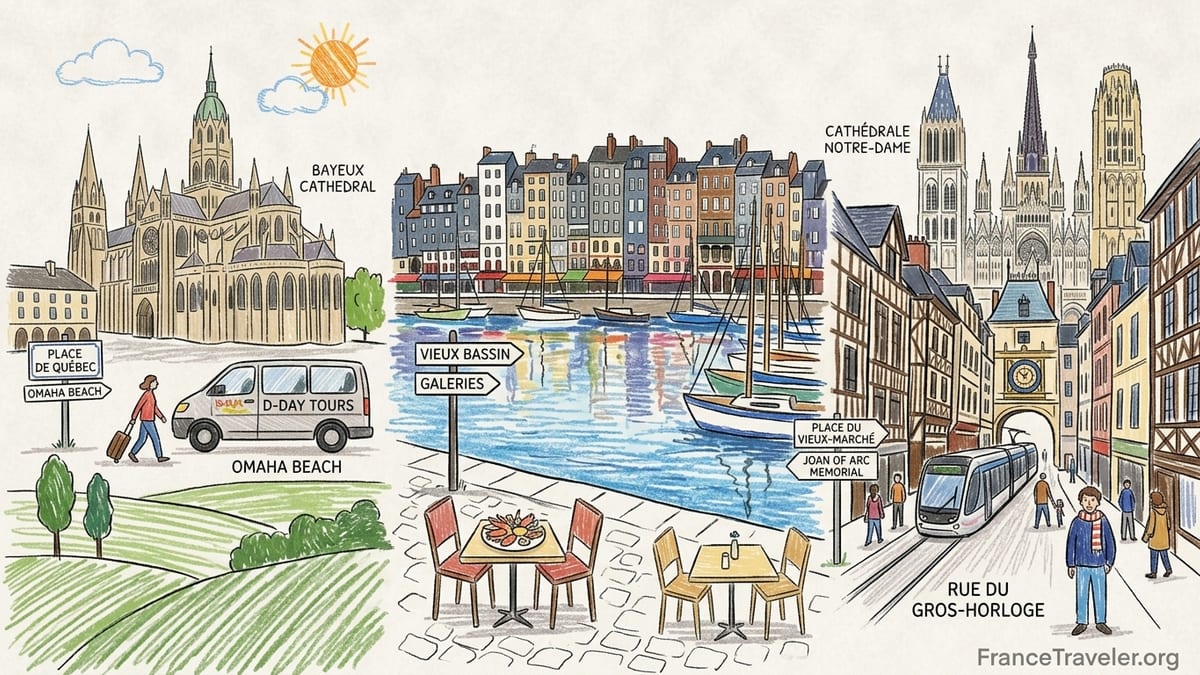
My first base in Normandy was Bayeux, and it felt almost tailor-made for that classic D-Day pilgrimage. I arrived by mid-afternoon train from Paris, wheeled my bag five minutes to a small hotel near the cathedral, and immediately realised how compact the town is. Within ten minutes on foot I could reach the cathedral, the Bayeux Tapestry museum, a supermarket for picnic supplies and the Place de Québec, where many D-Day minivan tours now begin their rounds of Omaha Beach and the American Cemetery. Even on a June evening before the 80th anniversary commemorations, the old streets were calm once the day trippers left.
Honfleur, by contrast, felt like stepping into a painting the moment I first walked up from the Parking de l’Est and saw the masts and slate facades around the Vieux Bassin. The little harbour is ringed with tall, narrow houses whose reflections shimmer in the water, with restaurant terraces side by side. The tourist office leans into this postcard image and promotes the old harbour, medieval streets and galleries as the heart of town, and that matches exactly how it feels: an intimate, romantic stage set that fills up in the afternoon and glows at night.
Rouen is another world again. When I first used it as a base, I arrived at Rouen Rive Droite station from Paris and walked downhill into a proper small city, traffic on the river quays but a largely pedestrian historic core. The route along Rue Jeanne-d’Arc toward the cathedral drops you into a mesh of half-timbered houses, grand stone churches and busy shopping streets like Rue du Gros-Horloge. Rouen feels more urban and less curated than Bayeux or Honfleur, with university students, commuters and a full tram and bus network alongside tourists seeking Joan of Arc and Monet.
Hotel Access and Parking: Where It Is Least Stressful
My least stressful hotel arrivals in Normandy have been in Bayeux. Coming by train, I had no need to worry about parking, but on a later trip with a rental car I still found it easy. The centre has a ring of surface lots and street parking near the cathedral and the public gardens, and even on a May evening I was able to grab a spot a short walk from my hotel. Several central properties, like long-established hotels around the cathedral and main street, offer either courtyards or reserved spaces, usually against a modest nightly fee that felt worth paying to avoid hunting for spots in peak season.
Honfleur required a different mindset. The medieval street plan means very few hotels in the core have onsite parking, and I quickly realised that even the establishments that call themselves "harbour view" usually direct you to public lots. The first time, my satnav led me into the one-way tangle near the Vieux Bassin and I retreated back down to the large Parking de l’Est at the edge of the harbour. From there it was a five to ten minute walk with luggage to a small timber-framed hotel two streets behind the waterfront. The town and tourist office now clearly signpost options like the Bassin de l’Est car park with a day rate in the high single digits of euros, which matched what I paid during a spring weekend. I came to accept that in Honfleur the trade-off for that harbour charm is leaving the car in a lot and strolling in.
Rouen sits in between in terms of ease. Navigating into the very centre by car can be intimidating, with bus lanes, tram tracks and partial pedestrianisation, but I have had success aiming directly for underground garages like the Cathédrale or Vieux-Marché parking. They sit just under or beside key squares, with a few hundred paid spaces each, and once you are parked you can forget the car and do everything in the core on foot. On one trip I opted for a hotel a little away from the tightest medieval streets, closer to the river, precisely so I could roll my suitcase straight from the garage without dragging it over too many cobbles.
Atmosphere and Food: Evenings in Each Town
Bayeux’s evenings felt subdued and quietly friendly. After a long D-Day tour, I would wander back into town, pass the softly lit cathedral, and choose between a handful of bistros that strike a nice balance between tourist-friendly and local. One night I splurged at a well-regarded restaurant near the main drag and can still remember the buttery sole meunière and a bottle of crisp local cider. On another, I settled for a more casual crêperie with families and small groups of veterans comparing notes about Utah and Pointe du Hoc. By ten or ten thirty, even in June, the streets were largely quiet aside from a few hotel bars.
Honfleur in the evening is all about the Vieux Bassin and the streets leading up toward Sainte-Catherine church. The most vivid memory I have is of an April night when the wind off the water had dropped and we found a table outside, facing the masts. Touristy though the restaurants around the harbour can be, there is something irresistible about the lights reflecting in the basin while you pick through a plateau de fruits de mer or a simple moules marinières. After dinner we joined the steady promenade of couples and families doing circuits of the harbour, peeking in at small galleries on Rue du Dauphin and Rue de Grâce. They trade heavily on Impressionist heritage, with reproductions of Boudin and early Monet, and it genuinely feels like the town is wrapping itself in that slightly nostalgic, painterly glow.
Rouen’s historic centre, by comparison, felt livelier and more varied. Around Place du Vieux-Marché and Rue du Gros-Horloge I found everything from crêperies and brasseries to more contemporary wine bars and small-plate spots. One Friday night I joined friends at an outdoor table just off the square where Joan of Arc was executed, surrounded not by tour groups but by students and office workers. Later, the lit facade of the cathedral and the half-timbered houses gave the city a theatrical backdrop, but the energy was very much that of a lived-in regional capital rather than a resort.
Historic Sights: D-Day, Cathedrals and Harbour Stories
For D-Day history, Bayeux has been the best base I have used. The town itself was the first major French city liberated in June 1944 and escaped heavy bombing, which is why its medieval street pattern and cathedral survived. The British military cemetery and the Battle of Normandy Museum sit on the edge of town and can be reached on foot in about fifteen to twenty minutes from the centre. Several dedicated tour companies operate from here, with full-day British and American sector itineraries leaving from central squares or the train station. The convenience of walking from my hotel to a meeting point at around 8.30 or 9.00, coffee and baguette in hand, and returning in the early evening without touching a car, made a huge difference to how relaxed those intense days felt.
Honfleur’s history plays out more along the lines of maritime and artistic heritage. Walking around the harbour you encounter the Lieutenance, a remnant of the old fortifications, as well as the timber church of Sainte-Catherine, said to have been built by shipwrights. The Vieux Bassin took on its current shape under Louis XIV, and panel displays around the quays describe the town’s role as a departure point for New France and its later decline. In the nineteenth century, painters like Eugène Boudin captured the changing skies and tidal flats around the Seine estuary, laying groundwork for Impressionism. One drizzly afternoon I ducked into a small gallery and had a long chat with the owner about modern painters following that tradition along the Côte de Grâce. None of this replaces the emotional weight of the D-Day sites, but it gives Honfleur a different, more contemplative richness.
Rouen brings yet another layer of history. The cathedral, which Monet painted in series to capture shifting light, anchors the old town with its lace-like stonework. A short walk away, around Place du Vieux-Marché, the modern church of Jeanne d’Arc and a memorial mark the spot of her execution. On my first visit I took a self-guided city walk from the cathedral through narrow streets, past the Gros-Horloge clock arch, and on to churches like Saint-Maclou. Interpretation boards and the city museum fill in Rouen’s story as a medieval commercial hub, a Renaissance city and an industrial centre that suffered bombing in 1944. If your interest in Normandy history goes beyond the beaches, Rouen gives you much more to chew on than its coastal cousins.
Getting Around Without a Car
I have done Normandy both with and without a rental car, and my conclusion is that Rouen is the most comfortable base if you plan to remain car-free. Trains from Paris Saint-Lazare reach Rouen Rive Droite in roughly an hour and a half, with services running several times a day. From the station, the historic core is a manageable downhill walk, and a network of buses and a tramway-style system connect you to outlying neighbourhoods. For day trips, you can ride regional trains along the Seine valley to places like Le Havre or head inland, all without needing to decode country bus timetables in a foreign language.
Bayeux is also workable without a car, but with more constraints. Direct trains from Paris Saint-Lazare and Caen reach Bayeux station, which sits about a fifteen-minute walk from the old centre. On my first trip I relied entirely on organised minivan tours for D-Day sites, which was straightforward because departures were timed around incoming trains. In 2024 the region also ran a seasonal D-Day bus shuttle line between Bayeux and key beaches, with fares of only a few euros per day, but schedules were still tailored mainly to the peak months from mid-May to late September. If you stay outside those dates or want flexibility to linger at specific cemeteries or minor sites, a car quickly becomes attractive.
Honfleur is the least convenient of the three without a vehicle. There is no rail station, so access from Paris involves a train to Deauville or Le Havre and then a bus or taxi. I have used the Deauville route, stepping off the train and onto a bus that wound its way via Trouville and the Pont de Normandie before easing down into Honfleur. It works, but arrival times are tied to relatively sparse bus schedules, and for onward day trips along the coast you are again at the mercy of patchy connections. Once in Honfleur, however, you will not miss a car inside town, because everything in the historic core is easily walkable.
Day Trips and Regional Positioning
When it comes to sheer day-trip usefulness, Bayeux has been my strongest base for D-Day focused trips. On one stay I managed Omaha Beach, the American Cemetery, Pointe du Hoc and Sainte-Mère-Église in a single organised day, then used a second day to explore British and Canadian sectors such as Gold and Juno Beaches. Being able to stroll back to my hotel, rinse the sand from my shoes and sit down to dinner within ten minutes of being dropped off in town was more valuable than I anticipated. Bayeux also works for a quick dash to Caen, with its memorial museum and ducal castle, by regional train or car.
Honfleur shines for coastal roaming when you do have a rental car. From town I have driven west along the flowered coast to Deauville and Trouville for beach promenades, casino architecture and market halls, and in the other direction up onto the plateau for views of the Seine estuary. The Pont de Normandie turns Le Havre into an easy half-day excursion. One morning we left early, crossed the bridge before the main traffic, visited the concrete modernist centre of Le Havre and its art museum, and still made it back to Honfleur in time for sunset on the quays. The drive itself, across the estuary with big sky and tidal flats, felt like part of the experience.
From Rouen, my day trips have revolved more around the Seine and inland Normandy. You can follow the river west to abbeys like Jumièges or to the chalk cliffs around La Bouille, or board a train to the coast at Dieppe. Another option I enjoyed was a loop by car that took in the thatched cottages of the Parc Naturel des Boucles de la Seine, combined with lunch in a riverside village. Rouen is less optimal as a base for intensive D-Day exploration simply because of distance and traffic, though determined visitors with a car can make a long day of it.
Which Base Worked Best For What
For D-Day history, Bayeux was unquestionably the most effective base in my experience. Waking up steps from the cathedral, grabbing a takeaway coffee and meeting a guide in the centre for a full-day tour of the American and British sectors felt effortless. The combination of rail access, compact layout, on-foot connections to the British cemetery and Battle of Normandy Museum, and the density of specialist tour operators made the whole operation run smoothly over several visits. While you can reach the beaches from other towns, nowhere I have stayed matched Bayeux for this specific purpose.
For a romantic coast trip with a car, Honfleur is the place I would choose again. I still remember one particular evening walking hand in hand around the Vieux Bassin as the sky turned pink, the masts rattled in a light breeze and a street musician played accordion somewhere near the Lieutenance. Our room was in a creaky timber house a block back from the harbour, with sloping floors and a window that just caught the top of the masts. Days were spent driving to other seaside towns and viewpoints, but we always came back to that intimate, harbour-lit core at night. Parking demands a small compromise, but once you accept leaving the car at the Bassin de l’Est or similar, the rest feels idyllic.
For car-free travel, Rouen worked best overall. I appreciated stepping off the Paris train at Rouen Rive Droite, walking fifteen minutes into the heart of the historic centre and not having to think about rental contracts or fuel. Within the city, pedestrianised streets and the tram-bus lines carried me to sights and neighbourhoods, while regional trains and coaches offered enough options for short excursions. Evenings had more of a local buzz than a touristy one, and I never worried about driving back tired after a glass of wine.
For a first Normandy visit that tries to balance history, atmosphere and logistics, my own choice would still be Bayeux, with a night or two tacked on in Honfleur or Rouen if time permits. Bayeux packages D-Day, medieval charm and manageable scale in a way that is kind to first-time visitors who may already be juggling jet lag and culture shock. Once you are comfortable, adding the harbour romance of Honfleur or the urban energy and Joan of Arc legacy of Rouen makes for a richer second phase of the trip.
The Takeaway
If there is one thing my different Normandy trips taught me, it is that Bayeux, Honfleur and Rouen are not competing versions of the same destination. They are three very distinct answers to three different sets of travel questions. Bayeux is the natural choice when D-Day history is central and you want everything to work smoothly around that, from early-morning tour departures to quiet evenings processing what you have seen. Honfleur is the romantic postcard, better suited to meandering days along the coast and slow dinners by the water than to heavy sightseeing schedules.
Rouen rounds out the trio as the small city that ties Normandy’s medieval, religious and artistic history together and does it in a way that is comfortable for travellers who prefer trains and trams to rental cars. You can easily imagine returning to Rouen for a long weekend in its own right, even without a single beach or bunker on the agenda. None of the three is a universal winner, but each can be the best possible base for a particular kind of trip. The key is deciding whether your own Normandy this time is about standing in the sand at Omaha, watching the sunset over a harbour once painted by Boudin, or tracing Joan of Arc’s last steps beneath a cathedral that so obsessed Monet.
FAQ
Q1. If I only have two nights in Normandy and want to focus on D-Day, where should I base?
Bayeux is usually the most efficient base for a short D-Day focused stay, because you can reach many tour departures, the British cemetery and the Battle of Normandy Museum on foot from central hotels and still have time in the evenings to see the cathedral and tapestry.
Q2. Is Honfleur practical without a car?
Honfleur can be reached by a combination of train and bus from Paris or Le Havre, but once you factor in limited bus schedules and the lack of a train station, it is noticeably less convenient than Bayeux or Rouen for car-free travellers, especially if you hope to do several different day trips.
Q3. How difficult is parking in Honfleur for a weekend stay?
Parking near the Vieux Bassin can be busy, especially in summer, but large car parks such as the Bassin de l’Est usually have space if you are patient. Expect to park a short walk from your hotel and pay a fixed day rate in the single-digit euro range, which local tourist information confirms for recent seasons.
Q4. Can I visit the main D-Day beaches on my own from Rouen in a day?
It is technically possible with a car, but it involves several hours of driving each way and a long day. In my experience, using Bayeux as a base or joining a tour that starts closer to the coast provides a more comfortable and immersive visit to Omaha, Utah and related sites.
Q5. Which town has the best evening atmosphere for dining and strolling?
For a romantic waterside setting, Honfleur’s Vieux Bassin is hard to beat, with its ring of restaurants and reflections of masts in the water. For a livelier city feel with more local nightlife, Rouen’s streets around the cathedral and Place du Vieux-Marché have more variety and stay busy later.
Q6. Is Bayeux too quiet for a four- or five-night stay?
Bayeux is calm in the evenings, but for travellers who spend their days on D-Day excursions or nearby outings, that quiet can be a virtue. With a few good restaurants, a cathedral, the tapestry and a couple of museums, I have been comfortable using it as a base for up to four nights without feeling restless.
Q7. Which base works best for visiting both D-Day sites and Mont-Saint-Michel?
For this combination, I found Bayeux the most logical base. It sits close to many D-Day tours and has road and bus connections that allow a long but feasible day or overnight trip to Mont-Saint-Michel, without changing hotels multiple times.
Q8. Are there good budget options in these towns without a car?
In Bayeux and Rouen, I have stayed in mid-range, centrally located hotels and small guesthouses that were reachable on foot from the train stations, avoiding taxi costs. Honfleur’s most atmospheric properties near the harbour tend to be pricier, but simple rooms exist slightly back from the water if you do not mind walking.
Q9. Which town is best if I am nervous about driving in French cities?
Bayeux is the gentlest introduction to driving in Normandy, with light traffic and simple surface parking near the centre. Honfleur involves more one-way streets and tight turns near the harbour, while Rouen requires confidence with city driving before you tuck the car away in an underground garage and switch to walking.
Q10. Can I reasonably combine all three bases in a single week?
Yes, but it will feel like a moving road trip. One workable pattern I have used is three nights in Bayeux for D-Day and nearby sights, two nights in Honfleur for coast and harbour evenings, and two nights in Rouen for city history and car-free time before returning to Paris.