


The first time I drove into Normandy in early June, the wind coming off Omaha Beach cut straight through my jacket, even though the thermometer showed 18°C. The car parks were already overflowing with coaches, vintage jeeps and motorbikes decorated with Allied flags. A few years later, I came back in October and walked the same sand almost alone, watched only by the white crosses on the bluff. If you are trying to decide when to visit Normandy, the answer depends heavily on how you feel about weather, crowds and especially the D-Day anniversary period, which now stretches across more than two weeks every year.
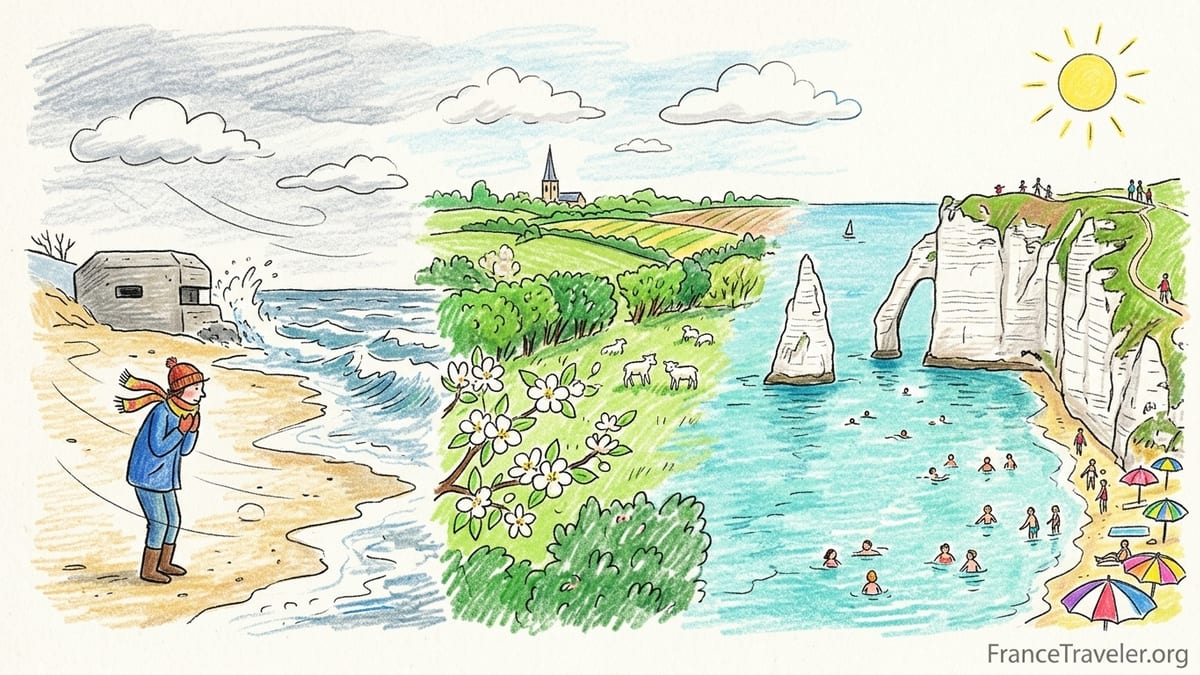
How Normandy’s Seasons Actually Feel on the Ground
On paper, Normandy has a mild oceanic climate, with average highs from around 8°C in January to 22°C in July in coastal areas such as Caen and Bayeux. In practice, the region feels cooler and windier than those numbers suggest when you are standing on an exposed beach or cliff edge. Even in late May, I have watched families arrive at Omaha Beach in T-shirts and leave 20 minutes later wrapped in every layer they packed, because the Atlantic wind turned 18°C into something that felt closer to 10°C once you were away from the shelter of the dunes.
Rain is a constant possibility in all seasons. Long-term climate data for Normandy shows measurable rain on roughly 10 to 15 days per month through most of the year, with annual rainfall spread fairly evenly rather than concentrated in one wet season. In my own trips, that has translated into fast-moving showers rather than all-day washouts. I have lost count of the times a sky that started grey and drizzly over Utah Beach turned blue an hour later while I was at Sainte-Mère-Église. Planning your day around flexible outdoor and indoor stops is much more important in Normandy than trying to “outrun” rain by picking a particular month.
Wind and daylight matter just as much. Exposed headlands such as Pointe du Hoc can feel almost brutal in winter and early spring, with gusts that push you sideways on the path and waves hammering the base of the cliffs. In summer, wind often drops to a steady breeze, but the open beaches and high chalk cliffs around places like Étretat never feel completely calm. Daylight is the reward for dealing with that wind. In June you can have usable light from about 5:30 to 22:30, which allows very long touring days and atmospheric evening walks among bunkers and cemeteries. By November, late-afternoon visits to the same sites happen under a low, slanting sun and a chill that encourages short, focused stops rather than lingering on the sand.
My Early June D-Day Trips: Beautiful Light, Serious Crowds
I have experienced Normandy twice during the D-Day anniversary period in late May and early June, staying near Bayeux and in a farmhouse inland from Utah Beach. The atmosphere in those weeks is unique. In 2026, the official D-Day Festival Normandy ran from May 30 to June 14 to mark the 82nd anniversary of the landings and the 20th edition of the festival, with events spread along the entire 80-kilometre front from Utah to Sword. Even in years without a milestone anniversary, those two weeks bring parachute drops, vehicle parades, outdoor concerts, wreath-laying ceremonies and late-evening firework displays that simply do not exist at other times of year.
On the ground, that festival transforms logistics. Around June 5 and 6, the coastal road between Sainte-Mère-Église, Carentan and Omaha can feel like a slow procession of coaches, campervans and World War II jeep convoys. In Sainte-Mère-Église, I have had to park more than a kilometre from the central square because temporary car parks were full by mid-morning. Local authorities often close streets completely around key ceremonies or turn city-centre lots into spaces reserved for officials and veterans. If you book a guided D-Day tour that promises pick-up from Bayeux or Caen during this period, expect much earlier starts, slower progress between sites and occasional last-minute route changes to dodge roadblocks.
Weather in those early June visits was mixed but manageable. Morning temperatures inland hovered around 10 to 12°C at 8:00, often under low cloud. By early afternoon on the coast, the air warmed to 17 to 20°C, but strong onshore wind made it feel cooler when you stepped out of the car at Pointe du Hoc or on the pier at Arromanches. On one June 4 visit to Omaha, sand blew in visible sheets across the beach, stinging my cheeks while re-enactors in wool uniforms leaned into the gusts. Another evening, I stood in a fleece and windproof shell at the Normandy American Cemetery after 21:00 while a ceremony unfolded under a pale sky that never quite went dark.
The emotional impact of that period is considerable. In Bayeux on June 5, I watched veterans in wheelchairs roll down streets lined five deep with visitors holding flags. At Pegasus Bridge, the café terrace was packed with British and Dutch families in regimental T-shirts, while a brass band rehearsed for the evening. At the same time, every museum was busier and less contemplative than on my autumn visits. In the Airborne Museum at Sainte-Mère-Église, it took patience to move through the glider exhibit as groups from several British coach tours merged in the same gallery. If your priority is quiet reflection, the early June festival might not be the best match for your first visit, even though the quality and variety of events are exceptional.
Étretat and the Alabaster Coast: Timing the Cliffs and Crowds
My experiences in Étretat were in late May and September, not in peak July and August, and that was a deliberate choice. Étretat’s tourist office explicitly recommends avoiding July and August, fine-weather weekends and the busiest midday period from 11:00 to 16:00 when possible. That matches what I saw even shoulder-season: by late morning on a sunny Sunday in May, day-trippers from Paris had already filled the main seafront parking areas and a loose queue of cars hugged the curb through the centre of town, waiting for any space to open up.
On both visits, the most rewarding hours were at the edges of the day. One September morning, I walked up the cliff path toward the chapel of Notre-Dame-de-la-Garde just after 8:00. The air temperature was about 13°C and the wind came off the Channel in sharp little gusts that made my eyes water, but aside from a handful of local dog walkers there was no one on the path. By 10:30, the same trail had turned into a slow-moving ribbon of visitors stopping every few metres for photos, and the sound of voices from the beach floated all the way up to the clifftop.
Wind and tide shape Étretat more than anywhere else I have visited in Normandy. The pebble beach drops steeply into the water, and the tide range is large. At low tide in calm conditions, families wandered far out over wave-cut rock platforms, past rock pools and under the famous arch. On a blustery afternoon two days later, strong waves pounded the same rocks and spray flew high enough to soak people standing what looked like a safe distance up the beach. When I checked the weather station readings that week, gusts were frequently over 40 km/h on the headland, even though the air temperature still hovered around 18°C in the village. Good footwear matters: chalk dust, loose gravel and sudden gusts on the exposed cliff edge make the paths slippery, especially after showers.
If you are sensitive to crowds, consider following Étretat’s own advice. In practical terms, that means favouring May, June outside school holidays, September and early October, aiming for midweek rather than weekend days, and planning your main cliff walks in the early morning or after 17:00. In those windows, I found café terraces with empty tables facing the sea, and I could stand quietly on the headland watching light shift on the white cliffs without constantly stepping aside for group selfies. The trade-off is changeable weather: one of my September evenings ended with a sudden shower that blew in from the northwest so fast that within five minutes every bench on the promenade was empty.
Calmer Months I Have Known: Spring and Autumn Outside the Festival
Away from the D-Day festival and peak summer, Normandy feels much closer to the pastoral image many travellers imagine. On a late April trip based near Bayeux, morning frost still coated farm fields inland, but the hedgerows were full of blossom and lambs dotted the slopes. Air temperatures on that visit ranged from 6°C at breakfast to around 15°C in the afternoon, cooler on the beaches when the wind picked up. At Utah Beach around 16:00, the sand felt almost empty, with only a handful of kites and two or three families walking dogs. The museum car park was perhaps one-third full, and I could wander the exhibits in near silence.
October produced my favourite light. During a stay near Courseulles-sur-Mer, I woke several mornings to ground mist in the fields that burned off by 10:00, revealing clear blue skies. Highs stayed near 16°C on the coast, dropping quickly after sunset. On Juno Beach around 18:30, I watched surfers catching short, clean waves in full wetsuits while I stood on the shore in a fleece and light insulated jacket. The beach bars were still open but quiet, and the broad strip of sand felt very far from the packed scenes of August that locals described, when French school holidays and northern European vacationers combine.
Autumn also offered the most contemplative visits to memorials. At the Normandy American Cemetery in October, the parking area had ample space at 11:00 and I could walk the rows of crosses with only the sound of wind in the pines. Inside the visitor centre, I could take time with individual testimony films without feeling rushed by a crowd behind me. At Pointe du Hoc on an overcast October afternoon, wind whipped across the plateau hard enough to make me grateful for a hat and gloves, but there were long stretches when I saw no one else between the craters. The sea boiled white at the base of the cliffs, making it much easier to imagine the scale of the original assault than on a bright summer day with families picnicking on the grass.
The trade-off in shoulder seasons is shorter daylight and a slightly greater risk that a full day’s plan will be bent around weather. On that October stay, one day brought continuous drizzle and low cloud. Visibility from the bluffs was limited and the colour drained from the landscape, so I shifted to interior visits: the Bayeux Tapestry Museum in the morning and the Memorial Museum of the Battle of Normandy in the afternoon. Both were busy, but still far from summer levels. Having that indoor backup list made the day feel successful rather than wasted.
Months I Researched, Not Walked: Winter Chill and High-Summer Rush
I have not personally spent time in Normandy in deep winter or in the core of the July and August high season, so what follows is researched advice rather than first-hand experience. Climate records for coastal Normandy show average highs of about 7 to 9°C in January and February, with frequent rain, strong wind and a high number of overcast days. Wind speeds over 20 km/h are common, and on exposed sites that can feel much colder. Some smaller coastal hotels, restaurants and seasonal attractions scale back hours or close completely between November and March, particularly in smaller resort towns along the Alabaster Coast.
For travellers, winter brings two clear benefits. The first is solitude. Outside the Christmas and New Year holiday period, major D-Day sites such as Omaha Beach, Utah Beach and the cemeteries receive far fewer visitors. If your priority is paying respects in quiet conditions and you are prepared for cold, damp air, winter can suit. The second is cost. While exact numbers vary from year to year, accommodation prices in towns like Bayeux and Arromanches often fall noticeably in January and February compared with June. The drawbacks are shorter opening hours, fewer café terraces, slippery paths on clifftops and the real possibility that stormy weather could close some coastal walks.
High summer is the opposite. July and August are the warmest months, with average highs around 21 to 23°C on the coast and warmer inland. Humidity is moderate and sea temperatures are at their most comfortable for swimming, which makes this the traditional beach holiday season for French families. Visitor statistics compiled around the D-Day beaches show that the region welcomes millions each year, and a significant share of that traffic arrives in July and August. Local tourism offices and Étretat’s own guidance underline that these months bring very heavy daytime crowds on beaches and coastal paths, especially in fine weather.
If you travel in high summer, you gain reliable warmth, long evenings and a full slate of coastal activities, from sailing schools to beach bars and open-air markets. You also face more traffic on the A13 and N13 corridors from Paris, busier regional trains into Caen and Bayeux, and tight booking conditions around popular weekends. Rental car prices also tend to peak in this period across France. For visitors who mainly want to sunbathe, swim and enjoy a lively seaside atmosphere, July and August are ideal. For those whose priority is the D-Day story or quiet cliff walks, these months may feel too crowded and festive.
How the D-Day Festival Period Changes Practical Planning
Even outside landmark anniversaries, the D-Day Festival has become a major event in its own right. In 2026 it ran from May 30 to June 14 along the entire landing zone, with hundreds of individual events from Utah Beach through Omaha, Gold and Juno to Sword, and inland to Pegasus Bridge and Sainte-Mère-Église. That two-week window now reliably brings much higher demand for accommodation and guided tours, heavier traffic on the main routes along the coast, and more frequent police-enforced road closures around key ceremonies.
On my early June stays, local gendarmes set up checkpoints on roads into Omaha sector towns before major ceremonies, allowing only authorised vehicles through. Side roads that look quiet on a map filled with spectators’ cars. At Sainte-Mère-Église, temporary camps of military-vehicle enthusiasts and re-enactors occupied fields outside the town, complete with mess tents and rows of canvas shelters. These bring colour and atmosphere, and for many visitors they are part of the appeal, but they also consume parking space that on a random April weekday would be freely available to day-trippers.
Prices during the festival reflect that pressure. Hotels and guesthouses in Bayeux, Arromanches, Carentan and Sainte-Mère-Église often require multi-night minimum stays around June 6, and rates climb compared with the same properties in late May or September. Guided tour companies that normally run one or two day tours may add extra departures, some themed specifically around the anniversary. Tickets for special events such as commemorative parachute drops, concerts or conferences can sell out well in advance. It is not uncommon for visitors who book late to end up staying inland, for example around Saint-Lô, and driving 45 minutes to reach the coast each day.
For those who want the festival experience without the absolute peak intensity, consider targeting the second week of the programme. In 2026, that meant roughly June 8 to 14. Local tourism information highlights that this later period still offers a rich programme of events but with lower crowd density than the days immediately around June 6. You may find it easier to move along the coast, park at major sites and secure restaurant reservations, while still enjoying the unique energy of a region in remembrance.
Matching Your Priorities to the Best Time to Go
Choosing when to visit Normandy comes down to weighting weather, crowds and your interest in the D-Day festival against each other. If your top priority is standing on Omaha Beach at dawn near the anniversary, surrounded by veterans, serving soldiers and families from across the Allied nations, then early June is non-negotiable, and you will accept traffic jams and full car parks as part of the experience. In that case, book accommodation and car hire as far ahead as you reasonably can, plan for early starts and allow extra time between sites.
If, on the other hand, you want space and quiet to process what happened on those beaches, you might be happier nudging your trip just outside the festival. My own most powerful moments came in late October, when the wind roared through the craters at Pointe du Hoc and the beaches were nearly empty. Late April and early May offer a good compromise for many: longish days, blooming countryside, relatively light crowds and a still-high chance of showers and brisk wind that make a waterproof shell and layered clothing essential.
For visitors mixing in leisure along the Alabaster Coast with historic touring, the balance is a bit different. If you dream of walking the cliffs of Étretat in soft evening light and then lingering over seafood on the seafront, late May, June outside school holidays and September are excellent choices. They align with tourist-board advice to avoid the busiest July and August weeks and the heaviest midday period, while still giving fairly mild temperatures and a decent chance of bright days. In all cases, build flexibility into your plan, so that you can swap an exposed clifftop walk into a sunnier window and dive into a museum on a windy, wet afternoon.
Whatever month you choose, underestimate neither the wind nor the emotional weight of the region. Pack a windproof layer even in August, and leave room in your schedule for unplanned stops: a small British cemetery glimpsed from the roadside, or a viewpoint over the bocage landscape where you can picture how hard the fighting became once the landings succeeded. The right time to visit Normandy is the one that lets you experience both the physical place and its history in a way that matches your own pace.
The Takeaway
Across my trips, the most consistent truth about Normandy has been that conditions change fast. A beach that felt almost summery at midday in June turned cold and raw when the wind rose two hours later. A clifftop in Étretat that was nearly empty at 9:00 became a crowded promenade by 11:30. An April drizzle that threatened to write off a day lifted just in time for an evening walk among the bunkers at Longues-sur-Mer. Planning by broad season helps, but being ready to adapt inside each day matters even more.
If you want festival energy, ceremonies and the sense of being part of a living act of remembrance, aim for the D-Day Festival window from late May to mid-June and prepare for crowds, higher prices and occasional roadblocks. If you prize reflection and cooler air over events, consider late spring or autumn, when the beaches are quieter and the light can be extraordinary. For classic seaside holidays and cliff hikes mixed with swims, lean toward June or September around Étretat and the Alabaster Coast, following local advice to sidestep the busiest weeks and midday hours.
Normandy rewards those who come with realistic expectations about weather and crowds and a willingness to embrace its moods. On a good day, the combination of soft Atlantic light on white cliffs, the rust-brown remains of Mulberry harbours off Arromanches and the green patchwork of fields behind the dunes is unforgettable. Choose your moment thoughtfully, pack for wind and rain as well as sun, and you will find that Normandy’s seasons add texture to your trip instead of getting in the way of it.
FAQ
Q1. When is the overall best time of year to visit Normandy?
For most travellers, the sweet spots are late April to early June outside the busiest festival days, and September to mid-October, when crowds are lighter but weather is still relatively mild.
Q2. What is Normandy weather like in early June around the D-Day anniversary?
Expect cool to mild days, with coastal highs often around 17 to 20°C, cooler in wind, and a mix of sunshine and fast-moving showers, plus long daylight from early morning to late evening.
Q3. How crowded does Normandy get during the D-Day Festival from May 30 to June 14?
The festival period is one of the busiest times of year, especially from about June 4 to 7, with heavy traffic, full car parks, more road closures and significantly higher demand for hotels and tours.
Q4. Is it a good idea to visit the D-Day beaches on June 6 itself?
It can be deeply moving but also logistically difficult, with security measures, restricted access in some areas and very large crowds; many visitors choose nearby dates for easier movement.
Q5. When should I visit Étretat to avoid the worst of the crowds?
Aim for May, June outside school holidays or September on midweek days, and plan your main cliff walks before 11:00 or after 16:00 to sidestep the busiest hours and day-trip traffic.
Q6. Are Normandy’s beaches and cliffs very windy?
Yes. Even in late spring and summer, exposed spots like Omaha Beach, Pointe du Hoc and the Étretat cliffs often feel several degrees colder because of persistent Atlantic wind, so a windproof layer is essential.
Q7. Is winter a bad time to visit the D-Day sites?
Winter is colder, wetter and windier, with shorter days and some seasonal closures, but it also brings very low visitor numbers, so it can suit travellers who prioritise solitude and reflection.
Q8. How far in advance should I book accommodation for an early June trip?
For stays between late May and mid-June, especially near June 6, it is wise to reserve hotels or guesthouses several months ahead, as popular towns like Bayeux and Arromanches fill quickly.
Q9. Are museums and visitor centres open year-round in Normandy?
Major sites such as the Normandy American Cemetery visitor centre, Utah Beach Museum and Airborne Museum are generally open most of the year, though hours are shorter in winter and some smaller attractions may close seasonally.
Q10. What should I pack for a spring or autumn trip to Normandy?
Bring layers, including a warm sweater or fleece, a waterproof and windproof shell, sturdy walking shoes for wet paths, and a hat or scarf for exposed beaches and cliffs, plus lighter pieces for occasional sunny, mild afternoons.