


Choosing where to base yourself in Normandy is less about finding the prettiest town and more about matching a place to the trip you actually want to have. On my own visits I have stayed overnight in Rouen, Honfleur, Bayeux and near Mont-Saint-Michel, and I have also made the mistake of changing hotels too often, convinced it would “save driving.” It usually did not. What did matter were things like where I could park without stress, whether there was life in the streets after dinner, and how easy it was to get on the road or onto a morning train. This guide walks through how each of these four classic bases really works in practice, and how I would choose between them for different kinds of trips.
Understanding Normandy’s Distances Before You Book
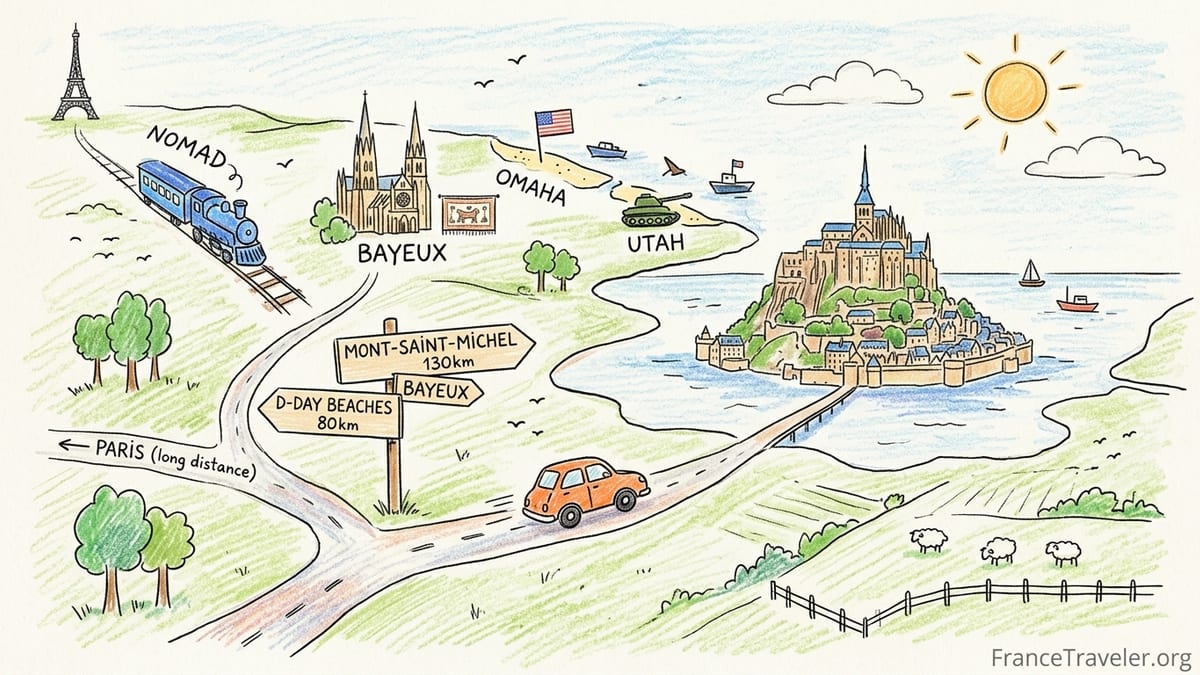
The first planning mistake most visitors make in Normandy is underestimating distances. The D-Day coastline stretches roughly 80 kilometres from Utah Beach in the west to Sword Beach in the east, and Mont-Saint-Michel sits another 130 kilometres southwest of Bayeux, which itself is the main base for many D-Day tours. That means driving from Bayeux to Mont-Saint-Michel and back is around a 260 kilometre round-trip, or three hours of pure highway time, before you count stops. Several rental car itineraries I have seen try to do Bayeux, multiple landing beaches and Mont-Saint-Michel in the same day, which often turns into nine or ten hours behind the wheel. It looks manageable on a map, but on the ground it feels very different.
Trains have their own geography. Mainline NOMAD regional trains connect Paris Saint-Lazare to Rouen in roughly 1 hour 20 minutes on paper, although regional reports note that congestion on the approach to Paris can add up to 30 minutes at busy times. From Rouen, onward trains run to Caen and Le Havre, but there is no simple rail connection from Honfleur or Mont-Saint-Michel. For those two, you either drive or you are stitching together buses and shuttles with limited departures. Once you see Normandy as a loose triangle between Rouen, the D-Day coast and Mont-Saint-Michel, it becomes easier to choose one or two efficient bases instead of chasing every postcard town.
Because the region sprawls, changing hotels rarely reduces driving as much as you expect. On my first big circuit I slept one night in Rouen, one in Honfleur, two in Bayeux and one near Mont-Saint-Michel. On paper it was neat and linear. In reality, every hotel change cost almost half a day by the time I checked out, stored luggage in the car, drove an hour or two, checked in again and then went to park somewhere on the edge of an old town. On later trips I stayed three or four nights in a single base and accepted longer day trips. I spent more time actually walking the beaches and cathedral squares and far less time queueing for hotel check-in.
With that context, the choice between Rouen, Honfleur, Bayeux and Mont-Saint-Michel comes down to what you want most: medieval city life with easy trains, harbour atmosphere and the Côte Fleurie, deep time on the D-Day sites, or the once-in-a-lifetime experience of seeing Mont-Saint-Michel almost empty outside day-trip hours. Parking setups, restaurants and evening atmosphere are very different in each place, and those small practical details matter more than you might think when you are jet-lagged, in a rental car, and looking for somewhere to eat at 9 p.m.
Rouen: Best Base for Eastern Normandy and Car-Free Trips
Rouen is the obvious base if you want to explore eastern Normandy without a car or if you prefer a real working city to a pure tourist town. Direct NOMAD trains from Paris Saint-Lazare reach Rouen’s Rive-Droite station in around 1 hour 20 minutes in theory, with frequent daily departures and assigned seats. In practice I have had both a smooth 1 hour 15 minute run and a 1 hour 45 minute evening service delayed by congestion near Paris. The key advantage is that once you roll your suitcase out of Rouen’s station you do not need a car at all to enjoy the city. The historic core, with its half-timbered houses and cathedral quarter, lies about a 15-minute walk downhill from the station, and local buses and trams cover anything further.
Parking is the main argument for leaving a car outside Rouen rather than trying to stay directly inside the medieval core. The city has several underground garages at the edge of the pedestrian area and a large parking deck integrated with Rive-Droite station. On one summer visit I arrived by car at around 5 p.m. and spent 25 stressful minutes looping one-way streets until I gave up and committed to the station car park for the night, which cost roughly the same as a mid-range city garage in Paris. Once parked, I walked down into the old town and did not move the car again until I left. Rouen’s one-way system and the permanent traffic around the Seine quays mean that if you mostly plan to walk the city and perhaps take a single day trip by train to the coast, you are better off returning the rental car before arrival or collecting it only when you leave.
Evenings in Rouen feel like a mix of student town and historic capital. The streets around the cathedral, the Gros-Horloge clock and Place du Vieux-Marché stay lively late into the evening, especially from Thursday to Saturday. On an autumn stay I joined a steady stream of locals walking the revamped riverfront, where old warehouses now hide bars, breweries and casual restaurants. It felt very different from the more curated harbourfront of Honfleur. For dinner I could choose between crêperies and cider bars in tiny timbered lanes or more contemporary bistros closer to the station. Because Rouen is a proper city, there was none of the 9 p.m. “kitchen already closed” panic that sometimes hits smaller resort towns in shoulder season.
For a car-free base, Rouen is the most efficient of the four. Trains fan out to Le Havre and Dieppe, and regional coaches link to sites along the Seine valley like Jumièges Abbey. For a first trip to Normandy where you want one foot in history and another in contemporary French life, and where you do not want to rent a car at all, I would happily spend three nights in Rouen with a day trip by train to the sea. The trade-off is that Rouen is not on the D-Day coast, and reaching the landing beaches or Bayeux without a car requires long, multi-leg trips that use up the better part of a day each way.
Honfleur: Atmosphere and the Côte Fleurie, With Parking Compromises
Honfleur is the heart choice rather than the head choice, and I say that as someone who keeps going back. The old harbour, the Vieux Bassin, is exactly what the tourist office promises: narrow slate-fronted houses rising over a tight oval of water, masts reflected in the surface and restaurant terraces lining the quays. Walking there at dusk with the lights coming on and the crepe stands just opening is one of the great small-town moments in Normandy. If you want atmosphere, and if you like the idea of driving out to the beaches of the Côte Fleurie during the day and then returning to a postcard harbour for dinner, Honfleur is a strong candidate.
The catch is parking. The old town is mostly pedestrian and sits in a pinch between hills and the Pont de Normandie, which funnels a lot of traffic through limited space. The tourist office lists several car parks ringing the centre. On my last high-season stay, the closest lots to the harbour filled by mid-morning, and by 10 a.m. cars were circling for spaces or giving up and heading to more distant parking near the Naturospace gardens or out toward the outlet mall. I learned to arrive before 9 a.m. if I wanted a convenient spot for a day of wandering and then to leave the car put until after dinner. In the evening, turnover from day-trippers freed spaces, but on summer Saturdays it still took patience.
Once you are parked, you can do almost everything on foot. Honfleur itself is small enough that you can cross the historic centre in 10 minutes, and the most interesting part of any visit is sitting in a café on the harbour, watching boats and people. Newer restaurants have joined the long-standing brasseries, and you now find everything from simple moules-frites to contemporary seafood plates or modern bistros opened in 2023 and 2024. Because many visitors are day-trippers, there is a pleasant thinning out after dinner; terraces stay busy, but the alleys behind the port quieten quickly. Unlike Bayeux, which has a more dispersed restaurant scene, Honfleur concentrates nearly all its nightlife around the Vieux Bassin, so if you crave calm you may want a hotel a street or two back.
Using Honfleur as a base for the Côte Fleurie can work if you accept some daily driving. Deauville and Trouville sit about a 30-minute drive west, Cabourg about 45 minutes. On one spring trip I spent three nights in Honfleur and did day drives to Deauville, the cider route inland and the cliffs around Etretat. The drives were pleasant, but traffic returning through the coastal corridor and over the Pont de Normandie added up. I would not choose Honfleur as my only base for intensive D-Day touring, both because of the extra driving to reach the landing sites and because getting in and out with a car each day becomes wearing. I would, however, choose it in a heartbeat for a romantic long weekend where the priority is wandering stone streets, lingering over seafood dinners on the harbour and making one or two gentle excursions.
Bayeux: The Most Efficient Base for D-Day Touring
If your main reason for coming to Normandy is to understand D-Day on the ground, Bayeux is the base that makes the most sense. The town sits just inland from the central landing beaches and acts as the departure point for a dense network of D-Day tours. Many operators start from a single central square near the tourist office, and they time their departures around 8.30 or 9 a.m. and returns around 5 or 6 p.m. This clustering is convenient; on my own D-Day-focused stay, I could leave my car in a hotel courtyard, walk ten minutes to my tour van in the morning, and be dropped back at the same square in time for dinner. I never had to navigate unfamiliar coastal lanes under time pressure.
Driving distances illustrate why Bayeux works so well. The American Cemetery and Omaha Beach are generally a 25 to 30 minute drive from town, Pointe du Hoc about 35 to 40 minutes, and Arromanches with its artificial harbour is roughly 20 minutes away. Utah Beach and Sainte-Mère-Église are further, closer to an hour. With two or three nights in Bayeux you can cover the core American sites in one long day tour, add a second day for British and Canadian sectors or for independent exploring, and still have time to visit the Bayeux Tapestry and cathedral on foot.
Parking in Bayeux is manageable compared with Honfleur or inner Rouen. The town provides several free or modestly priced surface car parks within a short walk of the centre, and my hotel stays there have usually included a small private courtyard or dedicated spaces. I have twice arrived around lunchtime in May and found a spot in a central lot within five minutes, something that would be unthinkable in Honfleur on a sunny weekend. Because Bayeux’s medieval core is compact but not hemmed in by water, it absorbs cars better. This makes it comfortable to keep the same hotel for three or four nights and simply drive out each morning.
Evenings in Bayeux are quieter than in Rouen but still satisfying. After my D-Day tour days I was happy to stroll the few streets between the cathedral, the Aure river and the main restaurant clusters, find a table for a set menu featuring local fish or lamb, and then walk back past the floodlit church. There is some outdoor seating in summer, but the atmosphere is more reflective than lively, especially outside July and August. For many travellers that is a feature rather than a bug. After absorbing emotionally heavy sites like the cemeteries and beaches, a calm small town feels right.
As a practical base, Bayeux also works well for reaching Mont-Saint-Michel by car at the beginning or end of a trip. The drive is around 130 kilometres and takes about 1 hour 45 minutes on main roads. On one itinerary I checked out of Bayeux at 9 a.m., reached Mont-Saint-Michel’s parking fields just before 11, dropped my suitcase at a hotel on the causeway, and still had several hours to explore the abbey before the afternoon crowds peaked. In hindsight, that combination of a Bayeux base for D-Day followed by a single night near Mont-Saint-Michel gave me more real time at both than my earlier attempt to sleep in three different towns.
Mont-Saint-Michel: Why an Overnight Stay Feels So Different
Mont-Saint-Michel is not a convenient touring base in the way Bayeux or Rouen is. It is a single, highly concentrated sight, with one access road, a set of large paid car parks on the mainland and a causeway that leads to the rocky island crowned by its abbey. For many visitors it is a day-trip destination. They arrive between 11 a.m. and 2 p.m. on coaches or by car, take the free shuttle buses from the parking area to the base of the mount, push through crowded lanes, visit the abbey and then leave again before dinner. Staying overnight changes the entire experience.
The logistics are straightforward once you understand them. All standard vehicles park in designated lots a few kilometres from the mount. Parking prices in 2026 vary by duration, time of day and season, but as of the latest official information the first 30 minutes are free for drop-off, and there is a free period overnight from early evening until around 3 a.m. outside peak summer dates. The visitor centre directs you either to a steady flow of free shuttle buses, which take around 10 to 12 minutes to reach the mount, or to a pedestrian walkway across the causeway that takes about 25 minutes. When I stayed overnight, I chose to walk in at sunset, dragging a small suitcase, and to take the shuttle out the next afternoon when the weather turned wet. That combination gave me both the classic long approach view and the practical backup when I was tired.
Once the last day-trip buses leave, Mont-Saint-Michel feels almost like a different place. On my overnight stay, I watched the main street clear between about 6 and 7 p.m. In the morning, I stepped outside just after 8 a.m. and for 20 minutes I walked almost alone up the steep stone lanes to the abbey entrance. Restaurants inside the ramparts are limited in number, and it is worth choosing and booking one in the late afternoon if you want a particular view or menu. I settled for a simple dinner inside a stone-walled dining room where the staff clearly recognised nearly all their guests from local hotels. It was not fine dining, but being able to wander back through lantern-lit alleys and look back at the empty causeway was worth every compromise.
As a base for driving, however, Mont-Saint-Michel is awkward. Getting in and out with a car involves repeating the same pattern of parking, shuttle and walking, which takes close to an hour each way when you include waiting time and security checks. The surrounding countryside has other pleasant villages and coastal viewpoints, and it is possible to base in neighbouring towns like Pontorson or along the bay and just visit the mount one or two evenings, but that is a different kind of trip. For most travellers I would recommend one night actually on the mount or in the hotels clustered along the access road, essentially as a special finale to a Normandy itinerary rather than as a hub for multiple day trips.
For photography and quiet reflection, that overnight is transformative. Early morning fog can hide the abbey completely from the mainland road, then lift to reveal the silhouette. Night lighting turns the whole structure a soft gold. None of that is accessible if you arrive at 11 a.m. and leave at 4 p.m. because you are worried about a long drive back to Bayeux or Paris. If your budget allows only one hotel splurge on a Normandy trip, I would put it here rather than on a boutique room elsewhere. You gain not just amenities but also time at the site when almost everyone else has gone.
Does Changing Hotels Actually Reduce Driving?
In theory, moving from town to town across Normandy lets you line up sights neatly and reduce backtracking. In practice, each move introduces its own friction. Checking out by 11 a.m., driving an hour or two to the next place, finding the hotel, unloading bags, locating a new parking solution and checking in eats into the middle third of the day. On the trip where I stayed successively in Rouen, Honfleur, Bayeux and Mont-Saint-Michel, I felt as if I were always arriving somewhere new at 4 or 5 p.m., too late for many museums and slightly too early for dinner. I still did a lot of driving, but I also lost some of the slow evenings that make Normandy rewarding.
Compare that with a later itinerary built around a three-night stay in Bayeux and a single night near Mont-Saint-Michel. From Bayeux I drove moderate distances each day to different beach sectors, sometimes looping inland through small villages on the way back. Because my hotel and parking spot were constant, I could linger over coffee in the morning and not worry about packing the car. On the Mont-Saint-Michel day I simply left Bayeux once, spent 24 hours focused on that one site, and then continued to the Loire rather than backtracking. The odometer at the end of the week told me I had driven almost the same total distance as on the multi-base trip, but my days felt less fractured.
The place where changing bases can make sense is on the eastern side, pairing Rouen and Honfleur. For example, you might spend two car-free nights in Rouen, arrive by train, explore the city on foot, then rent a car on departure day and drive just over an hour to Honfleur. There you could park once for a romantic harbour weekend before heading on to Bayeux or back to Paris. That shift reflects a change in trip style rather than a pure attempt to minimise kilometres. The moment you start designing your route only to “save driving,” and not because you genuinely want an extra evening in a particular town, you are likely to be disappointed.
The other factor is fatigue. Driving in rural Normandy is not difficult, but it does involve narrow lanes, frequent roundabouts and local habits like quick, decisive overtaking. Add in jet lag, unfamiliar manual gearboxes and variable weather and two and a half hours to Mont-Saint-Michel can feel longer than it looks on a map. Concentrating your nights in one or two bases gives you days where you do not have to plan every hour, which often translates into more spontaneous stops at cider farms or coastal viewpoints, the sort of unscheduled experiences most travellers remember best.
Which Base I Would Choose for Different Trips
For a first general trip to Normandy of four or five nights, I would choose Bayeux as the primary base, with one night at or near Mont-Saint-Michel if the budget allowed. Bayeux gives you efficient access to the D-Day beaches, a manageable parking situation, a handsome historic centre and enough restaurant choice to keep evenings varied. From there you can reach Omaha, Utah, the American Cemetery, Arromanches and inland museums within a series of day trips that rarely exceed an hour’s drive each way. Adding an overnight at Mont-Saint-Michel at the end lets you experience the abbey in the quiet of evening and morning before you drive on or take a train south.
For a trip focused almost entirely on the D-Day story, I would still base solely in Bayeux, and I would not bother moving to Mont-Saint-Michel unless I had extra time. In this scenario, the goal is to give yourself two or three full days for guided and self-guided explorations of the landing zones, bunkers, cemeteries and inland battlefields. Bayeux’s concentration of tour departures, its central position and its relaxed evenings all support that purpose. Moving hotels in the middle of such a trip usually shortens your available time at the sites without giving you better access.
For a romantic weekend, my choice would flip. I would stay in Honfleur, arrive by car around lunchtime on Friday, accept the cost and mild chaos of central parking, and then do very little driving. My days there mostly involve wandering the harbour, ducking into art galleries, making the short climb to the lookout at the Chapel of Notre-Dame de Grâce, and perhaps doing a coastal drive to Deauville or a cider tasting inland. Dinners on the Vieux Bassin, with lights reflecting on the water and old slate-fronted houses towering over the terraces, feel uniquely intimate. Bayeux and Rouen are more beautiful than many expect, but for sheer postcard romance Honfleur still wins.
For a car-free break built around rail travel, Rouen is the clear winner. I would take the train directly from Paris, stay within walking distance of the cathedral quarter, and spend two or three days exploring churches, museums and the Seine riverfront. If I wanted a taste of the sea I would add a day trip by train to Dieppe or Le Havre. Without a car, Honfleur and Bayeux become more awkward to reach, requiring a combination of trains and regional buses or organised excursions. Mont-Saint-Michel is possible by seasonal train and bus combinations from Paris or Rennes, but turning it into a comfortable car-free overnight is a more complex logistical project than most short breaks justify.
FAQ
Q1. Is it worth staying overnight at Mont-Saint-Michel instead of doing a day trip?
Yes, if your budget allows it. Overnighting lets you see the mount after day-trip crowds leave and before they arrive, when streets are quiet and views of the bay are unobstructed. You do accept higher prices and limited dining options, but the evening and early-morning atmosphere feels completely different from the midday crush.
Q2. For D-Day beaches, should I base in Bayeux or split nights along the coast?
For most travellers, a single base in Bayeux is more efficient. From there you can reach Omaha, Utah, Pointe du Hoc and Arromanches on day trips without constant hotel changes, and you have easy access to guided tours that depart from the town centre. Splitting nights between small coastal villages rarely reduces driving enough to justify extra packing and check-in time.
Q3. How hard is it to park in Honfleur in high season?
In July and August, central car parks near the old harbour often fill by mid-morning on sunny days, and traffic can back up on access roads. If you arrive before about 9 a.m. or after early evening you are more likely to find a space near the centre. Otherwise, be prepared to use larger lots a little further out and walk 10 to 15 minutes into town.
Q4. Can I visit the D-Day beaches without renting a car?
Yes, but it requires some planning. Several companies run full-day minibus tours from Bayeux that cover key sites and include hotel or central pick-up. Reaching Bayeux itself from Paris involves a direct train of roughly two hours. Without a car you will be tied to tour schedules, but you avoid driving unfamiliar rural roads and can focus on the historical narrative.
Q5. Is Rouen a good base if I want both city life and day trips?
Rouen works very well as a car-free city base thanks to direct trains from Paris and a compact historic centre. It is ideal if you want museums, churches and lively restaurant streets at your doorstep. As a hub for long day trips to the D-Day beaches, though, it is less practical than Bayeux because travel times by public transport become long and connections complex.
Q6. How long does it take to drive from Bayeux to Mont-Saint-Michel?
The drive from Bayeux to the Mont-Saint-Michel parking area is roughly 130 kilometres and usually takes about 1 hour 45 minutes in normal traffic on main roads. You should also allow extra time to park, reach the shuttle stop or footpath, and then walk up into the village, which can add close to another hour overall.
Q7. Will changing hotels reduce my total driving in Normandy?
Often it does not. While moving bases can shorten some individual drives, each hotel change uses up time for checking out, driving, parking and checking in again. Many travellers find that choosing one or two well-placed bases, such as Bayeux plus an overnight at Mont-Saint-Michel, results in similar total driving with a more relaxed daily rhythm.
Q8. Which town is best for a romantic weekend in Normandy?
Honfleur is usually the top choice for a romantic break. Its small harbour, tall slate-fronted houses and dense cluster of waterfront restaurants create a particularly atmospheric setting, especially in the evening. If you enjoy leisurely dinners, short scenic walks and minimal structured sightseeing, it suits a weekend very well.
Q9. If I travel by train from Paris, where should I stay first in Normandy?
If you are arriving by train and do not plan to rent a car immediately, Rouen is the most straightforward first base. Frequent direct trains connect it to Paris, and from the station you can walk or use local transport to reach the historic centre. Once you are ready to explore more rural areas, you can pick up a rental car or join organised tours.
Q10. Is it practical to visit both D-Day beaches and Mont-Saint-Michel in a single day?
It is technically possible by car, but not recommended. The distance between central D-Day sites and Mont-Saint-Michel is significant, and combining both in one day often means many hours of driving and rushed visits at each place. Most visitors enjoy the experience more by devoting at least one full day to the landing beaches and a separate day, ideally with an overnight, to Mont-Saint-Michel.