


I set out to drive Normandy’s Route du Cidre with a simple plan: follow the brown "Route du Cidre" signs for a day, stop wherever apples were being pressed or poured, and see how far I could get before the combination of tastings, tiny roads and timber-framed villages forced me to call it. The official circuit is only around 40 kilometers through the Pays d’Auge, but when you add in orchard detours, cellar tours and long lunches, it quickly becomes a full day out. Here is what that day actually looked like on the ground, producer by producer and road by road, and how much I could really drink while still safely driving.
Starting the Route in Beuvron-en-Auge
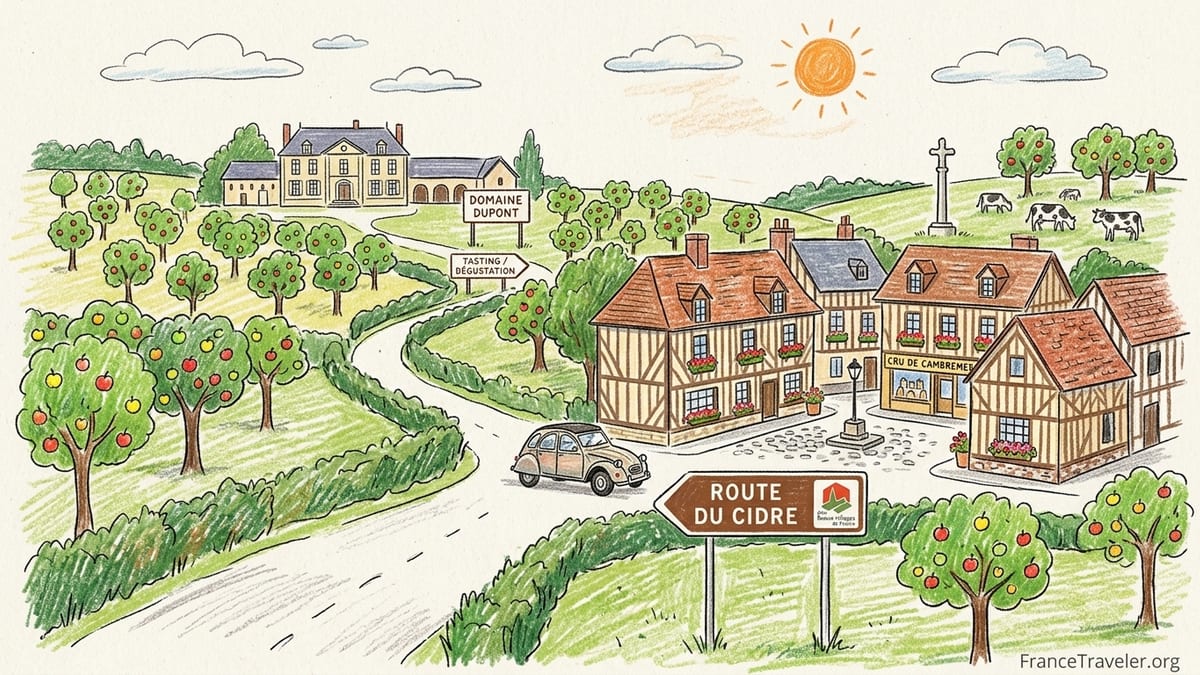
I began the loop in Beuvron-en-Auge, coming in on the D675 from the coast near Cabourg and picking up the first brown "Route du Cidre" sign as the countryside started to fold into hedgerows and apple trees. Beuvron-en-Auge is officially listed among the "Plus Beaux Villages de France," and it looks exactly like the postcards imply: half-timbered houses painted in soft creams and browns, geraniums in window boxes, and a small central square that works as a natural starting point for the cider route. I parked just off the square and walked across the cobbles before getting behind the wheel again, to avoid any temptation to start tasting on an empty stomach.
Before leaving the village, I stopped into a cooperative-style shop on the square where several Route du Cidre producers sell their bottles under the Cru de Cambremer signage. Inside, shelves were lined with Pays d’Auge AOP cider, Pommeau de Normandie and Calvados from the surrounding farms. It was tempting to start sampling immediately, but I limited myself to asking questions, taking photos of labels and buying two bottles of cider to drink later with dinner rather than opening anything there. Prices in autumn 2026 were generally between 4 and 8 euros for a standard 75 cl bottle of traditional cider and from about 16 euros upwards for a small-batch Calvados, which gave me a useful baseline for the rest of the day.
From Beuvron-en-Auge, the Route du Cidre signs led me out of the village on a small departmental road toward Victot-Pontfol. Traffic was light, mostly local tractors and a few campervans, and it quickly became clear why almost everyone tackles this loop by car. The distance on paper is modest, but the roads are narrow, sightlines can be short behind hedges and bends, and many producers sit another kilometer or two off the main loop along gravel lanes. It is absolutely possible to cycle or walk sections, but realistically, to cover several producers in one day with time for proper visits, a car or driver is essential.
Victot-Pontfol and a Structured Tasting at Domaine Dupont
My first real tasting stop was Domaine Dupont, one of the best-known estates on the Route du Cidre. The estate sits on the D16 at Victot-Pontfol, between Beuvron-en-Auge and Cambremer, clearly signposted from the main loop. A small lane led past orchards into a courtyard with dedicated visitor parking and a reception area that doubles as a shop. I had checked their visiting hours online that morning and arrived in late morning to join a scheduled tour.
The visit began in the orchards, with an explanation of the bitter, bittersweet, sweet and sharp apple varieties that go into Pays d’Auge cider and Calvados. We then moved to the press, the fermentation tanks and finally the ageing cellars, where rows of old barrels carried the familiar vanillin and baked-apple scent that seems to cling to this part of Normandy. The formal tasting at the end included one cider, one Pommeau de Normandie and one Calvados, which is the standard trio the estate currently advertises. Pour sizes were moderate, closer to a restaurant wine pour than to a festival splash, but even three drinks sampled in quick succession can add up when you are driving.
To be safe, I adopted a simple rule that held for the rest of the day: taste everything, finish almost nothing. At Domaine Dupont I took two or three small sips of each sample to understand the style, then tipped the rest into the provided spittoon. It felt a bit wasteful at first, especially with complex, long-aged Calvados in the glass, but it kept me alert behind the wheel. I bought a bottle of their Pays d’Auge cider at around 7 euros and a smaller bottle of Pommeau to take home, and left the Calvados for another trip when I would not be the driver.
Into the Heart of the Route: Grandouet and Cambremer
From Victot-Pontfol, the Route du Cidre bends through classic bocage scenery: small pastures edged with hedges, cows under apple trees, tall roadside crosses and a steady sequence of brown signs pointing toward individual producers. I followed the indications toward Grandouet, where the Manoir de Grandouet estate has become a familiar name on Route du Cidre maps. The drive there took me along single-lane roads where pulling slightly into the grass verge to let a tractor pass felt normal, so unhurried driving and keeping an eye on the mirrors were both essential.
At Manoir de Grandouet the setting was quietly beautiful, with timber-framed buildings and a small chapel tucked among the orchards. Tastings here were more informal: a counter in a converted farm building, a blackboard listing products and a staff member offering small pours of still and sparkling cider, Poiré (pear cider), Pommeau and Calvados. Again I stuck to small sips and made friends with the spittoon. Because I was driving, I focused on comparing two different ciders, one labeled as "brut" and one as a more traditional demi-sec, rather than moving up through the spirits. Bottles were in a similar price range to Domaine Dupont, with most ciders between 5 and 8 euros and Pommeau and Calvados higher.
By early afternoon I rolled into Cambremer, the practical heart of the Route du Cidre. The little town has a church, a few restaurants, a bakery and signs promoting the "Site Remarquable du Goût" label that recognizes the local gastronomic heritage. I parked near the square and made for lunch at a village restaurant that offered a short menu of regional dishes: andouille de Vire, tripe cooked in cider and, more appealing in the midday sun, a galette complete with ham, cheese and egg, plus a green salad. Here I finally allowed myself a full glass of cider with the meal, on the basis that I would linger over coffee and walk a little afterwards. A bolée of local brut cider ran to about 3 to 4 euros, cheaper than in many coastal tourist towns, and paired effortlessly with buckwheat and melted cheese.
Afternoon Detours: Bonnebosq, Beaufour-Druval and Side Roads
After lunch in Cambremer, I followed the brown signs toward Bonnebosq. The road climbed gently, giving occasional long views over checkerboard fields. Bonnebosq itself is not large, but its main street has enough services for a brief pause: a small supermarket, a bar, and bakeries that make convenient snack and bathroom stops between tastings. I did not visit a producer directly in the village that day, but several estates lie just outside Bonnebosq along signed lanes, and with more time or a hired driver, this would be an excellent area to slow down and explore in depth.
From Bonnebosq, the loop heads toward Beaufour-Druval, one of the route’s quieter corners. Here the scenery shifts slightly, with more wooded hills, deeper sunken lanes and occasional glimpses of larger manor houses behind gates. The brown "Route du Cidre" signs continue consistently and are easy to follow if you pay attention, but it is helpful to have an offline map on a phone or a paper brochure map in the car, especially if you decide to improvise short detours. I diverted at one point along a side road signed for a smaller producer, only to find that visits were by appointment outside harvest season, a reminder that not every farm shop keeps regular tourist hours.
On the way between Bonnebosq and Beaufour-Druval, I stopped briefly at the edge of an orchard where the public road cuts straight between rows of high-stem apple trees. There was no tasting here, just a chance to smell the slightly fermented scent of windfallen fruit under the branches and to appreciate how dominant apples are in this landscape. For travelers who do not drink, or for families with children, this part of the route is still worthwhile purely for the scenery, and several picnic spots can be found in laybys or at small viewpoints without needing to enter a producer’s property.
How Much You Can Honestly Taste While Driving
By mid-afternoon, after structured tastings at two estates and one full glass of cider over lunch, the limitations of self-driving on the Route du Cidre were clear. At each producer, the natural welcome involves offering tastes of multiple products: at minimum a cider, often a Poiré, perhaps a still cider or special cuvée, then a Pommeau and finally one or more Calvados. Even with very modest pours, a full sequence can add up to what would easily qualify as more than a single drink. French drink-driving limits are stricter than in some countries and penalties can be severe, so it is essential not to treat this like a bar crawl.
In practice, on my day around the loop I visited three producers for tastings and kept my intake to the equivalent of roughly one full drink over many hours, by spitting most samples and drinking plenty of water. It required discipline and a willingness to step slightly outside the usual social script and ask for small pours or leave glasses unfinished, but every producer accepted this without comment. Many are used to hosting tour groups where a guide or designated driver is expected to taste less, and some even explicitly provide spittoons and encourage responsible sampling.
Travelers comfortable with spitting and self-limiting can absolutely enjoy the Route du Cidre by car in this way. However, if you prefer to swallow everything poured, explore older Calvados in depth or add cheese and cream-heavy meals into the mix, booking a driver or guided tour becomes more attractive. Even the cumulative effects of sunshine, heavy food and the concentration needed for narrow rural driving can be tiring by late afternoon, before alcohol is factored in.
Would I Book a Driver Next Time?
Driving myself gave me maximum flexibility. I could linger at a producer that felt particularly welcoming, double back along a scenic stretch of road, or skip places that were busy with a tour bus. I could also start early from the coast, return at my own pace and stop for sunset at a viewpoint without watching the clock. For independent travelers, there is a real pleasure in feeling that you are navigating the loop by its brown signs and small hamlets rather than being shepherded from one stop to the next.
Yet, at several points during the day, I realized how much I was holding back. At Domaine Dupont, when the discussion turned to aged Calvados, I would have liked to compare several vintages side by side, something that is difficult to justify if you are behind the wheel. At Manoir de Grandouet, I skipped a few additional cuvées of still cider and Poiré that were open, because even small sips start to accumulate. I also found myself drinking slowly at lunch and choosing just one glass of cider instead of being able to try a brut and a sweeter style with dessert.
On a future trip, especially traveling with one or two other cider enthusiasts, I would seriously consider either hiring a private driver for the day from Caen or the coast, or booking a small-group tour that follows at least part of the Route du Cidre. While this adds a significant cost, it would change the nature of the day from careful sampling to more immersive tasting, and would remove the low-level stress of constantly calculating intake. Another good compromise would be to base in or near Cambremer or Beuvron-en-Auge without a car for a night, and arrange a local taxi for a few hours of producer-hopping, returning on foot to the village for the evening.
Practical Tips for Planning Your Own Pays d’Auge Cider Day
Spending a day on the Route du Cidre is not difficult to organize, but a bit of planning makes the difference between a relaxed outing and an overly ambitious schedule. Many producers publish their opening hours, tour times and any tasting fees online. Some are open year-round, others reduce hours outside the harvest season, and a few are only reliably open in high season or during specific festivals. It is wise to choose two or three key estates you definitely want to visit and check their hours in advance rather than relying purely on spontaneity.
A practical starting point is to collect a current brochure map of the Route du Cidre from a local tourist office in Caen, Bayeux, Deauville or on arrival in Beuvron-en-Auge or Cambremer. The map highlights the main loop, marks around twenty cider and Calvados producers and indicates viewpoints and small attractions such as gardens or churches. Having this physical reference in the car is reassuring when mobile reception drops or when you decide to step briefly off the official circuit to reach a producer on a side road.
In terms of timing, my loop from Beuvron-en-Auge back to Beuvron via Victot-Pontfol, Grandouet, Cambremer, Bonnebosq and Beaufour-Druval took a full day, roughly from 10:00 in the morning until after 18:00, including a sit-down lunch and three producer visits. That felt like a comfortable pace without rushing any stop, but it meant accepting that I would not visit every estate on the map. Trying to cover more than three or four producers in one day by car, while tasting responsibly and allowing time for orchard walks or cellar tours, would have left little room for simply enjoying the countryside.
The Takeaway
My day on Normandy’s Route du Cidre was less about ticking off every producer on the map and more about settling into the rhythm of the Pays d’Auge. The 40 kilometer loop linked postcard-perfect Beuvron-en-Auge, orchard-wrapped Victot-Pontfol, gracious estates near Grandouet, the practical charm of Cambremer, and the quieter stretches around Bonnebosq and Beaufour-Druval into a single, coherent story of apples and the people who work with them. Along the way I tasted carefully, spat often, and still drove some of the most beautiful little roads I have found in rural France.
If you are happy to sip lightly, spit much of what is poured and focus on the scenery as much as the drinks, self-driving is a satisfying and flexible way to experience the Route du Cidre. You will meet producers on their own ground, see the trees that give their names to labels, and carry home a couple of bottles that will taste better for the memory of the roads that led you there. If, on the other hand, you want to go deep into Calvados, compare multiple vintages, or simply relax into a long lunch without thinking about your blood alcohol level, seriously consider budgeting for a driver or organized tour.
Either way, give the loop the full day it deserves. Start after breakfast, aim for a late-afternoon finish, pause often, and let the Route du Cidre unfold slowly among the cows and apple trees. The distances are short, but the pleasures, from the smell of a freshly pressed must to the sight of evening light on half-timbered façades in Beuvron-en-Auge, reward anyone who takes their time.
FAQ
Q1. How long does it take to drive the full Route du Cidre loop?
Allow a full day for the 40 kilometer circuit if you plan to visit two or three producers, have a sit-down lunch and stop for photos along the way.
Q2. Do I need a car to explore the Pays d’Auge cider route?
A car or hired driver is the most practical option, as producers are spread out along narrow rural roads and distances between them are longer than they appear on the map.
Q3. Is it possible to taste cider and still drive safely on the route?
Yes, if you keep tastings very small, use the spittoons that producers provide, drink plenty of water and strictly limit how much you actually swallow.
Q4. Which villages are must-stops on a first visit?
Beuvron-en-Auge for its historic timber-framed center and Cambremer for lunch and services are the two most useful bases for a first day on the route.
Q5. How many cider producers should I plan to visit in one day?
Visiting two or three estates with time for orchard walks, cellar tours and unhurried tastings is realistic; more than that can feel rushed and tiring.
Q6. Are tastings on the Route du Cidre usually free?
Many cider farms offer complimentary or low-cost tastings, often expecting that visitors will buy at least one bottle; some charge small fees for guided tours.
Q7. When is the best season to drive the Normandy cider route?
Late spring brings blossom in the orchards, while September and October often combine harvest activity with mild weather and good light for photos.
Q8. Can I visit the route without speaking French?
Basic French is helpful, but many producers in this popular area can offer simple explanations in English, and tastings are easy to follow with labels and maps.
Q9. Is it better to self-drive or book an organized cider tour?
Self-driving offers flexibility, but a driver or small-group tour makes sense if you want to taste more freely, compare several Calvados and avoid alcohol limits.
Q10. Where should I stay if I want to spend more than one day on the Route du Cidre?
Staying in or near Beuvron-en-Auge, Cambremer or on a nearby farm guesthouse keeps you close to the loop and allows for relaxed evenings without extra driving.