


I thought I was prepared for Mont-Saint-Michel. I had read about the tides, checked the abbey opening times, and booked my ticket in advance. Yet walking away at sunset, calves burning and camera full, I kept thinking of all the small things I wished I had known before that first glimpse of the rock rising from the bay. This is the honest account of that visit: exactly how I arrived, how the tickets worked, what the abbey climb really felt like, and what I would change next time.
Arriving at Mont-Saint-Michel: First Glimpse From the Mainland
I arrived by car in late spring, coming from Saint-Malo along the D976. Even before the official parking signs, the outline of Mont-Saint-Michel appeared on the horizon, a grey-and-gold silhouette floating in the mist above flat farmland. I had seen photos all my life, but the first real-world sight still felt unreal, like the island was hovering above the fields. It was also the moment I realized that my visit would be shaped as much by logistics and timing as by beauty.
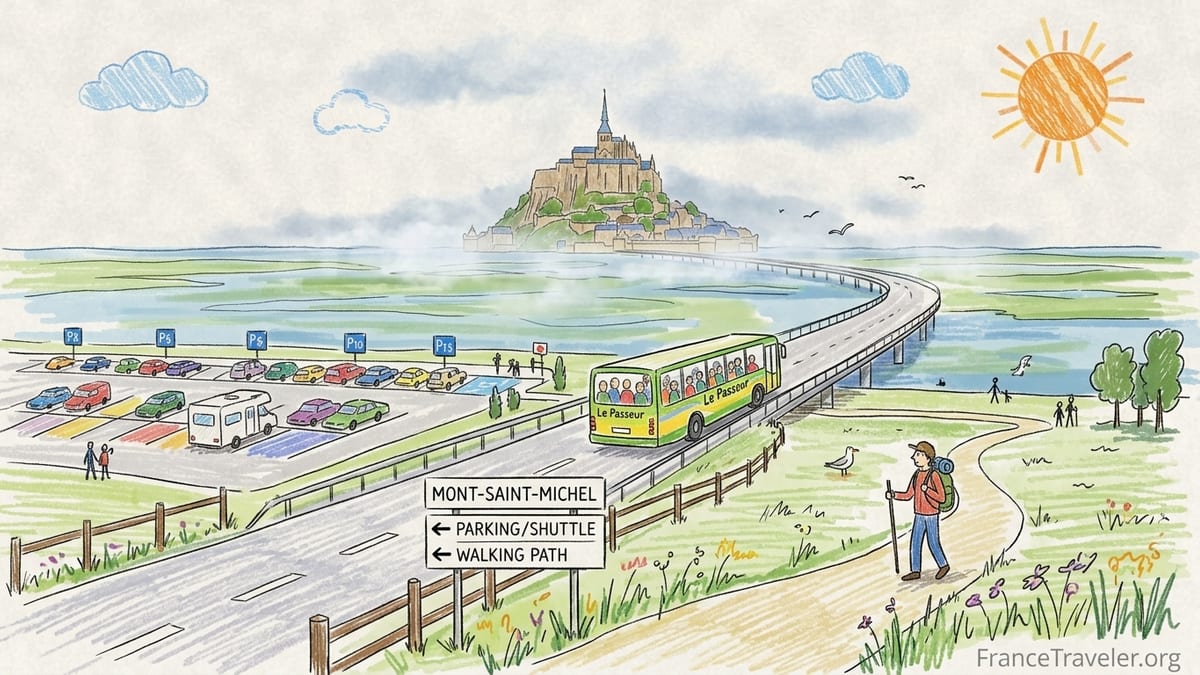
All official visitor parking sits on the mainland, about 2.5 kilometers from the mount itself, in a series of numbered lots from P2 to P13 laid out behind the dam and the visitor village. There is no driving up to the base of the rock. I followed the signs to the general car parks, which are well marked in French and English, and parked facing a long, straight view toward the abbey spire. The fact that the parking is outside the bay is not just for conservation: it completely changes the feeling of the approach, stretching out the anticipation as you get closer.
I paid for parking at the entrance barrier and kept the ticket carefully in my wallet, since you need it again to exit. Prices change by season and time of day, and there are different categories for cars, motorhomes and coaches, so it is important to check the current official tariff before you go rather than relying on old guidebooks. The key detail is that the parking fee includes access to the shuttle and the mainland visitor facilities, such as toilets and information desks.
From the car, I could already see the modern bridge leading out across the tidal flats. The temptation was to rush straight to the shuttle, but I took a few minutes to use the facilities at the information center and refill my water bottle. That turned out to be one of the better decisions of the day, because once you are inside the medieval streets, toilets are more scattered and often belong to cafés and restaurants.
Parking, Shuttles and the Walk: Choosing Your Approach
The central choice every visitor makes, knowingly or not, is how to cover the 2.5 kilometers between the parking area and the island: shuttle, on foot, or a mix of both. Officially, a free shuttle called Le Passeur runs year-round between the parking zone and a drop-off point about 350 to 400 meters from the main gate of the village. It usually runs every 5 to 15 minutes depending on the season and crowds and takes around 10 to 12 minutes for the transfer.
I decided to walk out and take the shuttle back. From the parking zone, the walk follows a broad, level causeway and the new bridge over the Couesnon river. It took me just under 30 minutes at a relaxed pace, with several stops to take photos as the mount grew larger and the bay opened around me. The surface is flat and accessible, and there are benches at intervals. On a dry, mild day it is one of the most atmospheric ways to arrive, and I would strongly recommend it to anyone with basic walking fitness and decent shoes.
The shuttle, which I used on the way back, is efficient but feels functional. It has doors at both ends so it shuttles back and forth without turning around, and audio-visual announcements in French and English. In the early evening there were no lines, but earlier in the afternoon I had seen queues form at the boarding points when several tour buses arrived together. If I had taken the shuttle in the morning, I might have arrived slightly fresher at the village, but I would have missed the slow, almost pilgrimage-like approach on foot.
If you are arriving by train, the pattern is similar. Regional trains run to Pontorson or Dol-de-Bretagne and are coordinated with buses that connect to the same mainland parking and shuttle area. Whether you arrive by car or public transport, the last stretch is shared: you must reach the mount either by walking the bridge or using Le Passeur, and both options feed visitors toward the same main gate.
Timing, Crowds and First Steps Through the Village
I reached the base of the mount at around 10:15 in the morning, and even on a shoulder-season weekday it was already busy. School groups, day-trip buses from Paris and Rennes, and organized tours from cruise ships all tend to arrive between 10:00 and midday. The result is a tide of people that almost rivals the sea. If I could redo my day, I would aim to arrive at the gate at 9:00 sharp, ideally even earlier, especially in high season.
Entering through the Porte du Roy, you step directly into the Grand Rue, the narrow main street that winds up toward the abbey. This lower section is lined with souvenir shops, crêperies and hotels. It is undeniably touristy, with magnets, toy swords, and postcards spilling onto the street. At 10:30 it was already a slow shuffle, and the first mistake I made was lingering too long in the lower village instead of climbing straight toward the abbey while it was still relatively calm.
After about ten minutes of browsing and dodging umbrellas, I ducked off the main street and onto one of the stone staircases that rise along the inner ramparts. Instantly the feel changed. The walls dampened the noise, the air cooled, and for the first time I felt the medieval fortress more than the modern commerce. Whenever I could, I chose stairways and side alleys over the central lane, and that is one of my strongest recommendations for a first visit: move up quickly at the start of the day, using the side stairs, and save the shop-lined Grand Rue for the way down when the abbey closes and crowds thin.
By 11:00 the lower village felt crowded enough that you had to pause frequently to let organized groups pass. I could see how, in July or August, this would feel overwhelming in the middle of the day. If you absolutely must visit in high season, consider staying overnight either on the mount itself or in nearby Beauvoir or Pontorson, and plan your abbey time for early morning or late afternoon rather than the central hours.
The Climb to the Abbey: Stairs, Slopes and Real Effort
Many descriptions of Mont-Saint-Michel gloss over the physical effort required to reach the abbey entrance. From the main gate to the abbey ticket office, you gain around 80 to 90 meters of elevation through a mix of sloping lanes and stone staircases. There are no lifts or escalators. If you have limited mobility or serious knee issues, this climb is the single most important factor to consider.
I am reasonably fit and used to city walking. Even so, with a backpack and camera, I was breathing harder than expected by the time I reached the terrace in front of the abbey. From the Porte du Roy, I took the Grand Rue for roughly half its length, then turned left up a series of stairs signed toward the abbey entrance. This staircase section is steep and uneven, and because many visitors stop to catch their breath or take photos, it can create bottlenecks. Wearing running shoes rather than city loafers made a noticeable difference to my confidence on the steps.
Total time from the main gate to the abbey ticket line, including a few pauses for photos, was about 25 minutes. Without stops, you could probably manage it in 15, but adding a buffer is wise, especially if you have a timed ticket. It is also worth noting that the climb does not end at the ticket counter. Once inside the abbey complex, the visiting route still involves multiple staircases, some internal and relatively narrow, as well as terraces and cloister walks.
Mobile signal inside the village was patchy in places. I had downloaded my ticket and a map in advance, which reduced the stress of trying to retrieve booking emails on the climb. If you rely on e-tickets, take screenshots before you leave the mainland parking area or hotel.
Tickets, Prices and Entry: What Actually Happens at the Door
One of the most confusing aspects before my trip was understanding what was free and what required a ticket. The rule is simple but crucial: the village of Mont-Saint-Michel is free to enter at all times, while the abbey at the top is a paid monument with set opening hours and security checks.
From October 1, 2026 to March 31, 2027, an individual adult ticket to the abbey costs 13 euros. During the high season in 2026, admission was 16 euros for an adult. These are official prices set by the body that manages national monuments in France. There are reduced and free categories for certain age groups and EU residents under specific conditions, and those details are best checked directly with official sources before your visit because they are subject to change, but the key point is that the abbey ticket is separate from any cost of getting to Mont-Saint-Michel itself.
When I visited, I bought my ticket online the night before, choosing a mid-morning entry slot. At the top of the mount, a clearly marked line separates visitors who already hold tickets from those who need to purchase them on site. There was a short security screening, similar to a basic bag check, then a scanner where staff validated my QR code and handed me a small paper leaflet with a floor plan and short descriptions in several languages.
Even with an advance ticket, there was a modest wait of around ten minutes at 11:30. The on-site purchase line was longer, perhaps 25 to 30 minutes. On particularly busy days, the difference can be greater. If I had known how variable the crowds were even outside summer, I would have booked an earlier slot to enter right after opening, which from May through August is at 9:00, and from September through April is at 9:30. Planning around those specific times, and not just “morning or afternoon,” makes a tangible difference to how squeezed you feel inside.
Once my ticket was scanned, the crowds immediately thinned. A large percentage of visitors never climb all the way to the abbey, preferring to shop and eat in the village. That makes the ticket checkpoint a kind of filter. Despite the thousands of people on the mount overall, the abbey interior felt surprisingly peaceful in places, especially in the cloister and the outer terraces.
Inside the Abbey: Route, Views and How Long to Spend
I spent just under two hours inside the abbey, moving at a medium pace and stopping often to absorb the details. The standard visitor route is one-way and clearly signposted, leading through the church, cloister, refectory, various crypts and chapels, and out onto terraces with sweeping views across the bay. There are stairs between most major sections, some broad, some spiraling and narrow, and relatively few places to sit apart from low stone ledges.
The first highlight for me was stepping into the abbey church itself, with its mix of Romanesque and Gothic elements and pale stone that glows softly in indirect daylight. A side chapel had votive candles burning, and the relative quiet after the bustle of the village gave it a contemplative atmosphere even with tour groups passing through. I had downloaded the free official app, which includes an audio guide, but in practice I used it only intermittently because I preferred to wander and read the small panels in each room.
The cloister, with its double row of slender columns framing a central garden, is on the highest terrace and feels suspended between sky and sea. From here and from the western terrace, you get the classic panoramic views over the bay, with sandbanks and shifting channels extending to the horizon. On my visit the tide was out, and I could see small guided groups crossing the bay barefoot far below, tiny dark dots against the pale sand. Knowing that the same area can fill with water at high tide, and that safe crossings require certified guides, added a sense of drama to the calm vista.
By the time I exited the abbey gift shop, which is near the end of the circuit, the time was around 13:30. I did not feel rushed, but I also did not linger in every room or read every inscription. If you are particularly interested in medieval architecture or religious history, allow at least two and a half hours inside. If you are traveling with impatient children, the one-way route and repeated staircases mean you should factor in breaks and perhaps shorten your expectations to about 90 minutes.
Guided Visit, Audio Tablet and Whether They Are Worth It
Before visiting, I debated whether to join a guided tour of the abbey, rent a multimedia tablet, or simply use the free leaflet and panels. In the end, I opted for the simplest option: self-guided with the printed plan and occasional use of the free app. After experiencing the monument, I have a clearer view of what I would recommend to others.
Inside the abbey, staff offer rented tablets that provide commentary and reconstructions in multiple languages for an additional fee on top of the basic ticket. There are also scheduled guided visits in French, and at certain times in other languages, led by official guides. These timetables and prices can change, so they should be checked directly before your trip. On the day I visited, I saw several small groups with tablets, standing off to the side as videos showed how the rooms were used by monks in different centuries.
For a first visit, if you are curious but not specialized, the tablet adds context but is not essential. The abbey spaces speak strongly for themselves through architecture and light. The basic leaflet gives enough orientation to understand the sequence of monastic life, from refectory to scriptorium to cloister. I occasionally felt that stopping to watch a full tablet segment would have disrupted the flow of moving through the building. However, for travelers who appreciate structured storytelling or who visit on a rainy day when lingering indoors is more appealing, the extra layer of interpretation could be worthwhile.
If I return, I would seriously consider joining one of the official guided tours in a small group. Hearing a live guide connect the abbey’s stones to particular episodes, sieges and restoration choices, and being able to ask questions, seems like a richer upgrade than a screen. My compromise recommendation is this: first-time visitors who prefer flexibility can skip paid add-ons and still have a deeply satisfying experience. History enthusiasts, or those visiting in the quieter months when there is more space to stand and listen, might want to budget the additional cost and time for a guide.
Exiting the Abbey, Exploring the Ramparts and Lunch Choices
After leaving the abbey, I followed signs toward the ramparts rather than dropping straight back onto the Grand Rue. A narrow path and low stone wall lead along the outer edge of the village, with repeated glimpses over the bay and back up at the abbey’s flying buttresses. This was one of the most enjoyable parts of the visit, and it was significantly less crowded than the main street below. I took my time, finding small viewpoints where only two or three other people stood quietly, listening to the wind.
By around 14:00, hunger pushed me back toward the main street for lunch. This was where I felt least prepared. Many restaurants were full or had waiting lists, and the menus leaned heavily on tourist standards at prices that reflected the location. I ended up with a simple omelette and salad at a mid-range brasserie. It was adequate but unremarkable, and the bill reminded me that location counts more than culinary ambition here.
If I could redesign this part of the day, I would either bring a picnic from the mainland or eat a more substantial meal before entering the mount, then treat myself only to a coffee or crêpe inside. There are picnic spots on the mainland side of the bridge with views of the mount, and in good weather that would have been a more relaxed and less expensive option. Inside the village, the tight medieval fabric and constant foot traffic make long, leisurely lunches feel less appealing than they might in a broader seaside town.
After lunch, I wandered the lower alleys, stepped into a small church, and browsed a few quieter shops, now that my main goal of seeing the abbey was complete. The pressure of “making it to the top” was gone, and I could appreciate corners I had rushed past earlier. Still, the crowds remained dense in mid-afternoon, especially when several tour groups converged outside the same shopfronts or viewpoints.
What I Would Do Differently Next Time
Looking back on the day, several practical changes stand out that would have made the visit smoother and more enjoyable. The first is timing. I would aim to reach the mainland parking at least 45 minutes before the abbey’s opening time. From May through August, that would mean arriving around 8:15 to be at the abbey doors close to 9:00. From September through April, arriving around 8:45 would be enough to walk in for the 9:30 opening. That buffer allows time to park, use facilities, walk or shuttle over, and climb without rushing.
The second change would be to reverse the order of village browsing and abbey visit. On my first trip, I let myself get pulled into shop windows and side streets immediately after entering the gate, which diluted my energy for the climb and pushed my abbey entry closer to peak time. Next time I would walk quickly through the lower village, ignoring temptations, and head straight for the ticket line. Only after exiting the abbey would I stroll back down at a gentler pace, using the ramparts and side alleys first and the main street as a final pass.
Third, I would pack as if for a modest day hike rather than a city museum visit. That means proper walking shoes, a refillable water bottle, a light rain jacket, and perhaps a small snack to eat while waiting in line or sitting on a rampart bench. I saw several visitors in dress shoes struggling on wet stone stairs, and others queuing for water in crowded cafés simply because they had not brought any from the mainland.
Finally, I would seriously consider staying one night nearby rather than doing Mont-Saint-Michel entirely as a day trip. The reports from travelers who have seen the village after sunset, once the day-tour buses leave and the cobbles shine under lantern light, are compelling. An overnight stay also allows you to choose your abbey slot based on the day’s weather and tides rather than fitting everything into a midday window.
The Takeaway
Mont-Saint-Michel is one of those rare places where the reality lives up to the postcards, but it rewards preparation. Knowing that the village is free but the abbey requires a paid ticket helps structure your day, and understanding the opening hours, seasonal ticket prices and the physical challenge of the climb lets you set realistic expectations. My own visit taught me to respect the stairs, to treat the approach from the mainland as part of the experience rather than a transfer, and to protect my early hours for the quietest moments on the highest terraces.
If you plan around the abbey’s schedule, arrive early, and decide in advance how you will handle lunch, you can transform what might be a crowded, tiring excursion into a day that balances effort with genuine wonder. Whether you walk the bridge or ride the shuttle, rent a tablet or simply trace the worn steps under your feet, Mont-Saint-Michel will leave an imprint. The key is to make choices that allow you to notice it fully, instead of spending half your time in queues and the other half searching for somewhere to stand.
The abbey ticket, whether 13 euros in low season or 16 in summer, feels modest in comparison with the scale of what you encounter once inside. My strongest memory is not of any single room or viewpoint, but of standing alone for a moment in the cloister, hearing the wind and distant gulls, and feeling the centuries of footsteps behind mine. With a little planning, you can give yourself more of those quiet instants, even in a place that welcomes millions.
If I could extend one simple piece of advice to any future visitor, it would be this: treat Mont-Saint-Michel as a living site instead of a quick photo stop. Take your time crossing the bridge, leave space in your schedule, and remember that the most rewarding parts of the visit often begin after you have already ticked the “must see” boxes.
FAQ
Q1. Do I need a ticket to enter Mont-Saint-Michel village?
The village itself is free to enter at all times; you only need a paid ticket if you want to visit the abbey at the top.
Q2. How much does an abbey ticket cost and when is it cheaper?
From October 1, 2026 to March 31, 2027 an adult ticket is 13 euros; during the 2026 high season it was 16 euros, with separate reductions for eligible visitors.
Q3. What are the abbey opening hours throughout the year?
From May through August the abbey opens from 9:00 to 19:00. From September through April it opens from 9:30 to 18:00, with last entry before closing.
Q4. How long does it take to climb from the gate up to the abbey entrance?
Most visitors should allow around 20 to 30 minutes from the main gate to the abbey ticket office, including a few short pauses on the stairs.
Q5. Is the free shuttle Le Passeur worth using, or should I walk?
The shuttle is fast and convenient, especially in bad weather or if you are tired. Walking the 2.5 kilometers offers better views and a more gradual, atmospheric approach.
Q6. How much time should I plan inside the abbey itself?
A comfortable visit is about 1.5 to 2 hours inside the abbey. Enthusiasts of history and architecture might want up to 2.5 hours to explore in detail.
Q7. Are the abbey and village suitable for visitors with limited mobility?
The village has steep, uneven streets and the abbey involves many stairs with no lift, so access can be difficult for anyone with serious mobility issues.
Q8. Do I need to book abbey tickets in advance or can I buy them on site?
You can buy tickets on site, but advance booking is strongly recommended in busy periods to shorten queues and secure your preferred entry time.
Q9. Is there anywhere affordable to eat on Mont-Saint-Michel?
Most restaurants on the mount are relatively expensive for what they offer. Many visitors eat on the mainland or bring a simple picnic to manage costs.
Q10. Can I visit Mont-Saint-Michel as a day trip from Paris?
Yes, long day trips by organized bus or train and bus connections are possible, but staying overnight nearby allows a calmer experience outside peak visitor hours.