


Normandy is one of those regions that quietly gets under your skin. On my first trip I tried to "do it all" in five days and failed spectacularly, but I did come home with a short list of things I would happily repeat, even if I only had a long weekend. This is not a greatest-hits checklist compiled from brochures. It is what I actually did, what it cost, how long it took, how crowded it felt, what surprised me, and which experiences I would genuinely make time for again.
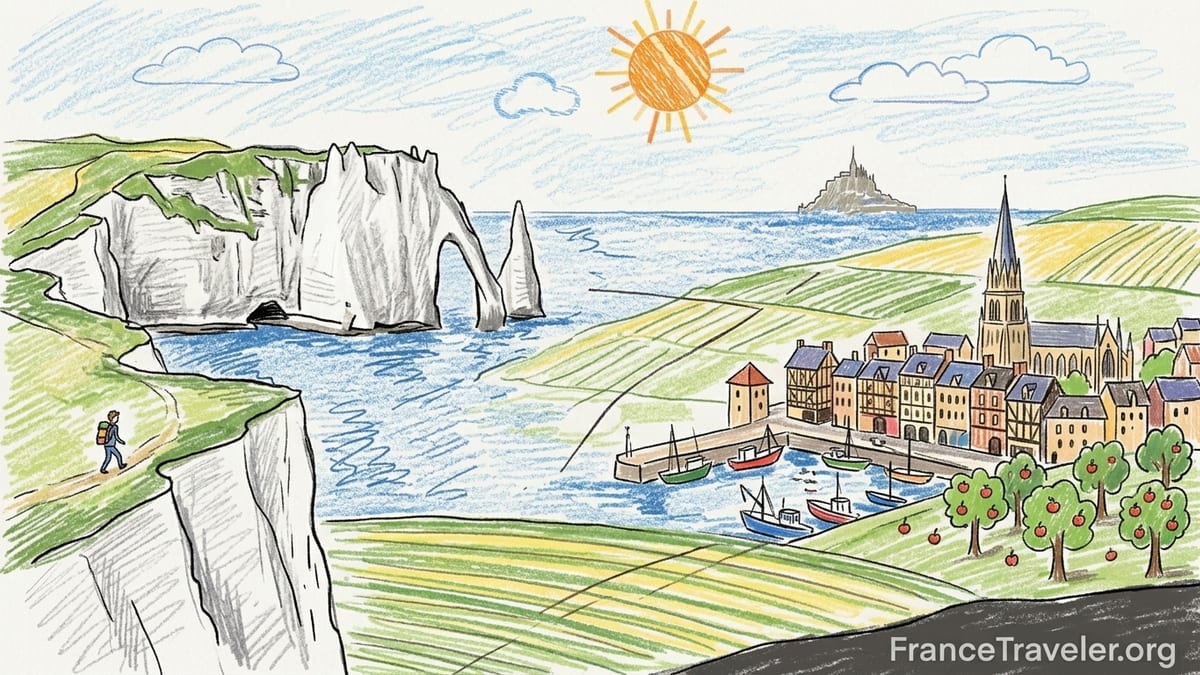
Walking the Cliffs at Étretat
I had seen Étretat’s white cliffs in Monet paintings long before I stood on them, but the reality is more visceral than any canvas. I arrived in town around 9:30 in the morning on a cool May weekday, parked in one of the paid lots on the edge of the village, and walked the last ten minutes down to the pebble beach. From there I started the classic loop up to the Falaise d’Amont to the east, then back down and up again toward the famous arch and needle on the Falaise d’Aval.
The walking itself is not complicated, more of a coastal ramble than a serious hike, but it still took me a solid three hours with plenty of photo stops. I spent about an hour on the eastern side, then almost two wandering the western paths and side tracks that give you slightly different angles on the arches. In total I walked roughly 7 to 8 kilometers according to my phone. I paid around 10 euros for a full-day parking ticket, then 6 euros for a coffee and pastry from a café near the beach, so the experience itself was essentially free beyond that.
By late morning the paths were busy with tour groups and day trippers, especially near the viewpoints closest to town. The surprise for me was how quickly the crowds fell away once I followed a less-trodden path inland for even five minutes. I also was not prepared for how slippery the chalky dust can be after a light mist, so I was glad I had real walking shoes rather than city sneakers. Another surprise was simply how exposed the edges are. There are warning signs, but large stretches have no barriers, and on a windy day I found myself instinctively stepping back from the cliff edge more than once.
Would I do it again? Absolutely, but I would aim for an earlier start and clearer weather. I would arrive closer to 8:00, walk first toward the western arches in the gentler morning light, and pack a simple picnic from a bakery in town instead of relying on the waterfront restaurants, which felt overpriced for the quality. If you only have one full day on the Alabaster Coast, I would still give Étretat several hours of it. The combination of sea, sky and stark white cliffs is one of those landscapes that justifies the hype in person.
Lingering Around Honfleur’s Vieux Bassin
Honfleur’s Vieux Bassin is the place every brochure puts on the cover for good reason. When I first arrived, just after lunch on a sunny June Tuesday, I was fully prepared to be underwhelmed by crowds and souvenir shops. Instead I ended up staying until blue hour, sitting on different benches around the harbor and watching working fishing boats slide past café terraces packed with people lingering over mussels and carafes of white wine.
My actual day in Honfleur was simple. I parked in one of the outer lots signposted toward the center, paid just under 15 euros for about six hours, and walked ten to fifteen minutes into town. I circled the Vieux Bassin multiple times, ducked into the wooden church of Sainte-Catherine for about twenty quiet minutes, then spent the rest of the afternoon doing very little that would qualify as sightseeing. I had a two-course fixed-price lunch for around 24 euros at a brasserie facing the masts, another 5 euros for an afternoon coffee on the opposite quay, and 7 euros on an ice cream near the carousel.
In terms of crowds, Honfleur felt busy but breathable. Around the Vieux Bassin itself it was shoulder-to-shoulder in spots from mid-afternoon, especially when a tour bus unloaded, but two or three streets back the mood changed completely. Half-timbered houses, small galleries and residential lanes were almost empty. I was surprised how easy it was to find quiet corners in such a famous stop, and also how much of the harbor life still felt authentic, with fishermen repairing nets on the far side while a busker played accordion near the restaurants.
Would I repeat it? Yes, though I would handle food differently. Next time I would book a table on the more modestly priced side streets instead of paying the harbor surcharge for a middling meal. I would also make time in the morning for the small Eugène Boudin Museum or a short walk out toward the modern Pont de Normandie for a different view of the estuary. But even if all you do is stroll, sit, and watch reflections shift on the water, an unhurried half day at the Vieux Bassin still feels worth a repeat.
Visiting D-Day Beaches and the American Cemetery
I was worried that the D-Day sites would feel like a checklist of museums, but the day I spent along the coast between Arromanches and Colleville-sur-Mer turned out to be one of the most affecting travel days I have had anywhere. I started at Arromanches-les-Bains around 9:00 for the new museum overlooking the remains of the Mulberry harbor, then drove on to Omaha Beach and the Normandy American Cemetery above it in the afternoon.
At Arromanches I spent roughly two hours. Entry to the museum cost just under 12 euros for an adult ticket at the time of my visit, with discounts for children and combinations with local attractions. I walked down to the beach for half an hour afterward to see the concrete caissons up close as the tide went out, then grabbed a quick sandwich and drink from a bakery for about 9 euros before driving west. At Omaha, I parked near the main access and walked down to the sand, spending about 45 minutes in near silence among a scattering of families and a few veterans’ groups.
The Normandy American Cemetery was both more crowded and more moving than I expected. Entry is free, but there is a security check at the visitor center, where I spent about an hour with the exhibits before walking among the rows of crosses and Stars of David. In total I spent roughly two and a half hours on the site. Even on a June weekday there were coach tours and school groups, yet the layout and sheer scale create a surprising sense of quiet. What surprised me most was the sound of the sea below the bluff; you can hear the waves throughout the cemetery, which makes the transition from museum to headstones to the overlook above the beach feel very immediate.
Would I repeat this day? Yes, though emotionally it is not something I would rush. Next time I would spread the D-Day sites over two days to avoid museum fatigue, perhaps pairing Arromanches with the Gold and Juno sectors one day and leaving Omaha, Pointe du Hoc and the cemetery for the next. I would also book accommodation in Bayeux as a base again. From there, having a car made visiting these scattered sites straightforward, and the ability to pause on a small country lane between stops was as valuable as the big-name museums. If you have even a passing interest in twentieth-century history, I would make time for at least one full day on this coast.
Touring Mont-Saint-Michel Abbey
Mont-Saint-Michel is the one place in Normandy I was initially prepared to skip, assuming it would be an overrun, commercialized icon. I am glad I ignored my own cynicism. I visited on a shoulder-season Wednesday in October, arriving at the mainland parking lots around 8:30 in the morning. From there I took the free shuttle bus across the causeway, walked the last stretch on foot, and climbed the narrow main street up to the abbey entrance in about twenty minutes.
I had reserved an abbey ticket online in advance to avoid the on-site queues. At the time of my visit, an adult ticket purchased through the official channel cost approximately 16 euros, with free entry for many visitors under 26 from the European Union and reductions for others. Once inside, I joined a free 45-minute guided tour offered by staff, which gave structure to the visit without any extra cost beyond the ticket itself. In total I spent about two hours inside the abbey complex, moving through the cloister, refectory and vast stone halls that stack one atop another above the rock.
Crowds were exactly what you would expect in one of France’s marquee sights, but the timing mattered a lot. Before 10:00 the village streets were busy but passable, with room to pause and look into small shops. By midday the main axis from gate to abbey was essentially a continuous slow-moving column. Inside the abbey, the tour group of around twenty people felt manageable, and there were pockets of real quiet in side chapels and the cloister. What surprised me most was how much of the abbey still feels like a functioning place of worship, not just a monument. A monk’s chant echoed faintly from a side room as our group moved through, and it changed the whole mood.
Would I go again? Yes, but I would change my strategy slightly. Next time I would plan a full day, arriving in the late afternoon to catch low tide and the changing light on the bay, staying overnight either on the mount or in a nearby village, and visiting the abbey first thing the following morning with one of the earliest time slots. I would also make sure to budget for the parking fee on the mainland, which came to just over 15 euros for the day during my visit, and for at least one sit-down meal either before or after the crush of peak hours. Despite the crowds and commercialization at the base, the abbey itself is one of those rare places where the icon lives up to its photographs.
Seeing Bayeux and Its Tapestry
Bayeux was my base for several nights precisely because it promised a mix of living town, soaring cathedral and one world-famous artwork. The morning I visited the Bayeux Tapestry museum, I walked from my small hotel near the ring road into the center in about ten minutes, crossing quiet streets lined with stone houses and bakeries already sold out of their best pastries. I arrived at the museum shortly after opening, collected my pre-booked ticket, and stepped into the dim, climate-controlled gallery.
When I visited in 2025, a standard adult ticket to see the tapestry in Bayeux cost a little under 12 euros, including an audio guide that walked along the length of the 70-meter embroidery at a steady pace. Once inside, the visit was carefully paced but relatively swift; I spent about 25 minutes moving along the glass case with the audioguide, then another 45 minutes in the upstairs exhibits that explain the historical context and restoration. In all, I was inside the museum for roughly an hour and a quarter. Afterward I walked five minutes to the cathedral and spent another 30 to 40 minutes exploring its nave and crypt, which was free to enter with a donation box near the door.
Crowding at the tapestry surprised me. Even with timed entry, there were moments when the line bunched up and I had to pause my audioguide while people ahead took extra time at specific scenes. It never felt chaotic, but it was not the hushed, near-empty gallery I had imagined. At the same time, seeing the original in Bayeux felt strangely intimate compared with later news reports I read about its blockbuster showing at the British Museum in London with very limited time slots and premium pricing. In Bayeux, the ticket felt fairly priced for what you get, and the staff allowed people to linger a little at the end of the gallery provided they did not block the flow entirely.
Would I repeat Bayeux itself? Without hesitation. Next time I would stay even closer to the old center, book a late-afternoon tapestry slot when tour groups have mostly left, and make more of the town’s smaller museums such as the Battle of Normandy museum on the outskirts. I would also happily return to the same crêperie where I paid around 15 euros for a savory galette, sweet crêpe and cider at lunch, eaten on a terrace under the cathedral towers. More than almost anywhere else in Normandy, Bayeux managed to feel like a real town that happens to hold extraordinary history rather than a place defined solely by a single monument.
Driving the Cider Route in the Pays d’Auge
The Route du Cidre in the Pays d’Auge looked almost too picturesque on paper, all half-timbered farms and apple orchards. In practice, spending a lazy day driving that 40-kilometer circuit between Cambremer, Beuvron-en-Auge and the surrounding hamlets turned out to be one of the simplest and most satisfying experiences of my trip. I set out from Bayeux in the late morning, reached Cambremer in just over an hour by car, picked up a paper map from the local tourist office, and followed the well-marked brown cider route signs from there.
Over the course of about six hours I visited three cider producers, stopped in Beuvron-en-Auge for a late lunch, and pulled over more times than I can count to photograph orchards and timber-framed farmhouses. Tastings at the cider farms were usually free with the expectation that you would buy at least a bottle or two. I bought a 75-centiliter bottle of brut cider for around 5 to 7 euros at each stop, along with a small bottle of Calvados at one estate for about 18 euros. My main expenses beyond purchases were fuel for the rental car and a simple countryside meal in Beuvron-en-Auge, where a plat du jour of roast chicken, fries and salad with a glass of cider cost just under 20 euros.
Crowds were almost nonexistent on the day I went, a Thursday in spring outside major holidays. I shared most tasting rooms with at most one other couple, and often the producer themselves poured and explained their cider in French or basic English. The surprise for me was how rural the route really feels. This is not a continuous strip of attractions but a loop of small roads that wind past grazing cows and hedgerows. Phone reception dropped to almost nothing in some valleys, so having a physical leaflet from the tourist office and pre-downloaded maps felt practical rather than quaint.
Would I drive the Cider Route again? Absolutely, though I might plan it earlier or later in the season depending on what I wanted to see. In spring I caught the end of blossom on some trees; in autumn you would see crates of apples stacked and presses working at full tilt, although recent reports about drought affecting apple harvests are worth checking if you are particularly interested in production. Next time I would also book a countryside bed-and-breakfast for the night instead of driving back to Bayeux, both to avoid getting behind the wheel after multiple tastings and to enjoy the deep rural quiet after day visitors have gone. If you have a car and even a mild interest in cider, the Pays d’Auge is an experience that feels as Norman as any famous cathedral.
Slow Days in Rouen’s Old Streets
Rouen was the surprise city of my Normandy trip. I expected a quick cathedral visit and perhaps a Joan of Arc site or two. Instead I ended up staying two nights and would happily give it the same time again. I arrived by train from Paris in about an hour and a half, walked fifteen minutes to my hotel near the old town, and spent most of my time simply weaving between half-timbered houses, the Gros-Horloge clock and the squares around the cathedral.
On my main sightseeing day I started early at Rouen Cathedral, arriving before 9:00 when the nave was nearly empty. Entry was free, though there was an optional fee to climb the tower or visit some small exhibits. I spent about 45 minutes inside, then another half hour walking the exterior to appreciate how the façade changes with the light, something Monet understood long before the rest of us. From there I wandered under the Gros-Horloge, visited the modern church and memorial on the site where Joan of Arc was executed, and had a long lunch for about 22 euros at a bistro under leaning timbered façades.
Crowds in Rouen felt busy but human-scale. School groups dipped in and out of the cathedral, and tour groups clustered under the clock at predictable hours, but step a block away and you could have a medieval side street almost to yourself. The biggest surprise for me was how lived-in the city felt. Chain stores and normal offices coexisted with tourist boutiques, and the evening I spent sitting on the terrace of a wine bar, watching locals commuting by bike and students gathering in the squares, did more to fix Rouen in my memory than any single monument.
Would I return? Without question, yes. Next time I would book my stay to include a night when the cathedral façade is lit by a sound-and-light show in summer, something I missed by a week, and I would make time for at least one of the city’s art museums, particularly the Musée des Beaux-Arts with its collection of Impressionist paintings. I would also build in an afternoon simply to sit with a coffee under the arches by the Gros-Horloge and watch the city drift past. If you are choosing one Norman city to balance the region’s small towns and coastal landscapes, Rouen remains my first choice.
The Takeaway
Normandy is often sold as a region of headline sights, from Mont-Saint-Michel to the D-Day beaches, but what stays with me after several trips are the textures between those icons. Walking Étretat’s cliffs, lingering at Honfleur’s Vieux Bassin, tracing the Bayeux Tapestry, tasting cider under low beams in the Pays d’Auge and watching evening settle on Rouen’s cathedral all felt less like ticking boxes and more like slipping briefly into a quieter rhythm of French life.
If I had to plan a repeat trip with limited time, I would anchor it around four days: a base in Bayeux for the tapestry and D-Day coast, a day looping through the Cider Route, a side trip to Mont-Saint-Michel with an overnight stay, and at least a night or two in Rouen either at the start or end. Étretat and Honfleur could fit into that framework if you have a car and are willing to accept some driving. More importantly, I would resist the urge to over-program every hour. Some of my clearest memories are not the precise moments inside famous monuments, but sitting on a harbor wall in Honfleur or a step in Bayeux as church bells echoed across stone streets.
Normandy rewards that slower approach. The region’s official highlights exist for good reason and are largely worth your time and ticket money, but they are at their best when you give them space around the edges. If you can travel in shoulder season, start your days early, and leave some room for unplanned detours down side streets or into orchards, you may find, as I did, that the experiences you most want to repeat are as much about atmosphere as they are about specific sights.
FAQ
Q1. How many days should I spend in Normandy for a first visit?
For a balanced first trip that includes D-Day sites, Bayeux, Mont-Saint-Michel, the Cider Route and at least one city like Rouen, I found five to seven days ideal.
Q2. Do I need a rental car to enjoy these experiences?
A car made my trip far easier, especially for the Cider Route and scattered D-Day beaches. Mont-Saint-Michel, Rouen, Bayeux and Étretat are reachable by train or bus, but combining them efficiently without a car takes more planning.
Q3. How much did I actually spend per day in Normandy?
On the days described here I typically spent between 80 and 150 euros per person, including accommodation in midrange hotels, simple restaurant meals, fuel or train tickets, and museum or abbey entries.
Q4. When is the best time of year to visit to avoid heavy crowds?
My best experiences were in May, early June and October, when most sites were open with long hours but crowds were thinner than in peak summer and accommodation easier to book.
Q5. Is Mont-Saint-Michel worth visiting with all the crowds and commercialization?
Despite the souvenir shops and busy main street, I found the abbey itself atmospheric and would return. Arriving early, staying overnight nearby and pre-booking a ticket helped a lot.
Q6. Can I visit the D-Day beaches and Bayeux in one day?
I based in Bayeux and comfortably combined Arromanches, Omaha Beach and the American Cemetery with an evening in town, but it made for a full, emotionally heavy day that I would now split across two.
Q7. Is the Cider Route safe if I plan to taste at several farms?
On my visit, pours at tasting rooms were small, and I limited myself to a few sips at each stop and bought bottles to drink later. If you expect to drink more, consider a designated driver or staying overnight on the route.
Q8. How physically demanding are Étretat’s cliffs and Mont-Saint-Michel?
The cliffs at Étretat involved several short but steep climbs on sometimes slippery paths, while Mont-Saint-Michel required many stone steps. I managed both with good walking shoes and regular breaks, but they would be challenging for anyone with serious mobility issues.
Q9. Do I need to book tickets in advance for major sights?
For the Bayeux Tapestry, Mont-Saint-Michel abbey and some D-Day museums, I was glad I booked timed tickets or checked schedules ahead, especially in late spring and early summer when time slots can sell out.
Q10. If I only have one base, which town would I choose?
From my own trips, Bayeux worked best as a single base, with easy road access to D-Day sites, the Cider Route and Honfleur, plus direct train links to Paris and Caen.