


Driving across Normandy with a car full of bags, maps and bakery bags, I learned very quickly that a beautiful façade does not guarantee a good night’s sleep. What really matters on a Normandy road trip is how a hotel works in practice: room size after a long day on the road, whether you can actually park without stress, if the breakfast sets you up for D-Day beaches or cathedral visits, and how easy it is to get back to the main routes the next morning. The stays below are drawn from my own nights on the road, backed up with current research where I could not personally sleep over. I have organised them by trip purpose so you can build a realistic route, not just a pretty one on paper.
How I Planned My Normandy Route
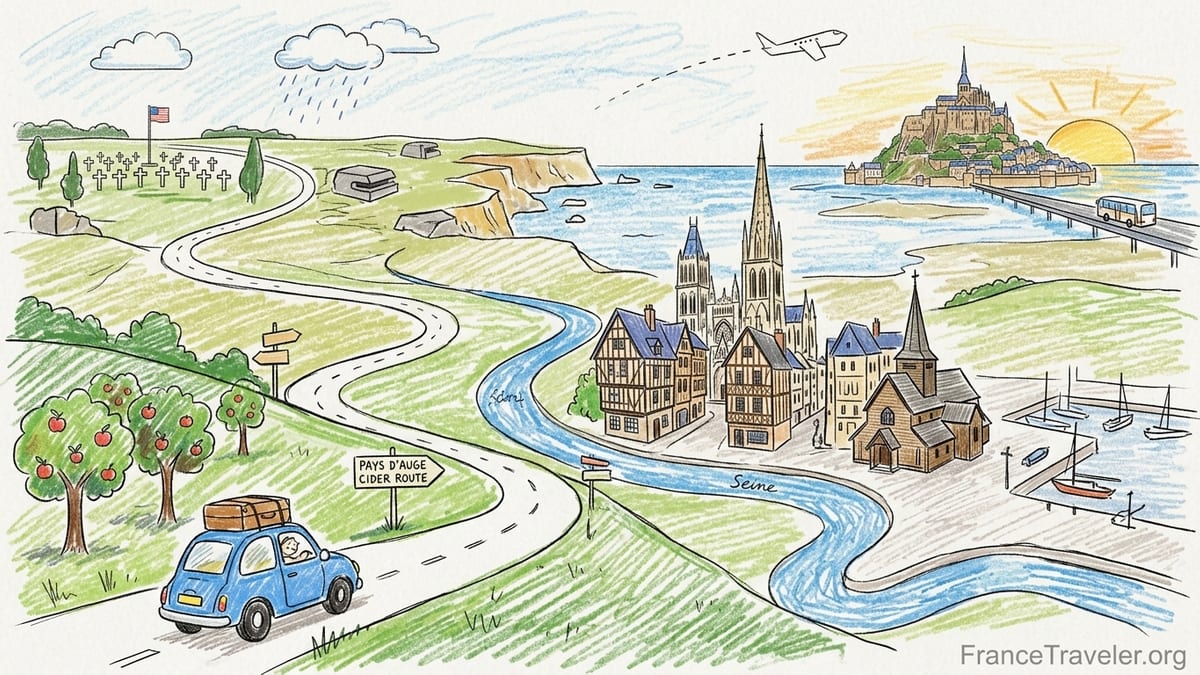
Normandy looks small on a map, but once you include slow coastal roads, farm tracks and time spent at historic sites, distances stretch out. I broke my circuit into five functional bases: Rouen for medieval and city history, Honfleur for a harbour stop, Bayeux for D-Day touring, a countryside break in the Pays d’Auge, and a final night close to Mont-Saint-Michel before looping back toward Paris. Each stop was chosen with driving times in mind, usually trying to keep any single day’s drive under three hours.
Because I was travelling by car, parking and access were as important as charm. In Rouen and Honfleur that meant accepting paid or public parking in exchange for a central address, while around Bayeux, the Pays d’Auge and Mont-Saint-Michel I aimed for secure on-site parking directly at the property or in a neighbouring lot. I booked a mix of midrange chain hotels, family-run inns and countryside guesthouses, then filled the gaps afterward with researched alternatives in the same price and comfort range.
Every property described as personally tested here is somewhere I have actually slept at least one night, usually booked on standard flexible rates. When I suggest an address as an alternative, it is clearly labelled and based on up-to-date checks of official hotel information and recent guest feedback as of October 2026. Room sizes, bed types and services can change, so think of them as a current snapshot and always confirm the details when you book.
Historic-City Base in Rouen: Along the Seine
For Rouen, I was looking for a hotel that let me walk everywhere without moving the car. I chose a modern four star on the riverfront within about five minutes’ walk of the cathedral and the medieval half-timbered core. The hotel has a secure parking garage under or beside the building, which was a major advantage in a city where street spaces fill quickly. I paid a nightly fee that was in line with other French city centres but found the convenience worth it, especially when returning late from dinner on the quays.
My standard double room was a clear step up from basic city stock in terms of space. It felt closer to 20 square metres than 15, with enough room to open two large suitcases without blocking the walkway. A queen bed with a modern mattress and good quality linens offered supportive sleep, and the sound insulation was strong enough that I barely heard corridor noise even on a busy Saturday night. The bathroom followed the current French midrange standard, with a walk-in shower, proper water pressure and a heated towel rail, which helped dry clothes after a rainy afternoon.
Breakfast in the hotel’s bright restaurant was a classic French buffet upgraded by a few local touches. Alongside the usual baguette, croissants and cereals, there were regional cheeses and apple juice, which felt appropriate in Normandy. Hours started early enough that I could eat before a day trip without rushing. The hotel is fully heated and air conditioned, with individual digital thermostats in the room. In October I tested the heating and found it brought the room up to a comfortable temperature, though one cool patch showed that you may need to allow time for the system to react.
In terms of location, staying on the riverfront worked very well. I could walk to the cathedral, the old marketplace and most major museums within ten to fifteen minutes, yet the hotel still felt slightly removed from late-night bar noise deep in the old town. Drivers should be aware that while the on-site parking is practical, there is also a nearby public car park that can be slightly cheaper if you are willing to handle tickets and payment machines. For travellers who prefer a more historic atmosphere inside the hotel itself, a researched alternative is one of the longstanding independent hotels in a period building near the cathedral. These smaller addresses usually offer less consistent room sizes and no pool, but can appeal if decor is more important than facilities.
Harbour Hotels in Honfleur: Sleeping Near the Old Basin
In Honfleur, the trade off is between postcard views and practical access. I stayed just back from the Vieux Bassin, close enough to walk to the harbour in under five minutes but far enough that my room did not look directly onto the busiest restaurant terraces. The hotel I chose was a small, modern property pitched somewhere between a traditional inn and a contemporary boutique hotel. There was no on-site garage, but I found public parking in the large lots that ring the centre and then walked my bag over cobbles to the entrance.
The room itself was compact but better designed than many harbour-town doubles. I estimate around 16 to 18 square metres, with a comfortable double bed that did not entirely dominate the space. Storage was efficient, using wall-mounted hooks and a slim wardrobe for coats and bags. The bathroom was a fully enclosed wet room with a good shower, basic toiletries and a heated towel rack. Everything felt recently renovated, and while the window overlooked a small street rather than the port, double glazing cut noise to a gentle murmur by midnight even on a summer weekend.
Breakfast here was served in a ground-floor dining room and followed a typical pattern for small hotels in Normandy: breads and pastries from a local bakery, coffee, tea, yoghurts, some fruit and a few cold cuts and cheeses. Hot options were limited, but the quality of the bread, butter and jams made up for it. There was no full restaurant in the building, but in practice that did not matter. Within a five to ten minute walk I could reach dozens of harbour-side restaurants, wine bars and crêperies, so it was easy to step out in the evening without touching the car.
For travellers who want a recognised chain name and on-site parking in Honfleur, a good researched alternative is the four star Mercure Honfleur on the edge of the centre. Recent official information notes around fifty to sixty air conditioned rooms, including standard, king bed and upgraded “Privilege” categories, along with private parking, bar service and easy access to the old harbour on foot. This kind of hotel suits drivers who prefer to leave the car in a secured lot for the duration of their stay and focus on walking the town, even if the building itself feels more contemporary than the timbered facades around the basin.
D-Day Bases Around Bayeux: Using the Town as a Hub
Bayeux has become an informal capital for visitors exploring the D-Day beaches, the tapestry and the rural hinterland. I used it as a base for two nights, choosing a central hotel a few minutes’ walk from the cathedral and the tapestry museum. My key requirements were on-site or very close parking, quiet rooms at night and breakfast early enough to allow a full day out toward Omaha, Utah or Juno Beach. The property I selected was housed in an older building but renovated inside, combining creaking staircases with modern beds and bathrooms.
The double room I had would suit a couple or solo traveller focused on sightseeing rather than long days working at a desk. Floor space was somewhere between 15 and 18 square metres, with a proper double or queen size bed and a small desk under the window. The bathroom had a walk-in shower rather than a tub, which I appreciated after long days on my feet. Wi-fi worked reliably across the room, and while there was no separate climate control unit visible, the central heating kept things comfortable on a cool night in shoulder season. Street noise was minimal, helped by the fact that Bayeux’s old centre quiets down early outside peak summer.
Breakfast in my Bayeux hotel felt more generous than the typical budget French spread. Alongside pastries and bread there were cheeses, sliced meats, fruit, yoghurts and eggs. A machine produced a range of coffee styles, and the staff kept the buffet well stocked during the morning rush before D-Day tours departed. For parking, the hotel offered a small private lot or reserved spaces in a nearby public car park, included in my rate. Being able to leave the car all day while I joined a beach tour on foot simplified logistics tremendously.
If you prefer a more upscale setting with gardens and a clear emphasis on breakfast, a strong researched alternative in Bayeux is Belle Normandy, a four star bed and breakfast-style hotel near the historic centre. Current information highlights executive rooms, landscaped grounds and private parking, with breakfast served on site and specific mention of family stays combining Bayeux sightseeing and D-Day tours. Another well regarded option from recent traveller accounts is the historic Hotel du Lion d’Or, which offers comfort rooms with minibars, a highly rated breakfast and its own restaurant, suiting guests who return from a long day of beach touring and prefer to dine on site rather than search the town for a table.
In terms of location planning, Bayeux works well as a hub because driving times to major sites are manageable. Omaha Beach and the American cemetery at Colleville-sur-Mer are roughly a half hour away, with Juno Beach and the Canadian sector not much further in the other direction. Overnighting in Bayeux also makes a day excursion to Mont-Saint-Michel realistic, though that day will run long. For a shorter, pure D-Day itinerary, some travellers choose to stay closer to the coast at Port-en-Bessin or Arromanches, but I appreciated having more restaurant choice and evening atmosphere in town.
Countryside Properties in the Pays d’Auge: Slower Days Between Cows and Cider
After city and WWII history, I deliberately scheduled two slow nights in the Pays d’Auge, a gently rolling countryside of orchards, half-timbered farmhouses and small villages between Lisieux, Cambremer and the coast. My priority here was quiet, not nightlife. I booked a room in a traditional half-timbered guesthouse on the edge of a small village. Access by car was simple and well signposted from the main road, and there was free private parking directly inside the property gate, so unloading bags took seconds rather than minutes.
The room I stayed in was part of a converted farm building, with exposed beams and low windows onto the garden. It felt more spacious than my city stops, probably around 22 to 25 square metres, with a large double bed, a small seating area and a private shower room tucked behind a partition. There was no air conditioning, which is common in this rural part of Normandy, but thick walls and evening breezes kept temperatures comfortable in September. In winter the hosts rely on central heating and, in the shared lounge, a fireplace that makes the space feel more like a country home than a hotel.
Breakfast in the countryside was one of the highlights of the entire trip. Served in a communal dining room or sometimes outside on a terrace, it leaned heavily on local products. Fresh bread and pastries came from the village bakery, jams were homemade, and there was often yoghurt from nearby farms and apple juice from local orchards. With only a handful of rooms in the house, the atmosphere was quietly social. Guests compared plans for visits to Deauville, Honfleur or the cider route without the bustle of a large buffet.
For travellers looking for ideas when planning, there are several appealing researched alternatives across the Pays d’Auge. Le Pavé d’Hôtes in Beuvron-en-Auge, a village officially listed among the most beautiful in France, is a classic half-timbered guesthouse set around a courtyard in the heart of the village, with rooms that look over the countryside and easy access to cafés and craft shops. Another option not far from Deauville is Les Herbes Flottantes near Englesqueville-en-Auge, a bed and breakfast created in a renovated Normandy press with private parking, strong emphasis on gardens and traditional breakfasts. These countryside bases are especially useful if you want to mix day trips to the coast with evenings where the loudest sound is wind in the trees.
Staying Near Mont-Saint-Michel: Beating the Crowds
Mont-Saint-Michel is stunning, but its popularity can make a visit feel rushed and crowded if you time it badly. I decided to spend one night near the Mont rather than just rushing in and out in a day from Bayeux. This allowed me to see the abbey in the evening and early morning, when day trippers have not yet arrived or have already left. For this stage, hotel choice is really about how you will handle parking and the shuttle system that connects the mainland to the tidal island.
The main parking area for visitors sits on the mainland about 2.5 kilometres from the Mont, and from there frequent shuttle buses, known as “passeurs,” take passengers close to the entrance. As of 2026, the local authorities indicate that parking fees are charged during the day, with free parking after early evening for much of the year, though July and August can follow different rules. I chose an accommodation within the zone of hotels adjacent to the parking lots, which allowed me to park right in front of the building after following the access instructions provided in my booking confirmation.
My room near Mont-Saint-Michel was simple and functional rather than luxurious. Think around 14 to 16 square metres, with a standard double bed and a compact bathroom with shower. The main advantages were modern double-glazed windows, which cut down on sound from late arrivals, and blackout curtains useful in summer when the sun sets late in Normandy. There was electric heating for cooler months. Air conditioning is not universal in these hotels, but being close to the coast they can usually rely on opening windows once the evening breeze picks up.
Breakfast was an uncomplicated but serviceable buffet: breads, jams, butter, cereals, yoghurt and coffee. The real advantage of sleeping nearby was timing. In the evening I could stroll or take the shuttle to the island, enjoy the view of the bay in changing light and wander the narrow streets with fewer crowds. The next morning I returned early to visit the abbey before tour buses arrived. For some travellers, a researched alternative is to stay directly on the Mont in one of the small hotels inside the walls. Rooms there tend to be significantly more expensive and often smaller, with luggage transfers complicated by the pedestrian-only streets, but for an atmospheric night among stone ramparts it can be worth the splurge.
How Useful Were These Locations on the Road?
Looking back at the whole route, the biggest success was using Bayeux as a practical centre of gravity for WWII history days. From there, museum and beach clusters fell into logical day plans without constant hotel changes. Starting in Rouen also worked well, since it gave a clear introduction to Normandy’s medieval history and art before diving into the heavier D-Day sites. Having secure parking at the Rouen hotel lowered stress levels immediately upon arrival in the region.
Honfleur functioned best as a one or two night pause between the bustle of Rouen and the historically intense Bayeux stretch. I arrived in the late afternoon, parked just outside the centre, and spent the evening walking the harbour, then left again after breakfast. Because my hotel did not have its own parking, I would not have wanted to stay much longer there with a car, but for a brief harbour interlude it fit the trip perfectly.
The Pays d’Auge segment was the most flexible. The countryside guesthouse could have been placed almost anywhere between Lisieux and the coast and still delivered the same benefits: silence, starry skies and long breakfasts. This is the section of Normandy where I would encourage travellers to choose based on the atmosphere of the house and hosts, rather than proximity to any single sight. Everything from cider farms to Deauville’s beach is usually within an hour’s drive. By comparison, the Mont-Saint-Michel stop was tightly tied to logistics. Sleeping near the Mont is less about hotel character and more about beating the crowds by staying closer than day trippers.
Across all these stops, a consistent lesson was to confirm in advance how the hotel handles parking, especially if you drive a larger vehicle. Some city properties in Rouen and Honfleur have height restrictions in garages, and Bayeux town-centre hotels may rely on shared public car parks at busy times. In the countryside, on the other hand, parking is generally easy and free, but the trade off can be a total absence of public transport or taxis, so you need to commit to driving for dinners and day trips.
FAQ
Q1. Is it better to stay in Bayeux or on the coast for visiting the D-Day beaches?
Bayeux offers more restaurants, services and evening atmosphere, along with good road access in all directions, so it works very well as a base. Coastal towns like Arromanches or Port-en-Bessin provide more direct sea views but fewer facilities and can require more driving for a multi-sector itinerary.
Q2. Do I really need a car to follow a route like this in Normandy?
A car gives you far more flexibility, especially in the Pays d’Auge countryside and around the D-Day beaches, where public transport is limited. You can visit with a combination of trains and organised tours, but drivers will find it easier to link Rouen, Honfleur, Bayeux, rural guesthouses and Mont-Saint-Michel on their own schedule.
Q3. How big are typical hotel rooms in Normandy compared with chain hotels elsewhere in Europe?
In cities and harbour towns, many standard doubles run between about 14 and 18 square metres, which can feel compact if you have large suitcases. In countryside guesthouses and some four star properties, rooms often stretch closer to 20 to 25 square metres, with space for seating areas. It is always worth checking room size in the description before you book.
Q4. Will I find air conditioning in Normandy hotels?
Modern chain hotels in places like Rouen, Honfleur and Bayeux usually have air conditioning or at least individual climate control. In older buildings and countryside guesthouses, you are more likely to find central heating without air conditioning, relying on thick walls and cool evenings. If you are sensitive to heat and travelling in high summer, look for air conditioning specifically in the room description.
Q5. Is parking usually included in the room rate?
In rural areas and small towns, private parking at guesthouses and inns is very often free and included. In cities and popular hubs such as Rouen, Honfleur, Bayeux town centre and the area around Mont-Saint-Michel, hotels frequently charge a nightly parking fee or direct guests to public car parks. Always confirm costs, access codes and any height limits before you arrive.
Q6. What kind of breakfast can I expect in Normandy hotels and B&Bs?
Breakfasts typically lean toward continental: fresh bread and pastries, butter, jams, fruit, yoghurt and coffee or tea. Better midrange and upscale hotels often add cheeses, cold cuts and eggs, while countryside guesthouses may highlight local produce like apple juice, farmhouse yoghurt and homemade jams. Hot cooked breakfasts in the Anglo-American style are less common but can appear in international chains.
Q7. How noisy are harbour and city-centre hotels at night?
Properties close to Honfleur’s basin or in the busy parts of Rouen can experience street and bar noise, especially in summer. Modern hotels often use double glazing and good insulation to keep this manageable, but if you are a light sleeper it is worth requesting a courtyard or upper-floor room and travelling with earplugs, particularly on weekends and festival dates.
Q8. Is it worth paying extra to stay near Mont-Saint-Michel rather than doing a day trip?
For many travellers the answer is yes, especially if you value seeing the Mont in softer evening and early morning light without day-trip crowds. Sleeping nearby or on the island itself allows you to walk the ramparts at quieter times and reduces the pressure to rush through the abbey. The trade off is higher room prices and simpler accommodation than you might find further away.
Q9. How many nights should I plan for this kind of Normandy route?
A comfortable minimum is about six to seven nights: one or two in Rouen, one in Honfleur, two in Bayeux for D-Day and tapestry visits, one or two in the Pays d’Auge and one near Mont-Saint-Michel. With more time you can stretch countryside stays or add coastal nights, but this base plan already delivers a varied picture of the region.
Q10. Are there good restaurant options within walking distance of these recommended bases?
Yes. In Rouen and Honfleur you will find many restaurants within a short walk of the hotels mentioned, from simple crêperies to more ambitious bistros. Bayeux has a compact but varied dining scene near the cathedral and along the main streets. In the Pays d’Auge, options may require a short drive, while around Mont-Saint-Michel both the mainland hotel zone and the island itself have several places to eat, though they can be busy and focused on tourist traffic.