


I went to Alsace at the height of Christmas-market season, chasing the postcard version of Strasbourg’s giant tree, Colmar’s half-timbered houses dripping with lights, and steaming cups of vin chaud in cobbled squares. I found all of that, and it was genuinely magical. I also found shoulder-to-shoulder crowds, packed trains, sold-out hotels, soggy gloves, and queues for everything from mulled wine to toilets. It was one of the most festive trips I have ever taken, and one of the most exhausting. Here is how it really felt on the ground, and what I would do differently next time.
Why Alsace at Christmas Is So Alluring
Before you even arrive, the expectations are sky high. France’s official tourism promotion leans hard into the idea of Strasbourg as a “Capital of Christmas,” with multiple market areas spread across the Grande Île and a towering tree on Place Kléber. Regional campaigns highlight a whole constellation of nearby festive towns such as Colmar, Mulhouse and Obernai, and dozens of wine-route villages that dress themselves in lights and wooden chalets. It is easy to imagine an old-world Christmas dream where you wander from market to market, mug in hand, discovering something new at every turn.
On paper, the logistics seem straightforward. Strasbourg and Colmar sit on the high-speed line between Paris and Basel, with regional TER trains linking them in about 30 minutes, often running several times per hour in the lead-up to Christmas. The region advertises efficient park-and-ride parking at the edge of Strasbourg, where a single ticket covers both parking and tram rides into the pedestrianised center for everyone in the car, usually for under 5 euros per day. Public information describes market opening hours that run roughly from late morning until around 9 p.m., with some exceptions on opening day and Christmas Eve. It sounds highly organized and visitor friendly.
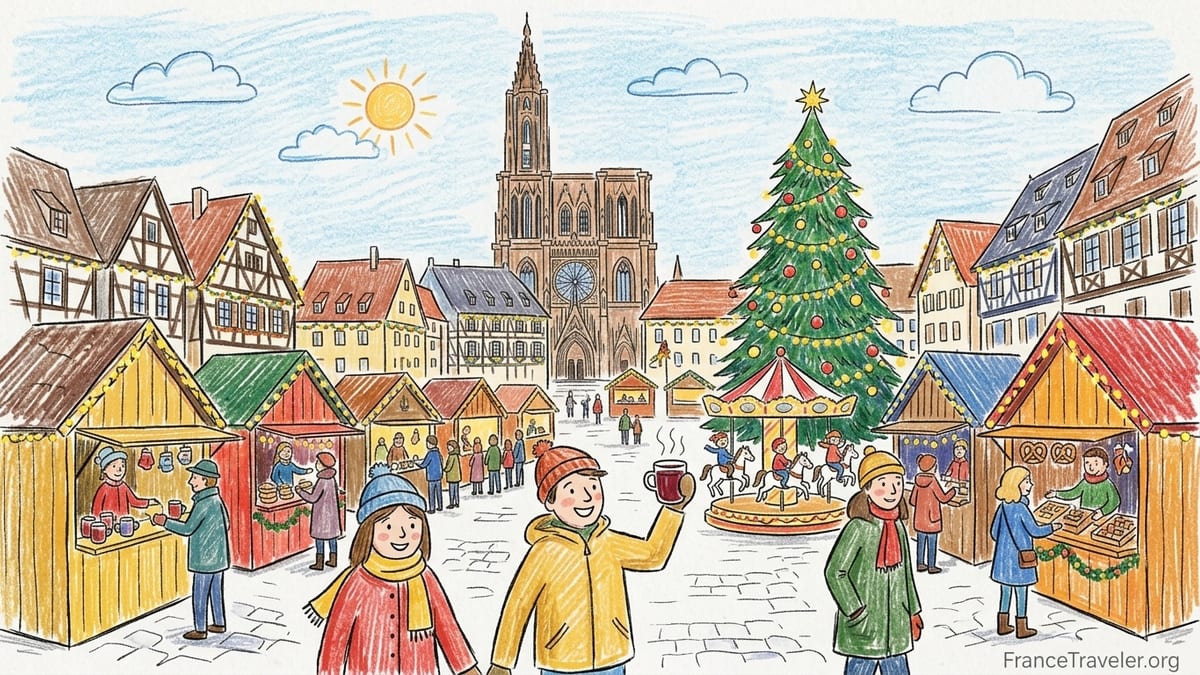
Once you are there, the visual magic is undeniable. Strasbourg’s cathedral square lit up against the night sky, the illuminated façades of Petite France reflected in the Ill River, Colmar’s rows of pastel half-timbered houses glowing with garlands and oversized ornaments. In Obernai, we watched children whirl around a small carousel while parents warmed their hands around steaming cups of spiced wine. Traditional biscuits like bredele appeared everywhere, alongside kougelhopf molds and hand-carved nativity scenes. If you grew up with German-style Christmas markets in storybooks, Alsace feels like those illustrations brought to life.
At the same time, that success has turned the season into a major tourism engine. City briefs explain that Strasbourg’s markets attract millions of visitors in just a few weeks, and local hoteliers openly acknowledge that a significant slice of their annual income depends on this period. In practice, that means crowds that feel more like a summer music festival than a quiet winter escape, especially on December weekends and in the final days before Christmas. I knew it would be busy; I underestimated how much that would shape every practical decision of the trip.
The Reality of Crowds, Trains and Traffic
My trip began with what seemed like a smart move: basing myself in Strasbourg and taking day trips by train. I arrived on a Friday afternoon in early December and immediately felt the crunch. The streets of the Grande Île were already closed to most traffic for security reasons, and the area around the station funneled waves of visitors in the same direction. Inside the station, the departures board showed regional trains to Colmar every 30 to 60 minutes, but the platforms were packed long before each departure was announced.
For the Friday evening train to Colmar, I bought a full-fare TER ticket at the last minute, which in theory is flexible and valid for any departure that day. The reality was a mad dash: as soon as the platform was posted, a solid wall of people surged forward. By the time I boarded, the standard carriages were already crowded, and latecomers stood in the vestibules with suitcases and shopping bags. Seats were not reserved, so families were split up and groups negotiated to trade places. The journey is only about half an hour, but when you are wedged between winter coats, it feels longer.
Driving would not necessarily have been easier. In Strasbourg, official advice pushes visitors toward the P+R park-and-ride car parks on the outskirts. Tickets there usually cost around 4 euros per day and include unlimited tram and bus travel for up to several people in the vehicle, a generous deal that quickly becomes essential once you see the center’s closures to traffic. The catch is that these car parks can fill rapidly on December Saturdays, sometimes reaching saturation between late morning and lunchtime. Travelers who tried to drive into the center itself found barricades, diversions and uniformed officers turning cars away, along with on-street parking that was either forbidden or already taken.
Colmar presented a different set of challenges. The old town streets where most of the five official markets are located are charmingly narrow, which also means they become choke points as soon as the day-trip crowds arrive. Several park-and-ride options on the edges of town, including seasonal relay car parks on busy weekends, are heavily promoted, and on Saturday and Sunday some local buses run free from these lots into the center. The idea works reasonably well first thing in the morning or later at night. By late morning, the queues for the shuttles can themselves be long, and drivers still circle for spaces at standard car parks closer in. It is not chaotic, but it is busy enough to add a layer of stress before you even see a single market stall.
Hotels, Prices and the Cost of Being Central
The first sign that Alsace at Christmas is both magical and over-subscribed arrives when you start searching for a hotel. I began looking in late summer for a long December weekend and found that many of the most central rooms in Strasbourg were already gone. What remained within the old town or just across the river tended to be priced in the range of about 180 to 250 euros per night for a mid-range double room, with some boutique properties going higher. Prices dropped somewhat if I moved out toward the station area or the tram-served business districts, where rooms could still be found for roughly 120 to 160 euros, but those filled too as autumn went on.
In Colmar, where the old town is more compact, the premium for location felt even sharper. Staying within the immediate radius of the Petite Venise quarter and the cathedral area during peak weekends often meant rates over 200 euros per night for standard hotels, with many small guesthouses requiring multi-night minimums. Looking at midweek dates in late November or early December, I saw more availability and a noticeable drop in prices, sometimes by 20 to 30 percent compared with Friday and Saturday stays. In other words, the calendar mattered as much as the star rating.
I ended up with a compromise: three nights in Strasbourg within a 15-minute walk of the cathedral, at about 190 euros per night, followed by a single night in Colmar in a slightly more modest property at around 160 euros. Both included breakfast, which felt worthwhile once I realized how long the queues could be at bakery counters after 9 a.m. The upside of staying central was obvious when I wanted to pop back to the room for a break or to drop bags. The downside was the constant noise of late-night revelers and the sense that every café within a few streets was permanently full.
Next time, I would book much earlier and think more tactically. In Strasbourg, I would still aim to stay within or just at the edge of the Grande Île, but I would target a Sunday through Wednesday window when rates are lower and business travel has thinned out. In Colmar, I would be more open to staying a tram or bus ride away from the very center, accepting a short commute in exchange for a calmer night and more realistic prices. Reserving fully flexible rates several months out, then adjusting once train times and work schedules are confirmed, strikes me now as the least stressful strategy.
Queues, Repetition and the Emotional Cost of Five Markets in a Day
On my first evening in Strasbourg, the sight of the main tree on Place Kléber lit up against the dark sky genuinely stopped me in my tracks. Brass music floated over the square, children craned their necks to look up at the star, and the smell of cinnamon and orange drifted through the cold air. I cupped my hands around a hot mug of vin chaud from a nearby chalet and felt exactly the storybook joy I had hoped for. That feeling returned, briefly but powerfully, at several points on the trip: inside the glowing courtyard of the cathedral market, walking past timber-framed houses in Petite France, and later in Colmar, watching reflections of lights dance in the canals of Petite Venise.
Between those moments came the queues. In Strasbourg, the line for a popular chalet selling flame-grilled tartes flambées stretched across half the square at around 7 p.m. On Saturday afternoon in Colmar, it took close to 15 minutes just to reach the counter of a mulled-wine stand near the Place de l’Ancienne Douane, and even the stall selling roasted chestnuts further away had a long, slow-moving line. At busy times, simply moving through the narrowest lanes in Colmar’s old town meant shuffling shoulder to shoulder at a few steps per minute. Parents hoisted children onto their shoulders partly so they could see, partly so they would not be tripped over.
There is also the psychological effect of repetition. Colmar advertises five separate Christmas markets, each with its own character and setting, and Strasbourg’s markets are spread over several squares. In theory, that means variety. In practice, by the time I reached my fourth or fifth cluster of chalets in a single day, I realized I was seeing many of the same products again and again: wooden ornaments, knitwear, scented candles, gingerbread, nougat, regional wines and spirits, raclette sandwiches, crêpes and waffles. Individual artisans and local producers definitely exist and are worth seeking out, but once the novelty wears off, the commercial nature of the whole enterprise becomes harder to ignore.
That does not make the markets any less valid as a festive experience. It does, however, raise a good question: does visiting five or six markets in a day really add much after the first two or three? For me, the answer was no. I discovered that I enjoyed the markets most when I treated them as atmospheric backdrops to an evening walk or as places to pause for one or two specific treats, rather than as checklists of squares and chalets to be “completed.” The more I tried to see them all, the more they blurred together into a single, crowded shopping mall with prettier architecture.
Weather, Weekdays and the Case for Slowing Down
Another reality that rarely appears in the marketing photos is just how tiring winter weather can be when you spend entire days outside. During my visit in early December, daytime temperatures hovered around 3 to 5 degrees Celsius, dropping close to freezing at night. It drizzled or rained lightly on and off, and one evening brought a mix of sleet and cold wind that drove visible steam off every cup of mulled wine. After hours of standing in lines and shuffling along cobblestones, I could feel the cold seeping up through my boots.
Weather on any given year will vary, but historical patterns for Alsace in December point to cold, damp conditions more often than not. That may be perfect if you imagine Christmas as breath hanging in the air and hands wrapped around hot drinks. It is less charming when your gloves are soaked and it is impossible to find a free seat under cover. Covered arcades and semi-enclosed squares exist, especially in Strasbourg, but when rain arrives at peak times those spaces fill instantly. For me, the fatigue of being cold and slightly wet for hours magnified the stress of the crowds.
One way to soften that impact is to choose weekdays instead of weekends. On the Monday I spent in Strasbourg, the difference was obvious. The morning felt almost calm; I could actually stand back from the cathedral to photograph the façade, and the tram platforms were busy rather than overwhelmed. Lines for food and wine stalls were much shorter before 5 p.m., and even during the evening peak it was still possible to find a table in a side-street winstub without a reservation. In Colmar, a Tuesday visit the year before had produced a similar impression: coach tours still arrived, but the density in the lanes was noticeably lower than on Saturday.
Slowing down the pace helps too. Instead of trying to squeeze Strasbourg, Colmar and a string of villages into a single weekend, I would now advocate for choosing one major city market and one smaller town or village, then giving yourself at least two full days in each. That allows time for non-market activities: visiting the Unterlinden Museum in Colmar, exploring Strasbourg’s Neustadt district, or taking a morning train to Obernai or Kaysersberg and enjoying their streets before the bulk of tours arrive. It also builds in space for something that is often missing from tightly planned Christmas trips: a quiet afternoon in a café, watching the lights slowly come on outside while you thaw out.
Restaurants, Reservations and the Perils of “We’ll Just Find Something”
Of all the logistical headaches I encountered, dinner was the one I most underestimated. Alsatian winter cuisine is hearty and comforting, full of choucroute garnie, spaetzle, baeckeoffe and cheese-laden tarte flambée. It is also enormously popular with both visitors and locals in December. On my first night in Strasbourg, I made the classic mistake of assuming that because there were restaurants everywhere, I could simply wander until I found a table. At 7:30 p.m., that proved wildly optimistic.
Most winstubs and traditional restaurants in and around the Grande Île were either fully booked or quoting waits of 60 to 90 minutes for walk-ins. Staff were unfailingly polite, but the message was clear: without a reservation, we were unlikely to eat before 9 or even 9:30 p.m. Standing outside in the cold, looking at rooms full of people enjoying steaming plates of choucroute, was a humbling lesson. We eventually found space at a less atmospheric brasserie a bit further from the cathedral, but even that took persistence and flexibility with timing.
The pattern repeated in Colmar. Around Petite Venise and the main market squares, many restaurants operated two tightly timed dinner seatings. By 6 p.m., several had signs at the door explaining that the evening was complet, fully booked. Takeaway options at the markets themselves exist, of course: crêpes, flammes, raclette sandwiches, sausages and pretzels. Those are fun, and on one night we simply embraced a “progressive” dinner of street food and mulled wine. After a few days of that, though, your body starts to crave vegetables and a place to sit down that is not a damp bench.
If I could rewind the trip, I would reserve dinners as soon as I had my hotel dates, particularly for Friday and Saturday nights and for any restaurants that are especially atmospheric or traditional. I would also deliberately plan at least one earlier dinner sitting, around 6:30 p.m., to avoid the worst of the lines and to free up later evening time for quieter walks through the markets. Lunchtime can be a smart alternative; on one weekday in Strasbourg, I enjoyed an excellent choucroute plat du jour at a historic brasserie with only a short wait, then grazed at the markets in the evening instead of hunting for a full meal.
Public Transport vs Driving, and How Early Day-Trip Spots Fill
Every December, local authorities and tourism offices in Alsace strongly encourage visitors to take public transport wherever possible. Having tried both sides of the equation, I now understand why. Strasbourg’s park-and-ride system is efficient and good value, but it still requires navigating ring roads, finding the right car park and trusting that spaces will be available when you arrive. Regional trains, by contrast, drop you directly in the centers of Strasbourg, Colmar, Mulhouse and several wine-route towns, with no need to worry about road closures or parking tickets.
For day trips between Strasbourg and Colmar, I alternated between TER trains and a single rental-car day. The train days, even when crowded, had one clear advantage: my time was my own. A standard full-fare ticket from Strasbourg to Colmar cost in the ballpark of 15 to 20 euros each way when bought close to departure, with occasional region-wide promotional fares or passes bringing that down if booked earlier or on specific days. Trains in the late morning and early evening were the busiest, often with standing passengers. Those around lunchtime or mid-afternoon had fewer crowds and made it much easier to find a seat.
On the driving day, I set out from Strasbourg around 9 a.m. with the intention of hopping between small villages: Ribeauvillé, Riquewihr and Kaysersberg. By the time I reached the first village car park, the main lots were already close to full and attendants were redirecting cars to overflow fields and roadside spaces. Shuttle buses from certain park-and-ride areas toward clusters of villages, especially on peak weekends in December, are widely publicized and do help to reduce congestion, but they also have their own timetables and queues. Several popular attractions and viewpoints filled before late morning, making spontaneous detours difficult.
If you do decide to drive, aim to reach your first destination by 9 a.m. at the latest, ideally earlier on Saturdays. That gives you an hour or two to enjoy the streets while they are still walkable and to photograph façades before crowds fill the frame. It also increases your chances of finding parking without being sent to a distant overflow. For most travelers, though, I would recommend building an itinerary primarily around trains and local buses, saving the car for a day or two if you want to reach particularly remote villages. Traveling light and accepting that you will walk a fair amount can make the experience feel far less stressful.
What Was Truly Magical, and What Felt Commercial
Even with the fatigue, there were moments on this trip that I would not trade away. Standing under Strasbourg’s cathedral as a choir sang carols in the cold, watching families press close to share song sheets, I felt part of a living tradition that stretched back centuries. Strasbourg’s markets did not appear overnight; the Christkindelsmärik has roots in the 16th century and has grown into one of Europe’s most established seasonal events. There is a sense, especially on quieter weekday evenings, that beyond the tourist trade the markets also belong to locals who meet friends there every year, buy familiar biscuits from the same chalet and treat the illuminations as a yearly ritual.
Colmar, too, had moments of enchantment. One night, mist rose from the canals in Petite Venise as soft white lights traced the outlines of houses and bridges. The reflections were so beautiful that people fell silent for a few seconds at a time, cameras forgetfully lowered. In a side courtyard away from the main crush, I stumbled on a small stall where a local winemaker poured glasses of late-harvest Gewurztraminer, talking quietly about the year’s harvest and which plots had been hardest hit by summer heat. Those were the human-scale encounters that made the trip feel more than a commercial spectacle.
Alongside those highlights, there were stretches that felt almost indistinguishable from any crowded shopping event. Branded plastic souvenirs, mass-produced ornaments imported from far away, and stands blasting recorded pop remixes of Christmas songs all contributed to an at-times generic atmosphere. Some smaller villages have tried to protect a more traditional identity by limiting the number of stalls, tightening selection criteria for vendors or opening only on advent weekends rather than every day. In the larger cities, though, the line between authentic craft and festive retail zone can blur quickly.
In the end, the imbalance between magical and commercial moments had less to do with the region itself and more to do with how I structured my time. When I gave myself space to wander slowly, to step into churches, museums or quiet side streets, and to enjoy one or two markets per day rather than five, the charm came back into focus. When I rushed from square to square, mentally ticking off lists of “must-see” markets, I ended up seeing more crowds than Christmas.
The Takeaway: My Ideal Revised Christmas Itinerary
If I were planning an Alsace Christmas trip again, knowing what I know now, I would resist the urge to sample every market on the map. Instead, I would build a slower, more focused itinerary that aims for depth over quantity, and that balances festive atmosphere with pockets of calm. I would also pay closer attention to the calendar, the weather forecast and my own tolerance for crowds, accepting that some trade-offs are inevitable during such a popular season.
My ideal plan would look something like this. I would arrive in Strasbourg on a Sunday or Monday in early December rather than a Friday, staying three nights in or near the Grande Île. I would book a central but not ultra-scenic hotel several months in advance, targeting rates in the 140 to 180 euro range for midweek dates, and I would confirm dinner reservations for at least two nights before I left home. I would use the first evening simply to stroll through the cathedral market and Place Kléber, without feeling any need to “collect” every market in one go.
On the second day, I would spend the morning exploring non-market parts of Strasbourg: the Neustadt quarter, the banks of the Ill or a museum or two. Only in mid to late afternoon would I head back into the core markets, ideally after a proper sit-down lunch. The following day, I would take a mid-morning TER train to Colmar, stay one night in or near the old town, and keep my ambitions modest: two or three of the five markets, a walk through Petite Venise after dark, and a visit to the Unterlinden Museum or the Toy Museum as a warm indoor break. Any additional time could be spent in a nearby village reached by bus, chosen for atmosphere rather than famous name.
Throughout, I would commit to using public transport as my default, reserving a rental car only if I decided to add a separate, quieter countryside day outside peak market hours. I would pack smarter, too: waterproof boots, a second pair of gloves, and a compact umbrella small enough to navigate through crowds. Most importantly, I would give myself permission to skip queues that feel too long and to leave a market square the moment it tips from festive to stressful. Alsace at Christmas really is magical, but it does not require racing from one market to the next to prove it.
FAQ
Q1. Is it worth visiting Strasbourg and Colmar at Christmas despite the crowds?
Yes, if you manage your expectations and itinerary. The lights, historic settings and regional food are genuinely special, but crowds can be intense on December weekends. Choosing weekdays, slowing the pace, and limiting yourself to a few key markets rather than trying to see them all makes the experience far more enjoyable.
Q2. How far in advance should I book hotels for the Alsace Christmas markets?
For December weekends in Strasbourg or Colmar, it is wise to start looking several months ahead, especially if you want to stay inside the historic centers. Central mid-range rooms during peak periods often run around 180 to 250 euros per night, with somewhat lower prices midweek and in less central neighborhoods. Flexible bookings allow you to adjust as train times and plans firm up.
Q3. Are trains between Strasbourg and Colmar very crowded during Christmas-market season?
Regional TER trains between Strasbourg and Colmar can become very full in the late morning and late afternoon, especially on Fridays, Saturdays and during school holidays. It is common to see standing passengers in the busiest carriages. Travel at off-peak times, such as late morning or mid-afternoon on weekdays, for a better chance of finding a seat, and allow extra time at the station on busy days.
Q4. Is it better to rent a car or rely on public transport in Alsace at Christmas?
For most visitors, public transport is the better option. City centers such as Strasbourg’s Grande Île and central Colmar are heavily restricted to traffic during the markets, and parking fills quickly on December weekends. Park-and-ride car parks around Strasbourg offer good-value combined parking and tram tickets, while trains and buses connect many of the main towns and some villages. A rental car can be useful for reaching smaller wine-route villages, but it is best reserved for non-peak days and early starts.
Q5. How expensive are food and drink at the Alsace Christmas markets?
Expect to pay only slightly more than standard café prices for basic items. A cup of mulled wine is usually just a few euros, often with a small deposit for the souvenir mug, while street dishes such as crêpes, sausages or raclette sandwiches fall in the range of an affordable casual meal. Prices can creep up at the most central or touristy stands, but you can still eat reasonably without breaking the bank if you mix market snacks with sit-down meals away from the busiest squares.
Q6. Do I really need restaurant reservations in December?
In Strasbourg and Colmar, reservations are strongly recommended for traditional winstubs and popular restaurants on December Fridays, Saturdays and around key dates. Walk-ins are sometimes possible if you are flexible about time and style of cuisine, but waits of an hour or more are not unusual in peak evenings. Booking ahead for at least some dinners ensures you have a warm, seated meal and can enjoy the markets before or after without stress.
Q7. How many Christmas markets should I plan to visit in one day?
While it is technically possible to see several markets in a single day, most travelers find that two or three distinct areas are enough before fatigue and repetition set in. The main cathedral and Place Kléber markets in Strasbourg, or two or three of Colmar’s five markets, already offer plenty of variety. Beyond that, the stalls can start to blend together, and the experience becomes more about navigating crowds than enjoying the atmosphere.
Q8. What is the best timing within the day to visit the markets?
Mornings right after opening and early weekday afternoons are usually the least crowded times, though some stalls feel sleepier during daylight. Late afternoon into early evening brings the most atmosphere as lights come on, but also the densest crowds. A good compromise is to explore part of the markets in the late morning, take a warm indoor break during the afternoon, then return around dusk for the illuminations before the very peak of evening.
Q9. How should I dress for Alsace Christmas markets?
Plan for cold, damp conditions. Waterproof or water-resistant boots, warm socks, a hat and a scarf are essential, and it is worth bringing a second pair of gloves in case the first gets wet. Layers that you can adjust when moving between outdoors and heated interiors work best. A compact umbrella or hood helps during passing showers, though large umbrellas can be awkward in crowded, narrow streets.
Q10. Which combination of places makes a good first-time Christmas itinerary in Alsace?
For a balanced first visit, pair one major city and one smaller town or village. A popular and practical choice is to spend two or three nights in Strasbourg, then one or two in Colmar or a nearby wine-route village such as Obernai or Kaysersberg. This combination delivers the full “Capital of Christmas” experience along with a more intimate village atmosphere, without requiring you to change hotels every night or race between too many markets.