

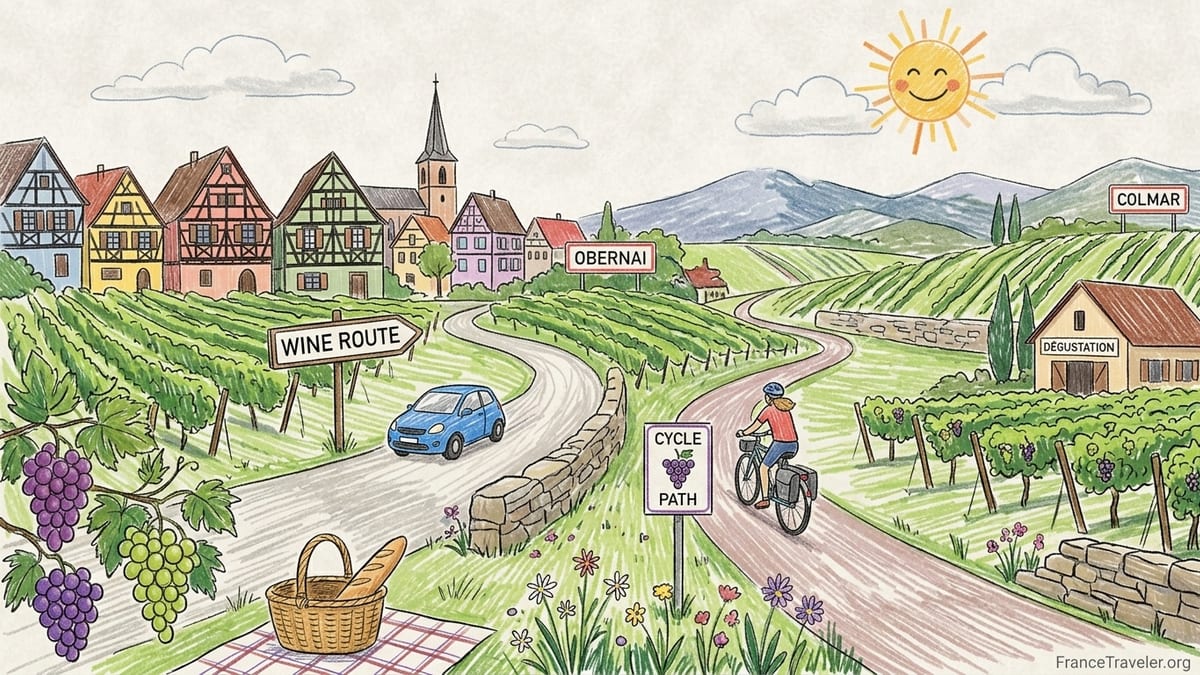
On paper, the Alsace Wine Route sounds like a dream: 170 kilometers from Marlenheim to Thann, half-timbered villages, Riesling in every glass, and a dedicated cycling route threading the vineyards. On the ground, it is more complex. Over one week, I drove part of the Route des Vins d’Alsace, cycled a substantial stretch of the Véloroute du Vignoble, and tasted in a dozen cellars. This is what it actually felt like, step by step, village by village, with real prices paid, appointments made or missed, and the very practical question of how to handle alcohol while trying to cover ground.
The Exact Route I Actually Traveled
I began in Strasbourg, picked up a small rental car near the station, and joined the Wine Route near Marlenheim, the official northern gateway. My on-the-ground route was a blend of the historic driving itinerary and the newer vineyard cycle path that parallels it. In total I covered roughly 140 kilometers of the 170 kilometer route, split between three days in a car and three days on a rental touring bike.
By car, my first day ran from Marlenheim to Obernai via Kirchheim, Odratzheim, Molsheim, Dorlisheim, Rosheim and Bischoffsheim, mirroring the official Wine Route corridor. I stopped properly in Marlenheim, Molsheim, Rosheim and Obernai. The second driving day picked up from Obernai and continued through Barr, Mittelbergheim, Andlau, Itterswiller, Dambach la Ville, Châtenois and on to Ribeauvillé and Riquewihr, where I spent the night. The third driving day linked Riquewihr, Zellenberg, Beblenheim, Hunawihr, Turckheim, Eguisheim and Rouffach, before cutting across to Cernay and finally Thann at the southern end.
The cycling portion followed the Véloroute du Vignoble d’Alsace, the signed vineyard cycle route that broadly parallels the Wine Route between Marlenheim and Cernay. I did it in two main segments: Obernai to Ribeauvillé on one day, then Colmar to Rouffach and back on another, using regional trains to shorten the transfers. The bike route often sits one or two kilometers away from the main road, climbing into the vines on narrow lanes and farm tracks. In many places it passes directly above or below the same villages you drive through, so I could compare the experiences almost side by side.
Across the week I stopped in 17 different villages, but I only counted a place as a real stop if I parked or locked the bike, walked around and either ate, tasted or visited a site. The list was: Marlenheim, Molsheim, Rosheim, Obernai, Barr, Mittelbergheim, Andlau, Itterswiller, Dambach la Ville, Ribeauvillé, Riquewihr, Zellenberg, Beblenheim, Turckheim, Eguisheim, Rouffach and Thann.
Villages: Where It Feels Busy, Where It Feels Quiet
The Wine Route’s marketing talks about “picturesque” villages, but it does not tell you that crowds concentrate heavily in a few star names while other places feel almost sleepy even in season. Riquewihr, Ribeauvillé, Eguisheim and, to a lesser extent, Obernai drew bus groups and packed car parks from late morning through mid-afternoon in June. Riquewihr’s main street between 11:00 and 16:00 felt more like a compact theme park than a rural wine village, with souvenir shops, language-switching menus and queues at popular winstubs.
By contrast, Mittelbergheim, Andlau and Itterswiller, just a short drive south of Obernai, were calm enough that I could hear tractors in the vines and church bells over the occasional car. Mittelbergheim in particular became my favorite base for an unhurried hour or two. Parking was simple, cellars were half full at most, and the winegrowers had time to talk at length. Even in more famous Ribeauvillé, stepping one or two streets away from the main drag brought me into quieter residential lanes and smaller family domaines.
The time of day mattered as much as the choice of village. In Eguisheim, I arrived once by car at 11:30 and once by bike at 18:30. Midday was shoulder-to-shoulder loops around the circular old town, with restaurant terraces overflowing. Early evening, especially outside peak holiday weeks, the same streets were almost empty apart from locals chatting in front of their houses and a few people leaving tastings. If you want the half-timber charm without the crush, plan your village walks either before 10:00 or after 18:00.
Thann and Rouffach at the southern end felt more like working small towns than postcard villages. They still have tasting rooms and wine events, but you share the streets with high school students, supermarket traffic and people going about their daily lives. This tilt back toward the ordinary is a useful reset after days of photogenic but tourist-heavy villages further north.
Parking, Lanes and What the Wine Route Really Looks Like
The phrase “wine route” suggests a scenic byway gently threading vineyards. In reality, much of the official road route passes just outside the most photogenic stretches of vines and then dives into villages where you are dealing with narrow one-way streets, residents’ garages and frequent 30 kilometer per hour zones. The landscape views are still beautiful, but they alternate with practical driving: roundabouts, crosswalks, small delivery vans and buses negotiating tight corners.
Parking varied sharply by village. In Marlenheim, Molsheim, Barr, Rouffach and Thann, I found free public parking close to the center in under five minutes, even on a Saturday. In Riquewihr and Eguisheim, by contrast, the main lots near the old centers charged hourly fees and were close to full by late morning in June. In Riquewihr I paid roughly 3 euros for just under two hours in a surfaced lot below the ramparts, with attendants directing drivers. Arriving by 09:30, especially on weekdays, made parking simpler and cheaper almost everywhere.
Once parked, the vineyard lanes themselves felt very different from the main road. Gravel or narrow asphalt tracks climbed gently out of villages like Mittelbergheim, Itterswiller and Zellenberg into the vines. They are shared spaces: tractors hauling trailers, walkers with dogs, e-bikes and touring cyclists all using the same one-lane road with occasional passing places. There is no continuous “panoramic ridge road.” Instead you get a series of short climbs and descents, each giving a new angle on the valley or the Vosges foothills.
On the bike route, the feel changed again. Between Marlenheim and Molsheim, the Véloroute follows parts of a former rail line, with long, almost flat stretches under trees. South of Barr it runs directly through vineyards, meaning constant small ups and downs. The signage uses a grape-cluster logo alongside EuroVelo 5 markings, which I found generally clear but occasionally hidden by vegetation. More than once I stopped and backtracked 100 meters after missing a turn where the sign had been rotated or obscured. It is not a sterile, perfectly manicured cycle highway; it is closer to a well-used rural utility route where vines, weather and local maintenance all leave their mark.
Tastings I Actually Did, Prices Paid and How They Felt
Over the week I did tastings at 12 different domaines and cooperative cellars. I will not pretend this was exhaustive, but it was enough to see clear patterns in how Alsace treats visitors. Most tastings cost between 6 and 12 euros per person for a flight of 4 to 6 wines, sometimes refunded with purchase. Group or premium tastings with grand cru flights or cellar tours climbed into the 15 to 25 euro range per person according to current 2024 price sheets at several producers.
In Mittelbergheim I booked ahead for a morning tasting at a family domaine known for dry Rieslings and Sylvaner. The appointment lasted just over an hour. For 10 euros per person, we tasted six wines: a basic Sylvaner, a Pinot Blanc, a village Riesling, two Rieslings from different limestone and marl parcels, and a Pinot Noir. The fee was waived when we bought three bottles, which came to just under 40 euros in total. The grower spent at least 15 minutes purely on terroir maps and explaining why Sylvaner has persisted in their parcels. It felt earnest rather than scripted, with a mix of French and very workable English.
In Riquewihr, at a larger producer with a modern visitor center, I joined a late-afternoon walk-in tasting. Here the basic “discovery” flight cost 9 euros for five wines poured at the counter: Pinot Blanc, Riesling, Pinot Gris, Gewurztraminer and Crémant d’Alsace. I paid the fee separately and did not buy wine, and there was no pressure to do so. The setting felt more like a professional bar, with staff working from a list and explaining each wine in two or three sentences. It was efficient but less personal, and the room was busy enough that follow-up questions had to be short.
The most intimate tasting happened in Andlau, where I simply walked in mid-afternoon to a small courtyard cellar marked only by a wooden sign. There was no menu or formal fee. The winemaker poured four wines, all Riesling from different nearby hillsides, and asked what styles I normally drink at home. After half an hour of conversation, I insisted on buying bottles rather than treating it as a free bar. Two Rieslings and one Pinot Gris cost about 45 euros altogether. Only then did he mention that tastings were generally complimentary when visitors bought at least a couple of bottles. It was a reminder that hospitality norms vary widely between small, family-run houses and larger, tourism-focused cellars along the same road.
Walk-ins, Formality and Language Realities
The level of formality along the Alsace Wine Route depends strongly on village and producer. In star villages like Riquewihr, Ribeauvillé and Eguisheim, many of the bigger or best known domains have clear opening hours, tasting counters and structured flights. Some allow walk-ins all day within listed hours. Others now prefer or require pre-booking for more in-depth cellar tours or grand cru tastings, especially in busy months and on Saturdays. When I tried to walk in to a well-known estate in Ribeauvillé at 16:00 on a Friday, a polite sign at the door explained that tastings were only by reservation that afternoon due to group bookings.
In smaller villages such as Mittelbergheim, Itterswiller and Rouffach, I had better luck with spontaneous visits. Often a bell by an unassuming courtyard door summoned the winemaker or a family member, who either hosted the tasting in a basic room beside the cellar or explained that they were in the middle of vineyard work and proposed another time. The experience there felt less like a polished visitor center and more like being a guest in a working farm business. Scheduling a phone or email appointment a day or two ahead smoothed things considerably, especially if I mentioned I would be traveling by bike and had limited slots.
French is the base language everywhere, but I repeatedly encountered staff comfortable switching to English or German, especially where international tourism is strong. In Obernai, Riquewihr and Colmar, restaurant and tasting room staff almost universally offered English menus and explanations. In Mittelbergheim and Andlau, initial greetings were in French, but once it was clear I could follow, the conversation alternated between French and English when technical terms came up. Knowing even a few phrases like “dégustation,” “sec,” “moelleux” and “sans rendez-vous” helped signal respect and made the interactions warmer.
Dress code and behavior are informal but purposeful. Visitors showed up in hiking clothes, cycling kits, city casual wear and everything in between. What mattered was attention and pace: not treating the tasting bar as a quick shot counter, being willing to spit or pour out leftovers, and buying at least a bottle or two when the tasting had clearly taken time and knowledge. Tipping is not expected in tasting rooms, but buying a bottle is effectively how you show appreciation.
Understanding the Wines Without Jargon
Alsace focuses on single-varietal wines, which makes it easier to connect what you are tasting in one cellar to what you will taste in the next. Riesling is usually dry, precise and high in acidity, with flavors that can run from lemon and green apple to stone and smoke. It pairs naturally with the region’s choucroute, freshwater fish and the rich sauces you will find along the route. In most tastings I tried at least two or three Rieslings, often from different village or grand cru sites, which made the soil and slope differences quite tangible even for a non-expert.
Gewurztraminer is the aromatic one: rose, lychee, sometimes spice. In Alsace it can be made dry or with noticeable residual sugar. Tasting room staff were generally clear about which was which when asked. I usually limited myself to one Gewurztraminer per tasting because the intensity can quickly overwhelm the palate. When I did buy, it was for late-afternoon sipping with Munster cheese rather than for the dinner table.
Pinot Gris in Alsace often sits in between Riesling and Gewurztraminer, fuller-bodied and slightly smoky, with ripe pear or apricot notes. It can be dry or off-dry. In Andlau and Riquewihr I gravitated toward the drier versions, which still had enough weight for dishes like tarte flambée or roast pork. Pinot Blanc and its cousin Auxerrois appeared together in many entry-level blends poured as the easygoing “everyday” white: softer acidity, gentle apple and floral notes. They anchored the cheaper end of the price lists and were often sold in liter bottles intended for simple home drinking.
Muscat and Sylvaner were rarer in the lineups but rewarding. Muscat from Alsace is generally dry, with sharp grape and flower aromas that make it a refreshing aperitif rather than a dessert wine. Sylvaner, especially from limestone soils around Mittelbergheim, was fresh, slightly herbal and extremely food friendly. It was also usually among the best-value wines on each list. Pinot Noir has grown in importance, with more domaines bottling serious versions aged in barrel. In tastings where I included Pinot Noir flights, I gave them the same focus as I would a Burgundy village wine: pale color, red cherry and spice, sometimes with a gravelly edge from stony soils.
How Many Tastings Before Palate Fatigue Hits
Before this trip I imagined three or four tastings a day, each with multiple wines. After the first full day, that fantasy collapsed. Even with moderate pours, spitting and plenty of water, my palate and concentration were noticeably dulled after the third stop. By the end of the week I had settled into a rhythm that felt realistic and safe: a maximum of two proper tastings per day, occasionally three if one of them was very focused and small.
On my most intense day, I did a mid-morning appointment in Mittelbergheim (six wines), a spontaneous short tasting in Itterswiller (four wines), and a booked late-afternoon flight in Ribeauvillé (five wines). That meant 15 different wines in total, almost all white, with significant acidity. By the time I sat down for dinner, everything tasted slightly flatter and I could not really distinguish fine differences in the last glasses. The quality of the experience dropped sharply with each additional wine, even if the overall quantity of alcohol swallowed remained controlled through spitting.
Walking the next day past several tempting “Dégustation” signs without going in was a little painful, but it preserved my enjoyment and my attention. A realistic plan for most travelers would be one substantial, sit-down tasting with a producer they really care about, and one lighter, opportunistic tasting, either at a cooperative or a smaller cellar that catches their eye. Anything more becomes work rather than pleasure unless you are a professional taster.
Food also plays a real role in fatigue. On the day I skipped lunch or ate only a quick pastry, I felt the acidity and small amounts of alcohol more. On days when I had a proper, if simple, hot lunch in a village restaurant, I felt steadier and better able to focus in an afternoon tasting. It is not just about alcohol absorption; it is also about giving your senses a break from a long string of white wines.
Transport, Alcohol and Staying Honest About Safety
The most awkward reality of the Alsace Wine Route is that it combines a lot of tasting opportunities with environments that still rely heavily on cars. France has clear legal blood alcohol limits for drivers, and the mix of narrow village lanes and pedestrians makes even minor impairment unacceptable. Over the week I tried several strategies: designated driver days, serious use of the spit bucket, cycling segments and targeted use of trains and taxis.
On pure driving days, either I or my travel partner acted as the de facto designated driver. That person spat every sample, drank water between wines and skipped any extra glass poured “for the road.” Spitting in Alsace tasting rooms is completely normal once you indicate you will be driving. Buckets are provided and staff rarely bat an eye. The downside is psychological more than practical: you feel slightly self-conscious at first. By the second day it felt routine, and the benefit was clear the first time we navigated a tight, dark village street after sunset in light rain.
Cycling adds other considerations. You are not exempt from road safety rules on a bike, and riding unsteadily through a village packed with families and other cyclists is both dangerous and socially frowned upon. On days when I combined cycling and tasting, I limited myself to one formal tasting mid-route and one glass with lunch, with spitting at the tasting. I also tried to cluster tastings near the end of the day, close to my accommodation, so I could walk back. The vineyard cycle route itself is mostly separated from heavy traffic, but it still crosses roads and shares space with tractors. Riding even gently tipsy on gravel or damp leaves between vine rows is an obvious fall risk.
Public transport exists but requires planning. Regional trains run along the plain, linking Strasbourg, Molsheim, Barr, Sélestat, Colmar, Rouffach, Cernay and Thann, usually with space for bikes. I used them to leapfrog stretches and avoid long rides on days when tastings were scheduled. Taxis and ride-hailing options are thinner in small villages, especially at night, so if you aim to drink freely at dinner, choose accommodation within walking distance of the restaurant and tasting rooms. Several villages such as Ribeauvillé, Riquewihr and Eguisheim have clusters of small hotels and guesthouses right in the center that make car-free evenings feasible.
For travelers who prefer to avoid all these calculations, guided minivan tours from bases like Strasbourg and Colmar are a straightforward option. They typically include two or three pre-selected tastings and handle driving for you. The trade-off is less flexibility in choosing exactly which domaines to visit and less time to wander villages spontaneously. After trying both independent and guided approaches on different days, I would use a guided tour strictly on my heaviest tasting day and keep the rest of the week under my own control.
What I Would Do Differently Next Time
Looking back, the main thing I would change is my appetite for covering distance. Trying to “do” as much of the 170 kilometer route as possible meant several rushed village stops and more time than ideal on practical road sections that felt like commuting. Next time I would pick a tighter stretch, probably from Obernai to Ribeauvillé for three days, then a shorter southern segment around Eguisheim and Rouffach if time allowed.
I would also reduce the sheer number of villages I tried to sample in one sweep. Of the 17 villages where I stopped properly, 8 or 9 anchored most of my best experiences. Instead of chasing variety, I would give myself permission to spend whole afternoons in places like Mittelbergheim, Andlau, Ribeauvillé and Eguisheim, walking vineyard paths between them instead of jumping back in the car or even on the bike too quickly. Lingering on one hillside path in mid-afternoon, listening to tractors, turned out to capture more of the “real” Wine Route than any quick dash through another village center.
In terms of tastings, my ideal future plan would be firm reservations with two or three domaines I am truly curious about, spaced with rest days or at least half days in between. That might mean one focused Riesling and Sylvaner producer in Mittelbergheim, one mixed-portfolio estate in Ribeauvillé or Riquewihr, and perhaps a Pinot Noir-focused visit south of Colmar. Around those anchor tastings I would leave space for only one or two spontaneous, shorter stops if I found myself outside an inviting cellar at exactly the right moment.
Most importantly, I would plan accommodation more tightly around walkability. Sleeping in or next to the villages where my main tastings and dinners were scheduled would cut down on evening driving and make spitting a matter of choice rather than safety imperative. It would also change the rhythm of the day, allowing early morning and late evening walks when the villages feel closest to real life rather than tourism.
FAQ
Q1: How many villages would you realistically include on an Alsace Wine Route trip next time?
On a five or six day trip, I would focus on about 8 villages instead of the 17 I visited: Marlenheim or Molsheim at the north, then Obernai, Mittelbergheim, Andlau, Ribeauvillé, Riquewihr, Eguisheim and Rouffach, using the others as cycling or walking through-points rather than full stops.
Q2: How many tastings per day turned out to be comfortable before palate fatigue?
Two tastings per day felt like the upper comfortable limit, with one substantial, booked tasting and one lighter, shorter visit. Three tastings a day quickly blurred flavors, even with spitting, and made the experience feel more like work than pleasure.
Q3: Do you need to book all tastings in advance on the Alsace Wine Route?
You do not need to book every tasting, but reserving key visits, especially at well-known domaines in places like Ribeauvillé, Riquewihr and Eguisheim, is wise. In smaller villages like Mittelbergheim or Itterswiller, walk-ins often work during listed opening hours, though calling or emailing a day ahead improves your chances.
Q4: Is cycling the Alsace Wine Route safe if you plan to taste wine?
Cycling is safer than driving in some respects but it still requires clear-headed riding. If you plan to taste, limit yourself to one formal tasting mid-ride and one small glass with lunch, use spit buckets, drink plenty of water and schedule any heavier drinking only once your bike is locked and you can walk back to your accommodation.
Q5: Are tastings in Alsace generally free or paid?
Both exist. Many family domaines still pour several wines free of charge if you buy bottles, while larger houses and more structured tastings often charge around 6 to 12 euros per person for a set flight. Premium or grand cru tastings can cost more, especially when combined with cellar tours.
Q6: Which Alsace grape varieties are easiest for beginners to enjoy?
For most beginners, Pinot Blanc and Sylvaner are the most approachable, with gentle fruit and softer acidity. Dry Riesling follows once you get used to its brightness. Gewurztraminer is intensely aromatic and can be wonderful, but it is best tasted in small quantities because it can quickly overwhelm the palate.
Q7: Is English widely spoken along the Alsace Wine Route?
English is widely understood in the most visited villages and at larger domaines, and German is also common. In smaller family cellars, basic French is helpful but you can usually manage with a mix of English, gestures and the tasting sheet. Being polite and learning a few key French terms goes a long way.
Q8: How much should you expect to spend on a bottle of wine at a cellar?
In most cellars I visited, everyday bottles of Pinot Blanc, Sylvaner or basic Riesling started somewhere in the low teens, with more complex or grand cru wines rising into the twenties and above. Buying directly from producers usually offers better value than souvenir shops in the busiest streets.
Q9: What is the best way to handle wine purchases if you are cycling?
If you plan to buy more than one or two bottles while cycling, consider using panniers or a sturdy rack bag, and ask domaines about shipping cases home. Many producers can arrange shipping within Europe and sometimes beyond, which avoids hauling heavy glass on climbs and keeps bottles safe.
Q10: How many villages and tastings would you personally schedule on your next Alsace Wine Route trip?
On my next trip I would schedule 8 villages as real stops and a total of 6 to 8 tastings spread across the week, averaging no more than two tastings on any given day and leaving entire days with no alcohol-focused activities to enjoy the landscape, castles and towns with a fresh head.