

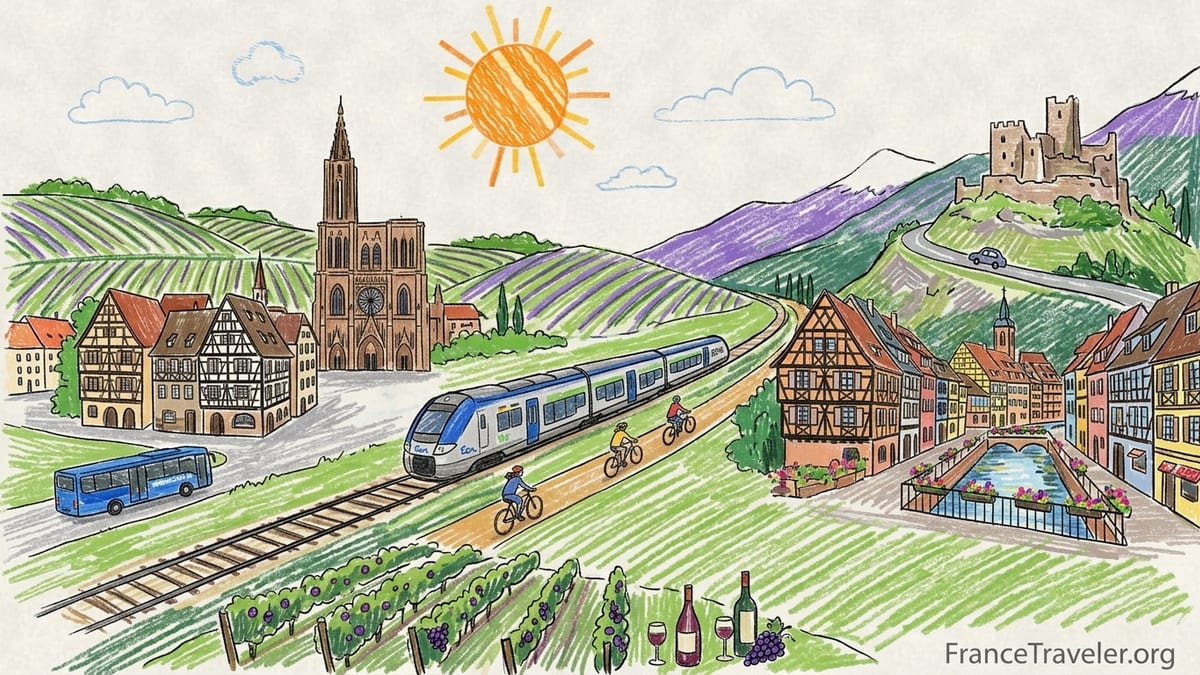
Alsace is one of the rare European regions where both car and train are genuinely excellent options. Strasbourg and Colmar are plugged into France’s high-speed TGV network, regional express trains knit together the main towns, and at the same time the classic Wine Route curls along hillsides that feel built for slow driving and vineyard-hopping. Choosing between train and car is not about right or wrong, but about matching the transport to the trip you have in mind. This guide walks through the trade-offs, from big-city weekends to wine-soaked village stays and Vosges mountain loops.
Understanding Alsace by Rail: Where the Train Shines
For Strasbourg and Colmar themselves, the argument for arriving by train is strong. Both cities sit on the main Strasbourg to Basel railway line, served by high-speed TGVs from Paris and a dense web of TER Grand Est regional trains. A direct TGV from central Paris to Strasbourg usually takes around 1 hour 45 minutes, and from Paris to Colmar about 2 hours 20 minutes with some trains running direct on peak days. Seat reservations are compulsory on TGV services, but once you arrive in Alsace the TER regional trains between Strasbourg, Colmar and Mulhouse work on a turn-up-and-go basis with no seat booking needed.
Within Alsace, the core rail spine is the Strasbourg to Colmar to Mulhouse axis. Regional TER trains branded "TER Grand Est" link Strasbourg and Colmar in about 30 minutes, typically with at least two trains per hour during the day on weekdays and a slightly lighter pattern in the evening and on Sundays. These trains also serve Sélestat, Erstein and other smaller centres, which makes it easy to base in Strasbourg and hop down to Colmar for a day, or vice versa, without worrying about traffic, parking or navigation.
In addition to Strasbourg and Colmar, Alsace has three more high-speed hubs: Mulhouse, Strasbourg Airport and sometimes smaller stops such as Sélestat or Saint-Louis that are served by passing TGVs depending on the timetable. In practice, that means five TGV-accessible stations across the region. This spread makes it realistic to arrive in Strasbourg, tour the city on foot and by tram, then leave by train from Colmar or Mulhouse without backtracking by car.
Both Strasbourg and Colmar are compact enough that once you arrive by rail, you can explore almost everything on foot, by tram or by a short bus ride. In Strasbourg, the cathedral, Petite France, the riverside quays and most hotels are within a 15 to 20 minute walk of the station, with trams running across the centre if you prefer not to walk. Colmar’s station sits roughly a kilometre from the historic core; you can roll a suitcase to the half-timbered streets in about 15 minutes on flat pavements. For stays focused on museums, canal-side quarters, restaurants and Christmas markets, the train is usually the most convenient and least stressful way to arrive.
Where the Car Becomes Valuable: Villages, Castles and Mountain Roads
The moment you start drawing loops between smaller wine villages, ruined castles and viewpoints in the Vosges, the car gains real advantages. The Alsace Wine Route runs for roughly 170 kilometres from Marlenheim, west of Strasbourg, to Thann, south of Colmar, threading more than a hundred wine-growing towns and hamlets. Many of the most photogenic names Riquewihr, Kaysersberg, Eguisheim, Ribeauvillé, Mittelbergheim and others sit several kilometres uphill from the rail line in side valleys or on slopes with no station. Public buses exist, but frequencies can be low, especially in the evening and on Sundays.
A car makes it realistic to link three or four villages in a single relaxed day. For example, from a base in Colmar you might drive a loop that visits Eguisheim in the morning, continues to Kaysersberg-Bourg for lunch, then drops into Riquewihr and Ribeauvillé before returning via vineyard backroads. Door-to-door, that is about 60 kilometres of driving for a full day of village-hopping, which is difficult to replicate with trains and rural buses without spending large chunks of time on timetables and transfers.
Castles and mountain routes are another strong argument for driving. The Château du Haut-Koenigsbourg, perched above Orschwiller, is one of Alsace’s headline sights. It is technically reachable by a combination of train to Sélestat and a dedicated shuttle bus in season, but a car allows you to combine it with nearby villages such as Bergheim or with the Route des Crêtes in the Vosges on the same day. The minor mountain roads between Le Hohwald, Mont Sainte-Odile, the Champ du Feu plateau and the high meadows above Munster are classic scenic drives, and while keen hikers can reach them by a patchwork of buses, a car gives by far the most flexibility.
Car travel also helps with winery appointments. Many family domaines in villages such as Husseren-les-Châteaux, Westhoffen or Barr receive visitors by prior arrangement. With a car, you can make a mid-morning appointment at one estate, stop for lunch in a nearby village inn, and then cross to another valley for an afternoon tasting before heading back to your base. Without a car, you are likely to be tied to estates close to the few train-served villages or to organised tours that select the stops for you.
Active Options: Cycle Routes, Walking and Car-Free Wine Route Days
The official promotional material for the Alsace Wine Route presents it as suitable for travel by car, bicycle and on foot. In parallel to the main Wine Route road, the Véloroute du Vignoble, often referred to in English as the Vineyard Cycle Route, runs for roughly 130 to 140 kilometres through or alongside the vineyards. It follows former rail alignments, minor lanes and dedicated paths where possible and links many of the well-known villages. For travellers comfortable on a bike, this is one of the best ways to experience the landscape at human speed.
In practical terms, you can rent e-bikes or standard touring bikes in larger towns such as Strasbourg, Colmar, Sélestat or Obernai, often through local rental shops near the station or tourist office. Day rentals for a quality e-bike often start somewhere around 35 to 50 euros, with helmets, locks and panniers either included or available for a small supplement. Many visitors choose to base in a town like Colmar or Obernai, pick up bikes in the morning, ride a loop through two or three villages using the signed Vineyard Cycle Route, and return in late afternoon without needing a car at all.
Walking is also very much part of the Wine Route experience. Short signposted vineyard trails connect villages such as Riquewihr and Hunawihr or Eguisheim and its surrounding Three Castles, with distances of 3 to 8 kilometres that work as half-day strolls. These can in theory be done entirely car-free by using trains or buses to reach a starting village and walking between others, but the return leg typically requires attention to bus timetables or a pre-booked taxi back to the nearest rail station. For visitors who enjoy linear walks, a hybrid plan can work well: train to a gateway town like Barr or Rouffach, a day hike across the vineyards with a lunch stop in a village inn, then a short taxi back to the station.
On selected dates each year, the region also stages car-free festival days on parts of the Wine Route under banners such as "slowUp". Sections of the road are closed to motor traffic, and walkers, cyclists and skaters take over for a day of tastings, food stalls and music. These events attract both locals and visitors and are easiest to enjoy without a car, using special shuttle buses or regular trains to gateway towns, then walking or renting bikes on site.
Wine Tasting and Driving: Safety, Law and Alternatives
The single biggest practical issue for visitors considering a car in Alsace is the combination of wine tasting and driving. Under current French law, the general legal blood alcohol limit for drivers is 0.5 grams of alcohol per litre of blood, with a lower limit of 0.2 for novice and certain professional drivers. Official road safety information stresses that penalties for exceeding the limit can be severe, including heavy fines, points on your licence and possible suspension of driving privileges on French territory. In real terms, this means that even two glasses of wine at lunch might be enough to push some drivers over the legal limit, depending on body weight and the time gap before getting back behind the wheel.
Because of this, travellers should treat the Wine Route like any other wine region where driving is involved and plan for either very light tasting or no drinking at all for the person behind the wheel. The safest option is always for the designated driver to avoid alcohol entirely during the day, saving their own glasses for the evening back at the hotel. Another conservative approach is to schedule winery visits in the late afternoon, taste modest sample pours and then park the car for the night in the same village, walking to dinner and back.
There are also several alternatives that allow you to taste without worrying about driving. Small-group guided wine tours operate out of Strasbourg and Colmar, typically using eight-seat minibuses with a driver-guide who handles all logistics. A typical full-day tour might cost in the region of 100 to 150 euros per person, including transport and tastings at two or three estates. Private driver-guides are more expensive but allow you to customise the route and pace, which can be valuable if you want to prioritise certain grape varieties or Grand Cru sites.
E-bikes and ordinary bicycles are another popular way to combine tastings and movement, but they come with their own safety considerations. Cyclists are also subject to road safety rules, and riding unsteadily after multiple tastings on narrow village streets is unsafe for both you and others. In practice, most visitors who tour by bike limit themselves to one or two tasting stops and drink plenty of water between them. Finally, sleeping in wine villages themselves sidesteps some transport issues: if you book a room in Riquewihr, Eguisheim or Andlau, you can walk between several tasting rooms in the evening and simply stroll back to your bed.
Public Transport, Taxis and Parking: City vs Villages
The regional public transport network in Alsace is strongest along the main rail corridor, weaker as you fan out into the hills. TER Grand Est trains and the Fluo Grand Est bus network connect Strasbourg, Colmar, Mulhouse and many medium-sized towns such as Obernai, Sélestat, Barr and Ribeauvillé. Some of the best-known wine villages can be reached by a combination of train and bus. For example, you can take a regional train from Colmar to Ribeauvillé’s nearest station and transfer to a Fluo bus up the valley, or ride from Colmar to Sélestat and continue by bus to Châtenois and the surrounding villages.
Seasonal services can make car-free travel easier. In recent years, hop-on hop-off style buses have linked Colmar with clusters of wine villages in high season, allowing visitors to get off for a couple of hours in one village and rejoin a later bus. The precise routes and operating season change, so it is important to check current details with local tourist offices in Colmar or Strasbourg shortly before your trip. Overall, buses work well if you are happy with one or two villages in a day and can accept relatively early last departures back to your base.
Taxi coverage is patchier. Strasbourg and Colmar both have taxi ranks at their stations and in the centre, and you can usually find a cab late into the evening. In smaller villages, however, taxis often need to be pre-booked by phone, and last-minute rides can be hard to secure, especially on busy summer Saturdays or December evenings during the Christmas markets. Private transfer companies based in the cities can provide pre-arranged pick-ups from wine villages, but costs add up quickly once you factor in the return journey and waiting time.
Parking is another area where the choice between rail and car has very visible effects. In Strasbourg and Colmar, hotel parking in or near the historic centre is limited and often charged. In Strasbourg, many visitors choose park-and-ride facilities on the tram network that let you leave the car at a guarded lot on the city edge and ride into the centre on a combined parking-and-tram ticket. Colmar has several central car parks but narrow streets and frequent pedestrian zones can make driving in circles to find a spot stressful at peak times. By contrast, most wine villages have at least one signposted visitor car park on the edge of the historic core. In places such as Eguisheim, Kientzheim or Mittelbergheim, you can usually park for free or a modest fee and walk into the half-timbered streets in five minutes.
Trip Scenarios: Matching Transport to Your Alsace Travel Style
To make the trade-offs clearer, it helps to look at concrete trip scenarios. For a city-focused weekend, such as two or three nights in Strasbourg with perhaps a half-day in Colmar, the train is the natural choice. You might arrive from Paris on a Friday evening TGV, stroll from the station or take a short tram ride to a hotel near the cathedral, spend Saturday exploring the Grande Île and Petite France entirely on foot, and then take a 30-minute regional train to Colmar on Sunday morning for a canal-side lunch before returning to Strasbourg for your evening departure. In this scenario, a car would likely spend the whole time in an underground car park.
For a wine-heavy trip where tastings are the main goal, a hybrid model often works best. One common pattern is to take the TGV to Strasbourg or Colmar, enjoy the city for a night, and then either rent a car for two or three days to explore the Wine Route, or book a sequence of guided wine tours. From Strasbourg, you could join a small-group minibus tour that covers Obernai, Barr and Mittelbergheim in one day, then travel by train to Colmar and join another tour that links Eguisheim, Kaysersberg and Riquewihr. This approach keeps everyone free to taste, at the cost of having less control over the exact wineries visited.
The Christmas market season, usually from late November through December, presents its own calculations. Strasbourg’s centre becomes extremely busy, with additional security measures, diversions and temporary parking restrictions. Many locals choose to leave their cars at home and navigate by tram or on foot during peak evenings. Colmar’s Christmas markets also draw large crowds to a small area of streets around the canals and squares. In this context, arriving by train and avoiding city driving can dramatically reduce stress. If you want to see decorated wine villages such as Riquewihr or Kaysersberg during the same trip, consider a single rented car day, a dedicated shuttle or a private driver from Colmar instead of keeping a car for the entire stay.
Families have a slightly different set of priorities. If you are travelling with young children and staying mainly in Strasbourg or Colmar, trains and trams are easy and stroller-friendly. A car becomes more attractive once you start adding side trips to animal parks, farm visits or mountain lakes where direct public transport is limited. A family could, for instance, base in Colmar without a car to enjoy the canals, toy museum and pedestrian streets, then rent a vehicle for a single long day that combines a short vineyard walk, a lunch in a village inn and an afternoon at a family-friendly attraction in the foothills. This keeps driving time concentrated and avoids the cost and bother of long-term parking in the city.
Cycling trips are naturally biased towards rail. You can arrive in Strasbourg or Colmar by TGV with a reserved bike space on specific trains, or rent bikes on arrival. From there, it is straightforward to design a two to four day ride along the Vineyard Cycle Route, staying in villages such as Obernai, Barr, Ribeauvillé or Rouffach along the way. Luggage transfer services exist for organised cycle holidays, but independent travellers often keep bags light and carry them. At the end of the ride, you can simply board a regional train back to your starting point. A car is only really needed if you want to reach trailheads or mountain passes that sit far from rail-accessible towns.
For Vosges-focused trips, the balance tips more strongly toward driving. If your main interest is high-level hiking around the Route des Crêtes, visiting war memorials such as the Hartmannswillerkopf or touring lakes like Lac Blanc and Lac de Gérardmer, public transport will feel fragmented. Buses do climb into the mountains in summer, but schedules can leave large gaps in the middle of the day. With a car, you can link two or three trailheads in one day, respond to sudden changes in weather and stop at farm inns known as fermes-auberges for meals without worrying about bus departure times.
The Takeaway
Alsace rewards both train travellers and drivers, but in different ways. Rail travel excels for getting you into and between the main cities. TGVs from Paris drop you in the heart of Strasbourg or Colmar in a matter of hours; TER Grand Est trains shuttle back and forth every day, and once you are in the centres almost everything you want to see is reachable on foot or by tram. For short city breaks, Christmas market weekends and cycling-focused itineraries that follow the Vineyard Cycle Route, there is little reason to bother with a car.
The car comes into its own on the ridges and in the folds of the hills: for quiet wine villages with no station, backroad combinations of castles, and multi-stop days where you move at your own pace. It is also the simplest way to knit together appointments at small family wineries, or to string mountain viewpoints into one scenic loop. At the same time, wine tasting and driving is a serious safety and legal issue in France, and visitors need to treat the blood alcohol limits with respect.
For many travellers, the sweet spot is a combined strategy. Take the train to Strasbourg or Colmar, enjoy the cities without worrying about traffic, then add a short car hire or one or two guided wine tours to reach the rural corners that trains and trams cannot. If you are willing to blend modes in this way, Alsace becomes both remarkably accessible without a car and deeply rewarding when you choose to drive, giving you the best of both worlds in one compact region.
FAQ
Q1. Is it better to base in Strasbourg or Colmar without a car?
Both work well without a car. Strasbourg has more trains, trams and big-city services, while Colmar gives faster access by bus or tour to the densest cluster of wine villages.
Q2. How long is the train journey between Strasbourg and Colmar?
Regional TER trains between Strasbourg and Colmar usually take about 30 minutes, with frequent departures throughout the day and no need to reserve seats.
Q3. Can I visit the Alsace Wine Route entirely by public transport?
You can reach many gateway towns by train and some villages by bus, but stitching together several small wine villages in one day is significantly easier with a car or guided tour.
Q4. What is the safest way to combine wine tasting with driving?
The safest option is for the driver not to drink at all during the day. Otherwise, keep tastings modest, allow several hours before driving, or use guided tours, taxis or village stays.
Q5. Do I need a car for the Christmas markets in Strasbourg and Colmar?
No. For the main Christmas markets it is usually better not to have a car, because of crowds, diversions and limited central parking. Trains and trams handle the traffic more smoothly.
Q6. Are e-bikes a realistic alternative to renting a car on the Wine Route?
Yes for travellers comfortable cycling 20 to 40 kilometres a day. E-bikes and the Vineyard Cycle Route make it easy to link several villages, but you still need to pay attention to traffic and weather.
Q7. How difficult is parking in the wine villages compared with Strasbourg or Colmar?
Wine villages usually have small car parks on the edge of the centre and are fairly straightforward. Parking in Strasbourg or Colmar can be tighter and is often paid, particularly near the historic cores.
Q8. Is driving in Strasbourg and Colmar stressful for foreign visitors?
Many visitors find navigating tram lines, one-way streets and construction in Strasbourg or Colmar more stressful than driving the Wine Route itself. Using park-and-ride or relying on trains avoids much of that.
Q9. What is a good compromise itinerary if I am unsure about renting a car?
Arrive by train, spend one or two nights in Strasbourg or Colmar car-free, then rent a car for one or two days to explore the Wine Route and Vosges before returning it in the same city.
Q10. Are there enough guided tours to avoid renting a car at all?
From Strasbourg and Colmar there are usually several small-group and private tours covering wine villages, castles and nearby sights. In peak seasons these can cover most rural highlights without needing a car.