


Planning a trip to Alsace usually starts with one deceptively simple question: where should you stay? Strasbourg, Colmar and the postcard wine villages all look irresistible in photos, but each offers a very different experience once you arrive and unpack. Your choice of base will shape everything from how easily you move around to what evenings feel like after the day-trippers have gone home.
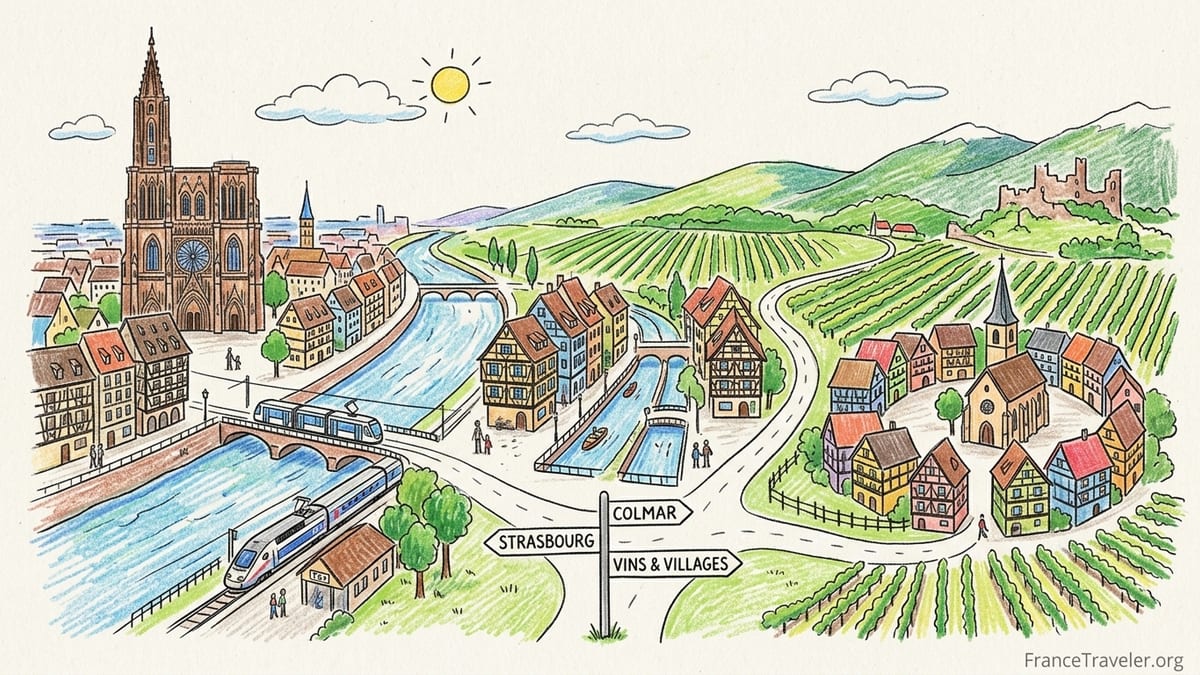
Big city, small city or wine village: the core decision
In Alsace, the real accommodation choice is not between specific hotels but between three distinct types of base. Strasbourg is the regional capital, a substantial city with a Gothic cathedral, tram network and a busy TGV station on the edge of its historic core. Colmar is a smaller, gentler city built around canals and half-timbered lanes, with its own TGV station only a short walk from the old town. Then there are the wine villages and rural stays that stretch along the 170 kilometre Alsace Wine Route between Marlenheim in the north and Thann in the south, home to famous names such as Eguisheim, Riquewihr and Kaysersberg.
Strasbourg suits travellers who want museums, river trams, bars and restaurants open late, plus effortless rail access to Paris and other regions. Colmar is ideal if you imagine most of your days among vineyards and storybook villages, with short drives or bus rides to Eguisheim, Turckheim, Kaysersberg and Ribeauvillé, all broadly within about 30 minutes by road from the city. Wine villages themselves are magical once the day-trippers leave, but they can have limited evening dining options and weaker public transport, which pushes many visitors either toward renting a car or joining organised tours from Strasbourg or Colmar.
Beyond those three, there are secondary choices. Obernai and similar small towns give a half-way option between city and village, with a train station and a compact old centre on the northern half of the Wine Route. Mulhouse and the southern wine belt near Guebwiller or Rouffach are practical if you are arriving via Basel or focusing on the southern vineyards. A final category is the Vosges foothills and rural bases, where you sleep in a farmhouse inn, spa hotel or chalet-style lodge above the vines and accept that a car is almost essential.
To decide, think first about how much time you want to spend inside a city versus on village lanes or in the countryside, and whether you are willing to drive. A three-night stay without a car looks different from a week-long trip with a rental in the driveway. Once that framework is clear, it becomes easier to choose between Strasbourg, Colmar or one of the wine villages instead of trying to do everything from everywhere.
Strasbourg: best for big-city energy and rail connections
Strasbourg is the natural gateway to Alsace for many visitors. High speed trains from Paris typically take around 1 hour 45 minutes on the LGV Est line, depositing you at Strasbourg’s main station, which sits just outside the historic centre and is linked to the Grande Île by trams and pedestrian routes. From here, regional TER trains run south along the Rhine valley through Sélestat and Colmar to Mulhouse and Basel, making Strasbourg a powerful car-free base for day trips by rail.
Within the city, you rarely need a car. The tram and bus network covers the centre and suburbs, while the old town, Petite France quarter and cathedral area are compact enough to explore entirely on foot. Parking for those who do drive is concentrated in underground garages at the edge of the historic core or in park and ride lots tied to the tram lines, which can feel expensive over several days but removes the stress of navigating narrow streets. Car use really only makes sense here if you plan frequent runs out into the countryside and prefer to return to an urban hotel each night.
Strasbourg’s restaurant and nightlife scene is the richest in the region. Around the cathedral, in Petite France and along rue des Juifs and rue des Frères, you find traditional winstubs serving choucroute, tarte flambée and local wines, alongside modern bistros and international options. On most nights outside the very quietest weeks in January, you can still sit down for dinner after 9 pm, something that is far from guaranteed in a wine village. Bars, riverside terraces and student haunts around the university keep the city lively after dark, and there are concert venues and theatres if you want more structured evening entertainment.
For Christmas, Strasbourg is one of Europe’s flagship market cities, with the Christkindelsmärik and satellite markets scattered across the Grande Île from late November through December. That atmosphere comes with practical consequences. Rooms near the centre are often booked months in advance, weekend rates climb, and security controls mean some streets are pedestrian-only at peak times. If you want to combine Strasbourg’s markets with quieter forays along the Wine Route, consider staying close to the station or a tram stop so early regional trains remain easy to catch.
Colmar: central crossroads for the Wine Route
Colmar sits roughly in the middle of the Alsace Wine Route, and that centrality is its biggest strategic advantage. The city’s TGV station lies only a few minutes on foot from the old town, and high-speed services connect from Paris in about 2 hours 50 minutes without requiring a change in Strasbourg. Regional TER trains link Colmar north to Sélestat and Strasbourg and south to Mulhouse and Basel, while local buses fan out into nearby villages that do not have their own railway stations, including Eguisheim, Kaysersberg, Ribeauvillé and Riquewihr.
Because Eguisheim and Turckheim are roughly 10 to 15 minutes away by road, and Kaysersberg, Riquewihr and Ribeauvillé around 20 to 30 minutes, Colmar makes it realistic to visit several wine villages on separate half days without spending hours in transit. Many small-group tasting tours and minivan operators use Colmar as a starting point for half-day or full-day loops through the central Wine Route, stopping at a mix of postcard villages and family wineries. For travellers who prefer not to drive after drinking, this concentration of wine-tour departures is a major advantage.
Colmar itself offers enough urban life to fill a relaxed stay without feeling overwhelming. The old town is highly walkable, with canalside streets in the so-called Little Venice quarter, colourful half-timbered houses, and attractions like the Unterlinden Museum and Bartholdi Museum. Restaurant choice is broad for a town of its size, with winstubs, wine bars and contemporary French kitchens dotted around the centre. Evening life is quieter than Strasbourg, but you can still find a late drink near Place de la Cathédrale or Place de l’Ancienne Douane, and there is usually more going on than in the surrounding villages.
At Christmas, Colmar’s old town hosts several markets in close walking distance, notably around Place des Dominicains and Place Jeanne d’Arc. It is easier to stroll between them without the crowds that throng Strasbourg’s cathedral square at peak times, yet you still wake up among decorated half-timbered facades and illuminated canals. For a December base, Colmar strikes a balance between festive atmosphere and practical access to the wine villages, which often run their own smaller markets on different Advent weekends.
Obernai and northern Wine Route towns: halfway between city and village
North of Colmar and south of Strasbourg, small towns such as Obernai, Barr and Mittelbergheim sit near the northern section of the Wine Route. Obernai is the best known of this group and functions as a useful compromise base. It has its own railway station on the line between Strasbourg and the southern Rhine cities, which means you can travel to and from Strasbourg by train in under 30 minutes on many services, then walk into the walled old town from the platform.
With cobbled streets, a central square and surrounding vineyards, Obernai feels more like a large village than a city, yet it has a good spread of restaurants and shops. You can expect several places around the main square and side streets to serve dinner until a reasonable hour, especially in summer and on weekends, although the choice thins out later in the evening compared with Strasbourg. Nightlife is modest, focused on wine bars and cosy inns rather than clubs, so evenings tend to wind down earlier.
For drivers, Obernai and similar bases are well placed for exploring both directions of the Wine Route and the nearby Vosges foothills. The vineyards rise almost immediately behind the town, and routes like the vineyard cycle way and local roads thread south through Mittelbergheim, Andlau and Dambach-la-Ville, or north toward Marlenheim, without the need to navigate big-city traffic. Parking is generally easier and cheaper than in Strasbourg, with surface lots and hotel spaces more readily available, although the most central spots can still fill on market days or during events.
Public transport beyond the main rail line is more limited, which matters if you plan to base here without a car. Buses reach some surrounding villages, but frequency can drop sharply in the evening or on Sundays. Wine-tasting tours from Strasbourg or Colmar sometimes include pick-ups in the Obernai area, but these need to be checked case by case. If your priority is to wake up in a village-like setting and still have quick rail access to Strasbourg and its cathedral, Obernai is appealing, but you should be comfortable with a quieter nightlife and plan day trips a bit more carefully.
Staying in a central Wine Route village: Eguisheim, Riquewihr, Kaysersberg
For many travellers, the dream version of an Alsace trip is waking up inside a wine village, with flower-decked half-timbered houses outside the window and vineyards rising up the slopes. Central Wine Route villages such as Eguisheim, Riquewihr and Kaysersberg deliver exactly that atmosphere. All three are officially recognised for their heritage and beauty and sit among the densest stretches of vineyards in Alsace. The trade-off is that none of them has a mainline railway station, and local buses may run only every hour or two, with fewer services in the evening or on Sundays.
If you have a car, these villages become superb bases. Distances between them are short, often measured in just a few kilometres. Kaysersberg is roughly a dozen kilometres from Colmar, Riquewihr lies around ten kilometres from Kaysersberg and about five from Ribeauvillé, and Eguisheim sits around seven kilometres south of Colmar. This means you can string together gentle loops through several villages plus a castle such as Haut-Koenigsbourg and still be back at your guesthouse by late afternoon. Parking during the day can be tight and sometimes paid, but guests usually receive access to a reserved space or small hotel lot.
Without a car, you will need to pay close attention to bus timetables or rely on taxis for the last stretch from Colmar or Sélestat. Some regional buses link Colmar with Eguisheim, Kaysersberg and Ribeauvillé, and seasonal services or hop-on hop-off routes operate in the central Wine Route during busy periods, but chaining three or four villages in one day using only public transport is often awkward. Many wine-tasting minivan tours do, however, pick up directly from central villages or offer departures that stop at Colmar station, so it is possible to build an itinerary where you hardly touch the bus network once you arrive.
Atmosphere after dark is where these villages shine. Once coaches and day visitors depart, streets that were crowded in the afternoon become hushed and lantern-lit, with the scent of wood smoke and the silhouette of church spires against the hills. A few inns and winstubs stay open for dinner, and in high season you can often dine on shaded terraces with vineyard views. However, choice thins out later in the evening, and many kitchens close earlier than big-city visitors expect. You cannot assume you will be able to stroll out at 9.30 pm and still find multiple restaurants taking walk-ins, particularly on weeknights outside summer and December.
For wine-focused trips, spending at least two or three nights in a village like Eguisheim or Riquewihr lets you walk to nearby wineries for tastings and explore local paths between vineyards on foot. It is easy to plan a morning cellar visit, a long lunch in a winstub, and an afternoon hike to a neighbouring village without needing to start the car. This slow rhythm is the opposite of a city-break schedule, so it suits travellers who want to decompress and accept that evenings will be quiet.
Southern Alsace, Mulhouse and the lower Wine Route
Although many visitors never stray far from Strasbourg and Colmar, southern Alsace offers some reasons to base further down the line, especially if you are arriving or departing through Switzerland. Mulhouse sits on the same Strasbourg to Basel railway axis as Colmar, and trains continue from here to Basel and onward to Zurich. That makes Mulhouse a pragmatic stop for itineraries that combine Alsace with Swiss cities or the Alps, or for travellers picking up long-distance trains at Basel.
Mulhouse itself has a more industrial history than Strasbourg or Colmar, reflected in its architecture and museums. It is less instantly picturesque, but it does offer big-city services, shopping centres and a wider range of budget-friendly accommodation, which can appeal to families or longer stays. The city is best known among enthusiasts for its transport museums, including major collections of cars and trains, which can fill a rainy day. At night, central Mulhouse has bars and brasseries open later than in village settings, though the atmosphere is more urban than quaint.
South of Colmar, the Wine Route continues through areas around Rouffach, Guebwiller and Cernay before reaching Thann at the southern end. Villages here receive fewer foreign visitors than the famous central stretch, but drivers will find plenty of cellar doors and hillside viewpoints. Public transport runs along the valley floor, with buses or local lines connecting out to some wine towns, but frequencies are limited compared with the main Strasbourg to Colmar to Mulhouse rail axis. For a car-based trip that also aims to cross into the Vosges mountains on the Route des Crêtes, a base near Guebwiller or Cernay can shorten driving times.
For Christmas trips, southern Alsace has smaller markets that complement those in Strasbourg and Colmar. Mulhouse often dresses its historic centre in textile-inspired decorations that reference the city’s industrial heritage, while Thann and nearby towns hold local markets on Advent weekends. These can be charming but do not match the scale of Strasbourg’s Christkindelsmärik or central Colmar’s clusters of stalls, so they work best as additions rather than replacements for the headline markets further north.
Vosges foothills and rural bases: inns, spas and quiet nights
Above the vineyards, the Vosges foothills and ridges offer a different kind of Alsace stay. Here, small inns, spa hotels and chalets sit among forests and pastures, and the main sounds at night are cowbells and wind in the trees rather than church bells and café chatter. Villages such as Munster in the Fecht valley or smaller hamlets off the main Wine Route give access to hiking trails, viewpoints and lakes, with the vineyards visible far below on clear days.
These rural and mountain bases almost always presuppose a car. While some valley towns have railway stations and bus links, accommodation that truly feels remote in the hills is rarely within walking distance of frequent public transport. Forest roads and minor passes can be winding or snow-affected in winter, so drivers should be comfortable with mountain conditions, especially if visiting between November and March. In return, you gain quick access to panoramas on the Route des Crêtes and to walking routes that can traverse from village to village through vineyards and woods.
Restaurant choice in the Vosges is shaped by the rhythm of half-board stays and spa packages. Many hotels run their own dining rooms that serve hearty dishes featuring Munster cheese, cured meats and regional wines, sometimes included in half-board rates. Outside those, standalone restaurants may be spread out and require short drives. After dark, the atmosphere is peaceful rather than lively. A glass of Riesling in a lounge with a fire or a soak in an outdoor hot tub under clear skies replaces bar-hopping, which can be exactly what some travellers are seeking from a mountain break.
Day-trip options from a Vosges base can extend beyond wine and villages. In summer, you can pair morning hikes with afternoon visits to lakes or alpine farms. In winter, small ski areas and snowshoe routes sit within reach of car parks off the main passes. Reaching Strasbourg or Colmar for day visits is still possible by car, but you will spend more time driving back and forth than if you had based in the plain. As a result, mountain stays work best for longer trips where you can devote two or three days purely to the hills, while still allocating separate nights in Strasbourg or Colmar at the start or end of the journey.
How bases compare for access, dining, nightlife and tours
Viewed side by side, the strengths of each Alsace base become clearer. Strasbourg and Colmar both have TGV stations within walking distance of their historic centres, making them the prime options for car-free travellers or anyone arriving directly from Paris or other French cities by high speed rail. Obernai and similar small towns add the security of a rail connection, but usually with slower regional services. Wine villages and rural Vosges bases lack mainline stations, so even when bus links exist, they are more suited to leisurely itineraries or visitors willing to use taxis and tours.
Car usefulness follows the same pattern in reverse. In Strasbourg, a car can feel like a burden because of narrow streets, traffic restrictions and parking costs. Colmar is friendlier to drivers but still compact enough to navigate on foot once you arrive. In wine villages, a car often unlocks the best experiences, turning a string of short hops between villages and viewpoints into an easy loop. In the Vosges, it is close to essential. For travellers building their routes around wine tastings, one common approach is to stay in Colmar or Strasbourg and use minivan tours for days that include multiple cellar visits, then rent a car only for non-tasting days focused on castles, hiking or independent village exploration.
Restaurant choice and nightlife also differ markedly. Strasbourg offers the widest spread of cuisines and price points, with many places serving until later in the evening and a genuine bar scene. Colmar has a rich restaurant offering, but evenings are calmer, and many venues focus on diners rather than drinkers. Obernai and southern towns like Mulhouse fall somewhere in between, with enough options to vary your meals over several nights but fewer late-night venues. Wine villages and rural inns can be wonderful for atmospheric dinners, especially on weekends or in high season, yet they often have a narrow window for evening service and very little going on after 10 pm.
For Christmas markets and tasting-tour pick-ups, Strasbourg and Colmar dominate. Both cities host large, long-running markets from late November to December, and both act as starting points for many guided excursions. Operators commonly advertise pick-ups at central hotels or near the main stations, as well as in certain well-known villages along the Wine Route. Wine villages may host their own Advent markets and small events on specific weekends, but these are best reached by car or as part of a tour, since public transport frequencies can be limited on winter evenings.
The takeaway: which base for your style of trip
For a three-day stay, Strasbourg works well if you want one day exploring its cathedral, canals and museums, plus one or two days on simple rail or bus excursions. You might spend day two in Colmar and a nearby wine village reached by a shuttle or tour, and day three visiting a cross-border city such as Kehl in Germany or returning to your favourite Strasbourg quarter. If you prefer the wine villages above all else, making Colmar your three-night base allows you to discover the old town on arrival day and use the remaining days for short loops into Eguisheim, Kaysersberg or Riquewihr.
For a five-day stay, consider splitting time between bases. Two or three nights in Strasbourg give you urban energy, international rail access and the major museums, while two or three nights in a wine village such as Eguisheim or in the Vosges foothills provide the quiet, vineyard walks and castle views many visitors picture when they think of Alsace. This split itinerary reduces backtracking and lets you experience the region’s contrasts instead of commuting daily from one base to very different landscapes.
If you are travelling car-free, Strasbourg and Colmar are the strongest options, with a slight edge to Colmar if your main aim is to explore the Wine Route. Both have stations on the north south line that runs along the Rhine valley, frequent regional trains and dense cores that reward walking. From either, you can join organised wine tastings and small-group tours that visit multiple villages in a day. Between the two, Strasbourg offers more big-city life and nightlife, while Colmar positions you closer to clusters of central wine villages that can be reached by short bus rides, taxis or e-bike rentals.
For a Christmas trip, stay in Strasbourg if you want to immerse yourself in one of Europe’s largest and oldest Christmas markets, with nightly walks among cathedral squares and bridges draped in lights. Choose Colmar if you prefer a slightly calmer setting where several markets are packed into a compact medieval centre and day trips to illuminated wine villages are shorter. Wine villages themselves can be enchanting on December evenings, with half-timbered houses outlined in lights, but accommodation sells out early and logistics without a car can be demanding.
For a wine-focused itinerary, make at least part of your stay in a central Wine Route village such as Eguisheim, Riquewihr or Kaysersberg, especially if you are comfortable driving short distances between tastings and scenic stops. If you prefer to avoid driving after sampling wines, base in Colmar and rely on operators that offer dedicated tasting tours along the central route. Families might gravitate toward Strasbourg or Colmar, where playgrounds, varied food choices and museums break up village visits, with perhaps a night or two in the Vosges for outdoor walks and cheese farms. In every case, knowing whether you crave city buzz, village calm or mountain air will point you quickly toward the Alsace base that turns a good trip into a great one.
FAQ
Q1. Is Strasbourg or Colmar a better base without a car?
Strasbourg is better if you prioritise big-city life, museums and restaurants, while Colmar is more central for short trips into the main Wine Route villages. Both have TGV stations on the edge of their historic centres and frequent regional trains along the Rhine valley, so the choice comes down to whether you want more urban energy or easier access to vineyards.
Q2. Can I stay in a wine village in Alsace without renting a car?
It is possible but requires more planning. Villages such as Eguisheim, Riquewihr and Kaysersberg are linked to Colmar by regional buses and seasonal services, and some wine-tasting tours collect guests directly from central villages. However, frequencies can be low in the evening or on Sundays, so you will have a more relaxed experience if you are comfortable using taxis or focusing on a smaller radius that can be explored on foot.
Q3. Which wine village makes the best base for first-time visitors?
Eguisheim is often suggested for first-timers because it combines circular medieval streets, abundant flowers in season, and proximity to Colmar only a short drive or bus ride away. Kaysersberg and Riquewihr are equally charming, with ruined castles and cobbled lanes, but they sit slightly further from Colmar and can feel busier during daytime peak hours, which is worth considering if you value quiet.
Q4. How far are the main Alsace wine villages from Colmar?
Distances are short by car. Eguisheim and Turckheim are roughly 10 to 15 minutes away, while Kaysersberg, Riquewihr and Ribeauvillé are around 20 to 30 minutes along local roads. This compact geography is why Colmar is often described as the most central base for exploring the Wine Route, letting you visit different clusters of villages on separate days without long drives.
Q5. Is parking difficult in Strasbourg and Colmar?
In Strasbourg, parking near the cathedral and Petite France is limited and usually paid, so many drivers use underground garages or park and ride lots linked to the tram network. Colmar has a mix of surface lots and underground car parks around the edge of the old town; these can fill at peak times such as Christmas market evenings, but with a bit of flexibility it is usually easier to find a space than in central Strasbourg.
Q6. Are Alsace Christmas markets easy to visit by train?
Yes. Strasbourg and Colmar both sit on a main north south railway line with frequent regional services, so it is straightforward to visit one from the other in a single day by train. Many travellers stay in one city and day-trip to the other’s markets, then add shorter bus or tour-based visits to wine villages that host their own Advent events on selected weekends.
Q7. What is the best base in Alsace for families?
Families often find Strasbourg or Colmar easiest because they combine pedestrian-friendly historic centres with parks, playgrounds and a range of family-oriented restaurants. From either city you can add short excursions to wine villages, castles and, in Strasbourg’s case, boat trips on the river. If your children enjoy outdoor activities, a couple of nights in the Vosges foothills near Munster or between the vineyards and the crest roads can add hiking and farm visits to the mix.
Q8. How many nights should I spend in a wine village versus a city?
For trips around five nights, many travellers split their time, spending two or three nights in Strasbourg or Colmar for museums, markets and rail connections, and two or three nights in a wine village or rural inn for quiet evenings and vineyard walks. On shorter trips of three nights, choosing a single base is usually simpler, with Colmar and its nearby villages offering a particularly efficient mix of city comforts and wine-country access.
Q9. Is Mulhouse a good alternative base for exploring Alsace?
Mulhouse is useful if you are combining Alsace with Basel or Zurich, since regional and international trains run south from here into Switzerland. The city offers more budget-friendly accommodation and notable industrial and transport museums, but it is less central for the classic wine villages than Colmar. It works best for travellers who value rail connections and urban services over being surrounded by vineyards.
Q10. When should I book accommodation in Alsace’s most popular bases?
For peak periods such as December Christmas markets, spring weekends and late summer, it is wise to book Strasbourg, Colmar and famous wine villages several months ahead, especially if you want central locations or specific guesthouses. Outside those peaks, you generally find more flexibility, but small inns in sought-after villages and rural spa hotels can still fill quickly on weekends, so advance reservations remain prudent.