


After several trips up and down the Alsace Wine Route, I have stopped trying to “collect” villages. I no longer chase every name on the official Route des Vins brochures or the glossy France tourism roundups. Instead, I focus on a handful of places where I have actually stayed, eaten, searched for parking, and wandered after the last day-trippers drove away. This is a personal ranking of where I would spend my own limited time if I were planning another week in Alsace tomorrow.
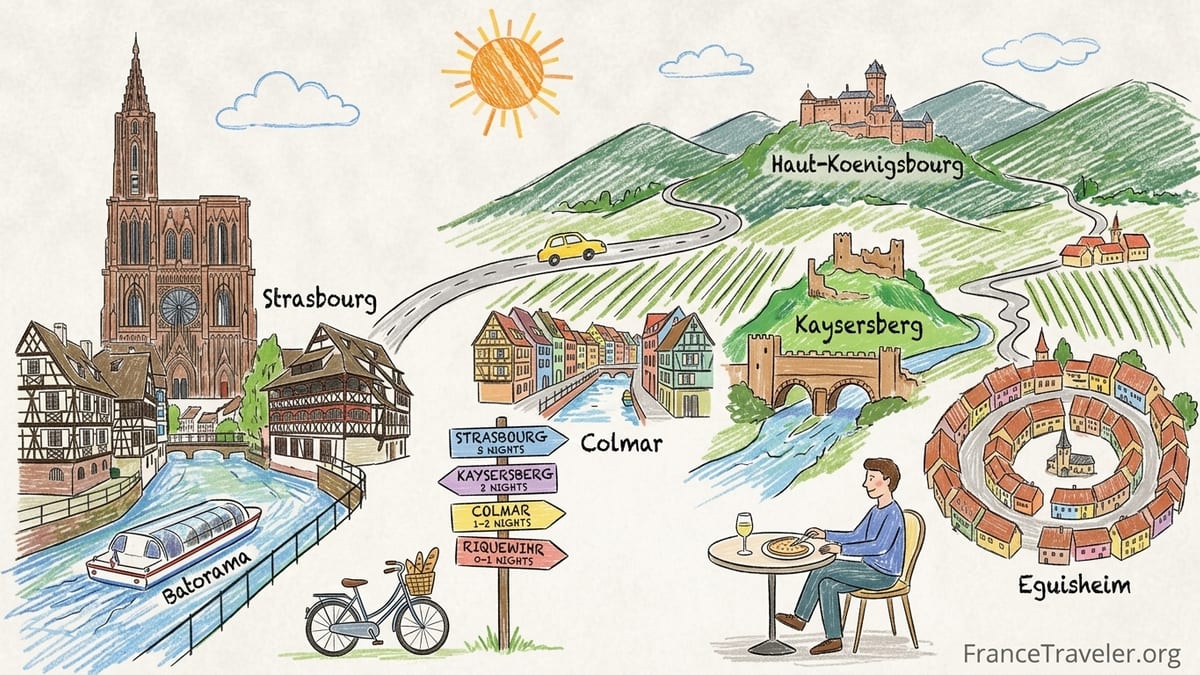
How I Chose: Less Checklist, More Real Days on the Ground
My ranking is based on real stays, not a drive-by in the middle of a rushed day tour. In each place below, I note roughly how long I stayed, whether that felt like too much or not enough, and how the practical details played out in reality. That includes parking versus train access, how the streets felt at noon compared with 10 p.m., and whether I could actually find a dinner table without booking a month ahead.
I also wanted this to complement official material rather than repeat it. The Alsace Wine Route promotes Bergheim, Kaysersberg and Eguisheim as celebrated villages, while national tourism campaigns often highlight Riquewihr and Obernai as perfect Wine Route snapshots. Those suggestions are not wrong, but they can push first-time visitors into the same crowded corners. Here I focus on what stood out after the brochures were folded away: which places had depth when I was tired, hungry or stuck in the rain, and which ones felt hollow once the postcard photo was taken.
Finally, I deliberately keep local attraction lists short. Alsace villages are compact. If you treat them as museums with a dozen “must-see” sights each, you will be exhausted and, frankly, miss the point. A village hub should leave you time to sit with a glass of Riesling and watch the evening settle over the half-timbered roofs, not sprint from one plaque to the next.
Strasbourg: My Base for Architecture, Water, and Real Urban Life
On my most recent circuit I spent three full nights in Strasbourg and it still did not feel like enough. I would not go below two nights here. Strasbourg is where Alsace feels like a living European city rather than a string of museum-villages. The Gothic bulk of the Notre-Dame Cathedral dominates the historic center, and the official tourism office describes it as the city’s absolute showpiece of Gothic architecture, with a richly carved facade and a celebrated astronomical clock inside. You can easily spend a full morning just circling the exterior and then climbing to the platform for broad views across the tiled roofs and out toward the Vosges foothills.
What makes Strasbourg different from Colmar and the wine villages is the combination of water and working city life. Boat tours on the Ill, run by local operators such as Batorama, loop you around the half-timbered quarter of La Petite France, the European Parliament district, and back past the cathedral in roughly an hour, according to the Strasbourg tourism office’s river tour guides. That single circuit helps first-time visitors understand how the old town sits like an island in the river, with tram lines and bike paths radiating outward into modern neighborhoods.
Practically, Strasbourg is the easiest entry point for most international visitors. The central station is connected by frequent high-speed trains to Paris, and the tram from the station drops you in the heart of the Grande Île in a few minutes. I chose a hotel just outside the pedestrian core so that I could keep a rental car in an underground garage without wrestling with medieval lanes. For a car-free stay, I would aim even closer to the tram stops around Homme de Fer and walk into the center.
Evenings are where Strasbourg really wins. Unlike many wine route villages, the city does not shut down after dinner. Bars around Place du Marché Gayot and the streets east of the cathedral stay lively, and there is a noticeable local crowd mixed with visitors. I never felt the need to “protect” evening space here. If anything, I wished I had one more night for a contemporary restaurant on the Krutenau side of town instead of repeating tarte flambée in the old quarter.
Colmar: Concentrated Scenery in One or Two Nights
I have spent everything from a rushed afternoon to two full nights in Colmar. My conclusion is that one or two nights is the sweet spot. Colmar condenses many of the clichés people associate with Alsace into a walkable package: canals in the Petite Venise district, painted half-timbered houses, and a tight old town that can be crossed in ten or fifteen minutes on foot. It is unfailingly photogenic, which is why it is also unfailingly busy.
Arriving by train is very straightforward. Colmar’s station sits about a fifteen-minute walk from the old town, along broad, safe avenues. This makes it an excellent car-free base if you want to visit wine villages using local buses or seasonal services such as shuttle buses that link Colmar with nearby wine route stops at certain times of year. The city’s tourism office publishes updated maps that show both the tourist trail through the center and the main public parking garages, which is useful if you are combining rail and rental car.
Parking by car is workable but requires some planning. The Colmar tourist office lists multiple paid car parks around the center, along with digital payment options through services such as PayByPhone, Easypark and Flowbird. In practice, I found it easiest to choose a hotel or guesthouse that included garage space and then leave the car parked while I explored on foot. Once you are in the old town, a car is more of a liability than an asset.
Evenings in Colmar are mixed. In high season and during the Christmas markets, the core stays animated, sometimes overwhelmingly so, with restaurants around Petite Venise full of visitors well into the evening. At other times of year, things quieten noticeably after about 9:30 p.m. That can be pleasant if you pick a quieter side street for dinner, but if you are seeking a deep bar scene or late-night culture, Strasbourg is a better bet. I now treat Colmar as a picturesque two-night interlude rather than the centerpiece of an Alsace trip.
Kaysersberg: The Village I Would Always Return To
Out of all the wine route villages I have slept in, Kaysersberg is the one I would most eagerly book again. I have stayed twice, for one and then two nights, and in both cases wished I had added at least one extra night. The draw here is atmosphere rather than a list of marquee sights. The village straddles a small river spanned by a fortified stone bridge, its lanes crowding up toward the ruins of a castle on the hillside. The official Wine Route material describes Kaysersberg as one of the celebrated villages of the route, and for once that label matches the lived experience.
Kaysersberg sits directly on the Alsace Wine Route, surrounded by vineyards, and the village was even voted a favorite village of the French in a national poll a few years ago, which reflects how strongly it resonates with domestic visitors. The mix of river, stone, and timber gives it a depth that some postcard-perfect places lack. I enjoyed simply looping up to the castle ruin in the late afternoon, looking out across the straight green lines of vines, then dropping back into the streets as the day visitors filtered away.
Parking here is far easier than in some more famous neighbors, provided you accept that you will park just outside the densest core and walk in. The local municipality publishes a clear plan of the historic center with designated parking zones on its website, and when I followed the visitor signage I usually found a spot within a few minutes. Once you have checked into a guesthouse, there is no reason to move the car for at least a full day.
Evening atmosphere is Kaysersberg’s strongest card. After about 6 p.m., when coach groups and road-trippers leave, the village feels almost like a private stage set. A handful of winstubs and small restaurants remain open, serving local specialties and bottles from estates whose vines you can see just beyond the last houses. It never felt overrun at night, even in December when Christmas lights reflected off the river. If you want a wine route base with charm and breathing room, this is where I would put at least two nights.
Riquewihr: A Classic I Would Not Rush Back To
Riquewihr is the famous name I now recommend with caution. I have visited three times, always as a day trip, and each time left more certain that I would not choose to stay there overnight. On paper, it is close to perfect: classified among the most beautiful villages in France, sitting on the Route des Vins, and highlighted on France’s national tourism platforms as a representative wine village, known for Riesling and its intact medieval streets.
The problem is not the architecture. The main street, lined with high half-timbered houses leaning inward above cobbled lanes, really does look like an illustration from a storybook. The issue is the intensity of visitors in a limited space. A regional travel guide notes that from roughly late morning to mid-afternoon in the main season and during December weekends, Riquewihr becomes one of the busiest villages on the route. My own experience matches that: between about 11 a.m. and 4 p.m., the central street turns into a slow-moving queue in both directions.
Parking underscores the problem. The village website explains that visitors should use signed paid car parks outside the walls, including the large Vignoble parking area, with hourly fees that increased again in 2024. Local information puts short-stay rates in the range of a few euros per hour, and visitor reports describe bottlenecks when payment machines malfunction or multiple coaches arrive at once. I have spent too many minutes here shuffling through hot asphalt car parks to feel any romance about arriving by car.
Would I say never go? No. Riquewihr is worth a first look, ideally either early in the morning or late in the day when tour buses have gone. I enjoyed visiting a small wine cellar on a side street and walking a short loop into the vineyards behind the walls. But compared with Kaysersberg or quieter villages like Bergheim, Riquewihr felt too stage-managed and tourism-focused for me to choose it as a hub. When friends plan a short Alsace trip, I now suggest one well-timed visit rather than precious nights here.
Eguisheim: Compact Circles and Car-Free Charm
Eguisheim is the kind of place that rewards guests who slow down. I have visited twice for long afternoons and one overnight stay. The village is celebrated in official Wine Route material and regularly appears in lists of France’s prettiest villages, yet it somehow still feels gentler than Riquewihr. What makes it special is its layout. Eguisheim is built in concentric circles of lanes around a central square and fountain, so wandering feels like spiraling slowly outward through rings of cottages, flower boxes, and wine cellars.
Because Eguisheim is compact, a single night is enough to absorb its character, though two nights would allow time for a vineyard walk and a lazy afternoon in a café. I arrived both by car and, on another trip, using a combination of bus from Colmar and a short taxi ride. Approaching by public transport takes more effort but means you enter the village on foot, through low stone archways, without the stress of finding a parking place.
For drivers, parking is organized mainly in signed lots on the edges of the village. Local information boards point visitors to pay-and-display areas just outside the old circular streets, and staying in a guesthouse often comes with access to a space in one of these lots. I learned to park once, then forget the car until I was ready to leave for the next village. Inside the rings, lanes are narrow and mostly for pedestrians, which keeps noise and traffic down in the evenings.
Eguisheim’s evening mood is one of quiet lamps and clinking glasses rather than music and crowds. A few winstubs and wine bars remain open, serving local Pinot Gris and Crémant d’Alsace, but after about 9 p.m. the village is calm. For some visitors that will feel too sleepy. For me, it was ideal after a day cycling through nearby vineyards. If your priority is compact village character and you are comfortable with a limited choice of restaurants, Eguisheim deserves at least one night of your itinerary.
Obernai and Bergheim: Two Quieter Priorities
Obernai and Bergheim do not always headline international guides, but after staying in or near both, I now rank them higher than some of the more famous names. I first used Obernai as an overnight stop almost by accident, then returned for a longer two-night stay. The town appears in national tourism promotions as a representative stop on the Alsace Wine Route, but on the ground it feels more like a small working town that happens to be incredibly pretty. The central square with its belfry, market halls, and line of cafés is lively without tipping into chaos.
Practicalities favor Obernai as a base. It has a train station, which ties it directly into the Strasbourg rail network, and a decent amount of everyday commerce: bakeries, supermarkets, local clothing shops. Several travelers who had toured the wine route described Obernai as notably less busy than other spots, especially compared with crowd magnets like Riquewihr, and that matches my own impressions on both a midweek autumn visit and a December market trip. Parking is relatively straightforward around the ring roads and in municipal lots.
Bergheim is where I would send anyone looking for a quieter alternative on the central wine route itself. The village is officially highlighted among the celebrated wine route villages, but on my visits it saw a fraction of the visitors I encountered in neighboring stops. Bergheim is still encircled by substantial medieval walls that you can walk along in short stretches, and the main street feels residential once you step away from the handful of wine cellars and restaurants.
I have only spent long afternoons in Bergheim, not nights, but next time I would happily book a two-night stay here as a base for exploring nearby vineyards by car or bike. Parking directly outside the walls is usually possible, and from there the village can be crossed on foot in minutes. Even in high season, I found empty benches under plane trees and side alleys where the only sounds were swallows and distant church bells. If you want to keep your village hub from feeling like a stage set, Bergheim is an excellent candidate.
Vosges Castles and Hills: Essential Variety Beyond the Vines
However pretty the wine route villages are, an Alsace trip that never leaves the valley floor feels incomplete. I always try to spend at least one long day in the Vosges or around a major castle, both for the views and to reset my sense of the region. The most famous castle, Haut-Koenigsbourg, sits on a ridge above the wine route between Sélestat and Ribeauvillé. I have visited twice, once driving up from Colmar and once detouring between Obernai and Kaysersberg.
Haut-Koenigsbourg itself is heavily restored and unabashedly popular, but it earns its place in this ranking because it breaks the pattern of low stone houses and timber facades. From the ramparts you can see the checkerboard of vineyards below, with the Rhine plain stretching toward Germany. It is a rare place in Alsace where you can step back and physically see how all the villages you have been visiting line up along the foot of the mountains. Parking is arranged in paid lots below the castle entrance; I arrived shortly after opening to avoid queues and found a space close enough to walk up in a few minutes.
Beyond the castle, the Vosges offer quiet alternatives that I now consider essential. Short hikes above Kaysersberg, for example, lead through forested slopes to viewpoints and farm inns, where you can eat a simple meal of munster cheese, potatoes and local charcuterie at wooden tables. On another trip I spent a cool, misty day following a ridge road between passes, stopping at a lake for a walk and coffee. None of those stops appear in the major brochures, but they gave the trip a dimension I still remember far more clearly than my third or fourth half-timbered village.
If you are driving, set aside one day to leave the wine route entirely. Choose a loop that combines a castle, a mountain pass, and perhaps a lunch stop at a ferme-auberge. If you are traveling by train and bus, consider booking a guided day trip from Strasbourg or Colmar that includes the Vosges; local operators often combine Riquewihr or Kaysersberg with Haut-Koenigsbourg in a single excursion. Either way, that change in altitude and scenery keeps Alsace from collapsing into one long village photograph.
The Takeaway
Looking back over repeated visits, the places that stayed with me in Alsace were not necessarily the most photographed ones. Strasbourg stands out for its cathedral, waterways, and lived-in urban rhythm. Colmar offers a compact burst of postcard charm that is worth one or two nights but not a full week. Kaysersberg, with its river, castle ruin, and gentle evenings, is the village I would book again without hesitation. Eguisheim, Obernai, and Bergheim each provide their own balance of character and calm, and deserve more attention from travelers who want to avoid the heaviest crowds.
Riquewihr, despite its beauty and rightful place in official promotions, is the one spot I would now treat as a carefully timed detour rather than a base. Its density of visitors, parking stress and tourism-focused main street left me satisfied with a half-day but not hungry for more. In contrast, quieter corners along the wine route and up in the Vosges hills gave the region space to breathe. A morning walking ramparts in Bergheim or an afternoon above the tree line in the mountains did more to round out my understanding of Alsace than another circuit of souvenir shops.
If I were planning one more weeklong trip to Alsace tomorrow, I would divide my time between Strasbourg, Kaysersberg or Eguisheim, and a quieter base like Bergheim or Obernai, with at least one full day given to the Vosges and a single, strategic visit to icons like Riquewihr and Haut-Koenigsbourg. That mix keeps the essential highlights while preserving what makes the region special once the camera is back in the bag: the slow shift of light on half-timbered facades, the ritual of an evening glass of wine, and the feeling that you are not just collecting villages, but actually living in them for a while.
FAQ
Q1. How many nights should I spend in Strasbourg versus the wine villages?
For a week in Alsace, a balanced plan is two or three nights in Strasbourg for museums, the cathedral and river life, then four or five nights split between one or two wine route bases such as Kaysersberg, Eguisheim, Obernai or Bergheim, plus a day in the Vosges.
Q2. Is it better to rent a car or rely on trains and buses in Alsace?
Strasbourg and Colmar work well by train, but a car gives you much more freedom along the wine route and into the Vosges, especially for smaller villages where buses are infrequent or seasonal. If you prefer not to drive, consider basing in Strasbourg or Colmar and using guided day tours to reach wine villages and Haut-Koenigsbourg.
Q3. Which village is best as a first-time base on the Alsace Wine Route?
Kaysersberg is my top choice for a first base, thanks to its river setting, manageable parking and strong evening atmosphere. Eguisheim is ideal if you want compact, car-free charm, while Obernai and Bergheim work well if you prefer somewhere quieter that still has enough shops and services for a longer stay.
Q4. Is Riquewihr still worth visiting if it is so crowded?
Yes, Riquewihr is worth a half-day for its architecture and vineyards, but timing matters. Aim for early morning or evening, park in the signed lots outside the walls, and treat it as a highlight stop rather than your main base so you avoid the heaviest midday crowds and parking stress.
Q5. How easy is parking in Colmar and Strasbourg?
Both cities have structured car parks and signed surface lots, but driving into their historic centers can be stressful. In Strasbourg, I prefer a hotel near a tram line with access to an underground garage. In Colmar, I either book accommodation with parking or use one of the municipal garages shown on the tourist maps and explore on foot from there.
Q6. When is the best time of year to visit Alsace to avoid crowds?
The shoulder seasons of April to early June and late September to early November offer a good balance of open services and fewer visitors, though weekends and school holidays can still be busy. July, August and the Christmas market period draw the largest crowds to hotspots like Colmar and Riquewihr.
Q7. Can I visit the Vosges and Haut-Koenigsbourg without a car?
It is possible but requires more planning. There are regional buses that reach the castle on certain days, and some tour operators in Strasbourg and Colmar run day trips combining wine villages with Haut-Koenigsbourg. If you want full flexibility for hikes and mountain lakes, renting a car for at least a day is the simplest solution.
Q8. Which places in Alsace offer the best evening atmosphere?
Strasbourg has the most varied nightlife, with bars and restaurants staying open later than in the villages. Among the wine route stops, I find Kaysersberg particularly pleasant in the evening once day visitors leave, while Obernai often has a gentle buzz around its main square and Colmar’s core stays fairly active in high season.
Q9. How many villages can I realistically see in one day from Colmar or Strasbourg?
With a car, two or three villages in one day is comfortable; more than that starts to blur together. From Colmar, for example, you might combine Eguisheim and Kaysersberg, or Bergheim and Riquewihr. From Strasbourg, plan on one or two stops plus travel time, especially if you also want to visit a winery or castle.
Q10. Do I need to book restaurants and wineries in advance?
In popular spots like Colmar, Strasbourg and Riquewihr, advance reservations are wise for dinner on weekends and during peak seasons or Christmas markets. In smaller villages, it is often enough to book a day or two ahead once you arrive, especially if you are flexible about exact dining times and happy to try less publicized local addresses.