


I went to Alsace with the kind of itinerary that looks perfect on paper. A ribbon of wine villages, a succession of half-timbered squares, one Christmas market after another. The official brochures talk about a region of castles, mountains, cycling routes, beer, wine, gastronomy and family attractions, and I believed I could somehow do it all in a week. Instead, I built a trip that repeated itself day after day. What follows is not a list of general tips, but the concrete mistakes I made in Alsace and how I would design the same trip very differently now.
Trying to See Every Village on the Wine Route
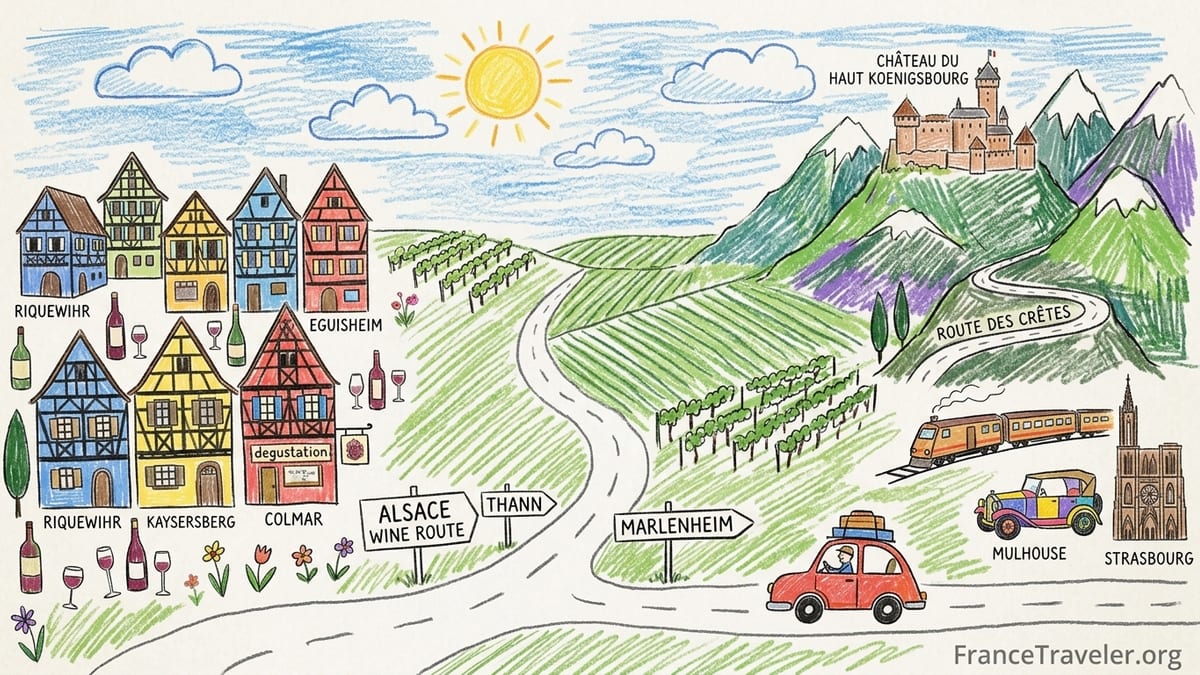
What I planned was the classic first timer’s dream: drive almost the full length of the Alsace Wine Route, which runs for about 170 kilometers between Marlenheim in the north and Thann in the south, touching dozens of villages. I circled names like Riquewihr, Ribeauvillé, Eguisheim, Kaysersberg, Obernai, Bergheim and Turckheim on the official map, then kept adding smaller places whenever I read the words “most beautiful” or “authentic.” In my notebook I had eleven villages penciled in for five and a half days.
What happened on the ground was that the villages blurred together. One morning we left Colmar after breakfast, drove twenty minutes to Eguisheim, wandered its concentric lanes, climbed the church tower, then moved on to Turckheim for lunch, a tasting and a quick look at the old gate. By mid afternoon we were in Kaysersberg, trying to muster enthusiasm for yet another pastel main street lined with winstubs and souvenir shops. By early evening we pushed on to Riquewihr, arriving in time to join a queue at a single busy bakery and walk the ramparts in the last light.
It was a mistake because the Wine Route crosses more than 100 wine growing towns and villages and you simply do not need to see them all to understand why Alsace is beautiful. Official tourism information suggests that the route passes through at least seventy villages, yet I acted as if missing Bergheim or Barr would leave a hole in my understanding of the region. In reality, the extra villages meant more time in parking lots and on short hops along departmental roads, less time lingering on a terrace in one place. By our third day each half timbered house felt like déjà vu.
If I were planning now, I would pick two or three villages to explore in depth and accept that the rest would be glimpsed from the car. For example, I would base for two or three nights around Kaysersberg or Ribeauvillé, choose just one additional postcard perfect stop such as Eguisheim, and let everything else depend on mood and weather. I would plan full half days with no driving at all, giving myself time to walk up to the vineyards above Riquewihr or follow a marked trail above Turckheim instead of racing to the next medieval gate.
Living Almost Entirely on the Wine Route
What I planned was a trip that more or less traced the vineyard road from start to finish. Guidebooks rightly celebrate the Alsace Wine Route as a mythical itinerary and the official tourism board promotes it as a star attraction, highlighting the 170 kilometers of vineyards, cellar doors and flower decked facades. So I booked our bases accordingly: three nights in Colmar, two in a wine village north of it, and a final night further south, all within a short drive of the vines.
What happened is that we spent nearly the entire week inside a narrow corridor between the Rhine plain and the first foothills of the Vosges. Each day began with a quick check of the wine route map and a fresh stretch of the same low road between parallel rows of vines. One afternoon we detoured slightly to see the fortified church of Hunawihr, another day we went up just far enough to visit the three castles of Ribeauvillé, but the rhythm was identical: breakfast in a wine town, drive to another wine town, tasting, lunch, repeat.
It was a mistake because Alsace is far bigger than the strip of land marked by signposts for the Route des Vins. The regional tourism board promotes not only wine, but also beer routes, the 131 kilometer Vineyard Cycle Route that runs parallel to the wine road, family parks, the Route des Crêtes in the Vosges and a necklace of castles overlooking the plain. By staying almost glued to the vineyard road, we never experienced the change in temperature and light at 1,000 meters on a Vosges ridge, or the industrial energy of Mulhouse, or the sense of Alsace as a borderland along the Rhine.
If I were planning now, I would treat the Wine Route as one of several themes rather than the whole story. I would still devote two full days to villages and tastings, perhaps between Ribeauvillé and Eguisheim where the density of pretty stops is highest, but then I would intentionally break the pattern with a day in the mountains and a day in Strasbourg. I would also consider swapping one overnight in a wine town for a night closer to the Vosges so that the trip contains more than one landscape and more than one version of Alsace life.
Underestimating Strasbourg and Skipping Mulhouse
What I planned for Strasbourg was a respectable city stop that felt generous when I first drew it up: one night and one full day at the end of the trip, arriving by train from Colmar and leaving for Paris the following morning. In my head this day would be a relaxed finale, a chance to see the cathedral, stroll La Petite France, and visit one or two of the major museums clustered on the Grande Île. For Mulhouse, I planned nothing at all. Every time I looked at the map, my eyes slid past it toward more villages or the next castle ruin.
What actually happened in Strasbourg was a sprint. We arrived around 10:30 in the morning and spent almost an hour crossing the station area and checking into a hotel near Place Kléber. By the time we reached the cathedral square, grabbed a coffee and stood in front of the astronomical clock, it was nearly lunchtime. The afternoon vanished inside the cathedral, the narrow streets of the old town and a rushed circuit of La Petite France. We arrived outside the Museum of Modern and Contemporary Art half an hour before closing and never made it to the Alsatian Museum or the European institutions. The single evening in town was just long enough for one winstub dinner and a walk along the Ill.
Mulhouse did not happen at all. I had vaguely considered a side trip to see the Cité du Train, the national railway museum, which is one of the largest of its kind in Europe, and the Cité de l’Automobile, known for its Bugatti collection. Faced with the choice between an afternoon among vintage locomotives on the edge of an industrial city or another couple of hours wandering cobbled lanes lined with geraniums, I went with the romance of the villages. It felt right in the moment and shallow in hindsight.
It was a mistake because Strasbourg is more than an atmospheric backdrop for a glass of pinot gris and Mulhouse is part of the region’s identity. Strasbourg holds the seat of the European Parliament, a Gothic cathedral known across France, major museums and, in winter, one of the most famous Christmas markets in Europe. Mulhouse, meanwhile, anchors the south of Alsace with a history shaped by textiles and engineering rather than vineyards. By giving Strasbourg barely a day and ignoring Mulhouse, I reduced Alsace to timbered facades and cellar doors.
If I were planning now, I would allocate at least two nights in Strasbourg, ideally at the beginning of the trip before I fell under the spell of the villages. That would allow one full day for the cathedral, museums and riverfront and another to explore contemporary neighborhoods or cycle along the canals. I would also carve out at least a half day in Mulhouse, either on the way to or from Basel or the southern Vosges, to visit one of its flagship museums and walk the old town center. Even a short visit would rebalance the narrative of the trip.
Ignoring the Vosges, Castles and the Route des Crêtes
What I planned for the mountains was essentially nothing. I told myself that we would “play it by ear” and drive up into the Vosges if the weather turned clear, but I never blocked out a proper day for it. The brochures highlighted the Route des Crêtes, which snakes along the summits of the Vosges for roughly 80 to 90 kilometers between Sainte Marie aux Mines and Uffholtz, but on my map it remained a faint gray line above the bolder symbol of the Wine Route. I put Château du Haut Koenigsbourg on a list of “maybe” stops without a date attached.
What happened is that the mountains stayed almost entirely theoretical. On the sunniest day of our week we still chose the comfort of the vineyards over the unpredictable weather of the ridges. We saw the Vosges mostly as a photogenic backdrop behind the vineyards of Kaysersberg and Riquewihr. We drove up just once, late one afternoon, to the parking lot below Haut Koenigsbourg, arriving too close to closing time to justify the entry. We admired the view across the Rhine plain toward the Black Forest, then rolled back down for dinner in yet another wine town.
It was a mistake because the Vosges is where Alsace becomes three dimensional. Regional information describes the Route des Crêtes as a high road with panoramic views, access to lakes and summits, and traditional farm inns serving hearty meals in season. The official material on tourist routes highlights that the Vineyard Cycle Route might be 131 kilometers long, but the scenic drives and ridge walks in the mountains are at least as significant for understanding the region’s geography. By not committing to a mountain day, we missed the chance to feel the temperature drop at 1,200 meters, to look down on the plain from the Grand Ballon, or to hike even a short loop above Lac Blanc.
If I were planning now, I would assign a full day to the Vosges as deliberately as I set aside days for wine. I would leave the vineyards after breakfast, drive up to a section of the Route des Crêtes, park near an accessible summit like Hohneck or the Col de la Schlucht, and walk an easy marked circuit. I would plan lunch in a ferme auberge, where you can sample dishes like marcaire potatoes and smoked meats, then continue along the crest road for a couple of viewpoints before descending. Alternatively, in summer I would combine a shorter drive with a chairlift ride at a resort like La Bresse to get high quickly. The key would be to treat the mountains as a main course rather than a side trip.
Overloading Wine Tastings and Then Driving
What I planned looked efficient on the spreadsheet. I booked a late morning tasting at a family domaine just outside Ribeauvillé, then a second one at 2 p.m. in Riquewihr and a third informal stop in a cooperative cellar later in the afternoon. My idea was to sample rieslings, gewurztraminers and late harvest wines in a range of styles, from small organic producers to larger houses. I checked that each appointment was only a short drive from the previous one, never more than fifteen or twenty minutes.
What happened is that the day became a blur of cellar stairs and spittoons. Even tasting responsibly, with small pours and plenty of water, three appointments in six hours left us palate fatigued and sleepy. After the second tasting, where the winemaker generously opened an extra bottle of pinot gris and poured a sweet selection at the end, I found myself calculating alcohol units while climbing behind the wheel for the short drive back to our guesthouse. On a rainy afternoon in December, with wet roads and early darkness, it felt like an unnecessary risk.
It was a mistake because wine tastings in Alsace are not quick, transactional sips. Many family domaines offer a seated tasting of six or more wines for a modest fee or even free of charge if you buy a couple of bottles. The winemaker often comes to the counter between cellar tasks, happy to talk about vintages, soil types and the difference between a village riesling and a Grand Cru. Compressing multiple appointments into a single day turns these encounters into a race and leaves one person in each party locked into the role of designated driver for hours.
If I were planning now, I would limit myself to one booked tasting per day, with perhaps a spontaneous stop if we happened to pass a cellar with a free slot and we were on foot or using public transport. I would cluster tastings on days when we could walk between villages, such as pairing Ribeauvillé and Riquewihr on foot along the vineyard path between them, or use a local driver or organized small group tour for a more intensive wine day. Most importantly, I would build in long gaps between tastings, using them for walks through the vines or a coffee in a café, rather than stacking them back to back and then driving.
Eating Heavy Traditional Meals Twice a Day
What I planned, influenced by food writing and restaurant recommendations, was to eat like a local at every opportunity. That meant dishes such as choucroute garnie loaded with sausages and smoked pork, flammekueche topped with cream and lardons, baeckeoffe, and Munster cheese at the end of almost every meal. I made reservations for both lunch and dinner in popular winstubs in Colmar and Strasbourg, anxious not to miss the “authentic” places mentioned by name in guides and glossy magazines.
What happened is that we spent much of the week slightly uncomfortable and too full to enjoy afternoon walks. A midday choucroute and a shared tarte flambée in Colmar left us heavy and lethargic by the time we reached Eguisheim. A three course menu in Strasbourg that ended with kugelhopf and a glass of late harvest wine meant that we skipped an evening stroll along the Ill in favor of lying on the hotel bed. On at least two days, we sat down to dinner still half full from lunch, ordering out of habit rather than hunger because the reservation was there.
It was a mistake because Alsatian cuisine is rich by design and wants to be savored, not endured. Tourism material will proudly promote gastronomy alongside wine, highlighting everything from Michelin starred restaurants to farm inns, but it does not mean that every meal must be a feast. By eating heavy twice a day, we dulled our appreciation for the dishes themselves and lost the flexibility to follow our energy. It also meant we missed lighter options like market stalls, bakeries and simple plates of charcuterie that would have given us a broader view of how people actually eat in the region.
If I were planning now, I would choose one main meal each day and keep the other deliberately light. On a day in the villages, that might mean a bakery picnic of pretzels and fruit at lunch, then a sit down dinner with choucroute or coq au riesling. In Strasbourg, I would do the reverse, stopping for a long lunch menu in a classic winstub and then grazing in the evening on tarte flambée or salads. I would also intentionally seek out one or two contemporary restaurants or wine bars that offer a modern take on Alsatian flavors, to balance the traditional meals and introduce more vegetables and seafood into the week.
Repeating the Same Christmas Market Experience
What I planned for December was to lean into the Christmas spirit. Strasbourg brands itself as “Capital of Christmas” and hosts one of the oldest markets in France, which in recent years has opened in late November and run through late December. Colmar, Kaysersberg, Ribeauvillé and many smaller towns also run their own markets, some focused on particular weekends. I imagined each one as distinct and charming, so I lined up visits to the Strasbourg markets, at least two evenings in Colmar, and stops in several village markets along the way.
What happened is that the markets began to echo one another. Strasbourg was atmospheric, with its towering tree on Place Kléber, wooden chalets around the cathedral and light displays on the Grande Île. Colmar’s multiple markets wove through the old town, casting the half timbered facades in a warm glow. But smaller village markets often offered a similar mix of vin chaud, sausages, gingerbread, ornaments and regional crafts, only in miniature. By our fourth market, the same ceramic mugs and wooden toys greeted us at every stall and the crowd management routines of bag checks and one way flows felt more chore than magic.
It was a mistake because, as locals sometimes point out, Christmas markets in small Alsatian villages are charming but not fundamentally different from those in the major towns, apart from size. There are exceptions, such as themed medieval markets in Ribeauvillé on specific weekends, but dropping into every local event listed on a flyer simply ate into our limited daylight hours. I also failed to account for the fact that the markets themselves are only one layer of the December atmosphere. Streets and squares remain decorated before and after the official market dates, and the pleasure of winter in Alsace includes quiet moments on side streets and evening walks along canals without a cup of mulled wine in hand.
If I were planning now, I would focus on Strasbourg and one other major market, probably Colmar, and then treat any village markets as a bonus. I would schedule one evening for the Strasbourg markets, arriving early in the afternoon to explore the city in daylight first, and another evening in Colmar. In the villages, I would prioritize daytime visits to see the decorations and architecture, stopping for a single mug of vin chaud if we happened upon a small market instead of making it a destination in itself. That way the trip would retain its sense of occasion without becoming a circuit of similar stalls.
Using a Single Base and Creating Endless Backtracking
What I planned for logistics was to simplify. I chose one charming guesthouse in a village near Colmar and decided we would stay there for almost the entire week, with only a final night in Strasbourg. My logic was sound: fewer hotel changes, the comfort of unpacking once, and the pleasure of getting to know one village well. I convinced myself that daily drives north to Obernai, south to Guebwiller, and west to the Vosges would be manageable, since they looked short on the map.
What happened is that those “short” drives accumulated into long, repetitive days. A round trip from our base to Obernai and back, with a detour into Barr, easily meant more than two hours in the car once you counted the access roads and occasional traffic around roundabouts and supermarkets. Driving up to Haut Koenigsbourg from the same base, then back past it the following day on the way to Ribeauvillé, created a sense that we were looping over our own tracks. We developed favorite petrol stations and recognized certain supermarkets simply because we kept passing them.
It was a mistake because Alsace is compact but not tiny, and its attractions are stretched along a north south axis. The Wine Route alone covers roughly 170 kilometers between its official endpoints, and the Vineyard Cycle Route promoted by regional tourism extends for about 131 kilometers alongside it. By insisting on a single base near the middle, we made almost every day involve some degree of doubling back. The convenience of unpacking once did not compensate for the fatigue of repeated half hour drives at the start and end of nearly every excursion.
If I were planning now, I would accept at least one mid trip move as the price of a more efficient itinerary. For example, I would begin with two or three nights in Strasbourg, then spend three nights based around Ribeauvillé or Kaysersberg for the central Wine Route and nearby castles, and finish with two nights further south near Guebwiller or Mulhouse as a springboard for the southern vineyards and the Vosges. Each base would then anchor day trips within a 20 to 40 minute radius, with minimal overlap between them. The extra check in and check out would be offset by fewer anonymous stretches on departmental roads.
The Alsace Trip I Would Plan Now
After living through a version of Alsace that was rich but repetitive, the itinerary I would plan now looks almost minimalist on paper. Instead of trying to “collect” villages and tastings, it aims to touch each of the region’s main faces once: city, vineyard, mountain and festive atmosphere if traveling in winter. It trades volume for variety and speed for depth, without pretending that a single week can exhaust what Alsace offers.
The backbone of this revised trip would be a simple four part structure. First, I would spend one full city day in Strasbourg, anchored by two nights in a central hotel so that arrival and departure do not eat into the core experience. That day would include time inside the cathedral, a walk through La Petite France, a visit to at least one museum and, in December, an evening at the main Christmas market zones rather than a frantic circuit of every stall. Second, I would move to a wine village such as Ribeauvillé, Kaysersberg or Eguisheim for three nights, giving myself two full days on the Wine Route.
During those wine days, I would limit myself to one booked tasting per day, ideally timed for late morning, and spend the rest of the time walking between nearby villages or into the vineyards rather than driving. One day might be Ribeauvillé and Riquewihr on foot, with lunch in one village and coffee in the other. The other could combine Kaysersberg with a short hike to a nearby castle ruin. Afternoons would be deliberately unstructured, allowing for reading on a terrace, browsing a single shop, or sitting by the river. Meals would follow a lighter heavy rhythm: picnic or bakery lunch on one day, full restaurant lunch on another, and only one rich dinner per calendar day.
The third part of the new plan would be a dedicated active or mountain day. From a base near the center or south of the region, I would set off early for the Vosges, either to drive a segment of the Route des Crêtes with a couple of viewpoint stops and a farm inn lunch, or to combine a cable car or chairlift with an easy hike. The goal would not be to “do” all 80 plus kilometers of the crest road, but to spend unhurried time above the tree line, seeing Alsace as a patchwork of fields and villages far below. If visiting outside of the hiking season, I would look instead at a lower altitude lake walk or a day of cycling on a portion of the Vineyard Cycle Route, which offers more than 100 kilometers of signposted paths through vineyards.
Finally, if traveling in the run up to Christmas, I would add one extra evening in either Strasbourg or Colmar specifically for the markets and decorations, resisting the temptation to chase smaller village events. If visiting in another season, that final evening could be in Mulhouse, combining a late afternoon at the Cité du Train or Cité de l’Automobile with dinner in the revitalized old town. Either way, the week would end with a reminder that Alsace is not only about half timbered facades, but also about industry, modern art, European politics and the constant movement across its borders.
The greatest change in this new itinerary is not any single destination, but the attitude behind it. Instead of asking, “How much can I fit along 170 kilometers of Wine Route,” I would ask, “How many distinct versions of Alsace can I meet in seven days.” The answer, for me, is four: a river city tied to Europe, a band of vineyards and storybook villages, a high mountain ridge above the clouds, and a more industrial south anchored by Mulhouse. The trip I actually took touched pieces of each, but diluted them with repetition. The trip I would plan now leaves more things unseen, but lets each chosen place breathe.
The Takeaway
Alsace is one of those regions where abundance can turn against you. There are more pretty villages than you can reasonably see, more cellar doors than you can safely visit with a car, and more Christmas markets than you can enjoy before they blend together. My mistake was believing that by adding more of the same type of experience, I was getting closer to the “real” Alsace. In practice I was just multiplying variations on a single theme.
Looking back, the most satisfying moments of the trip were the ones that did not repeat anything: the first sight of Strasbourg Cathedral rising above the rooftops, a quiet hour on a bench beside the Lauch River in Colmar while a December drizzle blurred the lights, the brief glimpse from Haut Koenigsbourg across the misty Rhine plain toward the Black Forest. None of those required long lists or packed schedules. They required only enough space in the day to linger.
If you are planning your own journey to Alsace, consider building it not as a checklist of villages and tastings, but as a small collection of distinct days: one truly urban, one deeply rooted in the vineyards, one high in the mountains or out on a long cycle path, and one shaped by winter lights or industrial museums depending on the season. Keep your meals slower, your tastings fewer and your bases more than one. Leave room for the region’s breadth to reveal itself. Alsace will reward that restraint.
FAQ
Q1. How many days do I really need for an Alsace trip like this?
Four full days is an absolute minimum if you want to include Strasbourg, at least one day on the Wine Route and a short mountain or cycling excursion. A week gives you enough time to slow down, add Mulhouse or extra walks and avoid turning the trip into a daily car commute.
Q2. Is it worth renting a car, or can I do this without driving?
A car makes it easier to reach small villages and the Vosges, but it also complicates wine tasting days. If you prefer not to drive, you can base in Strasbourg and Colmar, use trains between them, take local buses to major villages and book one or two organized wine or mountain tours to reach more remote spots.
Q3. How many wine tastings per day are sensible if I am driving?
If you are driving yourself, plan for one booked tasting per day and consider a second only if you can walk between cellars or use a taxi. Spreading tastings across several days, with generous breaks and food, keeps you within legal limits and lets you actually remember what you drank.
Q4. When is the best season to visit Alsace for this kind of varied itinerary?
Late spring and early autumn work best for a mix of city, vineyards and mountains, with milder temperatures and quieter roads. December is magical for Christmas markets and decorations, but you will need to adapt mountain plans to winter conditions and book accommodation well in advance.
Q5. Should I stay in Strasbourg or Colmar if I have to pick just one city base?
If you want more culture, nightlife and easier train connections, choose Strasbourg. If you prefer a smaller town feel closer to the central Wine Route villages, choose Colmar. With enough time, spending at least one or two nights in each gives you a better sense of how different they are.
Q6. How can I include the Vosges without a long, tiring driving day?
Pick a single section of the Route des Crêtes or one specific lake or summit, and plan your day around that instead of trying to cover the whole ridge. Leaving from a base in the southern or central Wine Route keeps the drive under an hour and makes it easy to return before dark, especially outside summer.
Q7. Are smaller village Christmas markets really that different from Strasbourg and Colmar?
Most small village markets share similar food, drink and craft stalls on a smaller scale. Exceptions exist, such as themed weekends, but in general the big difference is atmosphere and crowd size rather than entirely unique products, which is why prioritizing one or two major markets works well.
Q8. How many village bases should I use during a week in Alsace?
Two bases are usually enough for a week: one in a city such as Strasbourg and one in or near the vineyards. Adding a third in the south near Mulhouse or the Vosges can reduce backtracking if you plan several excursions in that area, but more than three bases starts to eat into your time with repeated check ins.
Q9. Can I explore the Vineyard Cycle Route without being a serious cyclist?
Yes. The Vineyard Cycle Route offers many short, mostly gentle sections between neighboring villages that casual cyclists can handle, especially on rented e bikes. You can plan out and back rides of 15 to 25 kilometers that fit comfortably between breakfast and a late lunch.
Q10. How far in advance should I book tastings and restaurants in Alsace?
For popular villages and December visits, book key tastings and dinners several weeks ahead, especially on weekends. Outside peak season, a few days’ notice is often enough, but having at least one reserved restaurant and one prearranged tasting per day removes stress without over structuring your trip.