


Alsace is one of those regions that looks like a travel brochure brought to life. Half-timbered houses, steep vineyards, flower-filled balconies and church spires appear in village after village along the Route des Vins d’Alsace. The problem for trip planning is that they appear in village after village. Without a clear structure, it is very easy to spend a week driving in circles between places that feel charming yet surprisingly similar. This guide offers a planning framework, not rigid schedules, so you can decide how to use 3, 5 or 7 days in Alsace without visiting the same type of village twelve times.
Understanding Alsace’s Wine Route and Why You Should Not “Do It All”
The official Alsace Wine Route runs for roughly 170 kilometers from the area near Marlenheim in the north to the hills around Thann in the south, linking around 120 wine-growing communes. That scale matters. On a map the route looks compact, but on the ground it is a long chain of vineyard slopes and villages spread along the foot of the Vosges. Trying to “do the whole Wine Route” in a few days means racing past places like Riquewihr, Kaysersberg or Eguisheim, barely stepping out of the car before moving on to the next postcard stop.
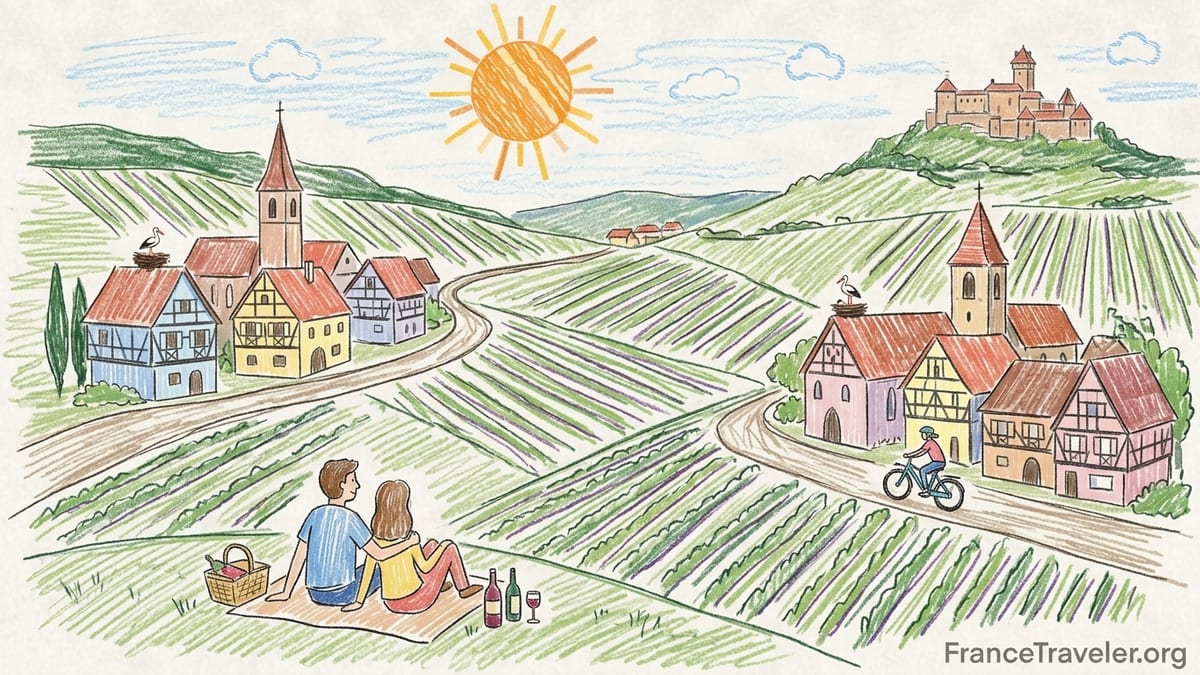
The core villages along the route share a similar visual language. You get cobbled streets, pastel half-timbered houses, stork nests on rooftops, a church tower above and vines rolling away toward ruined castles. It is beautiful and distinctive, but the similarities are exactly why moderation matters. After your fourth or fifth picture-perfect village in a single day, the colors and details start to blur together. Travelers often report that the first village of the day feels magical and the fourth feels like a repeat, even if it is objectively just as pretty.
Instead of chasing a checklist, it is smarter to think in clusters. Around Colmar, you have a dense group that might include Eguisheim, Turckheim, Kaysersberg and Riquewihr. Around Ribeauvillé you have Hunawihr and Bergheim. North of Strasbourg, Obernai and Barr anchor another stretch. Each cluster can easily fill a relaxed day when you include a walk through the vines and one or two winery visits. Building your itinerary around a few well‑chosen clusters keeps the impact of each village high and reduces time lost to transport.
This approach also respects the nature of Alsatian wine tourism. Many wineries are small family operations. Tastings are often informal, sometimes free if you buy a bottle, and staff cannot host groups constantly from morning to night. Planning just two or at most three tastings in a day, with villages and views in between, is far more rewarding than trying to stop at every cellar door.
How Many Days Do You Have: 3, 5 or 7 as a Framework
Think of your available days as a framework for trade-offs, not a countdown to squeeze in as many names as possible. Three days in Alsace is enough time to choose between a Strasbourg-centered city and culture break with a taste of vineyards, or a more wine-focused stay around Colmar and the middle Wine Route. Five days finally allows both Strasbourg and Colmar, plus one substantial Wine Route day and one contrasting experience in the mountains or at a major sight such as Haut-Koenigsbourg Castle. Seven days opens up northern or southern Alsace, cycling sections of the vineyards or relaxed family time without feeling rushed.
With around three full days, one logical framework is to base in Strasbourg the whole time and treat Colmar and the Wine Route as day trips. This might look like one intensive day in Strasbourg, one day in Colmar plus Eguisheim, and one day sampling a mid‑route cluster such as Ribeauvillé and Riquewihr. The other option is to base in Colmar, skip a detailed visit to Strasbourg and focus on vineyards, one or two of the region’s most beautiful villages and perhaps a short mountain side trip.
With around five days, splitting your stay into two bases starts to make sense. For example, you might spend two or three nights in Strasbourg for urban life, museums and the cathedral, then move to Colmar or a vineyard village like Kaysersberg for wine country and smaller‑scale exploring. That gives you space for one full Wine Route day between clusters, plus a contrasting experience such as the fortified hilltop castle of Haut‑Koenigsbourg, the forests and ridges of the Vosges or an industrial and automotive day in Mulhouse.
Once you reach seven days, you can add depth rather than just more villages of the same kind. You might ride a multi‑day stretch of the vineyard cycle route, add the northern wine villages near Marlenheim or Barr that many visitors skip, detour into the higher Vosges for a lakeside walk, or include a cross‑border day into Germany’s Black Forest. The key is to deliberately mix village time with city, mountains, cycling or family‑friendly outings so that no single type of place dominates your memories.
Bases, Hotel Changes and Daily Pacing
The number of bases you choose influences how hectic your trip will feel. For three days, one base is almost always enough. Strasbourg works well if you prioritize big‑city atmosphere, museums and Christmas markets in late November and December, with a quick look at vineyards. Colmar works better if your focus is wine and storybook villages, and you are comfortable treating Strasbourg as a quick in‑and‑out day trip by train, roughly 30 minutes on frequent regional services.
For a five‑day framework, two bases are usually the sweet spot. A common pattern is two nights in Strasbourg and three in or near Colmar, or the reverse. That limits you to a single hotel change, which is manageable even with luggage and children. It also shortens your daily driving or train times. For example, from Colmar you are within a short drive or local bus ride of Eguisheim, Turckheim and Kaysersberg, whereas from Strasbourg those same villages would mean a longer day out and more time on the highway rather than small scenic roads.
With seven days, you can still keep to two bases or add a third if you want a distinct mountain or rural stay. One approach is three nights in Strasbourg, three in Colmar, and one night in the Vosges near a mountain pass or lake. Another is a village-to-village cycling trip along part of the vineyard cycle route, using luggage transfer services offered by some local agencies or booking short hops between hotels spaced 30 to 40 kilometers apart. The trade‑off is that every hotel change costs you between one and two hours of packing, check‑out and check‑in time that could otherwise be spent in a museum, at a tasting or simply lingering over coffee on a village square.
When it comes to daily pacing, a useful rule of thumb is two villages per day, three at the very most, especially if one of them is Colmar or Strasbourg. A focused day might involve a morning in Kaysersberg, an afternoon in Riquewihr and an hour or two wandering among the vines or at a single winery. Cramming in Eguisheim, Turckheim, Kaysersberg and Riquewihr in one day technically fits on a map but usually leaves travelers tired and struggling to remember which village had which square or viewpoint.
How Many Villages and Wineries per Day Is Realistic
Alsace’s wine tourism culture is welcoming but relatively relaxed compared with some more industrial wine regions. Many producers still operate as family domaines. A typical tasting might involve a staff member or even the winemaker talking you through a handful of wines in a simple cellar or tasting room that also functions as a sales counter. There is rarely pressure to buy, but bringing home a bottle or two is appreciated, especially for smaller family operations that do not charge a formal tasting fee.
In practice, two tastings per day is ideal, and three is the upper limit before your palate and attention fade. For example, you might visit a well‑known estate near Riquewihr in late morning, have a long lunch in the village, spend a couple of hours walking or shopping, then stop at a smaller producer near Hunawihr or Zellenberg in the late afternoon. If you are driving, remember that tastings often include multiple pours, so spitting, sharing a tasting between two people or designating a strict non‑driving taster is important for safety.
On a village level, balancing one larger stop with one smaller one keeps variety high. You might pair Colmar’s canals and museums with Eguisheim’s circular lanes, or Ribeauvillé’s medieval main street with the quieter lanes of Bergheim. Each pair can easily occupy a day once you factor in a vineyard walk, a winery visit and proper sit‑down meals. Allowing at least three hours for Colmar or Strasbourg alone is reasonable, more if you visit museums such as the Unterlinden Museum in Colmar or Strasbourg’s cathedral and nearby historical quarter.
If you are traveling in peak periods such as summer weekends or the pre‑Christmas season, build in extra time for queues, especially in Strasbourg’s cathedral area and at popular photo spots in Colmar’s Petite Venise. Reservations are wise for dinner in hot spots like Eguisheim and Riquewihr, and many wineries appreciate advance notice for groups or visits outside standard opening hours. Some estates advertise approximate tasting fees or required purchases, but where current details are unclear you should check directly with the winery or a local tourism office before planning a tightly timed day.
Seasonal Strategies: Summer Wine Trips vs Christmas Itineraries
Alsace feels like two different destinations depending on the season. In late spring, summer and early autumn, the emphasis is on green vineyards, outdoor terraces and cycling between villages. The long days make it easy to fit in a village walk, a vineyard path and an evening meal al fresco. The landscape looks especially striking at harvest time, roughly September to early October, when the vines turn gold and the hills above villages such as Kaysersberg and Riquewihr glow in late afternoon light.
By contrast, the Christmas season transforms the region into a network of markets and illuminated streets. Strasbourg brands itself as the “capital of Christmas,” with the historic Christkindelsmärik typically operating from late November until just before Christmas Eve. Colmar hosts multiple markets across its squares, and many smaller villages along the Wine Route hold their own weekend or short‑season markets, sometimes focusing on crafts or local produce. Exact dates shift slightly year by year and are confirmed closer to the season by regional tourism boards.
A Christmas itinerary prioritizes atmosphere rather than vineyard views. In Strasbourg, much of your time will be spent navigating decorated streets, market stalls and indoor cafes for warmth. A three‑day Christmas framework might allocate one full day to Strasbourg’s markets, another to Colmar’s cluster of markets and illuminations, and a third to one or two nearby villages that hold particularly atmospheric markets on select weekends. Travel between sites can take longer because of crowds and occasional winter weather disruptions, so it is wiser to visit fewer places and stay longer in each.
One practical difference is the balance of daylight and opening hours. In December it may be dark before 5 p.m., which suits the lights and markets but leaves vineyards largely in the shadows. Winery visits are still possible but more limited, and some family domaines reduce hours during the holidays. In summer you can comfortably schedule a tasting at 11 a.m. and another at 4 p.m., with a village walk in between, and still have light for a post‑dinner stroll through half‑empty streets once day‑trippers have left. Both seasons are worthwhile, but your daily structure should adapt to either long sunny days or short market‑lit afternoons.
Frameworks for Different Types of Trips
First‑time visitors benefit from a classic balance of city and wine country. With five days, a good first‑timer framework might be two nights in Strasbourg and three in Colmar. In Strasbourg you focus on the cathedral, Petite France, a boat or tram ride and at least one museum or contemporary neighborhood to see a different side of the city. From Colmar you explore Petite Venise, the old town and the Unterlinden Museum, then dedicate one day to Eguisheim and another to a Ribeauvillé & Riquewihr loop with one winery visit each day. This structure delivers the region’s best‑known highlights without ever requiring more than two villages in a day.
For wine‑focused travelers, it can make sense to skip or drastically shorten Strasbourg, especially on a three‑day visit. You might base in a wine village such as Kaysersberg or Eguisheim, rent a bike or car and spend your days moving slowly between nearby villages and specific domaines you have researched in advance. Many enthusiasts plan around tasting particular grape varieties like Riesling or Gewurztraminer, or specific grand cru vineyards. The vineyard cycle route that runs close to the Wine Route allows you to ride between villages, stop for lunch at a winstub and then roll gently downhill to your next tasting, but you must keep tastings moderate and make use of spitting buckets if you are on a bike.
Christmas‑focused frameworks look different again. A three‑day Christmas stay might use Strasbourg as a single base because of its rail connections and dense cluster of markets. One day could be reserved for Strasbourg’s main markets and cathedral square, another for Colmar’s markets reached by regional train, and a third for a special outing to a village market that operates on that particular weekend. With five or seven days, you can reverse the pattern and base in Colmar, visiting Strasbourg on a day trip and spending more evenings in smaller, less crowded markets in villages such as Kaysersberg when they are running.
Families often prefer fewer hotel changes and more time in places where children can move freely. Colmar and several Wine Route villages are pedestrian‑friendly, with car‑free centers where children can walk without constant traffic worries. You might add a day at an indoor attraction in Mulhouse, which has well‑regarded museums such as the Cité du Train and an automotive museum, as an alternative to yet another cobbled village. Active travelers may build their framework around hiking or cycling in the Vosges, using the vineyard villages as lowland bases and heading into the hills by car, bus or, in some cases, chairlifts in the summer season.
Mountains, Castles, Cycling and Other Contrasts
One of the strongest arguments against stacking too many similar villages in a row is the wealth of contrasting experiences nearby. Haut‑Koenigsbourg Castle, set on a rocky spur high above the plain, gives you a dramatic change of scale from low‑lying villages. You can reach it by car or, in season, by shuttle bus from Sélestat, which climbs through forests to a parking area near the castle entrance. The interior shows reconstructed rooms, heavy timber beams and views across the Rhine plain that on clear days extend toward the Black Forest in Germany.
The Vosges mountains offer another contrast. From the vineyards you can drive up to passes such as the Col de la Schlucht, where hiking trails traverse open ridge pastures and wooded slopes. Spending a day or even an overnight in the mountains changes your perspective on the landscape you have been admiring from below. Instead of looking up at ruined castles from Ribeauvillé, for example, you might walk a loop that connects several of those ruins along the crest line, then descend by forest paths.
Cycling is increasingly popular in Alsace, both for casual day rides and multi‑day trips. The Véloroute du Vignoble d’Alsace runs roughly parallel to the Wine Route, linking vineyard villages along quieter roads, farm tracks and converted rail lines. Sections between towns like Molsheim, Obernai, Kaysersberg and Thann allow cyclists to ride through vineyards with minimal contact with main traffic routes. Many rental shops in Strasbourg and Colmar, as well as in some villages, offer standard bikes and e‑bikes suitable for these rolling routes, though availability and prices vary and should be checked close to your travel dates.
For an active or cycling‑oriented seven‑day framework, you might spend two nights in Strasbourg, then ride between a sequence of vineyard villages for three or four days, staying in guesthouses near the route. Distances of 30 to 40 kilometers per day are realistic for leisure cyclists in hilly wine country, especially when combined with one or two sightseeing or tasting stops. Luggage transfer services offered by local agencies or taxi companies can reduce the need to ride with full touring gear. Alternatively, you can base in one or two towns and make loop rides that always bring you back to the same hotel, which suits families and those who prefer to unpack once.
The Takeaway
The essence of planning an Alsace trip is restraint. The Wine Route covers around 170 kilometers and more than 100 wine‑growing communes, but you do not need to visit more than a handful to understand its charm. Overloading your days with near‑identical villages actually reduces their impact. Instead, decide first how many days you have, then choose one or two bases, and finally build each day around a limited number of places with clear contrasts between them.
Three days should push you to choose between Strasbourg plus a sample of vineyards, or a focused Colmar and Wine Route stay with the city as your urban anchor. Five days comfortably allows both cities, one substantial Wine Route day and a side trip into the mountains, to a castle or to Mulhouse’s museums. Seven days opens the door to relaxed cycling, deeper exploration of northern or southern Alsace and more evenings spent in just‑busy‑enough squares instead of rushing between villages.
If you leave with distinct memories of Strasbourg’s cathedral, Colmar’s canals, one or two favorite villages, a hillside castle, a walk through the vines and perhaps a cherished bottle of Riesling in your luggage, then you have planned well. The goal is not to conquer the Wine Route in a single trip, but to experience a balanced slice of Alsace that feels rich rather than repetitive.
FAQ
Q1. How many villages should I plan to see in one day in Alsace?
Two villages per day is a comfortable maximum for most travelers, especially if one is larger such as Colmar or Ribeauvillé. This leaves time for unhurried walks, a winery visit and relaxed meals without turning the day into a blur of similar streets and facades.
Q2. Is it better to stay in Strasbourg or Colmar for a short trip?
For a three‑day stay, choose Strasbourg if you prioritize a bigger city with major museums and want to sample vineyards briefly. Choose Colmar if your focus is wine, half‑timbered villages and easy access to the central Wine Route, and you are willing to visit Strasbourg as a quick day trip if at all.
Q3. Do I need a car to explore the Alsace Wine Route?
A car gives the most flexibility, especially for small villages and mountain detours, but you can combine trains, local buses, taxis and cycling to reach many highlights. From bases in Strasbourg or Colmar, several famous villages and some wineries are accessible without driving, though schedules and routes should be checked near your travel dates.
Q4. How many winery tastings are realistic in a single day?
Two tastings per day work well, and three is usually the upper limit before fatigue and alcohol make it difficult to appreciate the wines. Plan tastings at set times, allow for conversations with staff, and always prioritize safe transport, whether that means a designated driver, spitting, or relying on cycling and walking for short hops.
Q5. How does visiting during Christmas market season change my itinerary?
In Christmas season your days will revolve around markets, lights and indoor stops rather than vineyard walks. Crowds, winter weather and shorter daylight hours mean you should plan fewer locations per day, with at least one full day each in Strasbourg and Colmar if time allows, rather than trying to combine many small markets in rapid succession.
Q6. Is five days enough to see both Strasbourg and Colmar without rushing?
Yes, five days is a good length to combine both cities. A typical structure is two nights in one city and three in the other, with one full day on the Wine Route and one contrasting day for a mountain excursion, Haut‑Koenigsbourg Castle or a museum‑focused visit to Mulhouse.
Q7. Should I change hotels if I only have three days in Alsace?
With three days it is usually more efficient to stay in a single base, either Strasbourg or Colmar, and make day trips. Changing hotels for such a short stay can consume several hours that would be better spent exploring, especially if you are traveling with children or larger amounts of luggage.
Q8. Is Alsace suitable for a cycling‑focused holiday?
Yes, Alsace is well suited to cycling, with a vineyard cycle route that broadly parallels the Wine Route and numerous marked loops linking villages. Distances between key stops are manageable, and the terrain is mostly rolling rather than mountainous, although some climbs can be steep. E‑bikes are widely available for rent in larger towns and some villages.
Q9. What are good contrasting activities to balance village visits?
Popular contrasts include a visit to Haut‑Koenigsbourg Castle, a day in the Vosges mountains near passes such as the Col de la Schlucht, or time in Mulhouse exploring transport or industrial museums. These experiences change the scale and scenery of your trip so that village visits feel special rather than repetitive.
Q10. How far in advance should I book accommodation for peak periods?
For summer weekends and the Christmas market season, it is wise to book accommodation several months ahead, especially in small Wine Route villages where rooms are limited. Strasbourg and Colmar have more options but also attract larger crowds, so early booking helps secure central locations and better rates.