

On my first day driving the Alsace Wine Route, I made the classic mistake. Armed with a rental car, a list of “must‑see” villages and a sugar high from my first kougelhopf, I tried to squeeze seven postcard‑perfect stops between breakfast in Colmar and dinner in Ribeauvillé. By sunset, the photos on my phone were gorgeous. My memories, less so. Half the villages had already blurred into one long main street of half‑timbered houses, geraniums and wine shops. Alsace was as beautiful as the brochures promised, but the famous village circuit itself started to feel strangely repetitive.
The Seduction and the Sameness of the Alsace Wine Route
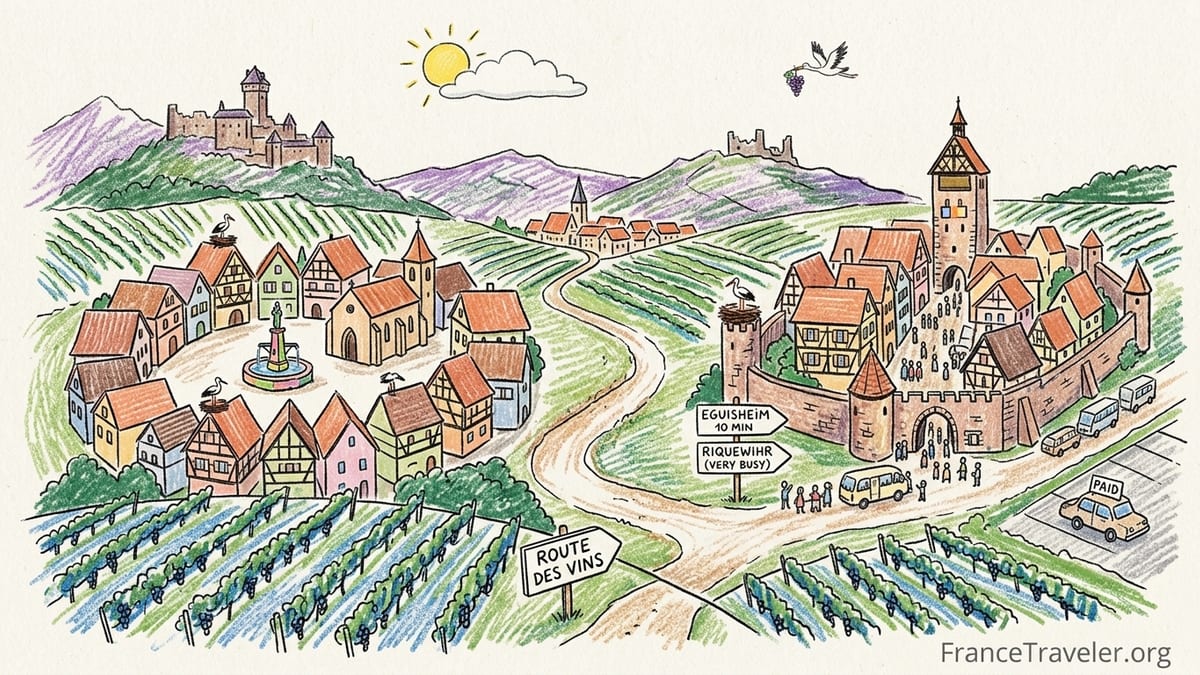
The official Route des Vins d’Alsace runs for more than 170 kilometers between Marlenheim and Thann and connects over a hundred wine towns and villages. It highlights darlings like Bergheim, Kaysersberg and Eguisheim, several of which hold the Plus Beaux Villages de France label, and promotional maps are dense with little icons begging you to stop. In theory, you drift from village to village, tasting Riesling and Crémant, collecting half‑timbered facades like postcards.
In reality, every stop has friction. You search for parking on the edge of town, feed a pay machine that often charges by the half‑hour, then walk ten or fifteen minutes into a historic center that is mostly pedestrian. Tourism offices in the region point out that parking and the walk in can easily swallow twenty to thirty minutes per village before you have actually seen anything. Add summer crowds or Christmas‑market controls, and simply reaching the first pretty lane can feel like a small project rather than a spontaneous detour.
Once you are inside the walls, the sameness creeps in. There is almost always a single spine of cobbled main street, half‑timbered houses with painted beams, and a church slightly off the center. There are stork nests on rooftops, overflowing window boxes, winstubs advertising tarte flambée, and wine shops offering tastings of Riesling, Pinot Gris, Gewurztraminer and Crémant under similar vaulted ceilings. It is objectively lovely. But if you drive from Riquewihr to Ribeauvillé to Kaysersberg to Eguisheim without a break, you begin to feel like you are walking the same scene on loop.
After a few days on the road I realized that beauty alone did not justify two hours in every village. Layout, crowds, parking stress and the small details of daily life were what made one place stand out while another, equally photogenic, faded into the background.
Eguisheim: Concentric Circles of Charm That Deserve Time
Eguisheim is one of the rare villages that genuinely rewards a slow visit. Just ten minutes south of Colmar, it is built in two near‑perfect concentric rings around the central square and Saint‑Léon fountain. That layout matters. Instead of a single up‑and‑down main street, you can follow the outer rampart lane, curve slowly around pastel facades with carved dates and religious niches, then cut inward and repeat on the inner ring. It feels like unwrapping a present layer by layer.
I parked in a signed lot outside the historic center and paid a modest hourly fee in coins. By the time I walked in under the flower‑wrapped houses and turned onto the circular lanes, the ten minutes of logistics were forgotten. The houses lean at irregular angles, painted in apricot, duck‑egg blue and butter yellow, each with its own balcony of geraniums or petunias. Flower displays here feel curated rather than industrial; there are fewer giant municipal planters and more window boxes clearly tended by residents.
Eguisheim’s cellar density is another reason it stands out. Within a few minutes’ walk of the main square you can step into several family wineries and cooperatives for tastings. Most offer informal flights of three or four wines at modest prices, and some waive fees if you buy bottles. Between cells and the Romanesque‑Gothic church, you can easily spend two to three hours in Eguisheim without repeating streets or shops. This is also a place where I did not mind lingering over lunch in a timber‑framed winstub, then looping the outer ring again in softer late‑afternoon light.
I have been back in December, when Eguisheim hangs modest but atmospheric Christmas decorations: pine boughs over doorways, wooden stars, and warm lights strung across the narrow lanes. The compact layout works in winter too. You can stroll slowly with mulled wine in hand, circle the rings without getting lost, and slip into a cellar to thaw out. Eguisheim feels like a complete experience, easily worth half a day. It is the opposite of a “fifteen‑minute photo stop” village.
Riquewihr: Fairytale Facades, Overloaded Experience
Riquewihr is the star of many brochures and Instagram feeds, and for good reason. The village sits inside mostly intact medieval walls, and the main street climbs gently from a lower gate to the signature Dolder tower. Almost every angle from that central lane is photogenic: jumbled half‑timbered houses, projecting upper stories, whimsical signs, and vines trained along the walls. Several vineyards and tourism sources note that Riquewihr attracts more than a million visitors per year despite having only around a thousand residents, and you feel that imbalance as soon as you step through the gate.
On my last summer visit, I arrived around 11 a.m. The parking lots just outside the walls were almost full, with stewards guiding cars into remaining slots. I paid several euros for a couple of hours, joined a line of visitors walking in from the lot, and spent the first twenty minutes shuffling toward the village gate behind coach groups. By the time I reached the bottom of the main street, there were already tight knots of people taking photos at the same viewpoints, and many shop doors were crowded.
The architecture is outstanding, yet the experience felt oddly compressed. The village has a single central street with a few side alleys and a path along the inside of the walls. With the crowds, I could walk the main stretch up to the tower and back in about thirty minutes, stopping for photos but never quite escaping the flow. Wine shops here are polished and plentiful, but tastings feel more like retail than discovery, with pre‑packed gift boxes and multilingual signs geared toward tour groups. Restaurant menus on the main drag cluster around the same heavy Alsatian greatest hits and post‑lunch tables turn rapidly.
For me, Riquewihr is the classic overrated experience on the Route des Vins. The village is stunning from a distance, especially if you approach on foot through the vineyards or see it from above at sunset. Inside the walls in high season, though, the crowds and parking stress eat into any sense of medieval atmosphere. Unless you stay overnight or visit very early or late in the day, I struggle to justify more than an hour here. If you have already wandered another walled village that morning, an extra lap through similar streets may not be the best use of limited time.
Kaysersberg and Ribeauvillé: Character vs Convenience
Northwest of Colmar, Kaysersberg and Ribeauvillé sit only a short drive apart, yet the two offer very different moods. Kaysersberg has one of the most picturesque settings on the route: a stone bridge from 1514 arches over the Weiss River, a ruined castle sits above the village, and steep vineyard slopes rise in the background. The main street bends gently, so views unfold gradually as you walk. I parked on the edge of the village, where the municipality maintains signed car parks and, outside peak events, relatively straightforward paid parking. Even with a ten‑minute walk in, this felt manageable.
In summer, Kaysersberg’s half‑timbered houses drip with flowers, and the river adds refreshing sound and space. I climbed the path up to the castle tower, puffed slightly up the steps, and was rewarded with a panoramic view over tiled roofs and straight vineyard rows. The streets can be busy at midday, but tucked side lanes and the riverside path create small pockets where you can step aside. At Christmas, Kaysersberg runs an “authentic” market over select weekends, with craft stalls in the Arsenal hall and behind the church. In recent years the village has introduced park‑and‑ride arrangements and shuttle buses on those days, funneling visitors from larger peripheral lots into the center. The decorations lean toward natural greenery, candles and crafts rather than neon displays, and the atmosphere, despite the crowds, feels anchored in the village itself.
Ribeauvillé, by contrast, is longer and more linear. Its main street runs on a slight incline toward three ruined castles on the ridge above, and the town feels more lived‑in, with butchers, bakeries and everyday shops mixed among the souvenir stores. Several tourist guides describe Ribeauvillé as one of the most practical bases on the Wine Route, and that rings true. There is more accommodation, a wider choice of restaurants and services, and slightly easier evening parking if you stay overnight.
As a visitor passing through for a few hours, though, Ribeauvillé did not enchant me in the same way as Kaysersberg or Eguisheim. The facades are pretty, and there are some ornate oriel windows and painted fronts, but stretches of the main street felt like “standard Alsace” after a few days of villages. I enjoyed a simple lunch here and appreciated the convenience of ATMs and supermarkets, but I did not feel the need to photograph every corner. If I had to drop one of the big‑name villages from a tightly packed day, it would probably be Ribeauvillé, unless I wanted to use it as a base or hike up to the castles above.
Both villages illustrate a key point: practicality and beauty do not always align. Kaysersberg is slightly less convenient for parking in December because of shuttle systems and weekend traffic, but its setting and riverfront make it distinctive and worth planning for. Ribeauvillé is easier to use as a base and to access repeatedly, yet for a first‑time visitor with only a couple of days, its charm may feel more muted compared to its neighbors.
Bergheim and Turckheim: The Power of Lower Expectations
If Riquewihr is my overrated stop, Bergheim is my underrated one. Officially recognized among France’s most beautiful villages, Bergheim somehow receives fewer day‑trippers than the more famous names in the same stretch of vineyards. Arriving in the afternoon, I found parking along the medieval walls without much circling, fed the meter, and walked straight through a flower‑framed gate into a quiet interior.
Bergheim’s old town folds around its ring of ramparts. The streets here are narrower, and the houses slightly more subdued in color than in Riquewihr or Eguisheim, with soft ochres and creams instead of candy‑shop pastels. What stood out was the sense of calm. On a June weekday, I shared the main street mostly with locals on bicycles, a few small groups of visitors, and cats sunning themselves on stone doorsteps. The village has wine estates on its doorstep, and simple, welcoming tasting rooms rather than high‑gloss boutiques. I wandered for more than an hour along the inner side of the walls, cut through back lanes with vegetable gardens and small courtyards, and never felt jostled.
Turckheim, just west of Colmar, is another village that rarely tops glossy lists but felt refreshingly different on the ground. Its plan opens into a central space with several gates rather than funnelling everyone into one narrow vein. Parking outside the historic center was straightforward in late afternoon, with clearly marked spots and modest fees. Inside, the architecture is still recognizably Alsatian, but there is more breathing room between houses and less pressure from souvenir shopping.
Turckheim also retains small rituals that hint at a village with its own life beyond tourism. In summer evenings a night watchman still performs a short round, calling traditional texts. There are working wineries within walking distance and a vineyard path that climbs gently out of the village, offering views back over turrets and roofs. I spent about ninety minutes here, including a short tasting and a stroll beyond the last houses. It was enough to appreciate its character without rushing, and I left feeling like I had discovered a place rather than checked a box.
Both Bergheim and Turckheim prove that lower‑profile villages can deliver richer experiences. They still offer flowers, wine shops and timber frames, but in doses that feel compatible with everyday life. If you trim one or two big‑name stops from your day, you might gain the bandwidth to notice the quieter charms of places like these.
How Long Does Each Village Really Need?
After several trips along the Wine Route, I have stopped timing villages by brochure promises and started counting the hidden minutes. Parking and walking in usually cost at least twenty minutes per stop. Buying or printing a ticket, waiting at a pedestrian crossing, and orienting yourself toward the historic core all add up. In Christmas season or on summer Saturdays, park‑and‑ride systems and shuttle buses can easily push access time higher, especially in and around Colmar, Kaysersberg, Ribeauvillé and Riquewihr.
Once inside, many famous villages reveal themselves quickly. In Riquewihr, the main axis can be covered in thirty to forty minutes of strolling and photographing if you do not linger in shops. Even if you add a short tasting and a coffee, you will struggle to fill more than ninety minutes without retracing your steps. In Ribeauvillé, a steady walk up and down the main street with a detour into side lanes might take an hour, longer only if you climb toward the castles.
By contrast, Eguisheim’s concentric lanes, Kaysersberg’s riverside and castle path, or Bergheim’s ramparts invite more meandering. These are places where a two‑ to three‑hour stop feels natural: one hour of wandering, one of tasting or sitting in a café, and some extra time for views or a short hike into the vineyards. When I started limiting myself to two or three villages in a day, I found I could actually sit and listen to storks clacking on a rooftop, linger over a tart of local mirabelles, or talk to a winemaker about a specific grand cru instead of racing through another row of wine bottles.
The key is accepting that some villages, however pretty, are best enjoyed as brief impressions. A beautiful but straightforward main‑street village that looks similar to somewhere you saw that morning may only deserve forty‑five minutes, and that is fine. You do not have to force every stop to fill two hours just because it took effort to park. Treat some as quick sketches and reserve depth for the places that offer distinct layouts, quieter back lanes, or a specific activity such as a cellar visit, a viewpoint, or a short signposted vineyard walk.
Christmas Decorations, Crowds and the Postcard Trap
Winter adds another layer of magic and repetition to the Alsace villages. From late November into December, lights and Christmas markets transform places like Colmar, Kaysersberg, Riquewihr and Ribeauvillé into dense bundles of color and scent. Tourism authorities schedule many of these markets only on specific weekends or days, and they have strengthened traffic controls around the busiest ones, sometimes obliging visitors to use remote car parks and shuttle buses. That can be good for safety but painful if you are trying to see multiple villages in a single day.
On a December weekend in Kaysersberg, I parked at a signed park‑and‑ride area on the valley road and boarded a shuttle bus into the village. By the time I reached the first stall, I had already queued for tickets, waited for a bus and walked across a security perimeter. Inside, the market itself was delightful: half‑timbered facades edged with fir branches, windows decorated with candles, stalls selling wooden toys and hand‑printed linens, and the smell of mulled wine and spice cookies. Yet every alley around the main market area was shoulder‑to‑shoulder by mid‑afternoon. I stayed nearly three hours because of the logistics involved, but by the end I was too tired to appreciate a second village properly that evening.
Christmas decorations can also heighten the sense of sameness. Many villages use variations on the same visual vocabulary: red and white hearts, stars, fir branches, teddy bears and sleds attached to window ledges, plus overlapping strands of warm white lights between houses. At night this is enchanting; in photos it is spectacular. In person, if you chain together too many markets in a row, the shock of delight dulls. It becomes one long corridor of mulled wine steam, wooden chalets and twinkling lights.
I learned to choose just one or two Christmas markets per day and to match them with something that breaks the pattern, like a visit to the hilltop castle of Haut‑Koenigsbourg or a quiet afternoon walk through bare vines above a less crowded village. Approached this way, the decorations amplify rather than flatten each village’s character. Kaysersberg’s focus on crafts and natural materials feels different from a small, intimate market in a lesser‑known town, and both feel more special when they are not sandwiched between four nearly identical stops.
Seen from the lens of Christmas, the postcard trap becomes clear. It is easy to plan based on images alone, yet images compress crowds, noise and queues into silent perfection. The more your itinerary is built on reproducing a series of photographs, the more likely you are to chase quantity over texture on the ground.
The Takeaway
After multiple trips along the Alsace Wine Route, I no longer believe that more villages automatically mean a richer experience. In fact, the instinct to tick off six or seven famous stops in a day can erode exactly what people come here to find: a sense of calm, beauty and connection to the landscape. Beauty is abundant along this route, but distinctiveness is not. Many villages share the same timbered architecture, the same palette of flowers, similar restaurant menus and comparable wine line‑ups. Once you have walked a couple of main streets, the marginal gain of each additional village shrinks quickly.
Instead of collecting names, I recommend planning for two, at most three, villages per day. Anchor the day around one or two that genuinely stand out for you. For many visitors those might be Eguisheim, with its concentric lanes and dense cellars, and Kaysersberg, with its river, castle and dramatic setting. Then add an underrated or quieter stop such as Bergheim or Turckheim, where you can feel the rhythm of a village that has not fully given itself over to tourism.
Between villages, choose one substantial activity: a proper sit‑down lunch in a traditional winstub, a winery visit booked in advance, a walk through the vineyards between neighboring towns, or an excursion to a nearby castle like Haut‑Koenigsbourg. These breaks reset your senses and stop the architecture from blending into one long half‑timbered blur. In practical terms, that might mean starting with a late‑morning stroll and tasting in Eguisheim, pausing for a long lunch at a family‑run restaurant, then driving up to a hillside castle in the afternoon before ending with an evening walk and dinner in Kaysersberg.
If you have more days, resist the urge to simply multiply villages. Add variety instead. Spend a morning in Colmar’s museums or markets, drive into the Vosges for a forest hike above Munster, or follow a signed wine trail through the vines between two towns rather than driving between five. You will still see bell towers and storks and geraniums, but they will belong to specific moments rather than a generic slideshow.
The famous villages of Alsace are not, in themselves, overrated. The mistake lies in treating them as a checklist to be completed from behind a windscreen. With fewer daily stops, more space between them and a willingness to skip a pretty but repetitive village, you give yourself the chance to remember not just how Alsace looked, but how it felt.
FAQ
Q1. How many Alsace wine villages should I plan to see in one day?
For a relaxed trip, aim for two, or three at most, in a single day. This leaves room for parking, wandering without rush, a proper meal and one extra activity such as a winery visit or short hike.
Q2. Which villages are best if I only have one full day on the Wine Route?
If you start from Colmar, a strong one‑day combination is Eguisheim in the morning for its circular lanes and cellars, then Kaysersberg in the afternoon for the river, castle and dinner. If you want something quieter, swap in Bergheim or Turckheim for one of the big names.
Q3. Is Riquewihr worth visiting despite the crowds?
Riquewihr is architecturally spectacular, but very busy between late morning and mid‑afternoon. It is worth seeing if you arrive early, late or in shoulder season, or if you stay overnight. As a short midday stop on an already tight schedule, it can feel more stressful than rewarding.
Q4. Which village felt most overrated to you, and why?
For me, Riquewihr felt most overrated. The main street is stunning, but the combination of packed car parks, tour groups and a relatively compact layout meant I could walk the core in well under an hour. After visiting other walled villages the same day, the experience did not justify a long stay.
Q5. Which village did you find most underrated?
Bergheim was the surprise highlight. It has intact ramparts, elegant but less flashy houses and calmer streets, plus easy access to vineyards and welcoming tasting rooms. I spent a peaceful afternoon there with very few tour groups in sight.
Q6. How much time should I budget for Eguisheim?
Plan at least two to three hours in Eguisheim. That allows time to walk both concentric lanes, visit a cellar or two, sit for coffee or lunch on the main square and take photos without rushing.
Q7. What about parking in these villages, especially in summer or at Christmas?
Most villages require you to park just outside the historic center in paid lots, then walk in ten to fifteen minutes. In peak periods some, like Kaysersberg at Christmas, use park‑and‑ride systems with shuttle buses. Factor in at least twenty minutes of access time per stop and carry coins or a card for meters.
Q8. Are the villages very different from each other, or do they start to look the same?
They share a strong family resemblance: half‑timbered houses, overflowing flowers and wine shops. Layout and setting create the real differences. Eguisheim’s circles, Kaysersberg’s river and castle and Bergheim’s ramparts felt distinctive, while some linear main‑street villages blurred together after a few days.
Q9. How should I structure a two‑day itinerary to avoid village fatigue?
On each day, combine one headline village with one quieter stop and a non‑village activity. For example, day one could be Eguisheim and Turckheim plus a vineyard walk, and day two Kaysersberg and Bergheim with a visit to a nearby castle. Keep driving distances short and leave space for long lunches or tastings.
Q10. Is it better to base in a village or in Colmar for exploring the Wine Route?
Colmar makes logistics easy, with frequent trains and large car parks, but feels like a small city. Basing in a village such as Ribeauvillé, Kaysersberg or Eguisheim gives you quieter evenings and easier access to vineyards, at the cost of relying more on a car. Both work; choose based on whether you value nightlife and services or village atmosphere after dark.