

I went to Alsace expecting a watercolor: candy-colored half-timbered houses reflected in calm canals, vineyard slopes glowing at golden hour, white wines poured in friendly family cellars. Much of that picture turned out to be true. Colmar’s Little Venice really does look like a film set in the early morning light, Eguisheim’s concentric lanes are as charming as the postcards, and I had some superb Riesling and Gewurztraminer in tiny tasting rooms where the winemaker’s dog slept under the counter. Yet as the days went on, I found myself unusually tired and a little grumpy. The problem was not Alsace itself, but the way I had planned my trip. Here is what I wish I had known before going, with specific examples of what went wrong and how you can do it better.
What Alsace Actually Does Beautifully
Before the reality check, it is important to admit that much of Alsace lived up to the glossy photos. The Route des Vins d’Alsace runs for roughly 170 kilometers through nearly continuous vineyards and wine villages, and stretches around Colmar really are as storybook pretty as they look in brochures. Colmar’s old town, with its canalside district known as Little Venice, is atmospheric in the early morning, with bakers rolling up shutters and locals crossing cobbles on their way to work. In Riquewihr and Eguisheim, pastel facades lean toward each other above cobbled lanes, window boxes overflow with geraniums and storks nest on church towers.
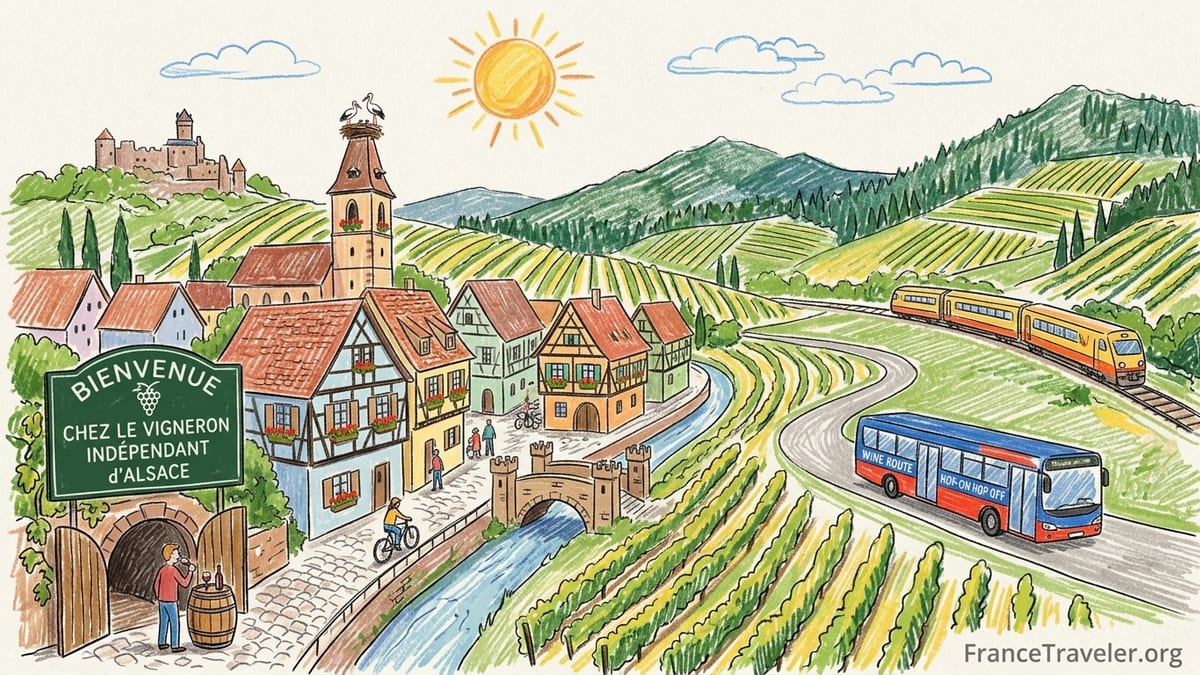
Wine is another clear strength. This is one of France’s classic white wine regions, with an official network of producers signed under the “Bienvenue chez le Vigneron Indépendant d’Alsace” welcome charter that emphasizes personal, informative tastings. Independent cellars, from larger estates with polished tasting rooms to small family addresses with just a bar and a few stools, can pour a wide range of Riesling, Pinot Gris, Gewurztraminer and Crémant d’Alsace. At places like Domaine Bernard Haas & Fils in Kaysersberg, for example, you can book a structured tasting that includes several wines and a walk through the cellar, while smaller producers near Eguisheim or Obernai offer by-appointment tastings in intimate spaces.
Prices, compared with many other French wine regions, remain relatively gentle. A good bottle at the cellar door can still cost in the range of 10 to 20 euros, and village restaurants often have house Alsace wines by the glass that are affordable for travelers. Public transport also works better than many visitors expect. Trains link Strasbourg and Colmar in under half an hour on frequent services, while local buses and seasonal services such as hop on hop off wine route buses allow car-free travelers to at least sample a couple of villages in a day.
This is the version of Alsace that pulls visitors in: scenic, cultured, mildly indulgent. The rest of this article is about where expectations quietly diverge from reality, based on what happened once my own initial enchantment began to wear off.
When Every Village Starts To Look The Same
I arrived with a classic first-timer plan: two nights in Colmar, two along the wine route, and “as many pretty villages as we can fit in.” The guidebook made it sound feasible to hop from Eguisheim to Kaysersberg to Riquewihr to Ribeauvillé, with Hunawihr or Turckheim as optional extras, over a couple of days. The villages are indeed close. Distances such as 10 kilometers between Colmar and Eguisheim or about 20 kilometers between Colmar and Riquewihr make it easy to chain several stops together by car in a single afternoon. What I did not anticipate was how repetitive it would feel.
On the first afternoon, Eguisheim’s circular lanes and flowered fountains were entirely delightful. We spent an hour circling the rampart lanes, ducking into a church, and pausing at a cellar door for a quick tasting. Then we drove on to Kaysersberg, parked at the edge-of-village parking belt, and wandered the main street framed by a fortified bridge and castle ruin. It was lovely again, in a slightly different key. Then we tried to add Riquewihr after a late lunch. By the time we stepped through its city gate, we had spent the better part of four hours among half-timbered facades, carved shop signs, and souvenir stalls. Instead of being wowed, my first reaction was mild fatigue.
It crystallized the next day when we added yet another stop, Ribeauvillé, after a morning in Colmar. Halfway up its historic main street, I realized that my photos were starting to blend into each other. Every perspective seemed to echo another village from an hour earlier. It was not that any one place was disappointing. The problem was volume: too many postcard-perfect villages packed too close together, without enough contrast in between. The specialness of each stop diminished.
The fix is simple but demands discipline: deliberately choose fewer villages and give each more time, and intersperse them with something entirely different. A realistic plan for a single day with a car might be Colmar in the morning, a long lunch and stroll in Eguisheim, and then either a hike through the vineyards above Turckheim or a castle visit such as Château du Haut-Kœnigsbourg, rather than squeezing in three more villages. If you have several days, anchor yourself in one or two bases like Colmar and Strasbourg and assign only one or two wine villages per day, leaving room for forest walks in the Vosges or a cycle along the canals. Alsace rewards focused attention much more than box-ticking.
Crowds That Steal The Magic
I knew the most famous villages would be popular. What surprised me was the intensity of the crowd at peak times, even outside the absolute high point of Christmas markets. Colmar’s old town, especially around Little Venice and the half-timbered houses near the covered market, can feel as busy as a compact theme park square by mid-afternoon in high season and on December weekends. During the Christmas market period, official information notes that vehicle access to much of the center is closed and special park and ride systems channel thousands of visitors into the core. That density of people changes the experience drastically.
On one December visit, I arrived at Colmar’s center around 3 pm, after a slow lunch outside town, and spent the next half hour shuffling shoulder to shoulder past chestnut stalls, mulled wine huts, and queues for photos in front of decorations. The architecture was still pretty, but I found myself staring more at the back of strangers’ jackets than at timber frames. When we tried to return in April, on a sunny Saturday around midday, the area near the covered market was once again saturated with day trippers and tour groups who had just arrived by train and coach.
Riquewihr and Eguisheim, both designated among the “most beautiful villages in France,” attract similar waves. Riquewihr’s single main street inside the walls can feel particularly compressed when tour coaches deposit groups at the top gate and they slowly filter downhill. That was exactly what we walked into one afternoon around 2 pm, and within ten minutes it felt like navigating a moving queue rather than exploring a living village. Eguisheim’s concentric streets are narrower, so even a moderate number of visitors can make it feel overrun.
The obvious adjustment is to play aggressively with timing. Arrive as early as you can stand, ideally before 9 am, for the most popular villages, then leave as they fill. On a later trip, we entered Riquewihr just after 8:30 am and had the main street nearly to ourselves for over an hour; by 10:00 am it was already busy, and by late morning the earlier quiet felt almost unbelievable in retrospect. Alternatively, plan evening visits on long summer days. Day-trippers and buses tend to leave by late afternoon, and a stroll around 7 pm can be considerably calmer, even if some shops are already closed. Another trick is to favor slightly less publicized villages such as Turckheim, Andlau or Mittelbergheim during core daytime hours, and keep Colmar, Eguisheim and Riquewihr for very early or quite late in the day.
Quiet Evenings And Shuttered Restaurants
My mental image of Alsace evenings involved a sunset stroll among vineyards, a glass of Crémant on a terrace, and then picking between several cozy winstubs for tarte flambée or choucroute garni. The reality, especially in smaller wine-route villages, was much quieter and more constrained. Visitor information for the region itself cautions that restaurant capacity in some villages is small, kitchens close early by international standards, and many places shut one or two days a week. I only fully understood this after being caught out twice.
The first episode was in Eguisheim on a shoulder-season Tuesday. We had spent a longer than expected afternoon walking the ramparts and tasting at a cellar, assuming that we would simply choose dinner on the spot around 7:30 pm. At that hour, several restaurants were already full, a couple were entirely closed for the day, and a few had stopped serving hot food. We eventually found a table, but the choice was limited and later arrivals were turned away. It was not a disaster, but it was not the relaxed “we will see what we feel like” evening I had imagined either.
It happened again in a smaller village near Ribeauvillé. A winegrower had recommended a particular winstub, which we tried to visit without a reservation on a Wednesday evening in September. It had a hand-written note on the door announcing annual vacation, the second-choice restaurant was closed that night as well, and the only place open in walking distance had already stopped serving by the time we arrived at 8 pm. We ended up driving back out to a larger town along the main road for a late pizza.
If you enjoy lively evenings and flexibility about where to eat, this matters. Many wine villages are essentially day-trip destinations that fall quiet once the last coaches and most visitors leave. For some travelers, that hushed atmosphere is a virtue. For others, it feels limiting. The way to avoid frustration is to either stay in a larger center like Colmar or Strasbourg, where there is more dining competition and later hours, or to treat stays in small wine villages as half-board retreats and book dinner in advance for each night. If you know you want to eat in a particular popular winstub in Riquewihr or Kaysersberg, call or reserve online a few days ahead and pay close attention to the weekly rest day and seasonal closures. In July and August you can sometimes improvise, but outside the core summer and Christmas periods, assuming that “something will be open” can backfire.
Parking Pressure And Driving Fatigue
Alsace seems, at first glance, like a perfect region to explore by car. Distances are short and signage for the Route des Vins d’Alsace is straightforward. What I underestimated was the parking pressure around Colmar and the most famous wine villages, and how draining it can be to pilot a rental car through tight medieval streets or around concentric one-way systems several times a day.
In Colmar, the municipality operates a mix of paid surface and underground car parks around the center, with certain periods such as midday and evenings offering free or reduced-rate parking in some zones. During Christmas markets, the city even sets up park and ride arrangements where you leave your car on the perimeter and take shuttles in, in part because access to the historic core is closed to general traffic on market days. That is good news from an urban planning perspective, but on the ground it means you may circle more than you expect before securing a spot within comfortable walking distance of the old town, particularly on weekends and in December.
In villages such as Kaysersberg and Riquewihr, there are dedicated parking belts or car parks at the entrance to the historic core, usually with hourly fees and time limits for spaces closest to the center. On one mid-August afternoon in Kaysersberg, we parked in an outer belt lot with a relatively low hourly rate, but saw drivers ahead of us turned away from the central spaces which were already full and capped at two hours. In Riquewihr on a spring Saturday, cars were queuing along the access road for a chance to enter a lot near the town gate, while coaches unloaded just beyond. The stress of managing tight parking windows quickly eroded the leisurely feeling that wine-route drives are supposed to deliver.
If you are set on driving, the remedy is to adjust expectations. Treat parking as part of your timing calculus, not as an afterthought. Aim to arrive in the busiest spots either first thing in the morning or after 5 pm, when spaces turn over. Use edge-of-village lots even if it means a slightly longer walk, because they are less stressful and often cheaper. If you plan to taste wine in several places, designate a driver who spits religiously, or balance cellar visits with non-tasting activities to avoid any temptation to drive under the influence.
Alternatively, consider minimizing driving days. Base yourself for several nights in Strasbourg or Colmar without a car and explore those cities on foot and by tram, then rent a car only for a carefully planned one- or two-day circuit of the wine route. Another increasingly popular option is to join a small-group tour from Strasbourg or Colmar for a full day along the wine route. You pay more per person than self-driving but gain the ability to taste freely and let someone else worry about parking, traffic and navigation.
Winery Visits Are Less Spontaneous Than You Think
Coming from regions like Napa or parts of Australia, I subconsciously assumed that I could simply drive along the wine route and pull into attractive estates for tastings on a whim. Alsace does not really work that way, especially once you get beyond the most commercial names. The local wine tourism model relies heavily on village-based tasting rooms and on visits that are either scheduled or at least semi-structured.
Many independent wineries welcome visitors but either operate only at specific hours or expect you to make an appointment, particularly for in-depth tastings or cellar tours. Examples include estates near Obernai where information clearly notes “by appointment only” for tastings, or properties like Domaine Claude et Christophe Bléger south of Colmar, where Sunday visits in the early part of the year are strictly by prior arrangement. During harvest season, usually in September and early October, cellars are often focused on bringing in and processing grapes, which leaves limited attention for drop-in visitors. Travelers who have contacted wineries ahead of time and secured set tasting slots often report rich, unhurried experiences, while those who show up unannounced can find doors locked, families away in the vineyards, or staff too busy to host a proper tasting.
In towns like Riquewihr or Colmar you will find larger houses with dedicated shops where you can walk in without a reservation and taste a defined set of wines at a counter, sometimes for a small fee or with an expectation that you will purchase a bottle. That is convenient, but it is a specific style of experience, closer to retail than to the intimate cellar visits many wine travelers imagine.
For me, the frustration came on a day when we tried to improvise entirely. We drove from village to village, turning in whenever we saw a promising sign. The first two places were closed with hand-written notes indicating unusual hours that week. The third was in the middle of a group booking. The fourth agreed to pour a few wines but clearly had one eye on other tasks. In the end, we cobbled together a fine afternoon, but it felt reactive rather than relaxed.
The lesson is to do a small amount of planning. Identify two or three producers whose wines interest you and email them a week or so before your visit to request a tasting slot, specifying your language needs and how much time you have. Leave gaps between appointments for slow drives or unscheduled stops at open village tasting rooms. Look out for the Independent Winegrower sign on cellar doors, which signals a commitment to hosting visitors well. If you will be traveling during harvest, assume that some addresses will be unavailable and that flexibility will be limited. And if you truly hate planning, focus on the more commercial tasting rooms in big-name villages, accepting that the experience will be more standardized but easier to access.
Rich Food, Repeated Too Many Times
Alsatian cuisine is hearty and satisfying: choucroute piled with sausages and smoked pork, flammekueche slathered with cream, bacon and onions, spaetzle with cheese, pork shank braised in beer. Paired with local wines and a cool evening, it can be ideal. The problem is that many traditional restaurants along the wine route offer variations on the same handful of dishes, and if you are not careful, you can easily eat three or four heavy meals in a row without a break.
On my second full day, after a lunch of tarte flambée in Colmar and a dinner of choucroute in Eguisheim, I woke up the next morning genuinely not wanting to see another plate of pork for a while. Yet when we sat down in Kaysersberg that evening, the menu offered essentially the same roster, with an extra cordon bleu and a couple of token salads. After several days of this pattern, even the best-executed traditional dishes became less appealing.
If you love this sort of food, that might sound like a pleasant problem, but for many travelers it becomes a real drag, especially in warm weather or on longer stays. It can also be an issue if anyone in your group eats vegetarian or has dietary restrictions, because smaller wine-route restaurants sometimes struggle to offer more than one or two non-meat options.
There are ways to balance the plate. In Strasbourg and Colmar, look specifically for restaurants that highlight lighter local produce, fish from the Rhine, or more contemporary Alsatian cooking, and not only winstubs serving traditional feasts. In wine villages, consciously alternate rich dinners with simpler meals: a picnic assembled from a village bakery, cheesemonger and fruit stall, or a plate of charcuterie and salad rather than the full choucroute. Plan at least one or two self-catered evenings if your accommodation has a kitchenette. If someone in your party is vegetarian, vegan or gluten free, research restaurants in Colmar or Strasbourg that explicitly cater for those diets and consider using those cities as bases, taking day trips into the wine country rather than staying in the smallest villages where menus are narrow.
Photogenic But Slightly Hollow Villages
It feels almost heretical to admit that parts of Alsace can seem more like a backdrop than a lived-in place, but that was my impression in a few heavily touristed villages. Riquewihr and Eguisheim in particular are so visually flawless inside their historic cores that they can feel at certain times of day like outdoor sets. One afternoon, walking down Riquewihr’s main street, I realized that almost every ground-floor doorway was either a restaurant, souvenir shop or tasting room. Real life persists of course, but much of it appears tucked away above or behind the postcard facades.
In Eguisheim, after tracing the inner circular lane twice, we realized that we had essentially walked past the same mix of wine cellars, gift shops and a few eateries arranged around the same fountains. It was lovely in photographs, but it was harder to find spaces where locals lingered or where daily routines were visible. In smaller, less renowned villages further from the main tourist bus routes, we saw more schoolchildren, locals chatting in front of bakeries, and fewer decorative shop signs pitched at passing visitors.
This distinction matters if you travel partly in search of everyday culture rather than purely for pretty pictures. When a village economy depends heavily on day-tripper commerce, its center of gravity shifts accordingly. Prices can skew higher, menus converge on what is easiest to serve to large numbers of short-stay guests, and there is less incentive to maintain diverse services aimed at residents.
To rebalance your experience, mix in larger towns and workaday places. Strasbourg’s neighborhoods beyond the cathedral, or the non-touristic quarters of Colmar away from Little Venice, reveal a different Alsace of markets, students and ordinary apartment blocks. Smaller, less promoted wine villages such as Andlau, Barr or Mittelbergheim still have photogenic cores, but also a more visible local life, with hardware stores, schools and winegrowers filling plastic tubs behind tractor trailers. Seek out weekly markets, cooperative wine cellars where locals refill containers, or village festivals if your dates align. The result will feel less like a succession of open-air museums and more like time spent in a living region.
The Takeaway
None of these drawbacks mean that Alsace is not worth your time. Colmar at 8 am, when shutters are just swinging open and delivery vans rattle over cobbles, is genuinely magical. A glass of Riesling on a terrace in Eguisheim at sunset, once the buses have rolled away, can feel like a secret. The problem is when visitors, as I did on my first trip, try to compress as many highlights as possible into a short window and assume the region will function like better-known wine tourism hubs with all-day tasting rooms and a wide spread of evening restaurant options.
Alsace becomes a far better destination when you consciously choose less and go deeper. Instead of six villages in two days, pick two or three and leave time for a mountain walk in the Vosges, a castle such as Haut-Kœnigsbourg, a cycling loop between vineyards, or a long lunch in Strasbourg’s Petite France district. Use cities for their energy and food variety, and villages for calm mornings or dusky strolls. Make a few winery appointments instead of chasing tastings blindly, and plan dinners ahead if you will be staying in small wine-route villages.
With that shift in mindset, most of the “problems” outlined here turn into manageable trade-offs. Quiet evenings become part of the charm rather than a shock. The need to book tastings nudges you toward more meaningful encounters with growers. Parking frustrations recede when you only tackle crowded hotspots at off-peak hours. You cannot change the fact that some places are crowded or heavily touristed, but you can design your trip so that you experience them at their best, and balance them with corners of Alsace that still feel unhurried and real.
FAQ
Q1. Is Alsace still worth visiting if I dislike crowds?
Yes, but you will need to be strategic. Focus on shoulder seasons outside major events, visit blockbuster spots like Colmar, Riquewihr and Eguisheim very early or late in the day, and spend more time in quieter villages and the Vosges mountains rather than only along the busiest stretches of the wine route.
Q2. How many wine villages should I plan to see in one day?
Two is a comfortable maximum if you want to actually enjoy them. For example, you might combine a morning in Eguisheim with an afternoon in Kaysersberg, leaving time for a winery visit or short vineyard walk, instead of racing through four or five villages in a blur.
Q3. Do I really need a car in Alsace?
A car is helpful for exploring smaller villages, but not mandatory. You can base in Strasbourg or Colmar, use trains and regional buses, and add a guided wine-route day tour if you want to taste without driving. If you do rent a car, consider limiting it to one or two days rather than the whole trip.
Q4. How far in advance should I book winery tastings?
For popular estates or visits during harvest and holiday periods, contacting wineries one or two weeks ahead is prudent. For smaller family producers, a few days’ notice often works, but do not assume you can just show up during busy times and be hosted for a full tasting without prior arrangement.
Q5. Can I visit Alsace if I am vegetarian or have dietary restrictions?
Yes, but planning helps. Traditional winstubs often focus on meat-heavy dishes, so base yourself in Strasbourg or Colmar where you can find a wider range of vegetarian, vegan or gluten free options, and research a few restaurants in advance instead of relying on whatever you see first in a small village.
Q6. When is the best time to avoid restaurant and shop closures?
High summer and the Christmas market season see the most openings, but also the most crowds. In spring and autumn, you may find excellent value and fewer visitors, but you should pay close attention to weekly closing days and make dinner reservations in small villages, especially early in the week.
Q7. Are the famous villages like Riquewihr and Eguisheim overrated?
They are truly beautiful and worth seeing, but they can feel heavily oriented toward tourism and crowded at peak times. Instead of skipping them, time your visit for early morning or evening and balance them with at least one less publicized village that shows more everyday life.
Q8. How can I balance rich Alsatian food over several days?
Alternate traditional dishes with lighter meals. Use bakeries and markets to assemble picnics, choose salads or fish when available, and plan a few meals in more contemporary restaurants in Strasbourg or Colmar so you do not end up eating choucroute or tarte flambée every night in a row.
Q9. What is a good base: Strasbourg, Colmar, or a small village?
Strasbourg works best if you want urban energy, museums and diverse food. Colmar is smaller but still lively and central for day trips. A wine-route village offers charm and quiet evenings, but suits travelers who are happy to pre-book dinners and accept limited nightlife.
Q10. How many days do I need in Alsace for a balanced trip?
A minimum of three full days lets you see a city, a couple of wine villages and at least one nature or castle excursion. With five to seven days, you can slow down, add cycling or hikes in the Vosges, and avoid the rushed, repetitive village-hopping that makes the region feel less special.