


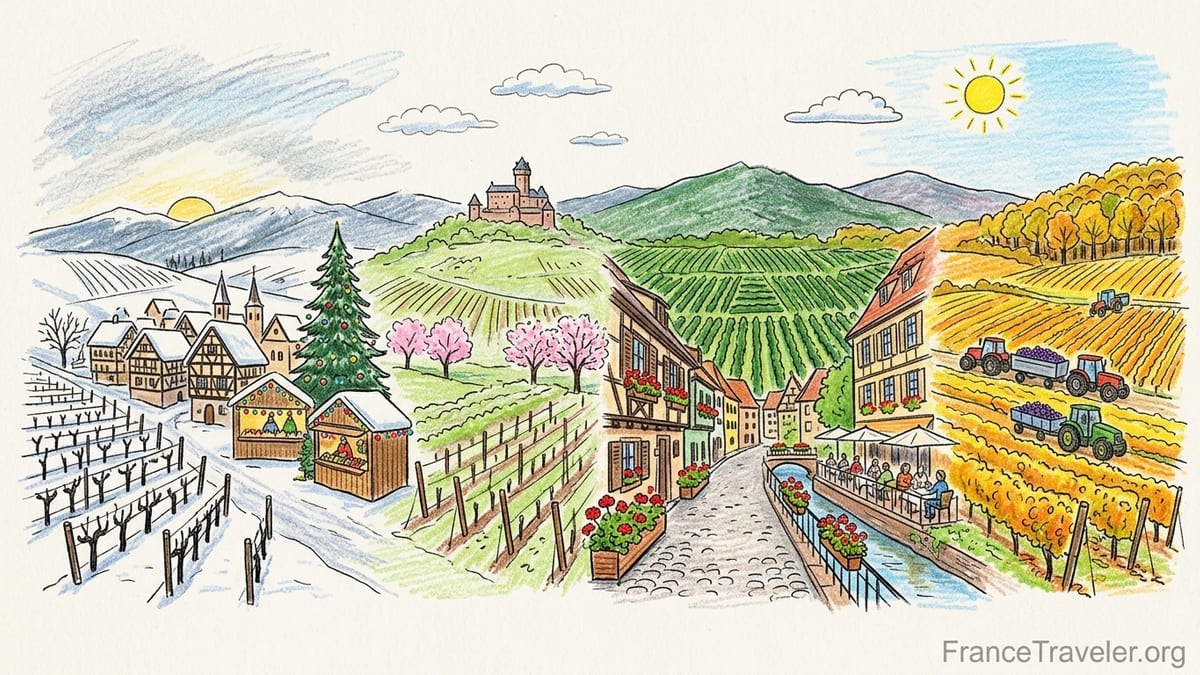
Choosing the best time to visit Alsace is less about finding a single perfect month and more about matching the region’s very different faces to your priorities. Vineyards swing from bare brown rows in March to lush green canopies in summer and gold in October. Strasbourg transforms into a European Christmas showpiece during Advent, while villages on the Wine Route feel almost rural in March or November. This guide looks at what genuinely changes by season so you can decide when Alsace will be “best” for you, whether you are here for wine, walking, Christmas markets, or simply quiet cobbled streets.
How Alsace Changes Through the Year
Alsace has a semi-continental climate with cold winters, warm summers and relatively dry conditions compared with much of France. In Strasbourg and Colmar, average January temperatures hover a little above freezing, with frequent frosts, while July afternoons often reach the mid-20s Celsius, sometimes higher during heatwaves. Rainfall is spread across the year, but the Vosges mountains create a rain shadow, so vineyard villages like Riquewihr, Kaysersberg and Eguisheim are often drier than you might expect in such a green landscape.
The look of the vineyards shifts dramatically by month. In late winter and very early spring, rows are brown and neatly pruned. By late April and May, new leaves appear and the hills begin to turn soft green. In June, the vines are fully in leaf; in July and August they form solid green stripes on the slopes. By late September and October, the foliage turns yellow and gold, often matching the chestnut and beech forests higher up the Vosges. These visual changes matter if you dream of certain photos or want to understand vineyard work up close.
Daylight is another key variable. Around the June solstice, Strasbourg enjoys long evenings, with usable daylight to walk the Petite France quarter or sit on a terrace in Colmar past 9 pm. In December, it can be dark by late afternoon. That early dusk helps the Christmas lights feel magical but shortens sightseeing hours for villages and viewpoints. Crowd levels also swing: midweek in March you might stroll nearly alone through Bergheim’s ramparts, while Saturdays in December around Strasbourg Cathedral can feel shoulder to shoulder.
Finally, remember that the Vosges mountains and the Rhine plain behave like two different destinations. A sunny April afternoon in Colmar may still mean snow on paths near the Col de la Schlucht above 1,000 meters, limiting high-elevation hiking. When you plan, think not only about “Alsace” in general but also whether your trip focuses on wine villages, Strasbourg’s urban culture or outdoor time in the Vosges.
Winter and Christmas: Alsace in its Festive Disguise
From late November through Christmas, Strasbourg deliberately presents itself as a Christmas capital, with streets of the Grande Île dressed in lights and multiple themed markets scattered around the center. France’s official tourism promotion consistently highlights Strasbourg’s role as a major Christmas destination and directs visitors toward other markets in Colmar, Mulhouse, Haguenau and Obernai. In practice, this means that during Advent the entire region leans into a festive identity: half-timbered facades in Colmar are loaded with garlands, toy soldiers and giant baubles, and even small villages like Kaysersberg and Ribeauvillé organize atmospheric markets on selected weekends.
December can feel magical. Colmar’s canals in the Little Venice quarter reflect colored lights, cups of hot mulled wine are sold at simple wooden chalets, and Strasbourg’s towering tree on Place Kléber becomes an evening gathering point for families. Many visitors build trips around specific market dates that typically run from the last week of November into late December. Exact dates shift slightly each year and some towns extend a few days beyond Christmas, so it is essential to confirm current-year calendars with local tourist offices when booking. As an example of impact, hotel prices in Strasbourg around the first and second weekends of Advent are often noticeably higher than in March or early October, and centrally located guesthouses can sell out months in advance.
There are trade-offs. Crowds in Strasbourg can be intense on Friday evenings and weekends, with security checks and one-way flows around the cathedral area. Queues form for popular food stalls, and sitting down for dinner without a reservation can be difficult. Driving into the city is discouraged; visitors are usually better off parking at a park-and-ride on the tram network and continuing by public transport. Cold weather also matters: you may find temperatures near freezing, occasional snow flurries, and damp conditions that make standing in lines tiring. Packing proper winter clothing and warm, waterproof shoes is important.
Outside the pure Advent period, winter is much quieter. From early January through February, Christmas decorations disappear, some smaller hotels and restaurants in vineyard villages close for breaks, and days are short. For travelers who want low prices and near-empty streets, a midweek February stay in a place like Andlau or Barr can feel almost private, but vineyards are bare, and many wineries use this period for work in the cellar and administration rather than public events. It is a fine time for museum visits in Strasbourg or Mulhouse and for hearty Alsatian cooking, but less suitable if you dream of green landscapes or outdoor cafes.
Early Spring: Quiet Streets and Bare Vineyards
Early spring in Alsace, roughly March to early April, offers a certain calm that appeals to repeat visitors and travelers who prefer atmosphere over spectacle. Vineyards are still mostly bare, with freshly pruned canes and visible stakes, so the hillsides around villages like Turckheim and Ammerschwihr look more brown than green. In clear weather, the geometry of the rows and the patchwork of parcels actually becomes easier to appreciate, which can be interesting for wine enthusiasts keen on understanding terroir.
Weather in March is variable. You might experience chilly days with wind, rain and highs in single digits Celsius, followed by a sunny mild afternoon around 15 degrees. Snow in the plain is not especially common but is still possible, while higher sections of the Vosges, including passes like the Col de la Schlucht, can retain snow cover. For walkers staying mainly on low-level paths between villages, early spring is usually fine. However, serious hiking routes at altitude may remain closed or require winter gear, and some exposed paths only fully open later in spring.
Crowds remain light in this period. Many wine estates reopen from winter break and are often glad to have visitors with time for longer tastings and cellar tours, especially midweek. It is usually easy to arrange visits by email a week or two in advance. Accommodation prices in Colmar, Ribeauvillé and other popular stops on the Alsace Wine Route are typically below their summer and Advent peaks. At the same time, not every seasonal ice cream stand, terrace bar or small museum will yet be open, and flower displays in villages will be limited to early bulbs rather than the elaborate geranium baskets that fame towns like Eguisheim in summer.
For cyclists, early spring is a mixed proposition. Dedicated vineyard cycle paths such as portions of the Véloroute du Vignoble are already rideable on dry days, and cooler temperatures make climbing gentle hills more comfortable than in August. However, early sunsets, potential showers and occasional morning frost mean you need flexible plans and proper clothing. If cycling is a central focus of your trip, you may find late spring a better fit than March.
Late Spring: Flowers, Green Hillsides and Shoulder-Season Sweet Spot
By late April and May, Alsace shifts into a gentler, greener phase. Vineyards around villages like Riquewihr, Hunawihr and Guebwiller take on a soft green tinge as leaves emerge, and by late May the hills are visually closer to their summer look. Flower boxes along half-timbered houses begin to fill, and town gardeners plant beds in Colmar and Strasbourg’s parks. While famous geranium displays reach their dramatic peak later in summer, late spring already offers very photogenic streetscapes with fewer crowds than July and August.
Weather in late spring is often pleasant for sightseeing and outdoor meals. Typical daytime highs in Strasbourg and Colmar move into the high teens to low twenties Celsius, with cool evenings that still benefit from a light jacket. Periods of rain remain possible, but there is usually enough sunshine to enjoy long walks between villages without the heat of high summer. Vineyards are actively growing; winegrowers may be tying, trimming and managing the canopy, which gives visitors a sense of the living agricultural side of the landscape.
Late spring is a strong option for cyclists and walkers who want to use waymarked paths without summer heat. Low-level routes between villages such as Kaysersberg, Kientzheim and Sigolsheim or around the hills near Barr and Mittelbergheim are typically accessible. Higher in the Vosges, snow retreats and many routes begin to open, though very early May can still bring patches of snow or muddy sections on north-facing slopes. Popular panoramic spots like the Route des Crêtes generally become reliably usable later in spring, but always check local conditions if you plan higher-level hikes.
From a crowd perspective, May brings a gradual rise in visitors, especially around French public holidays when Parisians and neighboring Germans enjoy long weekends. Colmar’s hotels and guesthouses can be busier on these dates, and some restaurants adopt summer schedules. Overall, though, late spring remains less intense than school-holiday summer or Advent, making it an attractive balance of atmosphere, comfort and availability.
Summer: Long Evenings, Busy Villages and Vineyard Green
Summer, from June through August, is when Alsace feels most “alive” in a conventional holiday sense. Vineyards are completely green, villages are heavily decorated with flowers, and restaurant terraces spill onto squares in Colmar, Obernai and smaller towns. Families fill ice cream parlors, and cultural events multiply, from open-air concerts in Strasbourg to wine festivals along the Route des Vins. For first-time visitors who imagine half-timbered houses framed by overflowing red geraniums and blue skies, July and August match that mental image closely.
Daylight is a major advantage. In June and early July, it may remain light past 9.30 pm, giving you time to combine a day of visits to wineries with an evening stroll in Ribeauvillé or a late return from the Vosges ridge. Warm evenings are ideal for dining outdoors in Petite France or along Colmar’s canals. However, recent summers have also brought spells of high heat. During heatwaves, afternoon temperatures can push above 30 degrees Celsius, and even the usually cooler Vosges may feel warm at lower elevations. Travelers sensitive to heat might prefer June or early July over the very end of July and early August.
Summer is also high season for crowds and prices. French school holidays typically run from early July through late August, and during these weeks family demand drives up occupancy. Accommodation in sought-after villages on weekends can cost significantly more than in March or November, especially for well-located small hotels and apartments. The upside is that everything is open. Almost every restaurant operates daily, museums and castles like Haut-Koenigsbourg have extended opening hours, and tourist-focused services such as guided tours and small tourist trains in Colmar and Riquewihr run frequently.
For cyclists and hikers, summer delivers the most reliable conditions in the Vosges. High passes like the Col de la Schlucht, at over 1,100 meters, function as classic cycling climbs and starting points for panoramic walks. Iconic trails such as the Sentier des Roches near the same pass are usually clear of snow and ice. You still need to watch for summer thunderstorms, often in late afternoon, but overall, July and August are the best bet for exploring ridge paths with expansive views over the Rhine plain and Black Forest beyond.
Harvest Season and Late Autumn: Gold Vineyards and Wine Activity
Harvest season, known locally as the vendanges, is one of Alsace’s most attractive yet misunderstood periods. Officially, the start of the grape harvest is controlled by a prefectoral order called the ban des vendanges, which authorizes picking for each grape variety and appellation based on maturity checks. In recent years, picking for Crémant d’Alsace base wines has tended to begin around mid-September, with still wine varieties following through late September, and late-harvest styles like Vendanges Tardives extending into October, sometimes even November for special lots. The exact calendar changes every year and has been gradually moving earlier due to warmer growing seasons.
For travelers, this means that visiting in mid-September through October gives you a good chance of seeing active harvest work without relying on a specific start date. You might notice tractors hauling trailers full of grapes through villages such as Dambach-la-Ville, watch teams cutting bunches on slopes near Ribeauvillé, or spot destemming machines running in courtyards. Many villages host harvest-themed events or wine festivals in September or October, with tastings and parades, though you should check local calendars for current-year dates.
There are clear benefits and limitations for wine-focused visitors. On the positive side, the landscape is spectacular: vineyards shift from green to deep yellow and orange, and forests on the lower Vosges echo the same colors. Light is softer, making views from the Route des Crêtes or hilltop chapels above Hunawihr particularly photogenic. Cooler air suits cellar visits and tasting. On the limitation side, winemakers are genuinely busy. Some estates reduce or pause tastings during peak picking days, or only accept visitors with firm appointments at set times. Others may welcome guests but have less time available for extended conversations. If you plan a harvest-season trip mainly for wine, write to targeted domaines well in advance and remain flexible about times.
Late autumn, from late October into November, comes after the main rush of picking is over. Many vineyards are fully golden or already leafless, and mornings can bring mist in the Rhine plain. This can create beautifully atmospheric scenes in villages like Bergheim, where medieval ramparts rise above fog. Crowds thin significantly after the autumn school holidays. Accommodation prices tend to soften except in the immediate lead-up to Advent, when Strasbourg in particular begins to ramp up again. For visitors who value mood and lower costs over bright summer color, early November can be a surprisingly satisfying moment to wander the Wine Route and Strasbourg’s old town.
Vosges Mountains vs Rhine Plain: Different Seasons in One Trip
Understanding the contrast between the Vosges mountains and the Rhine plain will help you time activities correctly. The plain, which includes Strasbourg, Colmar and most wine villages, sits at relatively low altitude, so spring arrives earlier and snow is rarer. The Vosges, by contrast, rise above 1,000 meters at passes like the Col de la Schlucht and summits such as the Hohneck. Temperatures up high are typically several degrees colder than in Colmar, and snow can persist well into April on shaded slopes, sometimes returning as early as late October.
For walkers and hikers, this means that a route between villages, for example from Kaysersberg to Kientzheim, may be comfortable in March, while a high-level traverse along the crest near the Sentier des Roches is still wintery. The main hiking season for most high Vosges trails generally aligns with late May or June through October, while low-level walking in the vineyards can stretch much longer. If you picture yourself picnicking by a lake such as Lac Blanc or Lac des Truites, plan for late spring to early autumn, and always check current conditions with local tourist offices or hut keepers.
Cyclists also experience the difference. Vineyard cycle paths and back roads in the plain become attractive ride options from April into late October, apart from the coldest or wettest days. Road cyclists seeking classic climbs often dream of tackling Vosges passes like the Col de la Schlucht or Col du Bonhomme, both of which can feature in major cycling events. These higher roads are most reliably enjoyable from June to September. Outside that window, you may face cold descents, patches of snow, or seasonal closures after heavy snowfall, even when Colmar feels relatively mild.
In winter, the Vosges become a small-scale snow playground. Areas around the Col de la Schlucht support downhill skiing, cross-country trails and snowshoeing when conditions permit. This opens an alternative face of Alsace: you could spend a December morning on snowshoes and your late afternoon among Strasbourg’s Christmas market stalls. However, snow reliability varies by year, and conditions can change quickly. If winter mountain activities are central to your plan, it is prudent to choose flexible dates and remain ready to shift to lower-level walks and cultural visits if snow turns to rain.
Who Should Choose Which Season? A Practical Decision Guide
Because Alsace offers distinct experiences at different times of year, the “best” moment depends heavily on your priorities. For a first general sightseeing trip that mixes Strasbourg, a day along the Wine Route and perhaps a short Vosges excursion, many travelers favor late spring or early autumn. In May or late September, you are likely to enjoy comfortable temperatures, some vineyard greenery or early autumn color, and manageable crowd levels in Colmar and Strasbourg. You avoid the peak August holiday rush and the intense weekend crush of Advent.
Wine travelers choosing dates around the harvest need to weigh atmosphere against access. If your dream is to see grapes being picked and trailers rolling through villages, target mid-September to early October and reach out to a handful of estates in advance to check whether they receive visitors during harvest. If, on the other hand, your priority is long, unhurried tastings and detailed conversations with growers, you might be happier in late spring or late autumn once the main cellar work is done. Throughout the year, many estates remain open with advance booking, but their energy and availability vary with the farming calendar.
For cyclists, shoulder seasons are appealing. Late April through June and September into early October usually provide moderate temperatures and stable conditions on vineyard roads, with enough daylight for long loops. July and August add the possibility of fine-weather days in the high Vosges but also introduce heat and busier roads on some passes. Families often gravitate to summer because of school calendars and the guarantee that almost all attractions, from castles to local swimming pools, are operating. Those traveling with small children might appreciate June or early July, when family-friendly walking routes in the Vosges are usually accessible but the hottest weeks have not yet arrived.
If your main objective is Christmas markets, your window is tight and dictated by event calendars rather than weather. Look at late November and the first half of December for abundant lights and stalls but relatively less intense holiday-week travel than the final weekend before Christmas. To avoid crowds overall, consider early spring, late autumn outside school holidays, or a non-festive winter week in January or February. In these quieter periods, you trade some services and visual lushness for empty alleys, easier restaurant bookings and more relaxed conversations with locals.
Decision Table: Matching Your Trip to the Season
Use the following table as a quick reference when deciding when to plan your visit. It does not name one universally “best” month. Instead, it pairs common trip types with the seasons that generally work well for them, based on the patterns described above.
First visit focused on classic villages and Strasbourg: Consider May, June or late September. In these periods, you will likely see green or turning vineyards, enjoy long enough days for walking tours and terrace dining, and avoid the heaviest school-holiday and Advent crowds. You also gain flexibility for a short Vosges excursion without needing full summer heat.
Wine-focused trip: For harvest atmosphere, aim for mid-September to early October, accepting that some estates may limit visits and that you should secure appointments in advance. For calmer, conversation-rich tastings, late April to June or late October to early November can work well, when winemakers are less pressured by field work and still present on the estate.
Christmas markets: Target late November to around the middle of December, aligning with Advent calendars. Strasbourg, Colmar, Mulhouse, Haguenau and Obernai typically host markets in this period, but exact dates vary yearly. Early December midweek visits tend to balance vibrant decorations and stall activity with slightly more manageable crowds and accommodation costs than peak weekends or the final days before Christmas.
Cycling and hiking: Choose late spring or early autumn. For vineyard cycling and low-level walks, April to June and September to early October usually provide pleasant temperatures and decent daylight. For high Vosges hiking, June through September offers the best chance of clear, snow-free trails and open huts. Winter visits can still include short vineyard walks, but mountain routes may require snow gear or shift to snowshoeing.
Families: July and August align with school holidays and guarantee a full menu of open attractions, family-oriented events and swimming opportunities, at the cost of higher prices and busier hotspots. Families with more flexible schedules might prefer late June or early July, when services are already running but the absolute peak has not yet begun, or late August into early September to combine summer warmth with a slight easing of domestic travel.
Avoiding crowds and seeking value: Look to March, early April, early November and non-festive winter weeks in January and February. Expect some limitations in mountain access, fewer flowers and occasional restaurant or hotel closures in small villages. In return, you gain lower room rates, short queues at major sights and the odd moment when a popular viewpoint or medieval lane feels like it belongs only to you.
The Takeaway
Alsace is not a one-season destination. Bare winter vineyards and quiet cobbles reveal the structure of the landscape and medieval towns. Late spring brings fresh green hills and accessible trails. High summer layers on long evenings, full flower boxes and festival energy, at the expense of higher prices and thicker crowds. Harvest season and late autumn drape the vineyards and forests in gold and animate villages with grape-picking routines, while Advent turns Strasbourg and nearby towns into a distinct Christmas product that draws visitors from across Europe.
The best time for your trip depends on whether your dream image involves steaming cups of mulled wine under cathedral lights, a nearly empty rampart walk at sunrise, a picnic on a high Vosges ridge, or close-up views of grape pickers at work. Use the seasonal patterns, trade-offs and decision table here as a framework, then check current-year event calendars and weather expectations as you book. Rather than searching for one ideal month, think in terms of which face of Alsace you most want to meet on your first or next visit.
FAQ
Q1. When are the Strasbourg and Colmar Christmas markets usually held?
They typically run from the last week of November into late December, with exact dates announced each year by local authorities and tourist offices.
Q2. Is December a good time to visit Alsace if I am not interested in Christmas markets?
Early December is dominated by Christmas activity, especially in Strasbourg and Colmar. If you prefer quiet streets without decorations, January or February is usually calmer.
Q3. When are the vineyards in Alsace green and full of leaves?
Vines generally leaf out in April, look fully green from May through September, and then turn yellow and gold in October before losing their leaves.
Q4. What months are best to see the grape harvest?
You have the best chance of seeing active harvest work from mid-September through October, although precise picking dates vary each year with weather and grape ripeness.
Q5. Are wineries open to visitors during harvest season?
Many are, but schedules can be restricted because winemakers are busy. It is important to arrange appointments in advance and remain flexible about timing.
Q6. Which months offer the best conditions for hiking in the Vosges mountains?
Most higher-elevation trails are most reliable from June to September, when snow has melted and mountain huts, roads and lifts serving walkers are generally open.
Q7. What is the best season for cycling the Alsace Wine Route?
Late April to June and September to early October usually provide comfortable temperatures, good daylight and fewer crowds on vineyard roads and cycle paths.
Q8. When is Alsace least crowded and more affordable?
March, early April, early November and winter weeks outside Advent usually see lower hotel prices and fewer visitors, though some services may be reduced.
Q9. Is summer too hot to visit Alsace now?
July and August can bring hot spells, especially during heatwaves, but many days remain comfortably warm. Planning outdoor activities for mornings and evenings helps avoid peak heat.
Q10. For a first-time visitor, which season gives the best overall mix?
Late spring and early autumn often provide a balanced combination of pleasant weather, attractive landscapes, open attractions and moderate crowd levels for a first visit.