


On my first winter trip to Alsace I promised myself one thing: I would not leave until I had earned an opinion on its famously hearty food and generous pours of wine. I based myself in Strasbourg and Colmar during Christmas market season, booked both old-school winstubs and a modern Michelin-style table, and kept track of every flammekueche, choucroute and glass of Riesling that crossed my path. What follows is not a theoretical guide to Alsatian gastronomy, but exactly what I ate and drank, what it cost, how it felt after a full day of walking cobbled streets, and what I would happily order again.
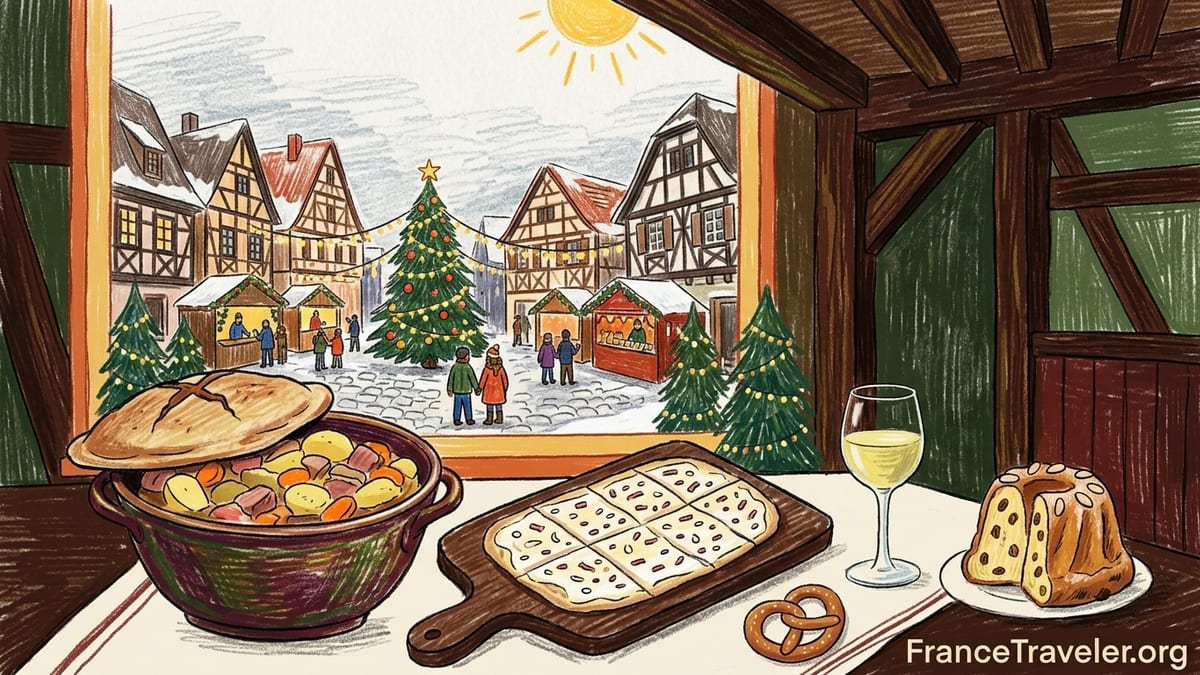
Setting the Scene: Eating in Alsace in Real Life
I visited Alsace in early December, splitting my time between Strasbourg and Colmar while the Christmas lights were already blazing and the markets in full swing. That timing shaped almost everything about my meals: restaurants filled early, service ran on a strict lunch and dinner rhythm around 12.00 to 14.00 and 19.00 to 21.00, and the gap between market snacks and sit-down dinners could make or break my appetite. Strasbourg tourism offices and local restaurant guides describe more than fifty traditional winstubs in the city alone, many of them concentrated on the Grande Île and in Petite France, and walking around at 19.30 it felt like every single one had a “complet” sign on the door.
Before arriving I had booked two traditional winstubs in Strasbourg, one riverside brasserie-style house that also runs a winstub room inside the historic customs building L’Ancienne Douane, and a more intimate wood-panelled address with a reputation for well-executed classics. Typical main dishes at these winstubs currently run around 18 to 23 euros for choucroute garnie or baeckeoffe, with flammekueche mostly under 15 euros per full round, according to recent menus posted by local restaurant guides and the houses themselves. I also reserved a lunch table at a modern fine-dining restaurant in Strasbourg highlighted in the city’s 2026 gastronomy press kit, offering a lunch menu starting around 54 euros, to see how chefs are reworking Alsatian products at a Michelin level.
The basic pattern of my days became clear after the first one. I would grab coffee and a pastry, eat a proper sit-down lunch around 12.30, graze lightly at the markets between 16.00 and 18.00, then head to a booked dinner at 19.30. That near-clockwork schedule is not just my planning instinct; both official Christmas market guidance and local FAQs stress that December evenings are extremely busy and that visitors without reservations often end up wandering for a long time looking for a table. By my second night I understood why locals insist on calling ahead, even midweek.
Portions at almost every traditional place were substantial enough that ordering both a starter and a main was out of the question if I wanted to try multiple specialties in a single day. That became one of the practical challenges: I wanted to taste choucroute, baeckeoffe, spaetzle, kougelhopf, Munster, pretzels, beer, wines and schnapps, but one full plate of anything could easily be enough for two moderately hungry people. My solution was to share with a travel companion whenever possible, or to ask explicitly for half portions if the restaurant allowed it, especially at lunch.
The First Flammekueche: Learning to Share the Classic
My first proper tarte flambée, or flammekueche, was at a lively brasserie-winstub near Place Kléber in Strasbourg that trades strongly on its beer heritage and serves flammekueches late into the evening. Local food guides and brewery communications mention their flammekueche as a house specialty, with individual rounds typically priced in the 9 to 13 euro range depending on toppings. I ordered the classic version: a very thin, crisp dough base topped with fromage blanc and cream, onions and smoked lardons, baked quickly in a very hot oven until the edges blistered.
The flammekueche arrived already cut into eight rectangles, perfect for sharing. For two people this was exactly the right portion as a light meal, or a generous shared starter for three. The texture surprised me most: the base was somewhere between a cracker and a very thin pizza crust, with enough chew in the centre to support the creamy topping without collapsing. The richness level was medium; the dairy layer was tangy rather than heavy, and the onions had enough bite left that each slice felt bright instead of stodgy. I paired it with a 25-centilitre glass of the brewery’s own lager, which was listed at just under 4 euros on the menu. The crisp, slightly bitter beer was a perfect foil for the salty lardons and cream.
Was it worth ordering? Absolutely, but with one important caveat: a whole flammekueche per person would have been too much, especially at dinner before a second course. Shared, it was ideal. On a return visit I would either order one classic to share as a starter or make it the entire meal with a mixed salad on the side. For wine drinkers, I would happily pair this with a dry Riesling or a Sylvaner by the glass if the winstub offers it, but the light lager felt more aligned with the casual, wood-panelled beer hall atmosphere that evening.
Later in the trip I tried a variation topped with Munster cheese at a more touristic riverside winstub in the old customs building. The price there was higher, around 12 euros for the specialty version, and the portion similar in size. Here the texture tipped into heavier territory: the Munster, melted in small pockets across the surface, brought a pungent, buttery richness that overwhelmed the delicate dough and cream. It was enjoyable as an experiment, but I left more full and slightly tired of the intensity. If you only have room for one flammekueche, I would keep it classic.
Choucroute Garnie: When Tradition Becomes Too Much
Choucroute garnie, the emblematic mountain of sauerkraut and pork, was non-negotiable for me. I chose to try it at one of Strasbourg’s oldest winstubs on the Grande Île, a house often singled out in restaurant roundups as offering a complete repertoire of Alsatian specialties. Recent listings for this winstub mention choucroute around 18 euros, with more elaborate “royale” versions a few euros higher. I ordered the standard garnished choucroute as a main course at dinner.
The plate that arrived could have fed a small family. At its base was a generous mound of warm, gently vinegared sauerkraut, not as sharp as German versions I have had, with juniper and bay giving it a rounded flavor. Buried and arranged around it were a boiled potato or two, a thick slice of smoked Kassler-style pork, a knack sausage, a garlicky Strasbourg sausage, and a piece of salt-cured pork belly. The meat was perfectly cooked and the sauerkraut was neither watery nor greasy, but by the fourth or fifth bite I began to feel that I was simply repeating the same flavor in different forms.
With the choucroute I ordered a glass of local Riesling, listed at about 5.50 euros for 12 centilitres on the wine card. Dry Riesling in Alsace has the acidity and structure to cut through the fat and salt of pork, and that pairing worked exactly as expected, keeping the dish from feeling cloying. The portion, however, was frankly too large for one person who also wants to explore other dishes during the same trip. Even eating only the sausages and a few forkfuls of sauerkraut, I finished the meal very full and skipped dessert entirely.
Of everything I ate in Alsace, this is the dish I would call overrated in its standard restaurant form. The issue is not quality but quantity. The abundance that historically made sense in a cold-climate farmhouse context translates into a one-note, heavy experience for urban travelers who have other meals to plan. If you are determined to try choucroute garnie, I would either share one plate between two people or look for a restaurant that offers a lighter, modern interpretation with fewer meats and more vegetables. The sauerkraut itself is delicious, but I would not devote an entire dinner to the full traditional version again.
Baeckeoffe, Spaetzle and Munster: Comfort Food with Caveats
Baeckeoffe, the slow-baked casserole of marinated meats and potatoes, became my favorite of the heavyweight Alsatian dishes. I ate it at a traditional winstub-bierstub beside the river Ill, an establishment that has been serving Alsatian fare since the early twentieth century and appears on many local lists of reliable classics. On the menu the three-meat baeckeoffe, marinated in Riesling and baked under a dough-sealed lid, was priced just under 24 euros. I ordered it on a cold, rainy evening after walking all afternoon among the half-timbered houses of Petite France.
When the server broke the crust at the table, a fragrant cloud of wine, onions and herbs escaped. Inside, chunks of beef, pork and lamb intertwined with thinly sliced potatoes and carrots in a broth that had turned silky from slow cooking and collagen. The portion filled a deep ceramic dish; realistically, it was enough for one very hungry person or to be shared with an additional side. Texturally, this was exactly what I wanted from winter comfort food: tender meat that still held its shape, potatoes that absorbed the broth without disintegrating, and just enough fat to coat the lips without feeling greasy. I paired it with a glass of Pinot Gris, slightly richer and more textured than Riesling, which matched the stew’s depth. The pairing felt spot-on, and I would repeat it without hesitation.
Spaetzle appeared twice in my week. First as a side at a country-style restaurant along the Route des Vins near Colmar, where I stopped for lunch after visiting nearby wineries. Here, buttered spaetzle accompanied a creamy “bouchée à la reine” type dish of chicken and mushrooms in puff pastry. The spätzle portion could have been a main on its own, a heaping scoop of irregular, slightly chewy noodles that soaked up the sauce. The plate cost around 18 euros according to the posted lunchtime menu. The texture was satisfying, but the combination of cream sauce, pastry and buttered noodles tipped into heaviness. I finished less than half and still had no space left to taste dessert.
My second encounter was more successful: crisped spaetzle with Munster cheese served as a small plate at a farmhouse inn between Colmar and the Vosges foothills, where I had booked an overnight stay specifically for the table d’hôtes. Here the portion was modest, closer to what an American diner might consider a large side rather than a main. The edges were browned and crunchy from the pan, and the Munster, melted through, gave a pungent, almost barnyard aroma without becoming overpowering. With a glass of Edelzwicker, the everyday blended white wine often served in carafes at country inns, the dish felt indulgent but manageable. This is how I would recommend trying both spaetzle and Munster: in smaller plates, ideally shared, rather than as an entire main course that leaves you anchored to your chair.
Sweet Things: Kougelhopf, Pretzels and Pastries Between Meals
Breakfasts in Alsace became my opportunity to try kougelhopf without sacrificing dinner capacity. In Strasbourg I sought out a century-old bakery in the city centre known for baking kougelhopf in tall, fluted molds stacked in the window. Individual slices of the yeasted, lightly sweet cake with raisins and almonds were priced at about 2.50 to 3 euros; a whole small kougelhopf to take away cost closer to 8 to 10 euros according to bakery signage. I ordered a slice with coffee and ate it standing at the narrow counter along the window, watching commuters hurry past in the cold.
Texturally, kougelhopf sits between brioche and panettone. The crumb was slightly drier than I expected, but in a good way; it made an excellent vehicle for absorbing coffee or tea. The top, dusted with powdered sugar, offered a faint crunch, and the toasted almonds embedded in the crust gave occasional bursts of nuttiness. As a breakfast item, I loved it. As a dessert after a heavy winstub meal, it would have been far too much. My recommendation is to treat kougelhopf as a morning or midafternoon snack, not something to “save room for” after choucroute.
Pretzels entered the picture mostly at the Christmas markets. Stands across Strasbourg and Colmar sell large, soft bretzels for around 3 to 4 euros each, sometimes topped with cheese or seeds. These are perfect for bridging the long gap between a 12.30 lunch and a 19.30 dinner reservation. One evening I bought a plain salted pretzel around 17.00, still slightly warm, and ate it walking between market squares. The texture was pleasantly chewy with a thin, glossy crust and fat grains of salt. Paired with a cup of hot spiced apple juice rather than mulled wine, it took the edge off my hunger without spoiling dinner.
Beyond these, I made a point to try at least one slice of fruit tart each day, often mirabelle or quetsche, at small salons de thé in both Strasbourg and Colmar. Slices averaged 4 to 5 euros on blackboard menus and were usually served on simple white plates with no garnish. Compared to the region’s heavy mains, these tarts were refreshingly restrained: thin, buttery crusts, a layer of fruit baked until just collapsing, and only light sweetness. If you find yourself too full for restaurant desserts but still wanting something sweet, an afternoon coffee and tart is the way to go.
Drinking in Alsace: Beer, Wine and Schnapps in Practice
Given Alsace’s dual beer and wine heritage, I tried to balance my drinks to match both the food and the setting. In Strasbourg, local guides frequently mention a central brasserie linked to the Meteor brewery, described as an essential stop for tarte flambée and beer and known for serving flammekueche until late at night. I visited once in the late afternoon for a flammekueche and ordered a 50-centilitre draught Meteor lager listed at around 6 euros. The beer was crisp and clean, with a subtle malt sweetness and gentle bitterness. With food, the half-litre felt generous but not excessive, especially after hours of cold-weather walking.
Wine became my default pairing at more traditional winstubs and the fine-dining restaurant. In Strasbourg and along the Route des Vins, most places offered local wines by the glass in the 4.50 to 7 euro range depending on the grape and producer, with carafes providing better value. With flammekueche and lighter dishes, I leaned toward Sylvaner or Pinot Blanc. With baeckeoffe and richer preparations, Pinot Gris gave enough body to stand up to slow-cooked meats. Riesling, of course, proved the most versatile, especially with anything involving pork or sauerkraut. I did one dedicated tasting at a family-run winery outside Colmar, where a standard flight of five wines cost around 12 euros, and then worked those preferences back into my restaurant choices.
As for schnapps, or eaux-de-vie, I approached them cautiously. Many winstubs and farmhouse inns bring out a bottle of locally distilled fruit brandy at the end of the meal, particularly mirabelle or kirsch. At the farmhouse inn near Colmar, a small complimentary glass of mirabelle eau-de-vie appeared after dessert without my asking. The clear spirit carried a powerful floral fruit aroma and a fiery warmth that spread slowly. One 2 to 3 centilitre pour was more than enough. In Strasbourg I ordered a measured glass of kirsch from the digestif menu at around 6 euros. It made sense as a ritual after such hearty food, but it is not something I would repeat nightly. For most travelers, I would recommend trying a single schnapps at a rural inn where it feels part of the house hospitality, rather than building whole evenings around it.
It is worth noting that the Christmas markets themselves offer plenty of hot drinks, from vin chaud to non-alcoholic punches, but local advice repeated in several guides and forums is that market food is better treated as a snack than a full meal. After sampling a cup of mulled white wine in a Strasbourg square one evening, I agreed: charming, sweet, but less interesting than what awaits in the winstubs and restaurants nearby.
Old Winstub vs Modern Fine Dining: Two Faces of Alsatian Cuisine
To understand how Alsatian food is evolving, I set one dinner at a traditional winstub against a lunch at a modern gastronomic restaurant in Strasbourg recognized by both the Michelin Guide and Gault & Millau. Strasbourg’s official fine-dining communications highlight chefs like Guillaume Scheer at Les Plaisirs Gourmands, whose lunch menus start around 54 euros and focus on local suppliers and creative sauces. I opted for a similar profile: a compact dining room in a half-timbered house near the river, one Michelin star, and a three-course lunchtime menu priced just under 60 euros.
At the winstub, the dining room glowed with dark wood, checked tablecloths and hunting prints. Tables were close together and conversations overlapped. Service was brisk but friendly, with staff carrying heavy plates of choucroute, braised pork knuckles and flammekueche through narrow aisles. My meal there was the aforementioned choucroute garnie, preceded only by a simple mixed salad, and accompanied by a carafe of Riesling. The experience was convivial and hearty, very much in line with the official tourism description of winstubs as former wine rooms turned into popular taverns. It felt authentic in its way, but also slightly trapped in amber.
The fine-dining room the next day was another world: white walls, bare wooden tables, precise lighting, and plenty of space between seats. The lunch menu began with a small amuse-bouche of a beet and goat cheese tartlet, then moved into a starter of confit trout from the Vosges with pickled vegetables and a Riesling cream, followed by a main of guinea fowl with spaetzle and a light jus, and ending with a dessert featuring local apples, caramel and a cider reduction. Portions were thoughtful, not punishing; I left satisfied but mobile. The sommelier proposed an Alsatian wine pairing at about 25 euros that traversed Muscat, Riesling and a late-harvest Gewurztraminer with dessert.
What struck me most was how recognizably Alsatian the fine-dining meal remained, even as the plating and portion sizes changed. The spaetzle with guinea fowl echoed the farmhouse plates I had eaten earlier, but the noodles were airy, lightly dressed in butter rather than drowned, and the jus was concentrated without being salty. The Riesling cream around the trout nodded directly to the region’s wine culture. Here, traditional ingredients became part of a layered composition rather than dominating the plate. If you are wary of leaving Alsace feeling overstuffed, one carefully chosen modern restaurant like this can balance a week of winstubs.
The Social Side: Reservations, Timing and Managing Your Appetite
Beyond the plates and glasses, eating in Alsace is also about working with local rhythms. During the Christmas period, Strasbourg’s official market information and independent guides alike recommend visiting markets earlier in the day if you want to avoid the heaviest crowds, reserving restaurants in advance for evenings, and not relying on market stalls for full dinners. My own experience mirrored that advice. On my first night I tried walking into several winstubs in Petite France around 19.30 without a booking and was turned away each time. By the time I found a less atmospheric brasserie with space, my only option was a quick plate and no lingering.
After that I reserved dinners two or three days ahead for Strasbourg and at least a day ahead in Colmar. Lunchtimes were more forgiving midweek, with some traditional restaurants able to seat walk-ins at 12.00, but by 13.00 most places were full. Meal timing is also stricter than in many big cities: kitchens often close between 14.00 and 19.00, and very few sit-down places will serve a hot meal at 16.00. That long afternoon window is exactly when pretzels, pastries and coffee saved me.
Portions are the other social factor. At many winstubs the default assumption seems to be that you are coming for one big meal. Mixed groups of locals around me often ordered just a main course, with perhaps a shared starter at most, and lingered over coffee or schnapps afterwards. As a visitor eager to “try everything,” it is easy to over-order. My most successful evenings were those where I accepted that one substantial dish and a glass or two of wine were enough, and that I could explore the rest at lunch or the following day.
In farmhouse inns along the Route des Vins, the social element takes a slightly different shape. There, dinner is often served at a set time to all guests, with a fixed menu announced in advance. At the inn where I stayed, for about 40 euros per person, dinner included a starter, a hearty main with spaetzle, cheese, dessert and a glass of wine. The mood felt more like being a guest at a large family table than in a restaurant. These settings are ideal places to taste local cheeses like Munster and to accept a small glass of schnapps afterwards, but less flexible if you are already “over” heavy food.
The Takeaway: My Ideal First-Time Alsace Food and Drink Lineup
Looking back, there are dishes and drinks I would repeat in a heartbeat and others I would approach with more restraint. If I were planning a first-time visitor’s three main Alsatian meals, built from what I actually enjoyed, it would look like this. For a first winstub dinner in Strasbourg, I would start with a shared classic flammekueche in a traditional setting such as one of the long-established winstubs on the Grande Île, accompanied by either a local lager or a glass of Riesling. As a main, I would choose baeckeoffe rather than choucroute, ideally the three-meat version in a place known for slow-cooked dishes, and pair it with a glass of Pinot Gris. I would skip dessert and finish instead with a small coffee, keeping the option of a walk and perhaps a fruit tart elsewhere later.
For a day focused on wine country, I would book a farmhouse inn or country restaurant along the Route des Vins for lunch. There I would order a dish featuring spaetzle in a moderate portion, perhaps as an accompaniment to roast poultry or fish, and make sure to taste Munster cheese on a shared cheese plate rather than as the main star. I would pair the meal with a carafe of Edelzwicker or a light Riesling and leave space to stop at one or two wineries afterward for tastings.
For the modern side of Alsace, I would reserve a lunch at a Michelin-listed or Gault & Millau recognized restaurant in Strasbourg or Colmar offering a set menu around 50 to 60 euros that interprets regional products with lighter sauces and smaller portions. I would gladly take the suggested local wine pairing if it focuses on Alsatian whites. Later that same day, dinner could simply be pretzels and a slice of kougelhopf or fruit tart with coffee, honoring the fact that you have likely eaten well enough at lunch.
Above all, I would limit choucroute garnie to a shared plate at most, treat kougelhopf as breakfast rather than dessert, and resist the urge to say yes to schnapps every night. Alsace rewards curiosity, but it also rewards pacing. If you give yourself room between plates and pourings, you will leave with clearer favorites and far fonder memories of exactly what you ate and drank.
FAQ
Q1. Do I really need restaurant reservations in Strasbourg during the Christmas market?
Yes. In December, especially on weekends, many winstubs and popular restaurants are fully booked from about 19.00 onwards. Without a reservation you may have to try several places or settle for a less interesting option, so booking at least a couple of evenings in advance is wise.
Q2. How much should I budget for a typical winstub meal with wine?
For a main dish like choucroute, baeckeoffe or a generous flammekueche and a glass of local wine, plan on spending around 25 to 35 euros per person, including a coffee or shared dessert. More elaborate dishes or touristy riverside locations can push that closer to 40 euros.
Q3. Is tarte flambée enough for a whole meal or should it just be a starter?
One classic flammekueche, usually cut into eight pieces, can work as a light meal for one person or a shared starter for two or three. Given how many other dishes you may want to try, sharing it as a first course is often the best strategy.
Q4. Is choucroute garnie worth ordering if I only have one big Alsatian dinner?
It depends on your priorities. The flavors are comforting and well executed, but portions are heavy and repetitive. If you are curious about several specialties, you might be happier sharing one choucroute at lunch or choosing baeckeoffe for dinner instead.
Q5. When is the best time of day to eat at the Christmas markets?
Markets are busiest from late afternoon into the evening. If you want space to move and take photos, late morning or early afternoon is calmer. Treat market food as snacks between proper lunches and dinners rather than full meals.
Q6. Can I find lighter or vegetarian options in Alsace, or is everything meat-based?
While traditional winstubs focus on meat-heavy dishes, many modern restaurants and some farmhouse inns offer vegetable-forward plates, fish, or meatless versions of classics. You can often find salads, vegetable tarts and pasta or spaetzle with mushrooms instead of meat.
Q7. What local drinks pair best with Alsatian dishes if I do not like beer?
Dry Alsatian whites are ideal. Riesling works well with pork and sauerkraut, Pinot Gris suits richer dishes like baeckeoffe, and Sylvaner or Pinot Blanc are good with lighter food and flammekueche. Ask by the glass if you want to try several.
Q8. Is Munster cheese very strong, and how should I try it?
Munster is aromatic and can smell intense, but when melted into spaetzle or served in small wedges with cumin seeds it is more approachable. Trying it as part of a shared cheese plate or a side dish is a good starting point.
Q9. Are kougelhopf and pretzels better as desserts or snacks?
Kougelhopf is slightly sweet and bready, making it excellent for breakfast or midafternoon with coffee rather than a post-winstub dessert. Large soft pretzels from market stands work best as late-afternoon snacks to carry you between meals.
Q10. Should I try Alsatian schnapps, and how much is enough?
Regional eaux-de-vie like mirabelle or kirsch are worth tasting once, ideally at a winstub or farmhouse inn that offers small pours. One 2 to 3 centilitre glass at the end of a big meal is usually plenty, both for flavor and for alcohol.