


The French Mediterranean is not one single coast but a chain of very different shorelines: wild lagoons, volcanic headlands, calanques, pine-fringed sandbars and urban promenades. Booking blind into “the South of France” can leave you in the wrong place entirely for the kind of trip you imagined. This guide compares Collioure and the Côte Vermeille, Sète, the Camargue (Aigues-Mortes and Saintes-Maries-de-la-Mer), Marseille and Cassis, Hyères and its islands, and the Riviera towns from Saint-Tropez to Menton. It focuses on how each area feels on the ground, how busy and expensive it is, and whether it works best as a base or a day trip.
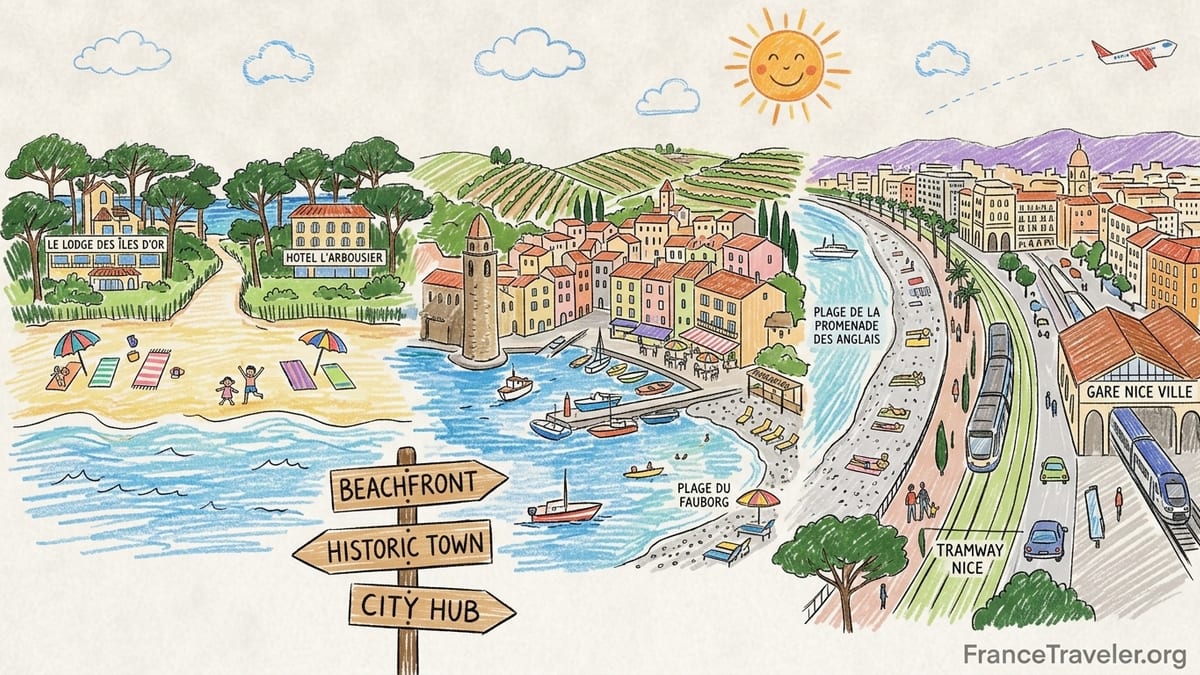
How to choose your stretch of the French Med
The first decision is not which town, but which coast type fits you. West of Marseille you find long, low, sandy shorelines and lagoons where flamingos feed and cycle paths run for kilometres behind the dunes. Around Marseille and Cassis the coast turns rocky and dramatic, carved into fjord-like calanques best reached by foot or boat. East of Toulon the Riviera takes over, with a run of resort towns strung along a narrow shelf between the sea and the mountains, where beaches are smaller, prices higher and public transport much stronger.
Think in terms of your priorities. For broad, swimmable sandy beaches with space even in August, look to Sète’s Lido sandbar, the Camargue beaches outside Saintes-Maries-de-la-Mer, or the long strands west of Hyères. For scenery and hiking, the Côte Vermeille around Collioure and the calanques between Marseille and Cassis are standouts. If culture and nightlife matter most, Marseille and Nice are the main urban hubs, with Cannes and Saint-Tropez adding a more polished, party-focused version of the Riviera experience.
Practicalities matter too. Rail access is excellent along the main axis from Perpignan through Sète and Marseille to Nice, but some famous names sit awkwardly away from the train line. Saint-Tropez has no station, so visitors often face a slow bus or expensive private transfer from Saint-Raphaël or Toulon, plus heavy summer traffic. By contrast, Collioure, Sète, Marseille, Antibes, Nice and Menton sit right on mainline or regional rail routes, which keeps both costs and stress down if you are travelling without a car.
Budget and crowd levels vary sharply. A basic hotel in Collioure in July might start around a modest mid-range price, while the same period in Saint-Tropez or Cannes can see three-star rooms start several times higher, with beach clubs charging premium prices for a sun lounger. On the other hand, shoulder seasons such as late May, June and September often bring milder prices along much of the coast, and some of the best sea temperatures on the Riviera occur in early autumn.
Collioure & the Côte Vermeille: Catalan coves at the Spanish border
Collioure, close to the Spanish border, feels more like a seaside village than a resort. The coastline here, known as the Côte Vermeille, is steep and rugged, vineyards dropping almost straight into coves of rounded pebbles. You swim beside a medieval royal castle and a harbourfront church, then have grilled anchovies on a stone terrace above the bay. The main beaches are small and pebbly rather than wide and sandy, but their backdrop of hills and pastel houses makes up for it if you are not set on long walks along the shore.
Culturally, Collioure is as much about painting and Catalan heritage as about the sea. Matisse and Derain worked here, and you still find small galleries and an arts trail around town. There is a modest evening buzz along the waterfront, with wine bars pouring local Banyuls and Collioure appellation wines, but little in the way of late-night clubs. For nightlife you head north to Perpignan or content yourself with long dinners that stretch past midnight.
As a base, Collioure works best for travellers happy with a compact town and slower pace. The local TER trains run fairly often to Perpignan and Cerbère, so you can hop to neighbouring Banyuls-sur-Mer or Port-Vendres in minutes. Hiking trails connect coves and viewpoints above the sea, and local buses reach a few hill villages, but without a car your world will remain the Côte Vermeille. For many visitors, that is exactly the appeal: a self-contained week of swimming, walks through vines and small-scale restaurants without big-city intensity.
Prices have risen in recent years, especially in peak summer, but Collioure remains noticeably more affordable than the glossier Riviera towns to the east. Expect mid-range hotel rates that are high for a village but still lower than Nice or Cannes in August, and restaurant menus where a seafood main is typically less than a similar plate on the Côte d’Azur. For that reason, plus its strong sense of place, Collioure is an excellent choice if you want scenery and character and do not need a large city nearby.
Sète: canals, sandbar beaches and working-port character
Sète, between Montpellier and Béziers, stands on a low hill between the open Mediterranean and the Étang de Thau lagoon. It is nicknamed the “Venice of Languedoc” for its web of canals, bridges and fishing quays, and it remains a working port town rather than a manicured resort. Around the old port and Canal Royal you see trawlers unloading fish at dawn, stalls at Les Halles food market piled with oysters and mussels from the lagoon, and locals crowding seafood bistros that spill onto the pavements.
The beaches here are very different from Collioure or the Riviera. From the edge of town a narrow sandbar, the Lido de Sète à Marseillan, runs for about 12 kilometres between the sea and the lagoon, backed by dunes and cycle paths. Several sections have lifeguards and simple beach bars; others feel semi-wild, especially if you walk or cycle a little further from the tram-style bus stops. In high summer it can be busy near the main access points, but because the shoreline is so long you can usually find space by walking ten minutes along the sand.
Culture in Sète is surprisingly rich for a town of its size. It is the birthplace of singer Georges Brassens and writer Paul Valéry, with dedicated museums and a famous sea-facing cemetery. Summer brings festivals like Fiest’A Sète and Jazz à Sète, many using the open-air Théâtre de la Mer, an old fort terrace overlooking the sea. The city’s signature event, the Saint-Louis water-jousting tournament in August, fills the canal with traditional boats and grandstands; hotel prices spike for those days, and many rooms are booked months ahead.
Sète is an excellent base for travellers using public transport. The station is on the main Marseille–Barcelona rail axis, with regular regional and TGV trains, and local buses fan out around the Thau lagoon to shellfish villages like Bouzigues. You can fill three or four days without a car, splitting time between canal-side walks, market lunches, Mont Saint-Clair viewpoints and beach afternoons. As for budget, Sète remains more affordable than the Riviera: cafe terraces around the port still serve coffees and glasses of local white wine at prices that feel closer to inland Occitanie than to Cannes.
The Camargue: Aigues-Mortes and Saintes-Maries-de-la-Mer
East of Sète the coast dissolves into the Camargue, a patchwork of salt flats, lagoons and marshland between the Rhône branches. This is not classic sunlounger territory. Instead you get long, wind-swept sandy beaches, flocks of semi-wild flamingos feeding in the shallows and white Camargue horses grazing behind reed beds. The sea is shallow for a long way out, waves are usually gentle, and the sense of big sky and empty horizon is very different from the enclosed bays of the Riviera.
Two main settlements structure most visits: Aigues-Mortes, a perfectly walled medieval town a short drive inland, and Saintes-Maries-de-la-Mer right on the sea. Aigues-Mortes offers history and atmosphere, with ramparts you can walk and salt pans that turn pink at certain times of year. However, it has no beach, so most visitors pair it with Saintes-Maries, whose low-rise sprawl of hotels and campsites gives way to a long town beach and wilder stretches just beyond. You can rent a bike to follow trails beside the dunes, take a boat trip on the Petit Rhône or join a guided visit to a manade, a traditional bull and horse ranch.
As a base, Saintes-Maries works well if your focus is nature, birdwatching and relaxed beach time rather than nightlife. There are plenty of casual bars and restaurants, some with live music in summer, but the town settles down earlier than Marseille or Nice. Aigues-Mortes, by contrast, is a better base if you want more architectural charm and do not mind driving or taking a shuttle to the sea. With a car you can easily explore both, as well as less visited corners of the Camargue regional park.
Public transport is comparatively thin here. Buses link Aigues-Mortes and Saintes-Maries to larger hubs like Nîmes and Arles, but frequencies can be modest, especially outside school holidays. Prices for accommodation vary widely: simple campsites and mobile-home parks around Saintes-Maries can be very budget-friendly outside August, while small boutique hotels inside the walls of Aigues-Mortes charge premiums for their setting. Compared with the Côte d’Azur, though, even high-season room rates are often softer, and restaurant bills more forgiving.
Marseille, Cassis and the calanques: big-city grit and limestone fjords
Marseille is the Mediterranean’s most complex French city: a major port with a multi-ethnic population, rough edges in some neighbourhoods and a cultural scene that has expanded significantly since it was European Capital of Culture in the 2010s. The Vieux-Port area is lined with cafe terraces, fishermen selling their catch at morning stalls and pleasure boats heading out to the Frioul islands and Château d’If. Inland, districts like Le Panier and Cours Julien mix street art, food from across the Mediterranean basin and an increasingly busy bar scene.
The beaches in Marseille are functional rather than idyllic. Prado and other city beaches are artificial or semi-natural bays of sand and shingle, backed by busy roads and sports facilities. They work well for a quick dip but do not compete with the more scenic strands around Cassis or Hyères. Marseille’s real coastal treasure is the Parc National des Calanques, a string of steep-sided limestone inlets between the city and Cassis. Here, turquoise water sits at the foot of white cliffs and pine forests; reaching the most famous calanques, such as En-Vau, involves hikes on rocky paths or a shared boat excursion from the old port or Cassis harbour.
For nightlife and culture, Marseille is one of the strongest bases on the entire coast. You can spend days between the MuCEM museum, the modern art collections at La Friche la Belle de Mai, football nights at the Velodrome and late dinners on bar terraces in Cours Julien. It is a major rail hub with fast TGV connections to Paris and good regional trains along the coast, plus an international airport. At the same time, some visitors find certain areas noisy or confronting at night, and you need to be more street-aware than in small resort towns, particularly around major stations and isolated streets after dark.
Cassis, half an hour along the coast by train or bus, is the photogenic foil to Marseille’s heft. It is a small harbour town backed by cliffs, with a compact beach and pastel waterfront houses. In summer, boats line up to take visitors along the calanques, and cafes are packed with day trippers. Cassis works well as a base if you want easy access to the calanques and a softer, village feel, but accommodation is limited and prices rise sharply in July and August. Many travellers therefore stay in Marseille, where hotel choice is wider and generally more affordable, and visit Cassis and the calanques on day trips by train or organised excursion.
Hyères and the western Riviera: islands, pines and softer prices
East of Toulon, before the full glamour of the Riviera kicks in, Hyères offers a more relaxed, nature-focused entry point. The historic old town sits on a hill inland, but most visitors gravitate to the Presqu’île de Giens peninsula and the long sandy beaches that run either side of it. One side faces open sea, often with enough wind for kitesurfing; the other side is calmer and more family-friendly. Offshore, the Îles d’Hyères, particularly Porquerolles, provide some of the most beautiful Mediterranean scenery in France: small coves with pale sand, clear water and umbrella pines, reached by short ferry rides and explored by rented bicycles.
Hyères works best with a car, although buses and shuttles connect the station, peninsula and ferry ports in summer. As a base it suits travellers who prioritise beaches and island day trips over urban culture. Nightlife is low-key, centred on harbourfront bars and seasonal beach clubs rather than big clubs or late-night scenes. Prices are generally lower than in Saint-Tropez or Cannes, especially if you stay in campgrounds or simple hotels a little back from the seafront, and shoulder-season deals can be attractive for those seeking spring or autumn sun.
Further east, between Hyères and Cannes, several smaller resorts such as Le Lavandou and Saint-Raphaël dot the coast. They share a similar profile: pleasant beaches, marinas, family-oriented promenades and stronger focus on domestic tourism than international glamour. Many travellers treat this entire stretch as a place to rent a holiday apartment or campsite bungalow for a week, using a car to explore bays and viewpoints. If you are torn between the nature focus of Hyères and the buzz of the main Riviera, this zone can provide a compromise, though without the iconic names of the Côte d’Azur.
In terms of crowd levels, Hyères and its islands do get busy in late July and August, particularly on Porquerolles, where bike-rental queues and crowded paths are normal on peak weekends. However, compared with central Nice or the beaches of Saint-Tropez, you will still find more breathing room, especially early or late in the day. If you plan to visit in high season, booking accommodation and ferry crossings well ahead is sensible.
Saint-Tropez, Cannes and Antibes: classic Riviera glamour
Saint-Tropez, Cannes and Antibes sit firmly in the imagination as shorthand for the Riviera lifestyle, but they are not interchangeable. Saint-Tropez remains the most exclusive and hardest to reach: a former fishing village turned luxury playground, with a harbour full of superyachts, designer boutiques in its alleys and a famous series of beaches along the Baie de Pampelonne. Those beaches are technically outside town, reached by car, shuttle or bike, and much of the shoreline is occupied by paying beach clubs that rent loungers at prices that can surprise first-time visitors. In summer, traffic jams on the single access roads are common, so arriving early or by boat from nearby ports can save time.
Cannes, by contrast, sits directly on the main coastal rail line and has a more urban beachfront feel. The Boulevard de la Croisette runs along a long arc of sand, fronted by grand hotels and convention centres, with a mix of private and public beach sections. Outside major event weeks such as the film festival, the city functions as a large, busy resort where mid-range travellers can still find apartments and hotels a few streets back from the sea at more reasonable rates than the waterfront. Nightlife runs from cocktail bars in palace hotels to more down-to-earth spots in the old town of Le Suquet.
Antibes, between Cannes and Nice, offers a different balance. The old town, with its market, ramparts and small sandy beaches like Plage de la Gravette, feels more intimate than Cannes while still having good rail connections and facilities. Nearby Juan-les-Pins has a stronger nightlife and jazz heritage, creating a two-sided base: quiet, historic Antibes for the day, livelier bars and clubs in Juan after dark. Prices in Antibes can still be high in summer, but travellers often find better value here than in Saint-Tropez, and the town’s position makes it easy to day-trip by train to Cannes, Nice and Monaco.
As bases, Cannes and Antibes both work very well for travellers relying on public transport. Trains along the coastal line run frequently, and local buses reach hill villages inland. Saint-Tropez is better seen as a day trip, either by bus-and-boat combinations or coastal cruises, unless your budget stretches comfortably to high-end hotels and you are prepared to cope with summer congestion. In all three towns, beaches get crowded in July and August, especially on weekends, so early-morning swims or sunset visits can be more pleasant than staking out a midday spot.
Nice & Menton: urban Riviera and Italian-border charm
Nice is the largest city on the Côte d’Azur and one of the most practical bases for exploring the eastern Riviera. Its seafront, the Promenade des Anglais, runs along a broad bay of mostly pebble beaches, with public and private sections. The water is clear and appealing, but the stones can be hard on bare feet, so many locals use swim shoes or rent loungers. Inland from the promenade, the old town’s narrow streets are packed with restaurants, bars and small shops, and districts like the Port and Libération have become hotspots for younger crowds and food markets.
Transport from Nice is a major advantage. The coastal train line brings Monaco within around half an hour, with Menton and Cannes also easy day trips. Buses and trams fan out through the city and up into surrounding hills, and the airport is one of France’s busiest outside Paris, with direct flights to many European cities. This combination makes Nice attractive for travellers who prefer not to rent a car: you can spend a week here, mix beach days with side trips to Eze, Antibes or hill villages, and never need to drive.
Menton, just before the Italian border, offers a softer, more small-scale feel. Its microclimate supports lush gardens filled with citrus trees, and its pastel facades and Belle Époque villas face a series of mostly pebble beaches, some with a strip of coarser sand or fine gravel at the waterline. The old town climbs steeply above the sea, rewarding climbs with views over rooftops and across to the Maritime Alps. Even in summer it tends to be calmer than Nice or Cannes, attracting a mix of French and Italian holidaymakers and travellers looking for quieter evenings.
As a base, Menton is ideal if you want to combine swimming and relaxed promenades with excursions to Italy and Monaco. Trains run along the coast to Ventimiglia, where Friday markets and food shops offer a different flavour of the Mediterranean, and west to Nice and Cannes. Prices for accommodation and dining can be slightly lower than in central Nice, particularly outside the peak of August, and crowd levels are more manageable. However, if nightlife and a broad choice of museums and cultural events are central to your trip, Nice remains the stronger hub, with Menton better suited to slower-paced stays or as a two- or three-night add-on.
Which towns make the best bases, and which shine as day trips?
Thinking in terms of bases helps avoid trying to hop between too many near-identical Riviera towns. For most travellers, two bases along the French Mediterranean are enough for a 10 to 14 day trip, with day trips filling the gaps. A classic pairing might be one western base such as Sète, Collioure or the Camargue, and one eastern base such as Nice, Antibes or Menton. This way you experience both broad, sandy beaches and lagoon landscapes and the mountain-framed Riviera in a single itinerary.
Good all-round bases with strong transport, varied food scenes and access to multiple coast types include Sète, Marseille, Nice and Antibes. Sète anchors the Occitanie coast and lets you sample canal-front life, sandbar beaches and the Thau lagoon villages. Marseille connects you to the calanques, Cassis and inland Provence while offering big-city culture. Nice and Antibes position you well for the eastern Riviera, with trains to Monaco, Cannes and Menton and local buses up to perched villages. Menton can work as a base if you prefer a quieter setting and are happy to spend a little longer on trains into Nice or Cannes when you feel like more buzz.
By contrast, several destinations shine more as day trips. Cassis is charming but small and heavily booked in summer, so it often works better as a long day from Marseille, especially if you join a calanques boat tour and a waterfront dinner before taking an evening train back. Saint-Tropez’s access challenges and price levels mean many visitors are content to visit for the day from bases in Saint-Raphaël, Sainte-Maxime or even Cannes. Aigues-Mortes, with its complete walls, also lends itself perfectly to a day or half-day trip from a base in the Camargue, Nîmes or Montpellier, while you spend your nights closer to the sea in Saintes-Maries or along the coast.
Budget and crowd tolerance play a big part in this decision. If you are travelling in July or August, booking a base with good everyday amenities and public beaches, such as Sète, Hyères, Antibes or Menton, can save you from chasing scarce loungers or restaurant reservations in the most starry locations every night. You can then dip into more high-profile spots like Cannes or Saint-Tropez once or twice, enjoy the atmosphere and retreat to somewhere calmer and more affordable at the end of the day. In shoulder seasons, when prices and crowd levels drop, staying directly in places like Collioure or Cassis becomes more tempting, as you experience their landscapes without the busiest crowds.
FAQ
Q1. If I have one week, should I focus on the western coast or the Riviera?
For a first visit, many travellers choose the Riviera because transport is easy and sights are concentrated. If you prefer broader beaches, working ports and nature reserves, a western base such as Sète, the Camargue or Collioure can be more rewarding. With seven nights, picking one base in either west or east and exploring thoroughly usually feels more relaxed than trying to cover the entire coast.
Q2. Which town is best without a car?
Nice is the most practical choice, with a major airport, extensive tram and bus network and frequent coastal trains. Sète, Marseille and Antibes are also strong options, all with mainline railway stations near the centre and local public transport to beaches and nearby towns. Smaller places like Cassis or Saintes-Maries-de-la-Mer are possible without a car but require more planning around limited bus timetables.
Q3. Where can I find the least crowded beaches in summer?
No part of the French Mediterranean is empty in late July and August, but you generally find more space on the long, open strands of the Languedoc and Camargue than on the Riviera. Sections of the Lido between Sète and Marseillan, stretches west of Saintes-Maries-de-la-Mer and some of the beaches around Hyères offer room to spread out if you walk ten or fifteen minutes away from main access points. On the Riviera, smaller coves and town beaches fill quickly, so early mornings and evenings are the best times for quieter swims.
Q4. Which destination offers the best balance of culture, beaches and nightlife?
Marseille and Nice both combine museums, historic districts, busy restaurant scenes and accessible beaches. Marseille adds the calanques and a more raw, port-city energy, while Nice offers a broader range of day trips and a slightly more polished feel along the promenade. If you like a lively but smaller-scale atmosphere, Antibes and Juan-les-Pins together provide beaches, a charming old town and a solid bar and live-music scene.
Q5. Are Collioure and the Côte Vermeille worth it if I mainly want beach time?
They are wonderful for scenery and swimming but less ideal if you imagine long sandy walks. Most beaches are pebbly coves backed by cliffs or villages, beautiful but compact. If beach days for you mean wide, flat sand and space for games or runs, you might be happier in Sète, the Camargue or Hyères, using Collioure and nearby villages as day trips for their views, wine and atmosphere.
Q6. Is Saint-Tropez overrated compared with Cannes or Antibes?
It depends what you are looking for. Saint-Tropez still offers a distinctive mix of glamour, yacht-filled harbour and marquee beach clubs, but access and prices can be demanding. Cannes and Antibes are easier to reach by train, give you a larger choice of accommodation at different price levels and make better bases for exploring. Many travellers visit Saint-Tropez once as a day trip from another base and are satisfied with that.
Q7. When is the best time of year to visit the French Mediterranean?
Late May, June and September often offer the best balance of warm weather, open services and manageable crowds. Sea temperatures are usually pleasant from mid-June through early October, with early autumn often providing especially good swimming on the Riviera. July and August bring the most reliable beach weather but also the highest prices and crowd levels, while winter can be mild and sunny but too cool for regular swimming.
Q8. How expensive is the French Mediterranean compared with inland France?
In general you pay more for accommodation and eating out along the coast than in inland cities and villages, especially in marquee destinations such as Saint-Tropez, Cannes and central Nice. Western ports like Sète and some Camargue towns remain closer to inland price levels, particularly outside August. Self-catering apartments, picnics from markets and using free public beaches instead of private clubs can keep budgets under control even on the Riviera.
Q9. Is Marseille safe for visitors?
Marseille has areas with higher petty crime and social tensions than most small resorts, but the majority of visits pass without issues. Taking normal big-city precautions, such as avoiding poorly lit streets late at night, watching your belongings on crowded public transport and being cautious around some large housing estates, goes a long way. In central neighbourhoods around the Old Port, main museums and popular dining areas, the atmosphere is generally lively and welcoming, especially in the evening.
Q10. How far in advance should I book accommodation on the French Mediterranean coast?
For stays in July and August, booking three to six months ahead is sensible for popular bases like Nice, Antibes, Collioure, Cassis or Saintes-Maries-de-la-Mer, especially if you want sea views or specific properties. Outside peak season you often find more flexibility and last-minute options, though weekends linked to festivals, public holidays or major events such as the Cannes Film Festival still fill quickly. If you are set on a particular calanques tour, island ferry or festival, reserving those key elements early can also prevent disappointment.