


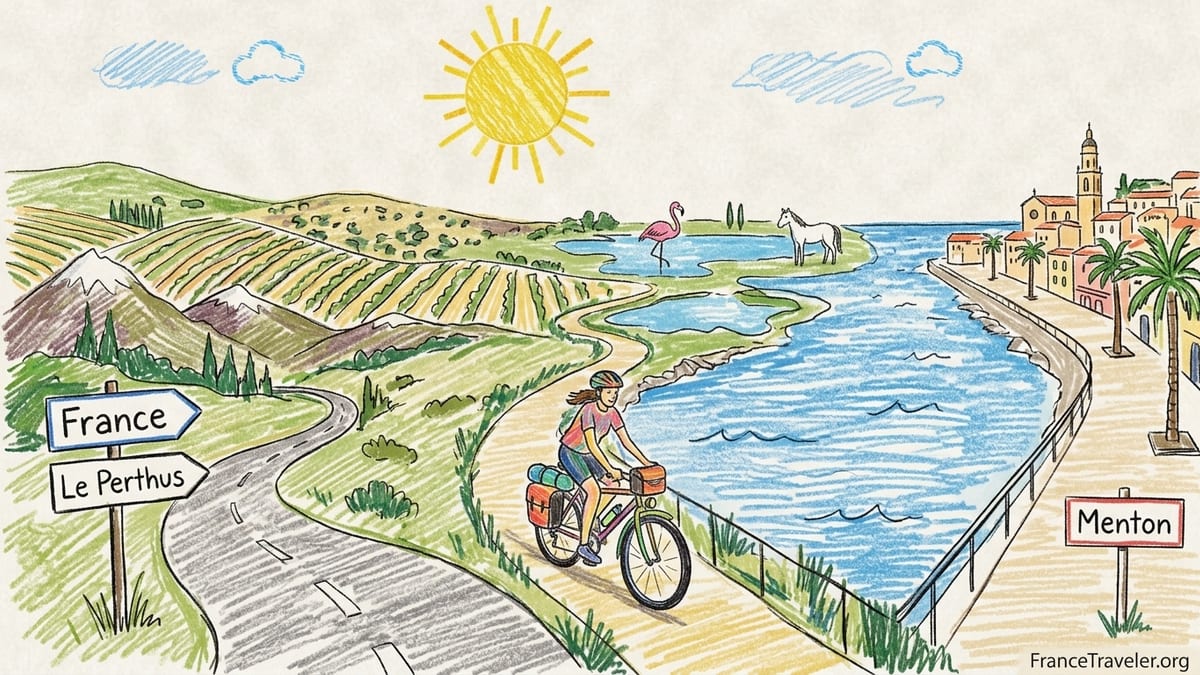
From the Pyrenees to the Italian border, La Méditerranée à Vélo, the French section of EuroVelo 8, strings together 850 kilometres of bike routes between Le Perthus and Menton. It is one of France’s most complete long-distance coastal products, mixing seaside promenades, canal-side greenways and quiet inland lanes through vineyards and hilltop villages. This guide focuses on the practical side of riding it: how the official route is laid out, what the surfaces and gradients are really like, how to use trains, where to sleep and how to pick the best sections if you do not want to cycle the full distance.
Understanding the Official Route from Le Perthus to Menton
The official French itinerary of EuroVelo 8, branded La Méditerranée à Vélo, runs for roughly 850 kilometres between the border village of Le Perthus and Menton on the Italian frontier. It is divided into about 20 main stages and mapped in nine detailed sheets, from Le Perthus to Leucate, then onward via Béziers, the Camargue, Provence and the Riviera. Around four-fifths of the route is currently open on signposted cycle infrastructure, with the remaining connections mostly on low-traffic roads. In practice most leisure riders start at Argelès-sur-Mer or Perpignan, which are much easier to reach by train than the Panissars pass above Le Perthus.
Although it is marketed as a Mediterranean coastal route, only part of the itinerary actually hugs the sea. Between Argelès, Canet-en-Roussillon and Narbonne-Plage, long waterfront promenades and cycle paths run beside beaches and lagoons. Past Sète the line repeatedly turns inland, following canals, former railway lines and small roads through vineyards before rejoining the waterfront in the Camargue and again on the Côte d’Azur. If you imagine a continuous balcony road over the water, you will be surprised: significant sections are a few kilometres from the shore, trading sea views for quieter traffic and better surfaces.
Signage is generally good in the most developed regions, especially the Pyrénées-Orientales coast, the Hérault lagoons, the Camargue and the Alpes-Maritimes. Look for the green and white “La Méditerranée à Vélo” signs, usually combined with the EuroVelo 8 logo and local route names. In a few urban areas, such as the fringes of Montpellier or around Marseille, you may still encounter gaps where waymarking is inconsistent. A recent GPX track from the official La Méditerranée à Vélo or France Vélo Tourisme planners is strongly recommended, and most riders pair this with an app like Komoot or Ride with GPS on their phone or GPS device.
Overall difficulty is classed as easy to moderate, with most days under 60 kilometres if you follow the standard stage breakdown. Elevation gain is modest along the coast and canals. The most sustained climbing is in the inland Provençal sections between Tarascon, Apt and Manosque, where rolling hills and a few short but steep ramps can test loaded touring bikes in hot weather. Many families and first-time tourers choose to skip those hilly stretches and focus instead on the flat coastal and river corridors.
Coastal Versus Inland: What You Actually Ride
From Le Perthus to roughly Sète, the route alternates between coast and inland lagoons. You descend from the frontier towards Le Boulou and Argelès-sur-Mer, then follow a purpose-built seafront path past Argelès, Saint-Cyprien and Canet-en-Roussillon. Here you are often within sight of the beach, riding on wide concrete or asphalt promenades lined with cafés and holiday apartments. Between Canet and Leucate, the itinerary runs behind the barrier beaches on quiet roads and cycle lanes that skirt large saltwater lagoons, with regular access points to the sea if you want a swim break.
Through Languedoc, especially between Narbonne and Sète, EuroVelo 8 spends more time inland than many cyclists expect. You follow the Canal de la Robine and canalised rivers, ride causeways between etangs, and use greenways like the former railway west of Béziers. While the Mediterranean is rarely more than 10 to 15 kilometres away, direct beachfront riding is limited to short stretches such as the seafront at Valras-Plage or the strip between Maguelone and Palavas-les-Flots. On the positive side these inland sections are usually quieter and better protected from crosswinds than the open shoreline.
From the Petite Camargue onward, the route becomes more maritime again. Between Le Grau-du-Roi and Les Saintes-Maries-de-la-Mer, you pedal on low dykes between rice fields, lagoons and wild beaches, often with flamingos in the shallows. After Arles and Tarascon the itinerary swings decisively inland into Provence, trading the sea for the Luberon, the Durance valley and eventually the Var hinterland. You do not return to continuous sea views until the Riviera section between Fréjus, Cannes, Nice and Menton, where dedicated seafront cycle lanes run right on the promenades for long distances.
In broad terms, expect perhaps half of the French route to feel distinctly “coastal” in the everyday sense, with clear sea views or immediate beach access, and the other half to be inland within a wider Mediterranean landscape of vines, orchards, garrigue and low hills. That balance is part of the appeal for many riders. It allows you to combine morning swims and evening seafood dinners with quieter days pedalling through vineyards or perched villages that would be hard to access on a pure seafront itinerary.
Surfaces, Gradients and Bike Choice
La Méditerranée à Vélo is designed first and foremost as a touring route, not a technical mountain bike trail. The majority of riding is on smooth asphalt or concrete, including seafront promenades in resorts like Argelès, Sète, La Grande-Motte and Nice and well-surfaced greenways such as the Voie Verte du Calavon in the Luberon. In these areas a classic trekking bike, hybrid or touring bike with 32 mm tyres is perfectly adequate. Many riders also use gravel bikes with 35 to 40 mm tyres, which offer more comfort on the occasional rougher link sections.
You will encounter some compacted gravel, especially on canal towpaths and agricultural service roads. For example, along certain stretches of the Canal de la Robine or between rice fields in the Camargue, the surface may be a fine, hard-packed grit with a few potholes. Shorter connecting sections can take you on small departmental roads where there is no separate cycle lane, though traffic volumes are usually low outside major urban centres and peak holiday weekends. In wet weather these unpaved parts can develop soft patches, so a tyre with some volume and puncture protection is a wise choice.
As for gradients, much of the Roussillon, Languedoc and Camargue is almost completely flat, apart from a few motorway or railway overpasses. Average daily climbs here might be under 150 metres. The feel changes in Provence, particularly between Tarascon, Apt, Manosque and Draguignan, where the route crosses rolling foothills. Climbs are rarely long, but you may see short ramps at 7 to 9 percent. Toward the Alpes-Maritimes, the cycle lanes along the Riviera promenades are again nearly flat, but getting into and out of towns like Nice or into hill villages above the route inevitably involves some steeper streets.
Because the surfaces and gradients are generally forgiving, e-bikes are a popular option, especially for riders tackling the hills of inland Provence or older travellers wanting to keep daily distances around 60 to 80 kilometres without fatigue. Throughout the route bike shops in larger towns such as Perpignan, Narbonne, Montpellier, Arles, Avignon, Aix-en-Provence, Cannes and Nice can provide basic repairs, new inner tubes and spares. Expect to pay prices similar to other Western European countries. A simple tune-up or new chain will often fall in the range of a modest restaurant meal for two, which is worth factoring into your budget.
Trains, Luggage Transfer and Practical Logistics
One of the key advantages of EuroVelo 8 in France is the quality of rail access. Major stations lie all along the corridor, including Perpignan for the western Pyrenees, Narbonne and Béziers for Languedoc, Montpellier and Nîmes for the central stretch, Arles and Avignon for the Camargue and western Provence, and Toulon, Cannes, Nice and Menton for the Riviera. Regional TER trains on many of these lines carry bicycles free of charge, without reservation, though peak summer services can be crowded and some Intercités and high-speed TGVs require a paid bike reservation or bike bag. As a practical example, many riders start in Argelès-sur-Mer because there is a direct TER service from Perpignan and better connections from Paris via high-speed trains to Perpignan than to Le Perthus itself.
Luggage transfer services are slowly expanding along La Méditerranée à Vélo, especially in tourist hotspots. Specialist companies and some local agencies now offer point-to-point bag transport on popular segments such as Perpignan to Narbonne, Montpellier to Arles or Avignon, and stretches of inland Provence near the Luberon. Prices are broadly comparable to other French cycling routes, with per-stage charges that are often similar to a modest hotel breakfast per person. These services usually require you to book fixed overnight stops, so they work best if you follow a predefined itinerary rather than improvising day by day. When planning, check operators that advertise services on major French cycle routes and confirm that they cover your chosen stages of EuroVelo 8.
For those riding self-supported, most cyclists simply carry panniers or bikepacking bags. In summer, lighter gear is sufficient, but sun exposure and heat should not be underestimated, particularly across the Camargue and Var interiors where shade can be rare. Water fountains in villages, beach showers and supermarket car parks are useful for refilling water, and many riders plan their days around lunch stops in small towns with bakeries and cafés. A typical plat du jour in an inland town might cost about the same as a casual lunch in a mid-range American city, and set menus on the coast can be slightly higher during July and August.
Public transport can also help you skip less appealing sections. For instance, if you want to avoid navigating traffic around Marseille and its industrial outskirts, you can use regional trains between Arles, Miramas and Toulon to rejoin more comfortable cycling environments further east. Similarly, if time is short, a train hop between Béziers and Montpellier or between Nice and Menton allows you to prioritise the stretches you most want to ride without compromising safety or enjoyment.
Bike-Friendly Accommodation and Services along the Route
France has developed an “Accueil Vélo” label for bike-friendly accommodation and services along major cycling itineraries, including La Méditerranée à Vélo. Hotels, guesthouses, campsites and certain attractions bearing this mark commit to providing secure bike storage, basic repair tools, information on nearby routes and often early breakfasts. As you search for places to stay in hubs such as Argelès-sur-Mer, Narbonne, Sète, Montpellier, Arles, Avignon, Aix-en-Provence, Fréjus, Cannes and Nice, filtering for this label is a good shortcut to finding establishments that understand touring cyclists’ needs.
Accommodation options vary widely along the route. On the Roussillon and Languedoc coast, large holiday campsites and apartment complexes dominate, particularly around resort towns like Le Barcarès, La Grande-Motte and Cap d’Agde. Many campsites accept cyclists for one-night stays, even when they prefer week-long bookings from car-based holidaymakers in high season. Inland, around the Luberon and Var, small chambres d’hôtes, farm stays and rural campsites are more common, often located in or near historic villages. On the Riviera, hotel prices and minimum stays rise sharply in summer, so booking well ahead for July and August is important, or consider shoulder-season travel in May, June, September or early October.
For riders on a tighter budget, municipal campsites and simple family-run hotels in smaller towns can still be found if you plan carefully. For example, choosing Lunel instead of central Montpellier, or staying in smaller Riviera towns between Cannes and Nice rather than in the very centre of Nice itself, can noticeably reduce costs. While wild camping might be possible in some inland areas for experienced and discreet campers, it is often difficult near the coast due to private land, protected natural areas and strict local regulations. Most cyclists therefore rely on official accommodations, which also provide access to showers, laundry and secure storage.
Bicycle rental is straightforward in major cities and many resort towns. In Perpignan, Montpellier, Avignon, Aix-en-Provence, Toulon, Cannes and Nice, shops rent trekking or e-bikes suitable for multi-day trips, sometimes including panniers and helmets. Some agencies offer one-way rentals along certain parts of the route, collecting bikes at a different end point for an extra fee. When comparing rental offers, look closely at included equipment, opening hours for pick-up and drop-off, and what support they provide in case of mechanical problems mid-journey.
Roussillon and Languedoc: Beaches, Lagoons and Canal Paths
The western part of La Méditerranée à Vélo, across Roussillon and Languedoc, is one of the most accessible and family-friendly sections. Starting from Le Perthus or more commonly Perpignan or Argelès-sur-Mer, the route first winds through the foothills of the eastern Pyrenees before reaching the long sandy beaches of the Roussillon coast. A new seafront cycleway between Argelès and Canet-en-Roussillon offers wide, smooth riding just behind the beach, with clear views of the Mediterranean on one side and the Canigou massif on the other. Ice cream stands, beachfront cafés and small supermarkets are frequent, making this an easy introduction to touring.
North of Canet, the path skirts the lagoons of Leucate and the Narbonnaise regional park. Here, low traffic roads and sections of cycle track run between vineyards, salt flats and shallow etangs dotted with flamingos and traditional fishing huts. Narbonne is a useful logistical hub, with train connections and bike shops, as well as a historic centre and covered market that make for a pleasant rest day. Many organised trips focus on this zone between Perpignan and the Camargue, offering week-long packages that cover around 300 kilometres of mostly flat riding along the coast, lagoons and the Canal de la Robine.
Further east, the route passes Béziers and Sète, where it briefly joins the towpaths of the Canal du Midi and its satellite canals, and then follows seafront promenades through resort towns. The causeway between Sète and Marseillan, with the sea on one side and the oyster beds of the Étang de Thau on the other, is a classic highlight. Riders who like combining cycling with food and wine often schedule oyster tastings at village sheds around Bouzigues or Picpoul de Pinet vineyard visits just inland. Daily distances in this stretch can be kept to 40 or 50 kilometres, making it ideal for relaxed holidays with plenty of swim stops and lunches on café terraces.
For travellers who cannot ride the full 850 kilometres, a concentrated Roussillon and Languedoc itinerary of four to six days between Perpignan and Montpellier works very well. Train stations at both ends, generally flat terrain and varied scenery from Pyrenean backdrops to wide beaches and historic canal towns make it a natural choice for a first multi-day tour. Many families choose to ride only the flattest seafront promenades and lagoon edges, using trains or transfers to bypass busier inland approaches into larger cities.
Camargue and Western Provence: Wild Wetlands to Hilltop Villages
The central section of EuroVelo 8, from around Montpellier to Arles and Tarascon, crosses the Petite Camargue and Camargue, one of the most distinctive landscapes on the French Mediterranean. Expect long, flat stretches on raised dykes and minor roads between rice paddies, marshes, reed beds and wide lagoons. Flamingos, herons and white Camargue horses are common sights. The route between Le Grau-du-Roi, Aigues-Mortes and Les Saintes-Maries-de-la-Mer is particularly memorable, with sections where you ride between lagoon and sea with virtually no buildings in sight. Wind can be a factor here, so checking the forecast and planning shorter days when strong mistral or tramontane winds are predicted is wise.
Arles and Tarascon mark the transition from wetlands to Provence proper. From here the official itinerary turns inland, using quiet roads and greenways through the Alpilles foothills and into the Luberon and Durance valleys. One standout segment is the Voie Verte du Calavon, a rail-trail that connects villages such as Saint-Martin-de-Castillon, Apt and Cavaillon along an old railway line. The surface is mostly smooth asphalt, gradients are very gentle, and the track passes vineyards, orchards and ochre cliffs with views of classic hilltop villages like Bonnieux and Lacoste on the ridges above.
Cyclists with a week to spare often design a loop around the Luberon that integrates parts of EuroVelo 8 with local circuits such as “Autour du Luberon” and “Les Ocres à Vélo.” This allows quieter exploration of famed Provençal villages, lavender fields in season and small markets, while still benefiting from the long-distance connectivity of La Méditerranée à Vélo. Daily distances of 40 to 60 kilometres are common here, but the repeated small climbs and summer heat make the riding feel more demanding than the numbers on paper.
If you prefer to avoid hills altogether, it is possible to cycle the Camargue segment from Montpellier or Nîmes to Arles and then use trains or shuttles to reach the Riviera, skipping the lumpier stretches between Tarascon, Apt and Manosque. Alternatively, you can stay low in the Rhône and Durance valleys and only dip into the hillier areas on day rides without luggage, using a base in villages such as L’Isle-sur-la-Sorgue or Apt where bike rentals and bike-friendly lodgings are well established.
Provence and the Riviera: From Inland Greenways to Seafront Promenades
East of the Durance valley, EuroVelo 8 gradually approaches the Alps and the Côte d’Azur. Between Manosque, Draguignan and the Var interior, the route runs on a patchwork of quiet roads, short greenways and rural lanes. Scenically this can be one of the most rewarding sections, with vineyards, olive groves and forested hills leading to perched villages and river gorges. At the same time it is also one of the more physically demanding stretches, with frequent small climbs and descents. Many riders tackle this segment with e-bikes or at a slower pace, planning 40 to 50 kilometre days and allowing time for detours to villages and local markets.
Near Fréjus and Saint-Raphaël, the itinerary finally meets the Mediterranean again for good, joining coastal promenades and cycle lanes that continue almost uninterrupted to Menton. Riding between Fréjus, Cannes, Antibes, Nice and Menton, you will spend much of your time on dedicated seafront lanes separated from traffic, with frequent access to beaches, marinas and town centres. The approach to Cannes, for example, includes long, broad waterfront paths lined with palm trees and cafés, while Nice offers an almost continuous cycle lane along the Promenade des Anglais with dramatic sea views and easy connections to the old town.
Urban riding skills are more important here than elsewhere on the route. The Riviera is busy, especially in July and August, with pedestrians, other cyclists, delivery vehicles and scooters sharing space. Traffic-calmed back streets can be a useful alternative when seafront promenades feel crowded. Many cyclists choose to ride early in the morning or late in the afternoon to avoid the worst of the heat and crowds, spending the middle of the day on the beach or exploring town centres on foot.
For travellers with limited time who still want a strong sense of the EuroVelo 8 experience, a three to five day trip between Fréjus or Cannes and Menton is a compelling option. You can reach the starting point easily by train from Marseille, Lyon or Paris, ride almost entirely on dedicated lanes with sea views, and finish at the Italian border town of Menton, from where regional trains connect back along the coast. Accommodation and restaurant prices are higher here than in inland Languedoc or the Luberon, but the density of services, short distances between towns and ease of logistics make it a practical and rewarding short break.
Choosing the Best Sections if You Do Not Ride It All
Very few leisure cyclists ride the full 850 kilometres from Le Perthus to Menton in one go. Instead, many break La Méditerranée à Vélo into shorter trips that match their available time, fitness level and preferred landscapes. If you want gentle terrain and frequent swim stops, the Roussillon and Languedoc coast between Perpignan and Montpellier is one of the best choices. It combines long seafront promenades, lagoon causeways and canal paths, with simple logistics and abundant campsites, holiday rentals and hotels.
If your priority is wild nature and birdlife with a dash of cultural history, the Camargue and Rhône delta between Montpellier, Aigues-Mortes, Les Saintes-Maries-de-la-Mer and Arles can fill three to five days of relaxed riding. You can then connect inland to Avignon or Arles by train or secondary routes, perhaps adding a couple of days on the Voie Verte du Calavon in the Luberon to experience classic inland Provence without committing to the hillier Var and Alpes-Maritimes.
For scenery and classic Côte d’Azur atmosphere, the Riviera section between Fréjus or Cannes and Menton is hard to beat. Here the experience is less about pastoral quiet and more about seafront energy, harbour towns and urban promenades. This can work as an early-season or autumn trip when temperatures are mild and the main holiday crowds have thinned out. Combining three days on the Riviera with two or three inland day rides from a base in the Luberon or Var interior offers a satisfying snapshot of both coastal and inland Mediterranean France in a single week.
Ultimately, the strength of EuroVelo 8 in France lies in its modularity. With dense rail networks, growing luggage transfer options and a wide range of accommodation, you can shape the route to your preferences. Whether you prefer long multi-week traverses with full panniers, a series of short holidays linked by trains, or a single base with radiating day rides on selected sections of the official route, La Méditerranée à Vélo offers enough variety and infrastructure to make it work.
FAQ
Q1. How long is the French section of EuroVelo 8 between Le Perthus and Menton?
The official La Méditerranée à Vélo route in France covers roughly 850 kilometres from Le Perthus on the Spanish border to Menton on the Italian border, divided into about 20 main stages that many cyclists tackle over one and a half to three weeks depending on daily distances.
Q2. How much of the route is actually on the coast rather than inland?
Only about half of the itinerary follows seafront promenades or runs within immediate sight of the sea, especially around Roussillon, parts of Languedoc, the Camargue and the Riviera; the rest is inland through lagoons, canals, vineyards and low hills a few kilometres from the shoreline.
Q3. What kind of bike and tyres do I need for La Méditerranée à Vélo?
A touring, hybrid or gravel bike with reliable gears and tyres around 32 to 40 millimetres is ideal, since most of the route is paved but there are also compacted gravel sections on canal paths and rural lanes where a bit of extra volume and puncture protection adds comfort and security.
Q4. Is the French section of EuroVelo 8 suitable for beginners and families?
Yes, especially on the flatter and better segregated parts such as the Roussillon and Languedoc coast between Perpignan and Montpellier, the Camargue dykes and the Riviera promenades; families often select these sections and keep daily distances around 30 to 50 kilometres.
Q5. Can I use trains to skip busy or hilly sections of the route?
Regional TER trains along the corridor, for example between Perpignan, Narbonne, Montpellier, Arles, Avignon, Toulon, Cannes, Nice and Menton, generally accept bikes and make it easy to bypass complicated urban stretches or hillier inland stages, although summer services can be crowded.
Q6. Are there luggage transfer services available on La Méditerranée à Vélo?
Luggage transfer is available on some of the most popular segments, especially near major tourist areas in Languedoc, the Camargue and inland Provence, but coverage is not yet continuous, so it is important to check current operators for your specific stages and book in advance.
Q7. When is the best time of year to ride EuroVelo 8 in France?
Late spring and early autumn, roughly from May to June and September to early October, usually offer the best balance of pleasant temperatures, open services and moderate crowds; July and August can be very hot, windy and busy, especially on the Riviera and major resorts.
Q8. How easy is it to find bike-friendly accommodation along the route?
Bike-friendly accommodation is common, particularly places with the Accueil Vélo label that provide secure storage and cyclist services in hubs such as Perpignan, Narbonne, Montpellier, Arles, Avignon, Aix-en-Provence, Cannes and Nice, alongside many campsites and smaller guesthouses on rural stretches.
Q9. Do I need to book accommodation in advance in high season?
On the coast and in the Camargue and Riviera during July and August it is strongly advisable to reserve hotels, guesthouses or campsites in advance, while in shoulder seasons you have more flexibility but should still secure stays in smaller villages and very popular towns ahead of arrival.
Q10. What are the best short sections if I have only a few days available?
Popular options include four to six days between Perpignan and Montpellier for beaches and lagoons, three to five days in the Camargue between Le Grau-du-Roi and Arles for wildlife and wetlands, or three to five days from Fréjus or Cannes to Menton for continuous Riviera seafront riding and easy rail logistics.