


The French Mediterranean is often reduced to a single image of parasols on the Riviera, but its coastline is remarkably diverse. From the endless sands of Occitanie to the wild dunes of the Camargue, from knife-edged limestone calanques to polished pebbles in Nice, beach experiences change dramatically every few kilometres. This guide looks beyond celebrity addresses to focus on beach type, helping you choose your perfect stretch of coast based on sand versus pebbles, shallow water, facilities, scenery, snorkeling, parking and crowds.
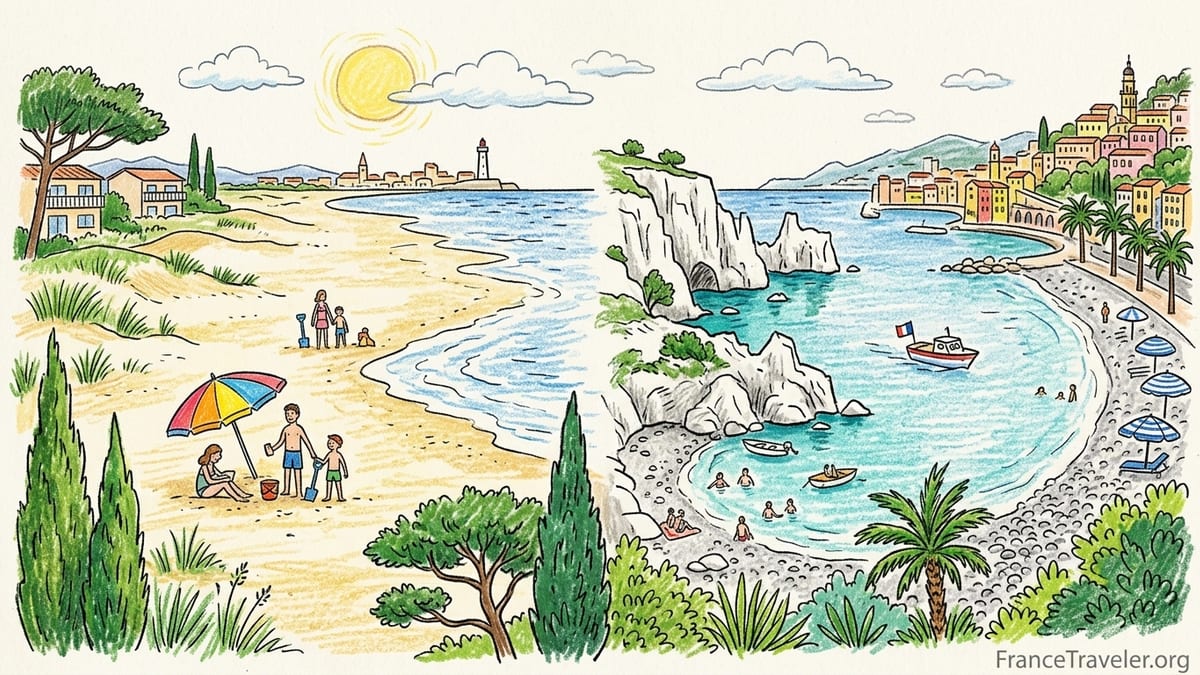
How the French Mediterranean Changes From West to East
Seen on a map, the French Mediterranean looks like one continuous curve, but for beachgoers it feels like several different countries. In the west, the Occitanie coast between the Camargue and the Spanish border is mostly low, sandy shoreline. Tourism officials there highlight its “long, wide sandy beaches” from Espiguette near Le Grau du Roi down to Argelès-sur-Mer, with only a short rocky interlude around Cap d’Agde and the Côte Vermeille near Collioure where coves cut into the cliffs. These broad sands are where you find classic family resorts such as La Grande-Motte, Leucate, Cap d’Agde and Argelès, with shallow water and room to spread out.
Travel east beyond the Rhône delta into Provence and the character changes. Around Marseille, Cassis and La Ciotat the coast rises into stark white limestone, split by narrow inlets known as calanques. Some have tiny pebble or shingle beaches squeezed between cliffs, others are just rock ledges dropping into deep, clear water. Further along in the Var, the shoreline alternates between sheltered sandy bays and rocky points, especially around Hyères and the islands of Porquerolles and Port-Cros, which are prime snorkeling territory.
On the Côte d’Azur between Saint-Tropez and Menton, the coast swings back to a more urban rhythm, but the variety continues. Cannes and Juan-les-Pins are famous for their groomed sandy beaches and private clubs, while neighbouring Nice and much of the line east to Monaco and Menton is dominated by rounded grey pebbles. Some bays, such as Menton’s Plage des Sablettes or a few small coves around Antibes, offer pockets of sand or grit, but for many visitors this stretch of the Riviera is synonymous with pebbles, beach clubs and a lively boardwalk scene.
Understanding this west-to-east shift is the key to planning a beach-focused trip. If you have toddlers who need space and shallow water, you will likely be happiest in Languedoc or parts of the Camargue and Var. If you want dramatic cliffs, swimming in deep emerald water and hiking to tiny rocky coves, the calanques are hard to beat. For people-watching, cocktails and polished service, Riviera resort towns win every time.
Big Sandy Beaches of Languedoc: Argelès, Leucate and Cap d’Agde
For sheer quantity of sand, it is hard to beat Occitanie’s Languedoc coast. Between Espiguette in the north and Argelès-sur-Mer near the Spanish border, you find long, straight beaches often backed by low dunes or simple promenades. In Argelès-sur-Mer, for example, the main strip runs for roughly 7 kilometres, divided into zones like Plage Nord and Plage du Centre, with lifeguard posts, beach volleyball courts and ice cream stands at regular intervals. The sand is fine to medium, the entry into the sea is generally gradual, and in summer you will see families set up for the day with shade tents and games.
Leucate offers a good snapshot of this style of coastline. Port-Leucate’s main beach is a wide, flat band of sand facing the open sea, with shallow swimming areas that make it popular for children learning to swim. Behind the beach, low-rise holiday apartments and campsites line the shore, and in season a handful of private beach restaurants set up loungers and parasols that you can rent for a day. A few minutes’ drive away, La Franqui has a more laid-back feel, with windsurfers and kitesurfers using the long, exposed shallows; it is the kind of place where you might park on a sandy verge and walk across a wooden boardwalk with your gear.
Cap d’Agde combines broad sandy beaches with a busier resort atmosphere. Plage Richelieu and Plage du Môle are classic family choices, with pedalos, inflatable play structures and nearby snack bars. Inland from the main waterfront you will also find the famous naturist quarter, with its own officially designated nude beach. The sea here remains relatively shallow for several dozen metres, which is helpful for nervous swimmers but can mean a long wade to reach deeper water. On calm days visibility can be surprisingly good for basic snorkeling around rocky groynes, but for richer marine life you generally need to head to rockier parts of the coast.
If you are driving, parking in these Languedoc resorts is usually easier than on the Riviera. Many beaches have large surface car parks that may charge a moderate daily fee in July and August, but you rarely need to pre-book. Public facilities such as toilets and freshwater showers are common near the main access points, and most towns operate regular beach-cleaning programmes, so the sand tends to be well maintained outside of storm events.
Wild Camargue Sands: Space, Dunes and Fewer Facilities
Northwest of Saintes-Maries-de-la-Mer, the Camargue’s shoreline feels wilder and more elemental. Here the Rhône delta fans out into lagoons, marshes and sandbars, creating beaches that can stretch for kilometres with little in the way of development. Espiguette, at the eastern edge of Occitanie, is one of the best-known examples: a vast dune system separating the open sea from shallow wetlands. Reaching the main beach involves a walk across boardwalks and sand from a large but often busy car park, which typically charges a fee in the main season.
Further west, near the protected areas around Beauduc, the feeling of remoteness intensifies. Access often involves several kilometres of unpaved track across the salt marsh landscape, and local authorities in the regional park have tightened rules on vehicle access and camping to protect the fragile environment. Recent regulations prohibit camping directly on the beach and restrict motorised traffic to certain tracks, and visitors are expected to pack out their rubbish and avoid disturbing nesting birds. In practice this means you can still find huge, almost empty expanses of sand, but you need to be self-sufficient and prepared for a lack of services.
Compared with resort beaches, Camargue sands offer a different experience. The water can stay shallow for a long distance offshore, and sandbars shift with storms and tides. Families who value space and don’t mind a bit of walking often appreciate the freedom for children to run and play without bumping into neighbouring parasols. At the same time, the lack of surveillance in certain stretches and the sometimes strong onshore winds mean you need to watch conditions carefully, especially if inflatable toys get caught by gusts. Windsurfers and kitesurfers favour parts of the Camargue for exactly this reason.
Facilities are intentionally minimal. You may find temporary food trucks at main access points in high season, but there are no lines of fixed restaurants along the dunes. Portable toilets are sometimes installed near car parks, but there are usually no showers, and there are few, if any, traditional beach clubs. This makes the Camargue ideal if you want a more nature-focused day and do not mind sandy feet in the car. It is less suitable if you need easy access to shade, lounge chairs or accessible infrastructure.
Rocky Coves and Calanques: Scenery Over Sand
East of the Rhône, between Marseille and La Ciotat, the coast becomes a world of cliffs, headlands and narrow inlets known as calanques. These are steep-sided canyons cut into limestone, some ending in a small pebble or shingle beach, others in rock ledges at water level. A typical example is the Calanque d’En-Vau, a deep fjord-like inlet hemmed in by high cliffs with a pocket beach at its end. The shore here is made of pebbles rather than sand, the water drops deep quite quickly, and the setting is spectacular, with turquoise water framed by towering white rock.
Nearby calanques such as Port-Pin and Sormiou are more forgiving. Port-Pin has a broader pebble shore and clearer, calmer water, making it easier for swimming and paddling, while Sormiou, one of the largest calanques, has a small sandy-pebble beach next to a cluster of simple cabins and a seasonal restaurant. In places like Sormiou the entry into the sea is more gradual than at En-Vau, though it is still stonier underfoot than in Languedoc. Offshore, submerged rocks and underwater cliffs create excellent conditions for snorkeling, with schools of bream and wrasse often visible close to the shore on calm days.
Reaching these calanques is more involved than walking onto a resort beach. Access roads are usually closed to private vehicles in summer because of fire risk and overcrowding, so most visitors hike in from trailheads around Marseille or Cassis, or take a boat excursion that stops for swimming. The national park authority has also introduced reservation systems for some sites at peak times, and regularly warns that main bathing spots are small and can be overcrowded in high season. This combination of hiking, limited shade and rocky footing means the calanques suit reasonably fit visitors who wear proper shoes and travel light.
Facilities in the calanques are minimal by design. There are no lines of sunbeds, and food options are limited to a few small establishments in calanques like Sormiou and Morgiou or to what you carry in your backpack. There are no lifeguards in most of the inlets, and cliffs limit mobile reception in places. In return you get clear, cool water, dramatic views and memorable swims beneath limestone walls. For many travellers, a half-day hike and swim in a calanque is a highlight of a Provence trip, but it is quite a different experience from a day on the sand with children and a pushchair.
Var Coast and Islands: A Mix of Coves and Sandy Bays
Continuing east into the Var department, the shoreline softens into a mix of rocky coves and sheltered bays that often have fine sand. Around Hyères and the Giens Peninsula, for example, you can choose between wind-exposed sandy beaches along the isthmus, popular with windsurfers, and more sheltered, pine-backed coves along the peninsula’s outer edge. Off the coast, the islands of Porquerolles and Port-Cros offer some of the region’s most appealing combinations of clear water, sandy seafloors and protected natural landscapes.
On Porquerolles, Plage Notre-Dame and Plage d’Argent are good examples. Both are sandy beaches accessible on foot or by bicycle from the village, with shallow, transparent water ideal for families and casual snorkelers. There are usually basic facilities such as toilets and seasonal snack bars near the main access points, but you will not find the dense rows of private sunbeds typical of the Riviera. Port-Cros, which is a national park, is rockier overall, with small coves and underwater trails marked for snorkelers, attracting visitors who are comfortable swimming from uneven rocks or tiny pebble pockets.
Elsewhere in the Var, popular coastal towns such as Saint-Raphaël, Fréjus and Saint-Tropez string together their own mix of sandy strands and rocky points. Pampelonne, near Saint-Tropez, is one of the most famous sandy beaches in the region, backed by dunes and a patchwork of beach clubs and public areas. Here you can rent a sunbed and parasol from mid-range clubs or splash out at high-end names, paying a premium for front-row loungers, waiter service and craft cocktails. A few kilometres away, small rocky creeks and headlands provide quieter swims and better snorkeling but require more care with entry and exit.
For drivers, parking in the Var is more limited and more expensive than on the Languedoc plains, especially close to fashionable beaches. Some car parks near Pampelonne and popular island ferry terminals fill up by mid-morning in July and August. Booking boat tickets or parking where possible, or arriving early or late in the day, can make the experience much smoother.
Riviera Beaches: Cannes, Antibes, Nice and Menton
The classic French Riviera image centres on cities like Cannes, Antibes, Nice and Menton. Here the coastline is shaped as much by urban life as by geology. Cannes is one of the few Riviera stretches where much of the central shoreline is genuinely sandy. Along the Boulevard de la Croisette, golden sand beaches, both public and private, run in front of hotels and apartment buildings. Many visitors choose a private beach club, where a day pass typically includes a sun lounger, parasol, towel and access to changing cabins and showers. Prices vary with location and brand, but it is common in high summer to pay a significant per-person fee for a front-row bed facing the water.
Antibes offers a mix of sandy and pebbly options. Around the old town, some small beaches have sand or coarse grit, while nearby Juan-les-Pins is known for its sandy bay, lined with beach clubs and public stretches. Families appreciate the relatively calm water in these sheltered bays, and the convenience of nearby cafés, shops and shaded streets for breaks from the sun. A little further around Cap d’Antibes, smaller coves and some hotel-linked beaches provide a more exclusive or secluded feel, though they may be harder to access without a car or a specific hotel reservation.
Nice, by contrast, is famous for its long promenade backed by pebble beaches. The rounded stones are smooth but can be uncomfortable for bare feet, so locals often bring folding mats or water shoes. Private beach clubs along the Promenade des Anglais lay soft decking or sand-filled platforms over the pebbles, creating more comfortable lounging areas with full restaurant service. The water deepens quite quickly here compared with the wide shallow shelves of Languedoc, which is pleasant for confident swimmers but requires closer supervision of younger children.
East toward Monaco and Menton, the shoreline remains largely pebbly, though there are small sandy pockets such as Menton’s Sablettes beach, which has a more sheltered feel and calmer water. Beach clubs are fewer than in central Nice or Cannes but still present in prime spots, often focusing on a quieter, more relaxed service with loungers, drinks and simple Mediterranean menus. Throughout the Riviera, public facilities such as lifeguard posts, showers and public toilets are generally good in high season, but parking in seafront car parks can be expensive, and using trains or local buses to reach beaches often makes more sense than driving.
Sand vs Pebbles, Families vs Snorkelers: How to Choose
One of the biggest practical questions when choosing a French Mediterranean beach is sand versus pebbles. Sand feels softer underfoot and is better for young children who want to dig and play. It also tends to mean shallower water near the shore. You find this combination in abundance around Argelès, Leucate, Cap d’Agde, many Camargue beaches, parts of the Var coast and in Riviera towns like Cannes and Juan-les-Pins. Pebble beaches, common around Nice and much of the calanque area, avoid the sticky sand problem and often produce very clear water because fewer particles are stirred up. The trade-off is less comfort walking barefoot and a steeper drop-off into deeper water.
For families with toddlers, the wide sandy shelves of Occitanie and selected Var and Riviera bays are usually the safest bet. Look for beaches with lifeguard stations, marked swimming zones and gently sloping entries. Many resort beaches also offer children’s clubs, inflatable play parks and clearly signposted first-aid points, making logistics simpler. In contrast, calanques and rocky coves demand more from parents: uneven paths, lack of shade, no lifeguards and sudden depth changes. Older children who are strong swimmers and like adventure may love them; very young children may not.
If your priority is snorkeling and underwater scenery, rockier coasts generally deliver more interest. The calanques near Marseille, the coves of the Côte Vermeille south of Collioure, rocky points in the Var and areas around the islands of Porquerolles and Port-Cros all provide habitat for fish and marine plants close to shore. In practice, this means entering the water from pebbles or rock slabs rather than fine sand, and being comfortable swimming in water that may become deep rapidly. Simple gear like a mask, snorkel and fins can make these swims more rewarding.
Crowd levels vary widely by region and even by access point. A central Cannes beach directly in front of major hotels in mid-August will feel very different from a remote stretch of Camargue dunes reached after a 20-minute walk. As a rule, the easier the access and the more services on offer, the more people you can expect. If you prefer quieter settings, look at larger, less-developed beaches such as certain parts of Espiguette, stretches south of Leucate, or peripheral sections of longer bays where facilities thin out.
The Takeaway
The French Mediterranean coast is not a single “type” of beach but a mosaic of very different shorelines. On the Occitanie side, from Argelès and Leucate to Cap d’Agde, you find broad, family-friendly sands with easy access, shallow water and ample parking. In the Camargue, these sands turn wilder and less managed, trading facilities and beach clubs for dunes, wind and space. Around Marseille and Cassis, the focus shifts to rocky calanques and dramatic coves where reaching the water is an excursion in itself.
Further east, the Var stitches together sandy bays and rocky promontories, while the Côte d’Azur overlays its mainly pebble coast with a dense layer of urban life, beach clubs and nightlife. Cannes and Juan-les-Pins offer the classic sandy Riviera look, Nice and much of the coast to Monaco present polished pebbles and quick access to deep water, and Menton softens things with more sheltered bays. Rather than chasing famous names, thinking in terms of beach type helps match your destination to your travel style.
If you want wide, easy, sand-based days with children, point your map to Languedoc or selected Var and Riviera bays. For wilder, more natural sands, look at the Camargue. If you crave dramatic scenery and clear deep water, plan a calanque hike or a day on the Var islands. And if your idea of the perfect holiday is a lounger at a beach club with lunch delivered to your parasol, the Riviera’s resort towns will happily provide. Along this short arc of coast, the question is not whether there is a beach for you, but which type of shore you want to step onto when you slide off your sandals.
FAQ
Q1. Are the beaches around Nice sandy or pebbly?
Most central Nice beaches are made of rounded pebbles rather than sand. Some nearby towns like Cannes and Juan-les-Pins offer sandy options within easy train or bus reach.
Q2. Which area is best for families with small children who need shallow water?
The wide sandy beaches of Occitanie, such as Argelès-sur-Mer, Leucate and Cap d’Agde, plus certain Var and Camargue strands, generally offer the gentlest, shallow entries and the most space for families.
Q3. Where can I find the wildest, least developed sandy beaches?
Look to the Camargue’s long dune-backed beaches, including areas around Espiguette and more remote stretches near protected wetlands, where facilities are limited but space and nature are abundant.
Q4. Are the calanques near Marseille suitable for young children?
Calanques involve rocky paths, limited shade, steep drop-offs and few services, so they are better for older children and confident swimmers than for toddlers or anyone who needs easy stroller access.
Q5. Which part of the coast is best for snorkeling?
Rockier areas tend to be best, including the calanques near Marseille, the Côte Vermeille near Collioure, parts of the Var coast and the islands of Porquerolles and Port-Cros, where underwater life is richer.
Q6. How expensive are beach clubs on the Riviera?
Prices vary, but on major Riviera beaches such as central Cannes or Nice in peak season, a full-day lounger and parasol at a private club can cost a noticeable amount per person, with food and drinks extra.
Q7. Do I need a car to enjoy these beaches?
A car is helpful for reaching remote Camargue dunes, certain Var coves and trailheads for calanques, but many Riviera and Languedoc resort beaches are easily reached by train, tram or bus.
Q8. Are naturist beaches common on the French Mediterranean?
There are several designated naturist areas, including specific beaches at Cap d’Agde and near some Languedoc resorts. They are clearly signposted, and clothing is required outside these zones.
Q9. When is the best time of year for swimming?
Sea temperatures are usually most pleasant from late June to early September. In shoulder seasons like late May or October, hardy swimmers still enjoy the water, but it can feel cool.
Q10. How crowded do popular beaches get in August?
In early August, central resort beaches and some calanques can become very busy, with towels almost touching. Choosing larger, less-developed strands, arriving early, or visiting in June or September reduces crowding significantly.