


On the French Mediterranean coast, the “best time to visit” depends less on the thermometer and more on what you want your days to look like. The sea is swimmable for months, trails are accessible most of the year, and prices and crowds follow their own logic. From the wild sand beaches of Occitanie to the calanques near Marseille and the polished resorts of the Côte d’Azur, timing your trip is about choosing your trade-offs: warmth versus breathing room, long swims versus long hikes, vibrant nightlife versus low-key village evenings.
How the French Mediterranean Seasons Really Work
The French Mediterranean coast runs roughly from the Spanish border past Perpignan and Montpellier, through Provence and the Calanques, to the Italian border beyond Menton. Locals will tell you there is no single “high season” or “off season” here, but several overlapping calendars: beach season, hiking season, sailing season and school holiday season. They do not start and end on the same day.
Beach clubs on the Côte d’Azur usually ramp up from late April or early May, setting out sun loungers on the pebbles in Nice and opening restaurants in Cannes, Antibes and Saint-Tropez. The sea lags behind the air: you can sunbathe comfortably in May while the water is still bracing for long swims, then enjoy bathtub-warm seas well into late September after the crowds have thinned out. Hotels price accordingly. A mid-range room that might cost 130–170 euros in early June in central Nice or Montpellier can jump to 250–300 euros or more in late July, even at the same property, then drop again in late September.
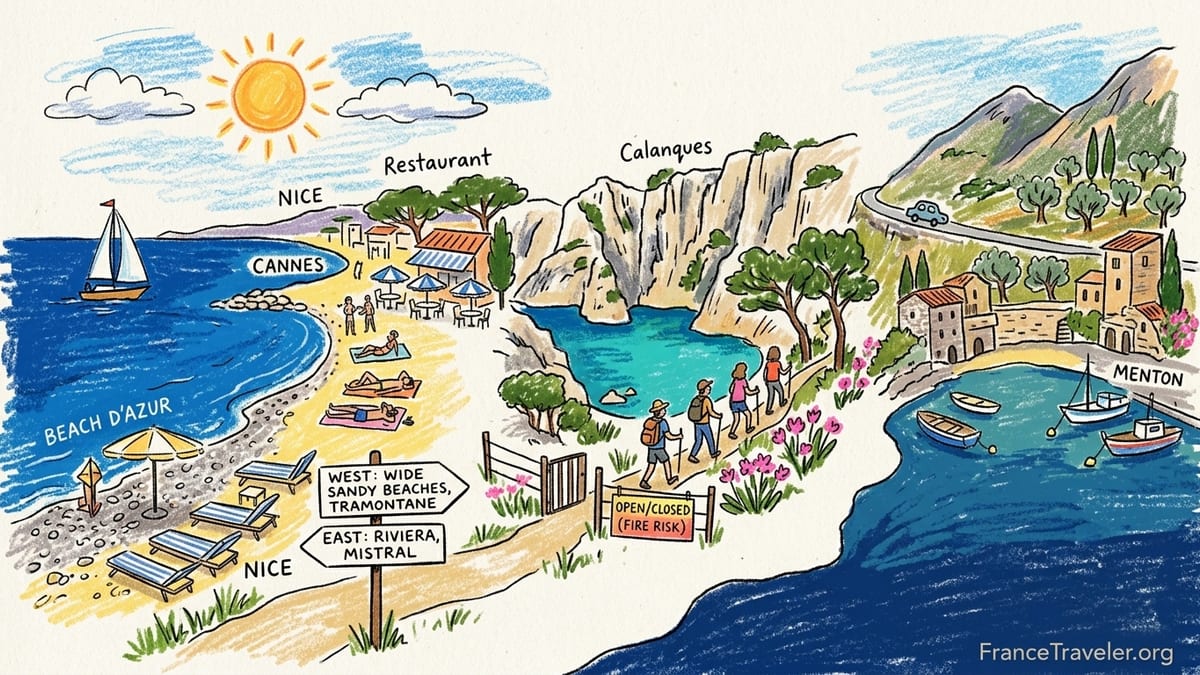
Weather differs subtly across the coast. The western stretch in Occitanie is more exposed to the Tramontane, a strong, dry northwesterly wind that can whip up the sea along wide sandy beaches like Espiguette near Le Grau-du-Roi or Racou near Argelès-sur-Mer, making some days feel cooler and choppier. Further east in Provence and the French Riviera, the notorious Mistral can roar down the Rhône Valley and out over Marseille, Cassis, Toulon and as far as the Var coast and even the Riviera, clearing the sky to a piercing blue but dropping temperatures and roughening the sea. On those days, cafes stay busy while sun loungers sit empty.
Beyond the winds, fire risk also shapes the calendar. In the Calanques near Marseille and Cassis, and in many Provençal forested areas, access to trails is regulated each year from June through September. On high-risk days, some paths close completely, which matters if your dream day is hiking to a cove like Sugiton or En-Vau and swimming off the rocks. This is one reason hikers and road-trippers increasingly favor late spring and early autumn over midsummer.
May and June: Shoulder Season Sweet Spot
May and June are the months that many frequent visitors quietly book for themselves. By mid to late May, daytime highs along much of the coast are often in the low to mid 20s Celsius, pleasant for walking the Promenade des Anglais in Nice or exploring the old port of Sète. In June, you can expect reliably warm sunshine, long evenings and a sea that has climbed enough for regular swims, especially by late in the month, without the crush of July and August school holidays.
For a mostly beach-focused trip that still feels relaxed, late May and especially June work well. In smaller resorts such as Collioure, Cassis or Bandol, beach bars and ice-cream stands are open, but you can still find space on the sand. Beach clubs in Cannes or Saint-Tropez are operating, yet it is often possible to reserve a front-row sunbed a day or two ahead, instead of weeks in advance. Sailing conditions are generally kind too, with lighter sea breezes and fewer days of intense mistral or Tramontane compared with winter and early spring, though powerful episodes are still possible.
Hikers and road-trippers arguably get the best of all worlds in these months. Trails above the Riviera, like the Nietzsche Path between Èze-village and Èze-sur-Mer, the coastal customs path near Saint-Jean-Cap-Ferrat, or the red-rock Esterel between Cannes and Saint-Raphaël, are open, flower-fringed and not yet scorching. Inland, you can combine the coast with lavender fields that start appearing in late June on the Valensole Plateau or around the Luberon, staying in a village like Lourmarin or Moustiers-Sainte-Marie and driving down to the sea for day trips.
The main caveat is events. Late May and early June bring major happenings such as the Cannes Film Festival, the Monaco Grand Prix and sailing regattas like the Voiles d’Antibes. These weeks see a spike in hotel prices and traffic in specific towns. A simple three-star hotel room in Cannes that might be 180 euros in mid June can double or triple during the festival. If you are flexible, shifting your stay a week on either side often restores the calm.
July and August: Peak Heat, Peak Buzz, Peak Crowds
July and August are the classic French holiday months, when Paris heads south and the entire coast feels like one long beach party. Days are reliably hot, with afternoon temperatures often above 30 degrees Celsius on the Riviera and even higher on the more continental plains behind Montpellier and Marseille. The sea is warm enough for long swims morning, noon and night; families stake out spots on the sand at 9 a.m. and stay till sunset, and beach clubs from La Grande-Motte to Juan-les-Pins and Pampelonne Beach buzz until late.
If you want a pure beach holiday where every day is guaranteed to feel summery, this is your safest bet. Children can spend hours in the water without getting chilled, and places like Palavas-les-Flots or Valras-Plage on the Languedoc coast transform into full-fledged seaside playgrounds, with night markets, open-air concerts and fairground rides. Ferries run at full frequency to islands such as the Îles d’Hyères (Porquerolles, Port-Cros), and boat rentals are easy to find in almost every harbor, from simple motorboats in Cassis to day charters of small sailboats in Antibes or La Ciotat.
The trade-offs are serious, though. Prices reach their annual peak. In late July, a simple studio apartment in Nice or Marseille that might rent for 400–500 euros for a week in May can push well past 800–1,000 euros, and parking in small coastal villages becomes a daily challenge. Popular calanques near Marseille or Cassis see parking lots filling early in the morning, and some coves now require advance booking to manage visitor numbers. Hiking becomes limited to early mornings and shaded paths. Inland roads, especially along viewpoints like the corniche roads above Monaco or the cliff roads into the Gorges du Verdon, can be slow with campervans and day trippers.
Fire and access restrictions are at their strictest in high summer. Throughout much of Bouches-du-Rhône and the Var, daily bulletins classify forested areas by fire risk level; on red days, trails in the Calanques and many pine forests close entirely to visitors. Even when paths are technically open, you may find bans on lighting stoves in campsites or on wild camping. For anyone dreaming of multi-day coastal trekking or spontaneous off-the-beaten-path walks, this is not the ideal season.
September and October: Warm Sea, Cooler Trails, Lower Prices
From the perspective of many travelers and local tourism boards, September and early October are the golden months on the French Mediterranean. The sea has stored up the summer heat and can feel at its warmest, especially in the first half of September, while the air cools slightly, making afternoons more bearable and evenings more comfortable for al fresco dinners. On the Promenade des Anglais in Nice, locals still swim before work and after school well into late September, but the crowds are mostly residents rather than summer visitors.
This is arguably the best time for a balanced itinerary that mixes beach days, day sails and hiking. In late September you can take the coastal train from Nice to Menton, hop off in Villefranche-sur-Mer for a swim at the sandy town beach before lunch in a quiet waterfront bistro, then continue to Monaco or Menton without needing to elbow through peak-season cruise ship crowds. In Provence, vineyards are busy with harvest and wine-tasting rooms around Bandol or Cassis are lively but not overwhelmed. Inland gorges and hill towns cool down enough that driving twisting roads and stopping for viewpoints is far more pleasant than in August.
For hikers, September and October are prime. Many fire restrictions ease from late September onward, reopening access to routes that might have been closed for weeks in high summer. Trails in the Calanques, such as from Luminy to Sugiton or from Cassis to Port-Miou, become more reliably accessible, though local regulations still apply on windy or unusually hot days. The ridges of the Maures and Esterel massifs offer big blue-sea panoramas without the punishing heat, and walkers on balcony paths above Menton or around Cap d’Ail enjoy cooler breezes. On the western coast, long sandy stretches like Espiguette or Narbonne-Plage are far less busy, yet warm enough for barefoot walks and quick dips.
Prices generally follow the crowds down. Many three- and four-star hotels on the Riviera quietly cut their rates after the last French school holidays in late August. A seafront hotel in Antibes that might charge 300 euros per night in early August could drop to 180–220 euros in late September, sometimes with breakfast included. Campsites near Collioure, Fréjus or Hyères become easier to book, and you may be able to arrive without a reservation and still find a pitch with some shade. One thing to watch is that some seasonal restaurants and beach clubs begin to close from early October, especially in smaller towns, although larger centers like Nice, Marseille and Montpellier retain plenty of year-round dining.
Winter and the Off-Season: Quiet Roads and Local Life
From November through March, the French Mediterranean coast enters a different rhythm. The beaches are largely the domain of locals walking dogs, runners on the promenades and hardy surfers or kiteboarders taking advantage of winter swells and strong winds. Daytime temperatures in coastal cities often hover in the low teens Celsius, milder than much of inland France, with a mix of crisp sunny days and occasional rainy spells. On mistral or Tramontane days, the sky can be strikingly clear and the light razor sharp, even if the wind makes it feel cold.
This is not the season for a traditional beach holiday. Most beach clubs dismantle their structures, and while you may see winter swimmers bobbing off the pebbles in Nice or the sand at La Grande-Motte, the sea feels icy to anyone not acclimatized. Many campsites close fully until spring, and ferries to islands may run on reduced schedules. In some smaller seaside resorts, shutters are down on seasonal souvenir shops and ice-cream stands, and a few hotels close for renovations or staff holidays.
However, winter can be excellent for road trips, city breaks and cultural travel. Coastal roads like the Corniche des Maures near Le Lavandou or the corniche between Nice and Monaco are far less congested, and parking in tight old towns like Collioure or Cassis is suddenly straightforward. Events bring life to the low season: Christmas markets and illuminations animate towns such as Nice and Montpellier in December, and February sees the famous Nice Carnival and the Lemon Festival in Menton, filling hotel rooms without filling the beaches. For hikers willing to pack layers, many lower-altitude trails remain accessible on clear days, from balcony walks above La Ciotat to clifftop paths in the Gardiole behind Sète.
For sailors, winter is more complex. While charter seasons typically pause or shrink, experienced crews still make use of sunny windows, and some local charter companies in ports like Marseille, Toulon or Antibes continue bareboat rentals for those comfortable with shorter daylight hours and a higher chance of strong winds. If your idea of a perfect sail is shorts-and-T-shirt afternoons at anchor, it is better to look at late spring or early autumn instead.
Beach Holidays vs Road Trips and Hiking: Different “Best” Times
When travelers ask for the “best time” to visit the French Mediterranean, they are often thinking primarily about beaches. For a pure beach holiday where swimming, sunbathing and seaside nightlife are the focus, late June, July, August and the first half of September form the core window. Within that, the coast-wide consensus leans toward June and early to mid September as the sweet spots. In June, you get long, sunny days, open beach clubs and an upbeat atmosphere, but coastal towns such as Nice, Antibes, La Ciotat or Collioure are still liveable, and you can typically find a square meter of space on popular public beaches without arriving at dawn.
Early to mid September often improves on this. The sea is usually as warm as or warmer than in June, many seasonal businesses stay open, and the crowd profile shifts from peak summer families and party groups to couples, retirees and travelers with flexible schedules. A couple visiting in mid September might spend the morning swimming at Plage de la Salis in Antibes, have lunch at a nearly full but not frantic café in the old town, then stroll around the Picasso Museum without queueing behind cruise tour groups. Evening restaurant reservations are advisable but not a scramble.
For road trips and hiking-focused itineraries, a different calendar shines. March to June and late September through October tend to be the most comfortable for exploring inland Provence, coastal massifs and hilltop villages. A week-long drive that links Montpellier, the Camargue wetlands, Marseille, Cassis and the Gorges du Verdon is far more pleasant when daytime highs sit in the high teens or low 20s Celsius, and when you can walk Roman streets in Arles or climb to the citadel in Bonifacio on Corsica as a side trip without overheating. During these shoulder seasons, car parks at viewpoints and trailheads, from the Dentelles de Montmirail to the Esterel, are busy but manageable rather than overflowing.
The catch is that shoulder seasons are more variable. An April trip might bring a run of dazzling blue-sky days where you picnic in a sheltered calanque in a T-shirt, or it might deliver a few cool, windy days where you are glad of a jacket. In late October, you could score a last golden swim on a calm day in Cassis or Collioure, but you are equally likely to prefer a seaside walk followed by a hot chocolate in a café tucked behind the harbor. If your priority is stable heat and guaranteed swimming, stick to June through mid September; if your priority is open trails, easy parking, lower hotel prices and fewer crowds on the roads, target late spring and early autumn.
Regional Nuances: Tramontane West, Mistral East
Across the coast, the personalities of the prevailing winds give each stretch a slightly different seasonal flavor. In Occitanie, from the Spanish border past Perpignan up toward Montpellier and the Camargue, the Tramontane is the defining wind. Blowing from the northwest, it can arrive suddenly and sometimes persist for days, flattening the light and whipping up whitecaps along wide beaches like Canet-en-Roussillon, Leucate or Gruissan. For beachgoers, a strong Tramontane day can feel colder than the thermometer suggests, even in late spring or early autumn, and it may push you toward sheltered coves or inland excursions.
On the plus side, the same winds create some of the best conditions in Europe for wind sports. Spots like Leucate and Port-la-Nouvelle fill with windsurfers and kitesurfers in spring and autumn, and specialized guesthouses and campsites cater to them. If you are planning a trip focused on these sports, April to June and September to October can be ideal, even when casual swimmers might prefer calmer days later in summer.
Further east, in Provence and the Riviera, the Mistral is the main player. It can blow hard and cold in winter, making January or February feel raw even under bright sunshine, but it also appears in other seasons. A summer mistral episode can quickly drop sea temperatures along parts of the coast by churning up colder deep water, so that beaches around Marseille, Toulon or even parts of the Riviera feel noticeably fresher than the day before. Sailors need to watch forecasts carefully, as a pleasant coastal cruise from Bandol to Porquerolles can become uncomfortable or unsafe if a strong mistral sets in. Many local skippers build in buffer days in May and October precisely for this reason.
These winds matter when you choose both your dates and your base. In shoulder seasons, if your priority is calmer seas for swimming and stand-up paddleboarding, you might favor more sheltered spots such as Villefranche-sur-Mer, the coves of Cap d’Antibes or the bay of Cannes, where headlands soften wind and swell. If you are more interested in big skies and dramatic light for photography, or in wind sports, choosing a base exposed to the Tramontane or mistral and traveling in spring or autumn can be a feature rather than a flaw.
The Takeaway
Choosing the best time to visit the French Mediterranean coast is ultimately about deciding what you are willing to compromise on. For most travelers who want warm sea, open restaurants and manageable crowds, June and September stand out. June delivers the feel of full summer without its most intense crowds and prices, while September adds even warmer water and calmer roads as European schools go back in session. July and August remain unbeatable if you want an all-out beach holiday with guaranteed heat and maximum buzz and do not mind paying peak prices or sharing the sand.
If your ideal trip involves scenic drives, hiking in the Calanques or along cliff paths, vineyard visits and time in hilltop villages as well as by the sea, then late spring and early autumn are better bets. You may trade a degree or two of water temperature for long comfortable walking days, lighter traffic and easier access to fragile areas that can close in high summer because of fire risk. Winter then offers a different, quieter Mediterranean: bright light, empty promenades, good value in city hotels, and events like Christmas markets and February carnivals, but very little in the way of classic beach life.
Whatever your priorities, building your plans around seasons and microclimates rather than just a weather chart will pay off. Decide first whether you are coming to swim, to hike, to sail, to drive scenic roads, or to sample local life when the crowds have gone. Then pick your month accordingly, balancing the rhythm of winds, fire regulations, school holidays and local festivals. The reward is a trip that matches your own idea of the Mediterranean, whether that is a lively August beach or a sunlit October trail with only the sound of cicadas and distant waves for company.
FAQ
Q1. What is the single best month to visit the French Mediterranean coast overall?
For a balance of warm sea, good weather, lower crowds and reasonable prices, many travelers find September the most satisfying month, with June a close second.
Q2. When is the best time for a pure beach and swimming holiday?
For long, reliable beach days and warm water, plan between late June and mid September, with July and August offering the most guaranteed heat but also the biggest crowds.
Q3. When is the best time for hiking and road trips along the coast?
Late March to June and late September through October are ideal for hiking and scenic drives, with cooler temperatures, fewer fire-related trail closures and lighter traffic.
Q4. Are June and September really less crowded than July and August?
Yes. June and September still feel lively, but beaches, trains and coastal roads are noticeably less congested than in the French school holiday peak of July and August.
Q5. How do the Tramontane and Mistral winds affect a trip?
The Tramontane mainly affects the western coast, making some days windier and cooler, while the Mistral can roughen seas in Provence and the Riviera and briefly lower temperatures.
Q6. Are there access restrictions to the Calanques and other forested areas in summer?
Yes. From June through September, high fire risk can lead to daily access limits or full trail closures in the Calanques and other pine forests, especially on very hot or windy days.
Q7. Is winter a good time to visit the French Mediterranean coast?
Winter is good for quieter city breaks, road trips and cultural events, but it is generally too cool for typical beach holidays and many seasonal businesses are closed.
Q8. When are hotel prices lowest along the French Mediterranean?
Prices are usually lowest from November to March outside major events, and somewhat lower in May, June, late September and October compared with the height of July and August.
Q9. Will restaurants and beach clubs be open in October?
In larger cities like Nice, Marseille and Montpellier, most restaurants stay open year-round, but many smaller resort beach clubs and seasonal venues start closing from early to mid October.
Q10. If I can travel only once, should I prioritize June or September?
If you want slightly longer days and more of a summer buzz, choose June; if you prefer an even warmer sea and calmer roads and beaches, lean toward September.