


Driving the French Mediterranean from the Catalan border to the Italian frontier is one of Europe’s classic road journeys. It is also, in high season, one of the most congested. The same stretch of coast that links quiet vineyard coves, flamingo-filled lagoons and Riviera beach towns can deliver gridlock, eye-watering tolls and impossible parking. This guide builds a realistic, coast-wide driving route from the Côte Vermeille to the Côte d’Azur, explaining when it is worth detouring to the scenic corniche, when to pay for the autoroute, and at what point along the journey a car turns from asset to liability.
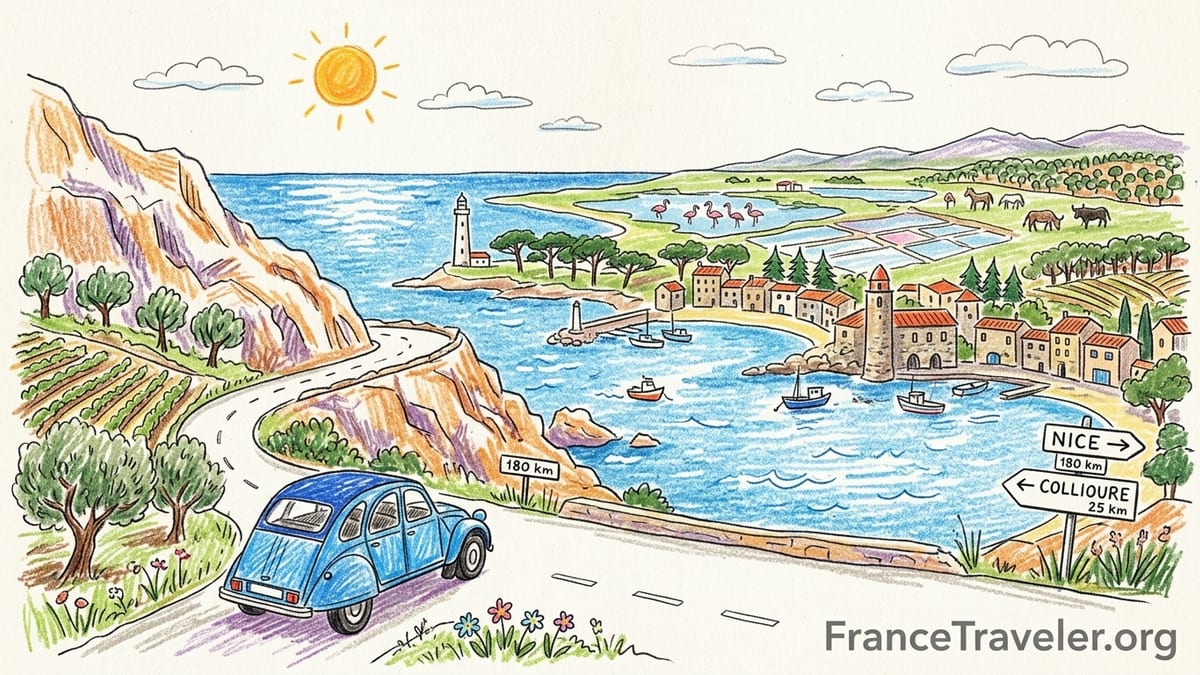
How to structure a coast-wide French Mediterranean road trip
The French Mediterranean coastline between the Spanish and Italian borders is too rich to tackle in a single, rigid itinerary. A realistic plan is to think of it in six driving zones: the Côte Vermeille near the Catalan border, the Sète and Languedoc lagoons, the Camargue, Marseille and Cassis, the Hyères and Var coast, and finally the Côte d’Azur from Saint-Tropez to Menton. Major roads rarely follow the water for every kilometre, so a good trip mixes fast inland autoroutes with deliberate scenic detours.
For many travellers driving from northern France or elsewhere in Europe, the first goal is to reach the sun as quickly as possible on the A6 and A7 “Autoroute du Soleil,” then continue along the A9, A54 and A8 which form the backbone of the Mediterranean corridor. These motorways are efficient but extremely busy on July and August weekends, when the French traffic service Bison Futé regularly flags the A7, A8 and A9 as red or even black for congestion between Lyon, Marseille and the Languedoc and Riviera coasts. In those periods it is not unusual for what should be a 2.5-hour Marseille to Nice run on the A8 to stretch to four hours or more in heavy traffic.
The solution is to build a flexible route with optional shortcuts and slow-downs. For a compressed three to four day trip, you might drive quickly from the Spanish border to the Camargue, then base yourself around Marseille or Cassis and finish with a single night on the Riviera. A one-week trip can include overnight stops on the Côte Vermeille, near Sète or Montpellier, then in the Camargue and around Hyères. With 10 days or more you can slow down further, add inland detours into Provence around Aix or inland Var hill villages, and leave the car parked for days at a time while you use regional trains or boats.
Throughout the route, your biggest practical questions will be tolls, fuel and parking. Motorway tolls between, for example, Marseille and Nice on the A8 typically add up to several tens of euros one way, and a full-length motorway journey from northern France to the Mediterranean can now easily exceed a hundred euros in toll costs alone. Fuel prices around €1.80 per litre for diesel and slightly more for petrol mean that detours and stop-start traffic carry a real cost over a long trip. Factor these into your budget and be clear where you want to spend money on speed, and where you prefer a slower, toll-free departmental road.
Côte Vermeille: from the Catalan border to Collioure
Arriving from Spain at Le Perthus or along the coast, the first French stretch, the Côte Vermeille in the Pyrénées-Orientales, rewards slowing down. Instead of staying on the inland A9, drop to the D914, also signed as the Route d’Espagne, which becomes a spectacular corniche road between Cerbère, Banyuls-sur-Mer, Port-Vendres and Collioure. This winding route clings to the cliff with the Mediterranean on one side and terraced Banyuls vineyards on the other, with regular pull-offs where you can safely stop for photos of tiny fishing ports and the line of the Pyrenees meeting the sea.
The D914 is narrow and demands concentration, but it is precisely the sort of scenic road where leaving the fastest route is worthwhile. In summer it can be busy with campervans and cyclists, and average speeds drop to 40 km/h or less, so allow generous time. Trying to combine a late-morning departure from Spain with a lunch stop in Collioure and then a long onward drive to the Camargue will feel rushed. Instead, consider an overnight stay in Collioure or Banyuls; you can then park in a paid municipal lot on the edge of town for around the price of a café lunch and explore on foot.
Parking in these small Côte Vermeille towns is tight in July and August. Free on-street spaces near beaches are often taken before 09:00, and local authorities have in recent summers increased paid parking zones to manage saturation. Plan to use marked car parks, where a half-day might cost the price of a glass or two of local wine, and resist the temptation to leave the car half on a verge. Fines and towing in French coastal communes are not uncommon, and police in this border area are alert to vehicles blocking emergency access on narrow roads.
If you are on a shorter three to five day itinerary, you can spend one or two nights on the Côte Vermeille and then rejoin the A9 inland near Perpignan for a fast run toward Sète and the Languedoc lagoons. Travellers with 10 days or more might instead meander via the smaller D roads across the vineyards toward Narbonne-Plage, stopping for a seafood lunch in Gruissan or Leucate before continuing east.
Sète and the Languedoc lagoons: where the road meets the sand
Between Leucate and Montpellier, the coast flattens into long spit beaches and étangs, or lagoons, separated from the sea by thin strips of land. Here, the seaside road between Sète and Marseillan runs for several kilometres with beach car parks on the seaward side and lagoon views on the other, a unique stretch where you really do drive almost at water level. This section is a reminder that France still offers accessible beach parking: many communal car parks near Sète and along the Languedoc coast remain either free or reasonably priced compared with other parts of Europe, especially outside the peak of late July and early August.
That said, local reports each summer highlight the same problems: by late morning, beach lots are full, overflow parking spreads onto cycle lanes and verges, and some visitors circle endlessly in 30-degree heat. To avoid this, either aim for the beach before 09:30, when you can usually still find a spot in the larger supervised lots, or wait until late afternoon and come for an evening swim and dinner in Sète or Frontignan. In practice, many French families plan a long lunch and siesta inland and then return to the water after 17:00, once the fiercest sun and traffic subside.
In Sète itself, a working port and lively cultural town, the car starts to become a secondary tool rather than the main way of experiencing the coast. Once you reach your accommodation, it is often better to park in a long-stay lot a little outside the centre and explore on foot or by bus. The inner streets are narrow, turning circles are tight for larger rental SUVs, and parking spaces were laid out long before today’s vehicles grew in width. For a compact car, expect to pay for underground parking near the canal-front restaurants, but you may find cheaper surface lots within a 10 to 15 minute walk.
For a week-long itinerary, Sète or nearby Montpellier makes a sensible base. From there you can day trip to the wilder beaches at Espiguette near Le Grau-du-Roi or to the fortified town of Aigues-Mortes by combining a short drive with local transport. Drivers on a very tight schedule, however, might simply use the A9 to skirt Montpellier and head straight for the Camargue or Marseille, limited to a quick lunch stop in Sète’s harbour district.
The Camargue: wild plains, flamingos and slow roads
East of Aigues-Mortes the coastline dissolves into the marshes and salt pans of the Camargue, where the Rhône meets the Mediterranean. This is a region of horses, bulls, rice fields and long, straight roads across levees rather than hairpin corniches. Driving here requires a different mindset: distances on the map look short, but the combination of 70 or 80 km/h speed limits, tractors, horse trailers and wildlife watching pull-outs means journeys take longer than expected. Once you leave the A9 or A54 at exits toward Arles or Saintes-Maries-de-la-Mer, plan on driving by feel rather than the clock.
In summer, parking bottlenecks concentrate around a few popular access points. The seaside town of Saintes-Maries-de-la-Mer has several large paid car parks set back from the beach, which can fill by late morning on August weekends. At the same time, beach access points along the D85a and D38, especially near Plage de Piémanson and Plage de Beauduc, see long lines of vehicles on weekends as campers and day trippers jostle for space. Many travellers find it more relaxing to leave the car in town and use local shuttle buses or hire bicycles to reach less crowded stretches of sand.
The Camargue is also one of the first places along the coast where having a car is essential at the beginning of the day but a liability in the evening. After a morning birdwatching at a reserve outside Arles and an afternoon swim near Saintes-Maries, you may not want to drive narrow dykes in the dark among mosquitos. A common pattern for those on 7 to 10 day itineraries is to spend two nights either in Arles or Saintes-Maries, keeping the car parked at the hotel from late afternoon and walking to dinner while the day trippers queue to leave the parking lots.
From a trip-planning perspective, the Camargue is a natural place to decide whether you will prioritise Provence’s inland landscapes or the urban coast. With five days in total you might visit only Arles and Saintes-Maries before dropping south to Marseille. With 10 days you can add a side trip into the Alpilles hills or Nîmes before rejoining the main corridor at Salon-de-Provence or directly toward Marseille on the A54 and A7.
Marseille, Cassis and the transition from car to train
Marseille is the Mediterranean’s largest French port, a complex tangle of motorways and tunnels where driving can be stressful even for locals. The A7, A55 and A50 converge here, feeding traffic toward the Old Port, industrial docks and eastern suburbs. Local transport reports consistently describe heavy congestion on the Marseille ring roads at rush hour, and visitors regularly comment that the combination of scooters, buses and complex junctions makes city-centre driving intimidating. At the same time, the city’s underground car parks near the Old Port and La Joliette are expensive enough that leaving a car idle for several days becomes poor value.
For many travellers, this is the point at which a car stops being useful. If your itinerary includes only Marseille, Cassis and the Côte d’Azur afterward, one strategy is to return your rental car at Marseille’s Saint-Charles station after the Camargue or Aix-en-Provence, then continue by train. Regional TER trains and intercity services link Marseille with Toulon, Hyères, Saint-Raphaël, Cannes, Antibes, Nice and Menton with regular departures. On busy summer Saturdays, these trains can be crowded but still spare you the worst jams and parking battles along the A50 and A8 corridor.
If you keep the car, plan your Marseille driving carefully. Use the A55 and the Prado-Carénage tunnel to cross the city quickly, even if you pay a modest toll for the tunnel, and avoid surface streets at peak times. Many visitors choose to stay in a hotel or apartment in the seaside districts toward the southeast, with private parking, then day trip to Cassis and the Calanques. Here again, parking is the limiting factor. Cassis has a handful of structured car parks which reach capacity quickly on sunny days, particularly when boat trips to the Calanques are running. Arriving before 09:00, or visiting on a weekday outside mid-July to late August, makes a huge difference.
Hikers planning to explore the Calanques National Park should note that in high fire-risk summers local authorities often restrict access to certain calanques or limit road traffic entirely during heatwaves. In practice, this can mean leaving the car at one of Marseille’s park-and-ride lots and using buses to reach trailheads. It is another example of how, moving east along the coast, public transport increasingly substitutes for private cars, especially in protected natural areas and dense urban zones.
Hyères, the Var coast and crowded peninsulas
Continuing east, the A50 carries traffic from Marseille to Toulon, then the A57 and A570 run toward Hyères, gateway to some of the Var’s best beaches and the Îles d’Hyères. Here the coastline becomes more indented, with peninsulas such as the presqu’île de Giens and the Saint-Tropez peninsula drawing tens of thousands of vehicles along single access roads. Local residents and recent visitors consistently describe heavy congestion on these approaches, particularly on summer weekends and at the start and end of the day when ferries to the islands run or beachgoers are arriving and leaving.
The roads onto the Giens peninsula, for example, are notorious for morning and evening jams in July and August, as cars queue for campsites, beach clubs and boats to Porquerolles. Parking near the ferry port is limited; in practice, travellers aim either to arrive very early, before 08:30, or park further back and walk or use shuttle services. Free or cheaper parking is sometimes available in designated lots away from the waterfront, but this is balanced by a hot, exposed walk of 10 to 20 minutes, not ideal for families hauling beach gear at midday.
Farther east, the single main D98 and D559 roads toward Saint-Tropez and Sainte-Maxime are legendary for slow traffic. A drive that takes 30 minutes in May can easily stretch to 90 minutes in late July, even outside weekend changeover days. Parking in Saint-Tropez’s port and village centre is dominated by a large paid lot that fills quickly on market days; many visitors now prefer to park in Sainte-Maxime or Saint-Raphaël and take a coastal boat into Saint-Tropez, avoiding the most frustrating part of the drive altogether.
For a 10 to 14 day itinerary, Hyères and the Var coast are an ideal place to slow down the car and embrace alternative transport. You can, for example, base yourself in Hyères or La Londe-les-Maures, leave the car parked for several days, and explore islands and beaches by boat, on foot and by bicycle. Inland, shorter drives to the Massif des Maures, Collobrières or the Chartreuse de la Verne give a sense of interior Provence without the intensity of the A8 corridor.
Côte d’Azur and the Italian frontier: when not to drive
From Fréjus and Saint-Raphaël east to Menton and the Italian border, the Côte d’Azur combines some of Europe’s densest coastal development with a relatively narrow strip of buildable land between sea and mountains. The A8 autoroute runs inland, connecting Cannes, Antibes, Nice, Monaco and Menton with a fast but expensive and often congested toll road. Parallel to it, smaller coastal roads thread through each resort and old town, offering sea views but requiring patience to navigate traffic lights, pedestrian crossings and summer crowds.
Local and visitor experience over recent years points in the same direction: once you reach the central Côte d’Azur, a car is more trouble than it is worth for day-to-day sightseeing. Parking in central Nice, Cannes or Antibes rarely costs less than a few euros per hour in underground car parks, and on-street spaces are scarce and tightly enforced. In high season, reports repeatedly describe parking as a “nightmare,” with drivers circling for 30 minutes or more in search of a space near popular beaches or old towns, and frequent fines for those who try their luck in restricted zones.
The alternative is unusually good coastal public transport. The TER regional train line runs along the shore from Saint-Raphaël through Cannes, Antibes and Nice to Menton, with frequent services that, in normal conditions, are faster than driving between those towns during daytime. Tickets are comparatively inexpensive, and the stations in Antibes, Cannes, Nice and Menton lie within an easy walk of beaches and historic centres. Local buses connect these hubs to hill villages such as Èze, Saint-Paul-de-Vence and La Turbie, places where parking is limited and streets are steep. For many travellers, the most relaxed Côte d’Azur experience is to rent a car only as far as Hyères or Saint-Raphaël, return it, and continue by train.
There are still stretches where a scenic drive is worth the effort. The three classic corniche roads between Nice and Monaco, in particular the Moyenne Corniche, follow the line of old routes like the Roman Via Augusta and provide views across the Baie des Anges and the cliffs dropping into the sea. Driving one of these corniches early in the morning, stopping at viewpoints above Villefranche-sur-Mer or Èze, can be a highlight of a longer journey. However, parking in the villages themselves is restricted and often requires using small paid car parks or even hotel valet services rather than relying on casual street parking.
For short trips of three to five days focused on the Riviera, a sensible pattern is to base in one town with good train access, such as Nice, Antibes or Cannes, and explore linearly without a car. Those on a two-week coast-wide road trip can drop their vehicle in Nice or Menton, then spend several car-free days at the end using trains and boats along the shore and into Italy, where parking constraints continue in Ligurian coastal towns.
Practical tips for tolls, summer traffic and parking
Across the entire French Mediterranean corridor, tolls and summer traffic patterns will shape your road trip as much as scenery. The A7, A8 and A9 motorways carry the bulk of long-distance holiday traffic from northern France and neighbouring countries to the Mediterranean. Official traffic forecasts regularly flag mid-July to late August weekends as critical, with warnings to avoid the A7 between Lyon and Marseille and the A8 between Marseille and Nice during the daytime on peak Saturdays. If you must travel in that window, consider driving early in the morning or late evening, splitting your journey with an overnight stop well before the coast, and using secondary routes such as the N113 or D6007 to bypass known chokepoints.
On tolls, a full north-to-south journey on French autoroutes now costs well into three figures in euros when driven entirely on motorways, and even shorter segments such as Marseille to Nice incur significant charges. Electronic toll tags, sold by French motorway operators and some travel agencies, can save time at toll plazas, allowing you to use dedicated lanes instead of queuing with cash or bank card users. Alternatively, some travellers purchase pre-paid or post-paid toll services through fuel card providers or at French bar-tabac shops, which can reduce the need to handle cash while driving.
Parking strategies vary by zone. On the Côte Vermeille, Sète and in much of the Camargue, small communes still provide a mix of free and paid lots near beaches and town centres, though peak-season saturation remains a problem. In Marseille and the Riviera, assume that any convenient central parking will be paid, time-limited and competitive. Booking hotels and apartments that include a guaranteed space, even if it adds a nightly surcharge, often works out cheaper than using public garages every day. In hill villages above the coast, plan to park in signposted visitor lots at the entrance to the village and walk in; this avoids navigating constricted medieval streets and respects local traffic restrictions.
Finally, be prepared to abandon the car altogether when conditions make driving more frustrating than freeing. If a heatwave coincides with wildfire risk, authorities may close access roads to parks like the Calanques or limit traffic on certain peninsulas. On some summer days, regional rail strikes or roadworks can shift the balance in the other direction. Checking local travel information services and traffic apps on the morning of each long drive, and being willing to swap a planned drive for a lazy beach day if the roads are jammed, will keep your French Mediterranean road trip enjoyable rather than exhausting.
FAQ
Q1. How long do I need for a French Mediterranean coast road trip from Spain to Italy?
Most travellers find that five to seven days allows for a fast, highlights-only drive with one night in each major zone, while 10 to 14 days is better if you want to slow down, stay multiple nights in places like the Camargue, Hyères and the Côte d’Azur, and include car-free days using trains and boats.
Q2. When is summer traffic on the A7, A8 and A9 motorways at its worst?
Traffic is heaviest from mid-July through late August, especially on Saturday changeover days when many rentals run from Saturday to Saturday. On those days, congestion between Lyon and Marseille on the A7 and along the A8 between Marseille, Cannes and Nice can last from late morning into the evening.
Q3. Are the scenic coastal corniche roads worth the detour compared with the autoroutes?
Yes, in selected stretches. The D914 corniche along the Côte Vermeille between Cerbère and Collioure and the corniche roads between Nice and Monaco offer outstanding views and memorable stops, but they are slow and winding, so it is best to use them for short, focused sections rather than as your main long-distance route.
Q4. How difficult is parking on the French Riviera in July and August?
Parking in central Nice, Cannes, Antibes and popular seaside villages is challenging in high season. Underground garages are expensive and often full at peak times, and on-street spaces are scarce and tightly controlled, so many visitors choose to rely on trains and buses instead of driving between coastal towns.
Q5. Should I keep a rental car once I reach Marseille and the Côte d’Azur?
Often it is better to return the car in Marseille, Toulon or Nice and continue by train, especially if your plans focus on cities and large resorts. Public transport along the Riviera is frequent and faster than driving at busy times, and you avoid the cost and stress of parking in dense urban areas.
Q6. Are there still places with free or inexpensive beach parking on this coast?
Yes, particularly along the Languedoc coast near Sète and in some parts of the Camargue and western Var, where communes maintain large surface lots. However, these can fill quickly on summer afternoons, and more towns are introducing paid parking or time limits to manage demand.
Q7. How should I plan fuel and toll costs for a coast-wide trip?
At current prices, fuel along the French Mediterranean is relatively expensive, and tolls on the main motorways add significantly to costs. It is sensible to budget for several tens of euros in tolls between major cities such as Marseille and Nice, and more if you are driving all the way from northern France in one trip.
Q8. Is it safe and practical to drive the coastal roads in a larger vehicle like a campervan?
It is possible but requires extra care. Roads such as the Côte Vermeille corniche and some village approaches are narrow and winding, with tight parking and limited turning space, so you may need to avoid certain streets, book campsites with suitable access, and be prepared to park outside town centres and walk in.
Q9. What is the best way to combine inland Provence with this coastal drive?
Many travellers branch inland around the Camargue or Marseille, using Arles, Aix-en-Provence or inland Var villages as bases for a few nights before returning to the sea. A flexible plan might include the Camargue, then a stay in Aix or the Luberon, before rejoining the coast near Hyères or Saint-Raphaël.
Q10. Do I need to speak French to manage tolls, parking and traffic information?
Basic French helps, but non-French speakers manage every year using clear road signs, multilingual payment machines, and common symbols for parking and services. Traffic apps and in-car navigation systems also provide live updates, and many local tourism offices can explain parking rules in English.