


Planning a trip to the French Mediterranean but not sure where to base yourself is a good problem to have. Between Collioure near the Spanish border and the glamour of Nice, the coast changes character every few hours by train or car. Prices, beach style, nightlife and even how easy it is to get around without a car can be dramatically different. Choosing the right stretch of coast matters more than picking the perfect hotel, because it will shape what your days actually feel like.
Beachfront, Historic Town or City Hub: How Do You Want to Stay?
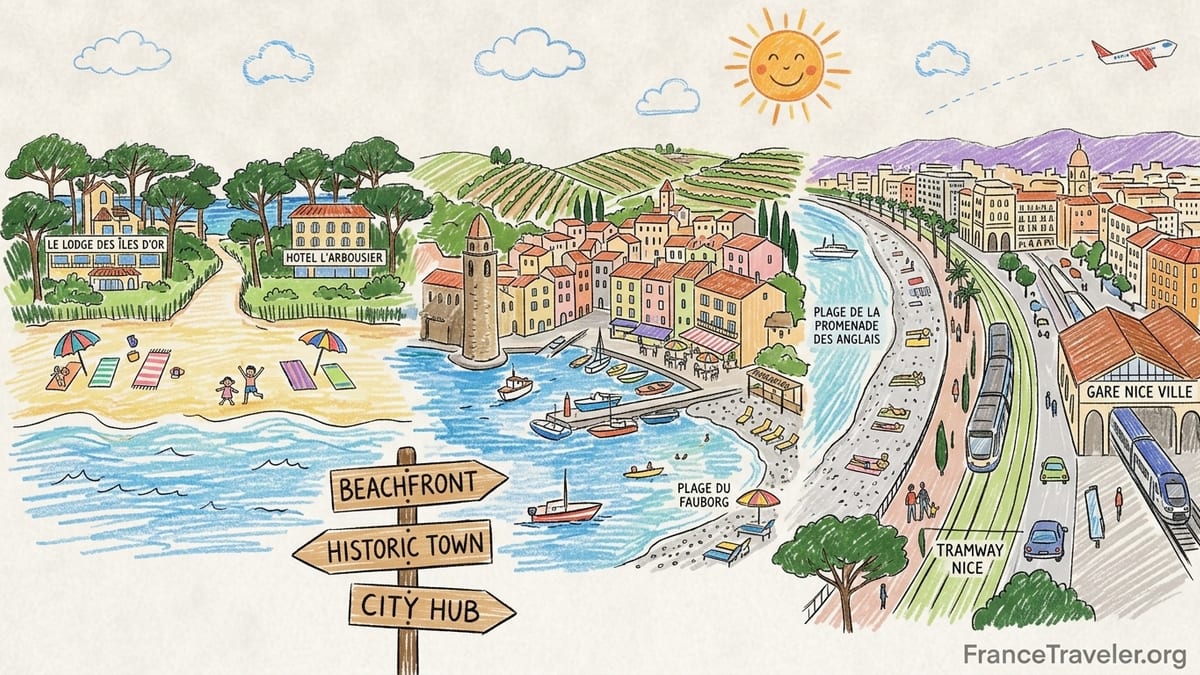
Before you decide between Collioure, Camargue or Nice, it helps to be clear about three basic accommodation styles. First is staying directly on a beach: think Giens peninsula near Hyères, where small hotels like Le Lodge des Îles d’Or sit behind a line of pines with a path straight onto La Bergerie’s sand. Here you trade urban buzz for the pleasure of walking from your room to the water in a swimsuit, with little more than a beach bar and a minimarket within a few minutes’ walk.
The second style is a historic coastal town, where you are based in a walkable center with a harbor, cafés and a proper old town, but the beach is a 5 to 15 minute stroll away. Collioure is the classic example: you might stay at a mid-range 3-star like Hotel Madeloc or a small guesthouse up the hill and wander down past pastel houses and the church tower to swim in the bay. You may not have a pool or private beach club, but you gain atmosphere, restaurants and a sense of place.
The third option is using a bigger city as your transport hub. Marseille, Montpellier and Nice are all on fast rail lines and have tram or metro systems plus frequent buses along the coast. In Nice, for instance, trams connect the train station, Old Town and airport, and regional TER trains or buses reach Cannes, Antibes and Menton in under an hour. You give up the quiet of a resort, but if you like eating somewhere different every night and doing day trips without a car, a city base is hard to beat.
Most travelers end up mixing two of these modes. A week might look like four nights in a city such as Nice for museums and easy transport, followed by three nights on a quieter beach near Hyères or in the Camargue to slow down. With that framework in mind, here is how the main stretches of coast compare in practice.
Collioure and the Côte Vermeille: Romantic, Scenic, Not for Partying
Collioure, close to the Spanish border, is one of the most picturesque towns on the French Mediterranean. The beaches here are mostly small coves and pebbly bays framed by terraced vineyards rather than long sandy strands. In high season, recent price comparisons show that 3-star rooms in Collioure often land around the mid 100s euros per night for well-rated hotels, with some July and August nights pushing above 300 euros in seafront properties. Budget rooms under 120 euros exist, but usually further from the water or without air conditioning.
Beach access is pleasant but not resort-style. You can swim right in town by the church, or walk 10 to 20 minutes to quieter coves toward Port-Vendres. There are a few beach restaurants and sunbed concessions, but you will not find the large organized beach clubs that line parts of the Riviera. Nightlife is low-key: dinners on terraces, a few wine bars and ice cream parlors. Collioure works best for couples and travelers who are happier with an evening stroll along the quay than in a nightclub.
Public transport is modest but workable. A regional train connects Collioure to Perpignan in about 30 minutes, with onward TGVs to Paris, and local buses link nearby villages. For a road trip, however, the Côte Vermeille is a delight. The coast road between Collioure and Banyuls-sur-Mer twists above the sea, with viewpoints and wineries to stop at. With a car you can also cross into Spain in under an hour for a day in Cadaqués or Figueres.
Stay here if you prize scenery and charm over nightlife and big sandy beaches, and are willing to pay relatively high boutique-town prices for the experience. Think of Collioure as a romantic painting come to life rather than a base for clubbing or shopping.
Languedoc & the Sète / Montpellier Coast: Wide Beaches and Sensible Prices
Between the Rhône delta and the Pyrenees, the Languedoc coast is a long run of sand backed by lagoons. Resorts such as La Grande-Motte, Palavas-les-Flots and Cap d’Agde were purpose-built for summer holidays, with large apartment complexes, campsites and family hotels. As a rule, you get better value here than on the Côte d’Azur. A straightforward 3-star room in peak season often starts in the 120 to 180 euro range, with full apartments and campsites providing cheaper options for families.
Beach access is Languedoc’s big strength. Many properties are either right on the sand or a short, flat walk away, and the beaches themselves are usually wide and shallow, good for children. The feel is more casual than glamorous: you will find a mix of public sand, simple beach bars and a scattering of sunbed rentals, rather than rows of designer beach clubs. Sète, a working port and canal town, offers a nice compromise, with long beaches just outside town and a more authentic, year-round center of markets and seafood restaurants.
Nightlife is varied but generally unpretentious. In summer, Sète and Palavas have bars that go late, open-air concerts and seasonal clubs, but the overall energy is more about sunset drinks and family funfairs than A-list DJs. Montpellier, a short tram or bus ride inland, is the place for a proper city night out, with student bars and late-opening venues around the historic center.
Public transport is an advantage. Montpellier is on the high-speed rail line, and regional trains or buses reach Sète and nearby coastal stops. If you are doing a road trip, this stretch of coast is straightforward driving on mostly flat terrain, with easy parking at campgrounds and beach car parks. Choose Languedoc if you want a classic beach holiday at relatively moderate prices, are fine with a slightly 1970s resort aesthetic, and like having a large city such as Montpellier close by for a day of culture or shopping.
Camargue: Wild Beaches and Nature over Nightlife
The Camargue, the Rhône delta west of Marseille, is about flamingos, white horses and big skies more than polished resorts. Saintes-Maries-de-la-Mer is the main seaside town, with a mix of small hotels, simple guesthouses and a few wellness-focused properties such as thalassotherapy hotels located near the beach and wetlands. Prices in peak summer usually sit below the Côte d’Azur level, but are often higher than the simplest Languedoc resorts, especially for renovated or spa-oriented hotels.
Beach access here means long, often windy stretches of sand. Plage de l’Est and nearby strands can feel almost wild once you walk a bit from the car park. Services are more limited: a handful of seasonal restaurants and snack kiosks, some sunbeds near town, and then long sections with no shade or facilities. It is perfect if your idea of a beach day is a big picnic and space to yourself, less ideal if you want waiter service and designer loungers.
Nightlife is muted. Summer brings a few bars with live music, some events linked to local bulls and horses, and evenings that revolve around waterfront dinners. Families and nature lovers tend to outnumber clubbers. For a livelier night scene you would drive to Arles or Montpellier, each roughly an hour or so away depending on where you stay.
A car is very useful in the Camargue. Buses exist, but the most rewarding spots are salt flats, bird hides and stretches of coast that are easiest reached by driving. As a road trip base, it combines well with Provence: you might stay three nights in Saintes-Maries for beaches and wetlands, then head inland to Les Baux or Avignon. Pick the Camargue if you want wild scenery, basic but atmospheric beach days and slow evenings rather than shopping and nightlife.
Marseille, Cassis and the Calanques: Cliffy Coast and Active Days
East of the Camargue, Marseille and Cassis front a much rockier coastline. Instead of endless sand, you get inlets and fjord-like coves known as calanques. In Cassis, mid-range hotels and guesthouses in high season frequently sit in the 180 to 300 euro bracket, with simple rooms selling out early due to the village’s small size. Marseille, as a big city, spans everything from budget chains under 120 euros to five-star waterfront hotels that can run several hundred euros a night in summer.
Beach access is more limited and varied. Cassis has a couple of small pebbly beaches right in town and easy boat access to the Calanques, where swimming is off rocks or tiny coves reached on foot. Marseille has a mix of city beaches like Prado, which have sand imported and are lined with casual eateries, and smaller local spots such as Malmousque that feel like seaside villages inside the city. If your priority is a long, sandy beach where you can rent a lounger for the day, this is not the best stretch, though families do manage fine using Marseille’s urban beaches.
Nightlife is strong in Marseille, with bars in neighborhoods such as Cours Julien and the Old Port keeping things lively until late. Cassis is more about dinners on the harbor and a few relaxed wine bars. If you want to hike or kayak in the Calanques by day and still have a serious choice of restaurants and bars at night, staying in Marseille and day-tripping to Cassis is a practical approach.
Public transport here is solid. Marseille is on high-speed rail links and has metro and tram lines, plus buses to Cassis and coastal suburbs. For road-trippers, the drive from Marseille to Cassis and on toward Toulon is scenic but can be congested in July and August, and several Calanques car parks now require advance reservations or are limited in summer to protect the environment. This coast suits active travelers who do not need a resort-style beach and prefer a mix of city grit, villages and clifftop scenery.
Hyères and the Giens Peninsula: Quiet Beach Life and Island Hopping
Hyères marks a transition between Marseille’s urban coast and the more overtly glamorous Riviera. The old town sits on a hill inland, while the Giens peninsula stretches toward the islands of Porquerolles and Port-Cros. Here many hotels and holiday villages sit just behind fine sandy beaches such as La Bergerie and La Capte, including properties with direct paths from the garden to the sand. Prices in summer for a comfortable beach hotel often range from roughly 150 to 250 euros per night for a standard room, with simpler motels and campsites pulling that down and stylish, recently refurbished hotels pushing it higher.
Beach access is the main draw. Some addresses on Giens have private or semi-private sections of sand, but the area is known more for long public beaches with shallow water and plenty of space. Almanarre beach on the west side is a famous kitesurfing spot, windy and backed by a salt road that is sometimes closed in winter, while the east side beaches are more sheltered for families. From the peninsula, regular ferries reach Porquerolles, where you can rent a bike and pedal to postcard coves such as Notre-Dame beach.
Nightlife is low-key, centered on seafront restaurants, a few beach bars and some hotel lounges. Hyères town has more cafés and wine bars, but this is not an area for high-end clubs. If you want late nights, you would drive to Toulon or even as far as Saint-Tropez on a day or night trip. For many visitors, the trade-off is worth it for quiet evenings and starry walks along the sand.
Public transport options include regional trains to Hyères from Marseille and Toulon, and local buses that reach Giens, but schedules can be infrequent in the evening. For a road trip, this stretch is appealing: you can base on Giens and make easy drives to Bormes-les-Mimosas, Le Lavandou and inland Provençal villages. Stay here if your ideal week is about swimming off the beach before breakfast, occasional island excursions and simple coastal drives rather than shopping streets and nightlife.
Saint-Tropez and the Surrounding Gulf: Glamour, Crowds and High Prices
Saint-Tropez and the surrounding Gulf are shorthand for Riviera glamour. The town itself is small, its old port lined with yachts and designer boutiques rather than big hotels. Many visitors actually stay in nearby Ramatuelle, Gassin or Sainte-Maxime, where there is more space for hotels, villas and holiday parks. Prices in high season are among the steepest on the French Mediterranean. In July and August, expect many standard double rooms in stylish 4-star hotels to start in the 300 to 500 euro range or higher, with luxury properties and villas running significantly more.
Beach access here can be either pure fantasy or crowded reality, depending on your expectations. Pampelonne beach is a long, soft sandy bay, but large sections are occupied by private beach clubs renting loungers and umbrellas at premium rates. There are still public segments of sand where you can lay your own towel, yet parking and access are strained in peak weeks. Around Sainte-Maxime you will find more family-oriented beaches and a somewhat more relaxed atmosphere, though the whole gulf is busy in summer.
Nightlife is part of the appeal for some travelers. Saint-Tropez has a cluster of famous clubs and late-night bars that attract an international crowd, particularly in July and August, alongside high-end restaurants that can require reservations well in advance. The downside is that costs add up quickly, from cocktails to taxis.
Public transport is limited compared with the big cities. Buses do connect towns around the gulf, and there are boat shuttles between Saint-Tropez and Sainte-Maxime, but trains do not reach the peninsula directly. Traffic jams on the access roads in summer are notorious. This area works best if you are comfortable driving at off-peak hours or traveling slightly outside the absolute high season, and if you value people-watching and atmosphere over practical logistics and pricing.
Nice and the Côte d’Azur: Urban Hub With Easy Day Trips
Nice, capital of the Côte d’Azur, is the strongest choice for travelers who want the flexibility of a city with easy beach access. Recent city break guides still list a spread of hotel prices: off-season deals in mid-range 3-star properties in the city center can come in under 100 euros per night, but in July and August, well-reviewed central hotels often sit between 180 and 300 euros, with seafront or boutique addresses higher. Apartments, guesthouses and budget chains increase the range at both ends.
The main beach in Nice, along the Promenade des Anglais, is a long strip of pebbles rather than sand. Some travelers love the clear water and deep blue color, others miss the softness of sandy bays. Sections are free public beach; others are run by private beach clubs where you can rent a lounger and umbrella for the day. For softer sand, it is easy to hop on a train or bus to nearby Villefranche-sur-Mer, Antibes or Cannes, all within about an hour and offering different beach vibes from family-friendly to chic.
Nightlife runs the full spectrum. The Old Town has a dense cluster of bars and small clubs, the port area has a growing restaurant scene, and the broader Riviera offers casinos, beach parties and festivals in Cannes, Juan-les-Pins and Monaco. You can spend one evening with a casual socca and wine in a backstreet bar, the next at a rooftop cocktail lounge with views of the bay.
Public transport is arguably the best on the French Mediterranean. Nice airport sits right on the tram line, which also links to the main train station and city neighborhoods. Regional trains run frequently along the coast to Menton, Monaco, Antibes and Cannes, while buses cover hillside villages like Èze. This makes Nice an excellent base for travelers without a car who still want to see multiple towns. For a road trip, parking and traffic require more planning, but the coastal and hinterland drives are some of the region’s most scenic. Choose Nice if you prefer an urban pace, are happy with a pebble beach and want maximum flexibility for day trips.
Which Coast for Which Traveler? Matching Budgets and Travel Styles
When you zoom out, the French Mediterranean splits into a few clear personalities. Collioure and the Côte Vermeille are for romantics who want a pretty historic town and are willing to put up with smaller pebbly beaches and higher boutique pricing. Languedoc resorts and the Sète / Montpellier coast suit families, budget-conscious travelers and anyone who values long, sandy beaches and spacious rentals over glamour and name recognition.
The Camargue is for nature first, beach second: great if you want to alternate swims with birdwatching and horse rides. Marseille and Cassis appeal to active travelers who like hiking, sea kayaking and a bit of city grit. Hyères and the Giens peninsula offer that sweet spot of easy beach days and island excursions without the prices and crowds of the most famous Riviera addresses, especially attractive to couples and families seeking quieter evenings.
Saint-Tropez and its gulf are a deliberate choice: you go there for a mix of prestige, nightlife and people-watching, understanding that practicalities like traffic and high prices come with the package. Nice and the broader Côte d’Azur are the best option if you want a single base with the broadest range of day trips, nightlife and hotel categories, especially if you plan to rely on trains and buses rather than a rental car.
If you are undecided, it can help to split your stay. For example, fly into Marseille, spend three nights in the city to explore Cassis and the Calanques, then continue by train to Nice for four nights of city life and day trips along the Riviera. Or combine a week by the beaches of Languedoc with a long weekend in Collioure or the Camargue. Thinking in terms of coast personalities rather than individual hotels will make it easier to build a trip that matches how you truly like to travel.
The Takeaway
Choosing where to stay on the French Mediterranean is less about finding a single “best” town and more about identifying your own priorities: sandy vs pebbly beaches, nightlife vs quiet, driving vs trains, boutique charm vs straightforward value. Collioure, Languedoc, Camargue, Cassis, Hyères, Saint-Tropez and Nice all deliver a version of the Mediterranean dream, but in very different flavors.
If you crave historic streets and a sense of discovery, lean toward Collioure, Sète, Marseille or Nice. If you want to roll out of bed straight onto the sand, look closely at Languedoc resorts and the Giens peninsula. For maximum flexibility without a car, Nice and the Montpellier / Sète axis are the clear winners; for memorable road trips, the Côte Vermeille, Camargue and Var coast around Hyères shine.
Start by asking how you imagine your perfect day: Are you sipping an espresso in a busy market before a museum visit, or carrying a picnic down a sandy path to an almost empty beach? Once you have that picture in mind, the right stretch of French Mediterranean coast, and then the right hotel, becomes much easier to choose.
FAQ
Q1. Is Nice or Marseille a better base without a car?
Both work, but Nice is generally easier without a car thanks to its airport tram, compact center and very frequent regional trains along the Riviera, while Marseille is better if you want a mix of city culture and day trips to Cassis and the Calanques.
Q2. Where on the French Mediterranean has the best sandy beaches?
The longest and widest sandy beaches are along the Languedoc coast near Montpellier and Sète, in parts of the Camargue, and around Hyères and the Giens peninsula, while much of the Côte d’Azur has pebbly or smaller coves.
Q3. Which area is most affordable in peak summer?
In general, Languedoc resorts and some parts of the Camargue and Var coast offer more affordable accommodation than the Côte d’Azur, with Nice, Cannes and Saint-Tropez usually commanding the highest average prices in July and August.
Q4. Is Collioure suitable for families with young children?
Yes, Collioure can work for families who do not mind smaller, pebbly beaches and hilly streets, but for toddlers and lots of sandcastles, flat sandy areas in Languedoc or near Hyères are usually easier.
Q5. Do I need a car to enjoy the Camargue?
A car is not absolutely essential, but it makes a big difference, as many of the most scenic spots, birdwatching areas and quieter beaches are spread out and not always served by frequent public transport.
Q6. Where should I stay if I want both nightlife and good public transport?
Nice is the most balanced choice, offering bars and clubs, a broad restaurant scene and frequent trains and buses to neighboring towns, with Marseille as a strong alternative if you prefer a slightly rougher, more local-feeling city.
Q7. Is Saint-Tropez worth the higher prices?
Saint-Tropez is worth it if you specifically want its atmosphere of glamour, beach clubs and nightlife, and are comfortable with higher hotel and dining costs; otherwise, nearby Var coastal towns can offer similar beaches at lower prices.
Q8. What is the best base for visiting the Calanques?
Cassis is closest and has a charming village feel, but accommodation is limited and often pricey, while staying in Marseille provides more hotel choice and public transport links, with day trips by bus or boat into the Calanques.
Q9. Are there quiet areas near Nice for day trips?
Yes, you can easily reach quieter spots such as Villefranche-sur-Mer, Cap Ferrat, Antibes or even inland villages in the hills by regional train or bus for calmer beach days and walks.
Q10. When should I book hotels on the French Mediterranean?
For July and August, booking several months ahead is wise, especially in smaller towns like Cassis, Collioure or Saintes-Maries-de-la-Mer, while in May, June, September or October you often have more flexibility but should still reserve waterfront and boutique options early.