


Mediterranean France really splits into two very different stories. To the west, the Languedoc coast stretches from the Camargue past Montpellier and Narbonne to the Spanish border, a long run of low-key resorts, big skies and wide sandy beaches. To the east, the French Riviera between Toulon, Saint Tropez, Cannes, Nice and Menton is a compact chain of famous resort towns, pebbly coves and high-gloss glamour. Deciding between them means balancing beach style, budget, atmosphere and how you plan to get around. This guide brings the two coasts side by side so you can choose the version of Mediterranean France that fits your trip.
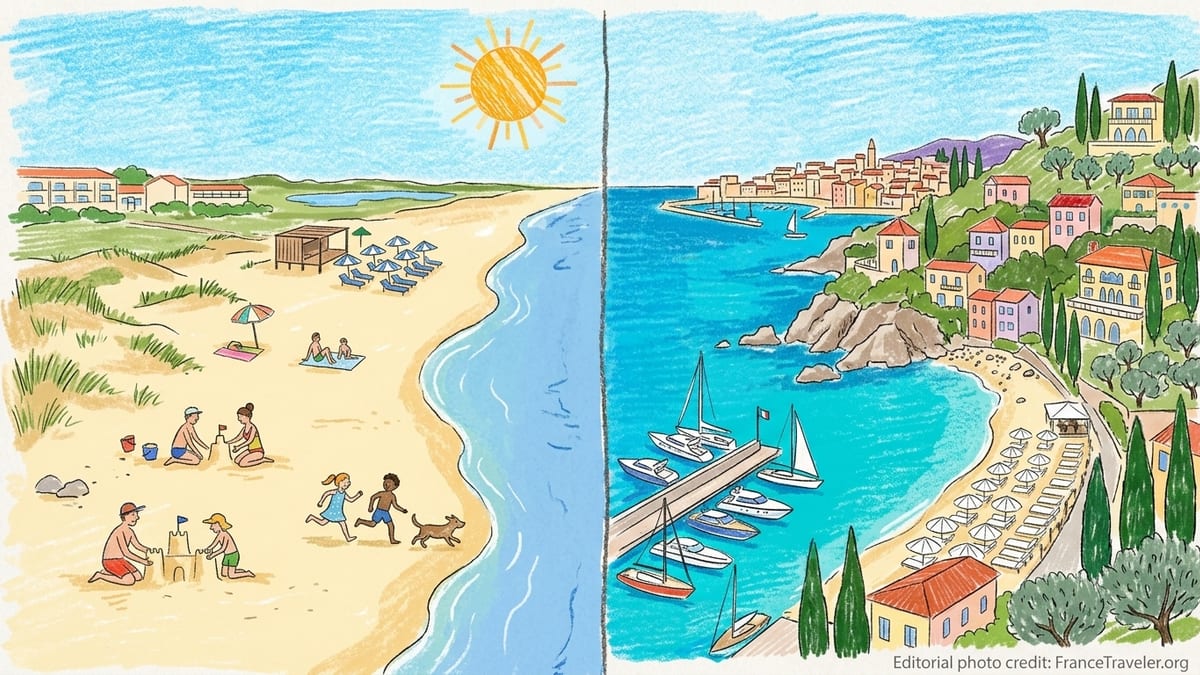
Two Coasts, Two Very Different Vibes
The Languedoc coast, usually wrapped into the modern Occitanie region, runs from around the Camargue wetlands past La Grande Motte, Palavas-les-Flots, Sète, Cap d’Agde, Valras-Plage, Narbonne-Plage and Gruissan to Collioure and Argelès-sur-Mer near the Spanish border. Much of this shoreline is a continuous ribbon of dune-backed sand with low-rise resorts, campsites and nature reserves rather than dense city skylines. Distances between hubs such as Montpellier, Sète, Béziers, Narbonne and Perpignan are longer, and you feel that space both on the road and on the beach.
The French Riviera, or Côte d’Azur, is a much shorter stretch but far more urban. The classic core runs from Saint-Tropez and the Esterel coast through Cannes, Antibes, Nice, Monaco and on to Menton at the Italian border. Towns merge into each other, with rail stations every few kilometres and coastal roads backed by apartments, hotels and marinas. It is one of the world’s original resort coasts, long associated with artists, film stars, Formula 1 weekends and luxury yachting.
For travellers, the key trade-off is this: Languedoc generally offers more space, longer sandy beaches and lower prices, while the Riviera delivers dense public transport, famous names and high-energy resort life. Your priorities around budget, nightlife, car use and the kind of beach you prefer will usually tip the balance.
Beach Style: Wide Sands vs Pebbly Coves
If your mental picture of a Mediterranean holiday is a huge sandy beach where children can run and build sandcastles without bumping into anyone, Languedoc is closer to that ideal. Resorts such as La Grande Motte, Carnon and Palavas near Montpellier have broad, gently shelving beaches ideal for younger swimmers. Further south, the sands around Sérignan-Plage or Narbonne-Plage feel almost wild outside peak weekends, with grassy dunes and long walks between beach bars. In high summer you still share space, but it is far easier to spread out than in most Riviera towns.
On the French Riviera, natural sand is rarer, especially around Nice where the main city beaches are made up of smooth grey pebbles. You will often want water shoes for swimming, and sunbathers favour loungers over towels on the stones. There are patches of sand such as Juan-les-Pins near Antibes, the Croisette beaches in Cannes and family-friendly strips near Fréjus and Saint-Raphaël. However, many of the most postcard-perfect spots are small coves, sometimes reached by stairs or coastal paths, with limited space that fills quickly on sunny days.
Beach clubs underline the difference. In Languedoc, simple seasonal clubs at places like Villeneuve-lès-Maguelone or near Sète often mean a wooden deck, a few rows of loungers and a relaxed menu of salads, grilled fish and rosé at prices that feel manageable for a family day. On the Riviera, a similar setup on the Promenade des Anglais in Nice or on Pampelonne Beach near Saint-Tropez can feel distinctly upmarket, with designer-branded clubs, bottle service and per-person lounger fees that add up fast for groups.
Water clarity and backdrop also shift as you head east. The flatter Languedoc shoreline can look wilder than dramatic, though the rocky coves around Collioure and the Côte Vermeille offer striking scenery. The Riviera’s steep headlands and villa-dotted hillsides around the Cap d’Antibes, Villefranche-sur-Mer or Èze-sur-Mer create that densely built, glamorous seascape many travellers associate with the Côte d’Azur, at the cost of narrower strips of actual beach.
Prices, Value and Seasonality
Budget is one of the clearest dividing lines between the two coasts. As a rule, accommodation, dining and beach clubs are cheaper along the Languedoc shore than on the French Riviera, especially in marquee towns like Saint-Tropez, Cannes and Monaco. A basic but well-kept family campsite with a pool near Sérignan-Plage or Vias-Plage might offer week-long rental of a mobile home in July for a price that would barely cover three or four nights in a midrange Riviera hotel room in the same season. Self-catering apartments in towns like Sète, Grau-du-Roi or Narbonne often come in at more accessible nightly rates than equivalents in Antibes or Nice.
On the French Riviera, you are paying a consistent premium for location and name recognition. Midrange sea-view hotel rooms in Nice or Cannes often price more like upper-mid or entry-level luxury on the Languedoc coast. Restaurants on waterfront promenades in Antibes, Villefranche or Saint-Jean-Cap-Ferrat typically charge noticeably more for similar plates of grilled fish, pasta or salade niçoise than comparable brasseries in Sète or Collioure. Cocktails at high-profile beach clubs in Saint-Tropez or Monte Carlo can cost what two glasses of wine might run in a relaxed bar in Montpellier or Béziers.
Seasonality amplifies the gap. In July and August, both coasts are busy, but the Riviera feels more intense because its coves and town beaches are smaller. Prices ratchet up sharply around major events, from the Cannes Film Festival in May to the Monaco Grand Prix. In Languedoc, demand spikes during French school holidays, yet it is still easier to find last-minute availability in midrange hotels or campsites, especially around Narbonne, Gruissan or Argelès where international tourism is significant but less overwhelming.
Getting Around: Dense Riviera Trains vs Languedoc Space
The French Riviera is one of the most rail-friendly coastal regions in Europe. A mainline track hugs the shore from Marseille through Toulon, Saint-Raphaël, Cannes, Antibes, Nice and Monaco to Menton and across the border to Ventimiglia in Italy. Regional TER trains can run as often as every 15 minutes on busy sections between Cannes, Antibes, Nice and Menton, making it realistic to base yourself in one town and use frequent trains for day trips all along the coast without a car. Connections westward to Marseille and inland to Provence also tie in easily.
The Riviera’s dense network extends to local buses running from Nice to hillside villages like Èze or Saint-Paul-de-Vence, and from Antibes or Cannes up into the perfume town of Grasse. This means a largely car-free itinerary is very workable: fly or take the TGV into Nice, base in a single hotel or apartment, then ride trains and buses to beaches, old towns and villages. Parking in central Nice, Antibes or Monaco is both costly and stressful, so many visitors happily skip a rental car entirely.
On the Languedoc coast, trains do follow the shoreline between cities such as Nîmes, Montpellier, Sète, Béziers, Narbonne and Perpignan, with onward services to the Spanish border. However, the stations are often set back from beach resorts, and services are less frequent than on the Riviera. A regional train might be perfect for moving between Montpellier and Sète or Narbonne and Perpignan, but you will often need local buses or a car to reach resort areas like Cap d’Agde, Valras-Plage or the long strings of campsites along the dunes.
For this reason, Languedoc tends to suit travellers who are comfortable driving. A road trip from Montpellier to the Spanish border allows you to combine beach days with vineyard visits in the Corbières, medieval Carcassonne, and detours into the Pyrenees. Roads are generally easier to navigate than the Riviera’s congested coastal routes, and parking near beaches is more widely available, even in summer. If you are planning to travel entirely by public transport, the Riviera is usually the more practical base.
Crowds, Nightlife and Overall Atmosphere
The Riviera is busy, even outside peak summer. In May or September, you still feel a strong holiday buzz on the Promenade des Anglais in Nice, around the Palais des Festivals in Cannes or in Monaco’s casino district. Beachfront promenades throng with joggers, shoppers and cruise ship day-trippers. Nightlife runs late, especially in Cannes, Nice and Saint-Tropez, with rooftop bars, dance clubs and late-opening restaurants that cater to international visitors as well as locals.
Languedoc’s coastal atmosphere is more relaxed and, in many places, more French. Around Sète, Palavas or Narbonne-Plage, you hear more French than English on the bus or in the bakery, and evenings are as much about family strolls and children’s funfairs as cocktail bars. There are lively nightlife pockets in student-heavy Montpellier and in resort towns such as Cap d’Agde, which has a reputation for late-night bars and clubs in high season. Overall, though, the energy level is lower than on the Riviera, especially once you step away from the busiest beachfront strips.
Crowd density is where Languedoc really stands out. A sunny August Saturday will fill popular stretches like La Grande Motte, but you can usually walk a few hundred metres along the sand and find breathing room. In contrast, Riviera hotspots such as the central beaches in Nice or the narrow coves around Cap d’Antibes can feel shoulder-to-shoulder by mid-morning in peak months, with towel space at a premium. Travellers who dislike packed beaches often find the Languedoc coast more comfortable, particularly families with pushchairs or people who like long coastal walks.
In terms of perceived authenticity, many travellers feel Languedoc offers a glimpse of everyday French seaside life, with local markets, simple seafood shacks and seasonal fêtes. The Riviera leans into its international, glamorous identity, with yacht marinas, luxury boutiques and high-end restaurants baked into the experience. Neither feel is inherently better, but they create very different memories.
Where Each Coast Wins: By Traveler Type
For families, the Languedoc coast usually comes out ahead on both price and practicality. Wide, sandy beaches at places like Valras-Plage, Narbonne-Plage or Argelès-sur-Mer are easier for sandcastle-building and paddling than the pebbles of Nice. Campsites with pools and kids’ clubs offer relatively good value in July and August, and beachfront playgrounds, miniature funfairs and casual crêpe stands are designed around children rather than nightlife. Families who want one car, a campsite or apartment, and simple pool-and-beach days often find Languedoc the sweet spot.
Couples may be pulled in two directions. If you picture evening strolls through Belle Époque streets, long aperitifs on waterfront terraces and day trips to hilltop villages, the Riviera is hard to beat. Staying in Antibes, Villefranche-sur-Mer or Nice puts you within easy train hops of photogenic old towns like Menton or perched villages such as Èze. On the other hand, couples seeking quieter, more low-key romance might prefer Collioure’s pastel harbour in Languedoc, or empty off-season beaches where you can walk for an hour and see few people.
Luxury travellers almost always get more of what they are looking for on the French Riviera. Flagship hotels in Monaco, Saint-Jean-Cap-Ferrat or Cannes deliver top-tier service, designer spa facilities and beach clubs with private jetties. High-end shopping streets in Nice and Cannes bundle international brands, and fine-dining restaurants cluster around the Riviera’s marquee resorts. Languedoc has charming boutique hotels and winery stays, but far fewer destination spas or Michelin-starred addresses concentrated along the sea.
Campers and budget road-trippers lean the other way. The long, flat Languedoc shoreline is lined with coastal campgrounds where you can pitch a tent or park a campervan close to the dunes, sometimes with direct beach access. A multiday itinerary might string together campsites near La Grande Motte, Sète, Gruissan and Argelès, mixing beach time with inland excursions. On the Riviera, suitable campsites exist but are fewer, often set back from the sea or up in the hills, and public transport from them to busy resorts can be more complicated.
Car-Free Visitors, Road-Trippers and Quiet-Seekers
If you intend to travel without a car, the French Riviera is the clear winner. You can arrive by TGV or plane into Nice, step out to a well-connected rail and bus network, and reach most major towns within an hour. Many itineraries involve one base, such as Nice or Antibes, and a string of day trips by train: beach time in Juan-les-Pins, an evening in Cannes, a side trip to Monaco, a stroll in Menton. Even airport transfers slot seamlessly into this pattern, because the main Riviera airport sits right on the coastal corridor.
For road-trippers, Languedoc offers a more relaxed driving experience. A loop might begin in Montpellier, continue through Sète and its canal-front seafood restaurants, then follow quieter coastal roads past Agde, Narbonne and Perpignan before climbing into the Pyrenean foothills or crossing into Spain. Parking near beaches is generally simpler than in the tightly packed streets of Nice or Cannes, and it is easier to combine coastal stops with visits to inland abbeys, wine villages or castles.
Travellers who prioritise quiet beaches should lean toward Languedoc, especially outside the core school-holiday weeks. Long strands between resorts, dune-backed stretches like Espiguette near the Camargue, or shoulder-season mornings at Narbonne-Plage and Gruissan can feel remarkably peaceful for such a major coastline. On the Riviera, you will find moments of calm on less accessible coastal paths or in early morning light, but true solitude near the water is harder to come by in high season.
At the same time, quiet-seekers who still want a touch of Riviera glamour might compromise by basing in a smaller town such as Villefranche-sur-Mer or Beaulieu-sur-Mer, then exploring busy hubs like Nice and Monaco as day trips rather than overnights. That way, you enjoy the transport convenience and restaurant choice of the Côte d’Azur without sleeping amid its noisiest streets.
The Takeaway
Choosing between the Languedoc coast and the French Riviera is really about matching the coastline’s personality to your own travel style. The Riviera delivers big names, compact distances, famous hotels and dense train connections that make car-free travel effortless. Its beaches are more often pebbly coves than sweeping sands, but the scenery, nightlife and sense of glamour are hard to match. It is the right choice if you care more about atmosphere, dining and ease of movement than about space on the sand or tight budget control.
Languedoc, by contrast, trades star power for elbow room and value. You get huge sandy beaches, long promenades, family-friendly campsites and coastal towns that still feel primarily French rather than international. Public transport covers the main cities, but a car unlocks the best of the dunes, vineyards and mountain backdrops. For families, campers, slower travellers and anyone who equates a perfect beach with soft sand underfoot, it often proves the better fit.
In practice, many travellers who have time combine the two, arriving via Nice to sample the Riviera’s highlights, then driving west past Marseille toward Sète, Gruissan and the Pyrenees to experience a quieter, gentler Mediterranean. Whether you commit to one coast or link them on a longer journey, understanding these differences will help you choose the version of Mediterranean France that feels most like your own idea of a perfect holiday.
FAQ
Q1. Which coast is better for families with young children?
Languedoc is usually better for families thanks to its wide, gently shelving sandy beaches, abundance of campsites with pools and kids’ facilities, and slightly lower day-to-day costs than the French Riviera.
Q2. Is it realistic to visit the French Riviera without renting a car?
Yes. Frequent regional trains and local buses link most Riviera towns, so basing in Nice, Antibes or Cannes and using public transport for day trips works very well.
Q3. Where will I find the widest sandy beaches?
The widest sandy beaches are mostly along the Languedoc coast, around La Grande Motte, Palavas, Sète, Valras-Plage, Narbonne-Plage and Argelès-sur-Mer rather than on the Riviera.
Q4. Which region is more affordable in peak summer?
While prices rise everywhere in July and August, accommodation, dining and beach expenses in Languedoc generally stay lower than in marquee Riviera resorts like Nice, Cannes or Saint-Tropez.
Q5. Where should luxury-focused travellers stay?
Luxury travellers usually prefer the Riviera, choosing established high-end bases such as Monaco, Saint-Jean-Cap-Ferrat, Cannes or central Nice for upscale hotels and beach clubs.
Q6. I want quiet beaches and long walks by the sea. Which coast suits me?
Languedoc suits quiet-seekers best, with long dune-backed beaches and more opportunities to walk for extended stretches without crowds, especially outside school holidays.
Q7. Which coast is better for a road-trip combining beaches and countryside?
Languedoc is ideal for road-trips, allowing you to link beaches with wine country, medieval towns and the Pyrenean foothills on roads that are generally less congested than the Riviera’s.
Q8. Can I combine both Languedoc and the French Riviera in one trip?
Yes. Many travellers start on the Riviera around Nice or Cannes, then drive or take trains west toward Marseille, Montpellier and the Languedoc coast for a contrasting second half.
Q9. How do nightlife options compare between the two coasts?
The French Riviera has more concentrated nightlife, with busy bars and clubs in Nice, Cannes and Saint-Tropez, while Languedoc leans toward family promenades and lower-key evenings.
Q10. Which region feels more “authentically French” day to day?
Languedoc coastal towns often feel more everyday French, with local markets, simple seafood spots and predominantly French holidaymakers, whereas the Riviera feels more international and glamorous.