


The French Mediterranean coast runs in a dramatic sweep from the Spanish border to the doorstep of Italy, changing character every few dozen miles. For a first-time visitor, it can feel like several different countries stitched together: quiet coves framed by vineyards, endless sandy beaches lined with campsites, wild wetlands with flamingos, chalk-white fjords near Marseille and postcard towns squeezed between sea and mountains on the Riviera. This guide walks you along the mainland shoreline from Cerbère and Collioure in the west to Menton in the east, explaining how the landscape, atmosphere, and travel style shift as you go, and how to choose the stretch that matches the trip you want.
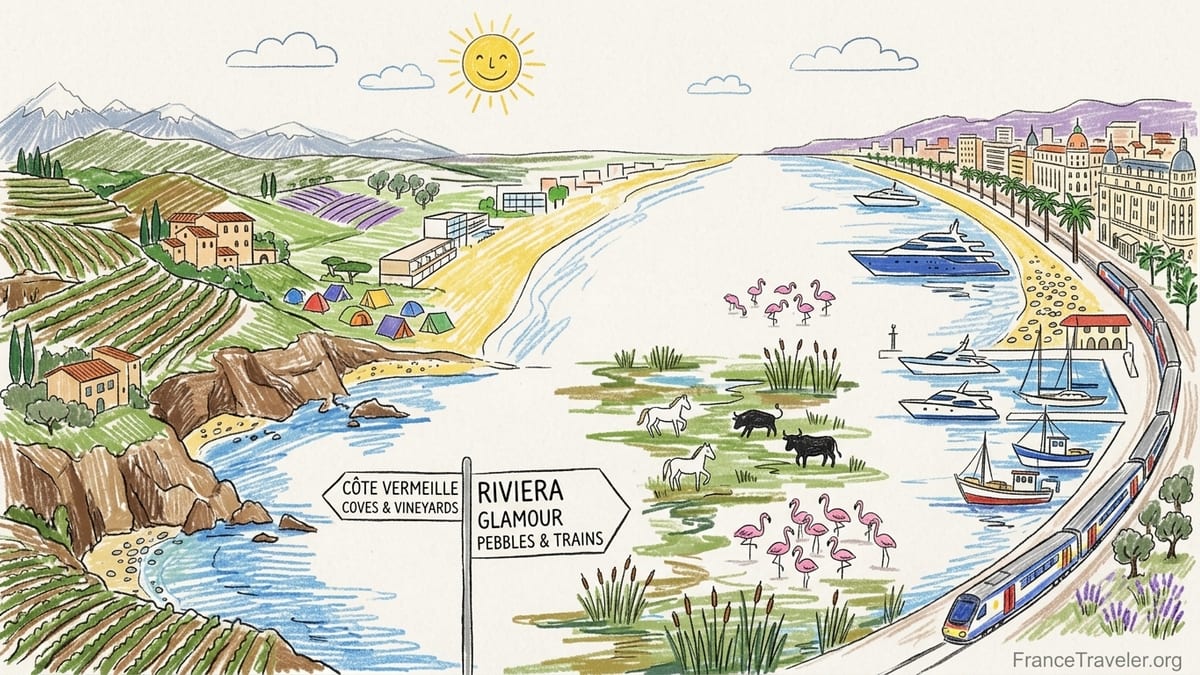
How the French Mediterranean Changes From West to East
Between the Spanish border and Menton on the Italian frontier, mainland France’s Mediterranean shoreline is just a few hundred miles long, yet it contains some of Europe’s most varied coastal scenery. In the far southwest, the Côte Vermeille feels almost secretive, with small pebble coves surrounded by terraced vineyards. Move east into Occitanie and the coast straightens into long, flat Languedoc beaches backed by lagoons and modern resorts. Beyond the Rhône delta, the Camargue spreads into a patchwork of wetlands, rice fields and salt pans before the coast hardens into limestone cliffs and calanques around Marseille and Cassis. Farther east again, beyond Toulon and the Var, the shore tightens and becomes more urbanized, culminating in the dense chain of Riviera resorts between Saint-Raphaël, Cannes, Nice and Menton.
For travelers, that variety translates into very different experiences within a short travel radius. In one week with a rental car you might snorkel in a marine reserve near Cerbère, cycle past flamingos in the Camargue, hike rocky coastal paths near Cassis and end your trip people-watching on Nice’s Promenade des Anglais. Even without a car, the combination of regional trains and local buses makes it realistic to cover two or three contrasting sections on one itinerary, such as combining broad family beaches in Languedoc with a couple of nights in either Marseille or Nice for culture and nightlife.
Prices and crowds also shift as you go. Campsites near Languedoc towns such as Le Grau-du-Roi or Argelès-sur-Mer often advertise simple pitches from around what might be the equivalent of a modest dinner out per night in high summer, while sea-view hotel rooms in Cannes or Saint-Tropez during late July and August can cost many times that. That disparity means first-time visitors do well to think in terms of zones rather than a single coast, matching budget and expectations to each region’s character.
Côte Vermeille & Roussillon: Coves, Vineyards and Spanish Flair
The Côte Vermeille is the first stretch you encounter if you cross in from Spain near Portbou. Official tourism information describes it running roughly 30 kilometers from Cerbère on the border to the Racou beach at Argelès-sur-Mer, with Collioure, Port-Vendres and Banyuls-sur-Mer strung between sea and the last foothills of the Pyrenees. Here the mountains plunge into the Mediterranean, creating a craggy coastline of headlands, stone terraces and pebbly inlets rather than big sandy bays. Collioure, long beloved of painters, mixes a small harbor, a waterfront royal castle and lanes filled with Catalan restaurants and anchovy shops, while Cerbère at the border has a more offbeat feel, with its 1930s modernist Belvédère du Rayon Vert building and easy access to marine nature reserves for snorkeling or diving.
The Roussillon section around Argelès-sur-Mer transitions from rocky coves to wider beaches. It is one of southern Europe’s classic camping belts, with a dense cluster of large holiday parks and family-focused campsites that cater to road trippers driving down from northern France, Germany or the Benelux countries. In high summer it is common to see campers cook outside their tents or mobile homes, then walk to evening funfairs and casual beach bars. First-timers who want a gentle introduction to the French Med with a dose of Spanish-Catalan culture often base in Collioure or Argelès: from there you can day-trip to the vineyards above Banyuls-sur-Mer, hike coastal footpaths between villages, or take regional trains north to Perpignan and west to the foothills of the Pyrenees.
Travel logistics here lean toward a mix of train and car. The railway line between Perpignan and Cerbère hugs the coast, stopping at places like Collioure and Banyuls-sur-Mer, so you can arrive entirely by rail from major hubs such as Barcelona, Toulouse or Paris with a change inland. Once on the ground, though, many of the best viewpoints and trailheads sit above town, so renting a small car for a couple of days, or using local buses and taxis, makes it easier to reach hillside vineyards or remote coves. Hikers will find marked coastal paths linking Argelès, Collioure and Cerbère, with sections that can be done as half-day walks using train or bus to return.
Languedoc Beach Belt: Wide Sands, Lagoons and Big Holiday Parks
East of Argelès-sur-Mer, the coast flattens and the landscape opens. From roughly the Racou beach through resorts like Canet-en-Roussillon, Leucate, Narbonne-Plage, Valras-Plage, Cap d’Agde and on to La Grande-Motte and the Espiguette beach near Le Grau-du-Roi, the Languedoc shoreline is famous for its long sandy beaches. Regional tourism boards highlight this area as the Mediterranean of Occitanie, where you can walk for hundreds of meters from towel to water in some places and still be on clean fine sand backed by dune systems or low-rise resort blocks. This is where you find some of France’s biggest campsites, many with pools, waterslides and family entertainment that turn the beach into one part of a broader vacation complex.
For first-time visitors, the style here can feel more relaxed and budget-friendly than the Riviera, especially outside August. Simple hotel rooms or apartment rentals a few streets back from the beach in towns like Valras-Plage or Palavas-les-Flots can be relatively affordable in June or September compared with central Nice or Cannes at the same time. Food leans toward seafood and casual dining, from mussel-and-fry platters in no-frills beach shacks to oysters from nearby Étang de Thau eaten at simple outdoor tables. Families in particular appreciate that many beaches shelve gently, making paddling and beginner swimming less intimidating than on steeper pebble shores farther east.
Getting around is easiest with a car, because many resorts sit on sandbars between sea and lagoons, separated from the main rail line that runs inland through cities like Narbonne, Béziers and Montpellier. A common pattern for road-trippers is to base for three or four nights at a campsite or holiday park, using it as a hub for both beach days and short drives to historic inland towns such as Narbonne or Pézenas, then continue east toward the Camargue or Provence. Public transport does exist in the form of regional buses linking coastal resorts to the main train stations, but schedules can be sparse outside school holidays, so planning ahead matters if you are traveling without a car.
Camargue: Wild Wetlands Between Sea and Rhône
At around Le Grau-du-Roi and Aigues-Mortes the shoreline begins to feel wilder and more elemental. You are entering the Camargue, the Rhône delta region where the river splits before meeting the sea. Official park material describes a mosaic of beaches, reedbeds, rice fields, salt pans and ponds, home to distinctive white horses, black bulls and large flocks of flamingos that feed in the shallow lagoons. Towns such as Aigues-Mortes, a fortified medieval city a short drive inland, and Les Saintes-Maries-de-la-Mer closer to the sea serve as bases for exploring the area’s dykes, canals and nature reserves.
Travel here is less about traditional beach resort life and more about nature and rural culture. You might spend a morning walking along the embankments of a lagoon watching birds, then ride in a simple open-sided trailer on a local ranch to see semi-wild horses or bulls, and finish the day with a plate of Camargue rice and grilled fish in a small-town restaurant. The longest beaches, including those stretching west from Les Saintes-Maries-de-la-Mer or near Port-Saint-Louis-du-Rhône, can feel almost empty outside peak weekends because they are accessed by long, sometimes unpaved roads rather than dense blocks of hotels.
A car is practical in the Camargue, because distances across the delta are surprisingly large and public transport infrequent. Many visitors rent bicycles from shops in Aigues-Mortes or Les Saintes-Maries-de-la-Mer for half-day rides along canal paths and quiet roads; rental prices are often comparable to what you would pay for a simple restaurant meal for one person. Camping is popular, with several sites near Les Saintes-Maries-de-la-Mer that attract nature lovers and birdwatchers as much as sunbathers. This is also a good region for travelers who enjoy photography and quieter evenings, as nightlife is limited and the dominant sounds after dark are often frogs and birds rather than beach bars.
Marseille & the Calanques: City Energy and Limestone Fjords
Continuing east, the coast passes through more built-up sections around Montpellier and Sète before, after the Rhône, turning toward Provence and Marseille. France’s second-largest city sits roughly in the middle of the Mediterranean mainland coast and acts as a major transport hub, with high-speed trains, ferries and flights linking it to the rest of Europe and North Africa. For first-time visitors, basing in Marseille for a few days offers a blend of urban energy, multicultural food, historic neighborhoods such as Le Panier and access to some of the most dramatic coastal scenery in the country only a short ride away.
That scenery is concentrated in Calanques National Park between Marseille, Cassis and La Ciotat. Here, the coastline is incised by narrow limestone inlets with steep, pale cliffs dropping into deep turquoise water. Official park information notes that some of the calanques closest to Marseille can be reached by public transport plus hiking, while from Cassis you can walk to Port-Miou in around half an hour from the town center. In high season, boat tours from Marseille’s Old Port or Cassis’s harbor cruise past calanques such as Sugiton or En-Vau, allowing less-mobile visitors to see the cliffs and hidden coves without committing to long, hot hikes over rocky ground.
Planning is essential because the park restricts access on certain summer days due to fire risk and erosion, and some trails involve steep, loose sections that feel more like mountaineering than a casual seaside stroll. Proper footwear, enough water and checking the day’s restrictions before setting out make a big difference. Many first-timers choose to combine one day of calanque hiking or boating with time exploring Marseille’s city beaches at the Prado or the slightly more sheltered coves near Les Goudes, then move on to quieter bases such as Cassis or La Ciotat for a few days of village-scale life.
Var & Hyères: Islands, Pine Forests and Quieter Coves
East of Marseille the coastline softens again around Toulon and into the Var. Between here and around Saint-Raphaël you find a mix of pine-backed coves, small ports and low-key resorts that feel significantly less dense than the Riviera proper. The Hyères area stands out for its offshore islands: Porquerolles, Port-Cros and Île du Levant form an archipelago reachable by short ferry rides from the Giens Peninsula near Hyères. Porquerolles in particular is popular in summer, with day-trippers renting bicycles near the village quay and pedaling to beaches such as Notre-Dame, where fine sand and clear water are backed by pines instead of buildings.
On the mainland, beaches around Le Lavandou, Cavalaire-sur-Mer and the bays west of Saint-Tropez offer a more relaxed version of Riviera life. There are still marinas, beach clubs and summer crowds, but the overall scale is smaller, and you can find stretches of sand backed by campsites or forest rather than promenades and high-rise apartments. For campers and road-trippers, this is a transition zone between the big holiday parks of Languedoc and the tightly packed coastal strip of the Alpes-Maritimes farther east. Reserving well ahead is advisable for July and August, when French vacationers fill both campsites and mid-range accommodation.
Travel logistics involve a mix of coastal roads and the main rail line that runs slightly inland. Regional trains stop at larger towns such as Toulon, Hyères and Les Arcs, but many of the smaller beaches require a bus connection or car. Sailing and boating are particularly appealing here, both because of the islands and the relatively indented coastline. Marinas in places like Hyères and Bormes-les-Mimosas host fleets of charter yachts and smaller rental boats; prices vary widely, but simple self-drive boats for a few hours on the water often cost less than guided sailing trips and can be an accessible way for small groups to explore shallow bays and swim far from the busiest beaches.
The French Riviera: Glamour, Trains and Pebble Beaches
The stretch most visitors picture when they hear “French Riviera” runs from roughly Saint-Raphaël through Cannes, Antibes, Nice, Monaco and on to Menton at the Italian border. Unlike the looser pattern of resorts in Languedoc, here the towns sit almost continuously along the shore, with the sea on one side and hills close behind. A long-standing coastal railway line, now served by regional TER and ZOU services, ties them together with frequent trains. Regional transport information notes that between Cannes and Menton trains can run as often as every 15 minutes at busy times, effectively making the line a coastal metro for day-trippers and commuters.
Geographically, the beaches are often narrower and many, especially around Nice and parts of Monaco, are made up of pebbles rather than fine sand. That does not deter swimmers, but it changes the feel underfoot and makes renting a lounger at a beach club more tempting for some visitors. In and around Antibes, Juan-les-Pins and parts of Cannes you find more pockets of sand, though even there beaches can be tightly managed with alternating public areas and private concessions. Inland from the coast, hill villages such as Èze or Saint-Paul-de-Vence add another layer of appeal for first-timers, who often combine one or two beach days with a trip up to cobbled lanes and panoramic viewpoints by bus.
For many travelers, especially those visiting without a car, the Riviera is the easiest section of the French Med to explore. You can base yourself in a single town such as Nice, Cannes or Menton and use the train to hop to different destinations each day, from museum visits in Antibes to half-day walks around headlands like Cap-Ferrat or Cap d’Ail. Timetables and fares are designed to accommodate commuters as well as tourists, so one-way tickets along short segments can be relatively inexpensive compared to long-distance high-speed services. Because accommodation prices rise sharply in midsummer and during major events such as the Cannes Film Festival or Monaco Grand Prix, first-time visitors often aim for late May, June, September or early October to balance good weather with more moderate costs and slightly thinner crowds.
Travel Styles: Road Trips, Rail Hopping, Beaches, Camping, Sailing and Hiking
How you travel the French Mediterranean matters almost as much as where you go. One classic approach for first-timers is the road trip: renting a small car in cities like Barcelona, Toulouse, Montpellier or Marseille and following the coast in stages of one to three hours of driving per day. This gives maximum flexibility to combine remote coves on the Côte Vermeille, large Languedoc beaches, Camargue backroads and inland hill towns with brief dips into denser areas like Marseille or Nice. Fuel, tolls and parking costs can add up, especially around big cities and Riviera resorts, so many travelers choose a hybrid strategy, using the car for less-served stretches between the Spanish border and Toulon, then dropping it before continuing by train.
Rail-hopping is the other main style, particularly attractive for those focusing on Provence and the Riviera. High-speed TGV and Intercités trains connect Paris and Lyon with Montpellier, Nîmes, Marseille and Nice, while regional lines link smaller towns along the shore. A first-time visitor might, for example, take a morning TGV from Paris to Montpellier, spend a few days on nearby beaches by bus or taxi, then continue by train to Marseille for an urban and calanques segment, and finally on to Nice or Menton for a Riviera finale. With luggage, choosing bases near main stations, such as neighborhoods around Nice-Ville or Cannes-Voyageurs, keeps transfers simple and allows for day trips without long walks at each end.
Beach-focused trips can fit into either framework. Families often favor Languedoc or the Roussillon campsites, where you can park directly beside your pitch or rental mobile home and walk or cycle to wide sandy beaches. Many of these sites include pools, kids’ clubs and basic supermarkets, making it feasible to spend most of the week without driving at all. On the Riviera, by contrast, beach days are more likely to involve a short train hop and a decision between staking out a patch of public beach with a towel or paying for a lounger at a beach club for comfort and services. In both cases, checking local rules about lifeguard coverage and flag systems for swimming safety is worth the effort, as conditions can change with wind and swell.
Camping, sailing and hiking layer different textures onto the same coastline. Tent and campervan travelers gravitate to the big belts of campsites around Argelès-sur-Mer, Cap d’Agde, Le Grau-du-Roi, the Camargue edge and parts of the Var, where simple unpowered pitches are still a mainstay alongside more upmarket rentals. Sailors and boating enthusiasts focus on marinas at ports like Port-Vendres, Sète, Marseille, Cassis, Hyères, Saint-Tropez and Antibes, chartering yachts or renting small motorboats for coastal exploration. Hikers find variety in short cliff-top paths on the Côte Vermeille, long-distance routes such as the coastal sections of the GR trails near Narbonne and the calanques, and half-day loops on the Riviera’s caps that start and end at train-accessible towns. For a first visit, picking one or two of these styles rather than trying to do everything in a single trip usually leads to a more relaxed and memorable experience.
Choosing Your Region for a First Visit
With so many distinct sections, the main challenge for first-timers is deciding where to focus. If your vision of a Mediterranean holiday centers on wide sandy beaches, casual camping and family-friendly facilities, the Languedoc belt and Roussillon around Argelès-sur-Mer, Canet-en-Roussillon and Cap d’Agde will likely suit you better than the pebble strands of Nice or the coves of the calanques. Couples seeking a mix of culture, food and dramatic scenery might prioritize a Marseille and Cassis combination, with day trips into the calanques and an excursion inland to Aix-en-Provence. Nature lovers and birdwatchers should consider anchoring a few days in the Camargue, perhaps paired with time in Nîmes or Arles for Roman heritage.
Travelers curious about the Riviera’s famous names are often surprised by how close together its towns sit and how different they feel. Cannes, with its luxury shopping streets and festival palace; Antibes, with a more lived-in old town and nearby sandy beaches; Nice, with its long promenade, museums and big-city energy; Monaco, with its steep streets and dense skyline; and Menton, with its pastel facades and gardens near the Italian border, all sit on the same train line and can be visited as day trips from a single base. If you intend to rely on public transport and want maximum choice of dining and nightlife, Nice or Cannes make strong bases; if you prefer a quieter atmosphere with good train connections, Menton or Antibes often work well.
Season will shape your experience wherever you go. July and August bring the warmest sea temperatures but also the heaviest crowds, highest accommodation prices and busiest roads, especially around the Riviera and major Languedoc resorts. Late May, June, September and early October can be more comfortable for first-timers, with pleasant swimming, more availability and easier restaurant reservations. Winter remains relatively mild, particularly on the Riviera, but many beach services, boat tours and seaside campsites operate on a seasonal basis, so checking opening dates before planning an off-season trip is essential.
FAQ
Q1. How many days do I need for a first trip along the French Mediterranean coast?
For a first visit focused on one or two regions, about 5 to 7 days is workable. To combine three or more distinct areas, such as Languedoc, Marseille and the Riviera, 10 to 14 days allows a more relaxed pace.
Q2. Is it better to rent a car or rely on trains and buses?
For Languedoc beaches, the Camargue and some Var coves, a car provides much more flexibility. On the Riviera and between major cities like Montpellier, Marseille and Nice, trains and local buses are frequent and practical, so many visitors combine both approaches.
Q3. Are the beaches sandy or pebbly along the French Mediterranean?
Most Languedoc and Roussillon beaches are long stretches of fine sand, while many Riviera beaches, particularly around Nice and Monaco, are pebbly. The Var and Hyères coast offers a mix of sandy coves and shingle, and the calanques near Marseille are mostly small pebble or rock inlets.
Q4. When is the best time to visit for swimming and fewer crowds?
Late June and September often balance warm sea temperatures with fewer crowds than July and August. May and early October can be pleasant for hiking and city visits, though water may feel cooler for long swims.
Q5. Can I visit the Calanques National Park without a car?
Yes, but it requires planning. You can reach trailheads near Marseille and Cassis by bus or on foot, and boat trips depart from both cities. Always check the day’s access restrictions and weather, especially in summer when fire risk can close some paths.
Q6. Is the French Riviera very expensive compared with other sections?
Accommodation and dining on the Riviera, especially in Cannes, Saint-Tropez and Monaco, tend to cost more than in many Languedoc or Roussillon resorts. However, regional trains, public beaches and casual eateries mean you can still visit on a moderate budget if you choose simpler lodging and avoid peak events.
Q7. Are there good options for camping along the coast?
Yes. Large, well-equipped campsites are common around Argelès-sur-Mer, Cap d’Agde, Le Grau-du-Roi, the edges of the Camargue and parts of the Var. Smaller sites also exist near some Riviera towns, though demand is high in summer and reservations are important.
Q8. How safe is swimming, and are lifeguards present?
Many busy beaches have lifeguard stations in high season and use flag systems to indicate conditions, but smaller coves and some wild stretches may not. Always observe local warnings, watch for currents near river mouths and avoid cliff jumping in the calanques or rocky areas.
Q9. Can I combine French Mediterranean beaches with inland sightseeing?
Yes, easily. From coastal bases you can visit inland highlights such as Carcassonne and Pézenas from Languedoc, Arles and Nîmes from the Camargue area, Aix-en-Provence from Marseille, or hill villages like Saint-Paul-de-Vence from the Riviera using trains, buses or a rental car.
Q10. Do I need to speak French to travel along the coast?
Basic French is helpful, especially in smaller towns and campsites, but staff in many hotels, restaurants and tourist offices along the coast speak some English. Learning simple phrases and carrying key details such as your accommodation address written down makes everyday interactions smoother.