


The French Mediterranean is often reduced to clichés of superyachts in Saint-Tropez or Cannes, yet the reality for most charter sailors is much broader. From the tramontane-swept harbors of Languedoc to the calanques of Marseille and the islands off Hyères, this is a coast you can approach as a practical, coast-wide sailing playground rather than a narrow luxury niche. With modern charter fleets now spread from Canet and Leucate to Antibes, it has never been easier to design a one or two-week itinerary that fits your budget, skills and appetite for adventure.
Understanding the French Mediterranean Sailing Zones
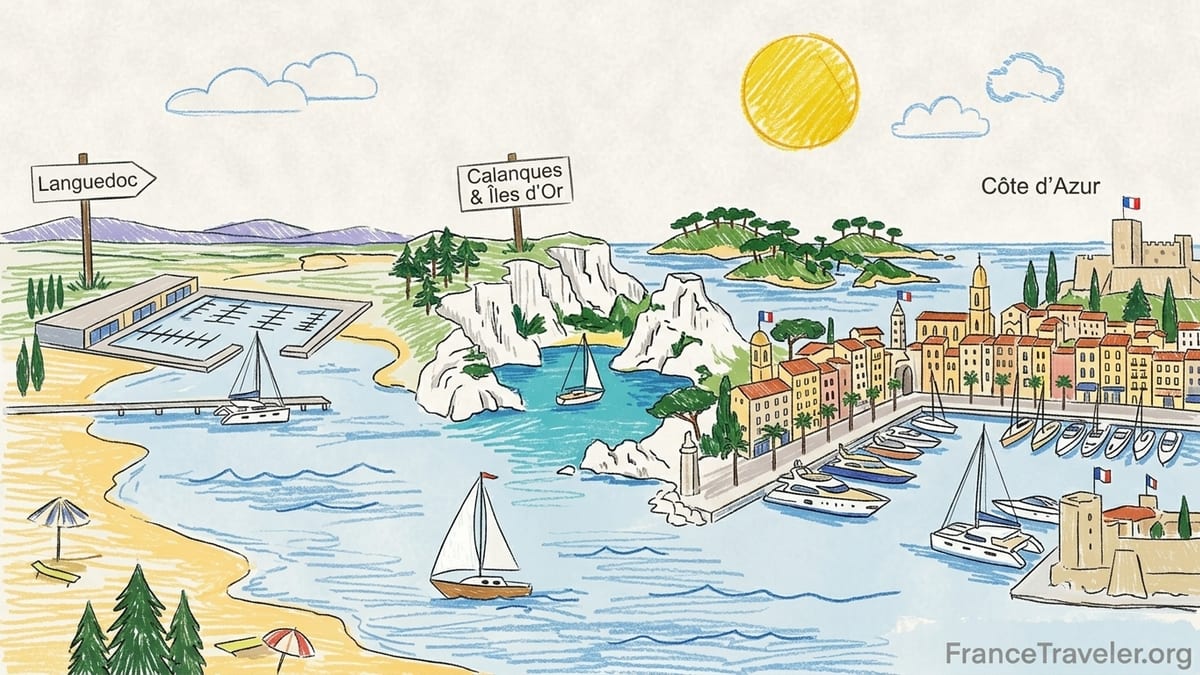
For charter planning it helps to think of the French Mediterranean in three distinct sailing zones. To the west, the Languedoc coast around Canet, Leucate and La Grande-Motte offers long sandy beaches, big skies and straightforward pilotage. It feels more like an ocean shoreline, exposed to the tramontane and mistral, with larger marinas purpose-built for charter fleets and easy access from airports such as Montpellier and Perpignan. This is often where value-focused bareboat charters start, particularly for families who prefer wide, forgiving approaches over tight Riviera harbors.
In the middle, around Marseille, Toulon and Hyères, the coast becomes dramatically more varied. The limestone cliffs and fjord-like inlets of the Calanques National Park sit just south of Marseille, while the Îles d’Or off Hyères, including Porquerolles and Port-Cros, create one of the Mediterranean’s most attractive island cruising grounds within a day’s sail of several charter bases. This area balances accessible marina infrastructure with wild anchorages, making it a strong choice for mixed-experience crews and those wanting both nature and historic port towns in a single week.
Further east, from Saint-Raphaël through Cannes and Antibes to Nice and Monaco, you reach the classic Côte d’Azur. Here the charter experience is shaped as much by shore life as sailing: waterfront promenades, art museums, high-end restaurants and dense marina networks. Marina fees are typically the highest on this stretch, especially in peak summer, but there are still ways to control costs by mixing city nights with anchorages off the Lérins Islands near Cannes or quiet coves around Cap d’Antibes. This is the zone to choose if evening atmosphere and people-watching matter as much as daytime passages.
Across all three zones, the modern charter market has filled in the gaps. Large brands and local operators base fleets in La Grande-Motte, Marseille’s Vieux Port, Port Pin-Rolland at Saint-Mandrier, Hyères, Saint-Raphaël, Cannes and Antibes, so you can now treat the entire shore as a connected charter region rather than isolated pockets. That coast-wide inventory opens up one-way itineraries, varied loop routes and a wide price spectrum for the same general coastline.
Charter Bases: From Canet and La Grande-Motte to Antibes
The western end of the French Mediterranean charter scene is built around the large marinas of Languedoc. At Canet-en-Roussillon and Port Leucate you will find mid-size fleets of monohulls and catamarans aimed at sailors who want to combine coastal hops with day trips inland to Perpignan or the Corbières wine region. These bases are practical rather than glamorous, with functional marina villages, marine supply stores and large supermarket complexes a short walk away, which makes turnarounds and provisioning straightforward.
La Grande-Motte, a purpose-built resort marina east of Montpellier, is now one of the most active charter hubs on this coast. The port authority publishes detailed 2026 tariffs, and visiting 40-foot monohulls can expect to pay in the region of a few dozen to around a hundred euros per night outside peak July and August, with multihulls charged more. Catamarans fall into specific tariff categories and often need to confirm berthing fees directly with the marina office. For charterers, this translates into a relatively predictable cost structure and easy access to the Etang de Thau, Sète and the Canal du Rhône à Sète for those wanting a taste of both sea and inland waterways.
Moving east, Marseille has evolved from a working port into a genuine charter gateway. Several operators now base fleets in or near the Vieux Port and in nearby marinas, using Marseille Provence Airport as the main entry point. From here, crews can reach the Calanques in a few hours’ sail, anchoring in turquoise inlets backed by white limestone cliffs, then continue towards Cassis or La Ciotat. Further around the bay, Port Pin-Rolland at Saint-Mandrier and the military and commercial harbor of Toulon form another cluster, with charter companies marketing these bases as ideal stepping stones to the Îles d’Hyères and the Var coast.
Hyères itself has become a key node for yacht charters. Recent overviews of the port area note multiple active charter bases spread between Port Saint-Pierre, La Capte and nearby facilities, underlining how the city serves as the natural jumping-off point for Porquerolles and Port-Cros. East again, Saint-Raphaël, Cannes and Antibes host dense concentrations of charter operators, from large international brands at Port Vauban in Antibes to boutique fleets in Cannes’ Old Port. These Riviera bases cater to crews who may spend more time at the dock, using the yacht as a waterfront apartment while exploring cities, than at anchor in remote bays.
Bareboat vs Skippered, Monohull vs Catamaran
Most French Mediterranean charter companies on this coast offer both bareboat and skippered options. A bareboat charter means you are responsible for navigation, maneuvering and safety on board, and the company will ask for proof of competence, such as an International Certificate of Competence or an equivalent national licence, plus a detailed sailing resume. Some French-based operators also accept extensive logged experience without a formal sail-specific licence, particularly where sail is the main form of propulsion, but this is always subject to the insurer’s policies and should not be assumed. A realistic example would be a 40-foot bareboat monohull from Hyères in June for seven days, priced in the low to mid four figures in euros before extras such as cleaning and fuel.
Skippered charters layer a professional skipper onto the same hulls, and on the Riviera often extend into fully crewed experiences. You still charter the entire boat for your group, but you do not need to drive it. On a 42-foot catamaran out of Cannes in August, adding a skipper will typically add several hundred to around a thousand euros per week plus gratuity, while a hostess or cook is extra again. The upside is stress-free docking in tight marinas like Cassis or Villefranche-sur-Mer and local knowledge about when to avoid crowded anchorages such as Porquerolles’ Plage d’Argent on a weekend.
Choosing between a monohull sailing yacht and a catamaran depends on your itinerary and crew. Monohulls around 38 to 45 feet remain the budget-conscious choice in La Grande-Motte, Marseille and Hyères, offering better upwind performance in strong mistral or tramontane conditions and smaller marina fees thanks to their narrower beam. In practice, a 40-foot monohull might pay a fraction of what a 40-foot-wide catamaran pays in the same harbor, because multihulls occupy more dock space and sometimes fall into separate tariff categories.
Catamarans dominate many of the fleets in Hyères, Saint-Raphaël, Cannes and Antibes, where much of the sailing is along the coast or between islands with plenty of space to anchor. They offer huge cockpit and saloon spaces, shallow draft for getting close to beaches like Pampelonne or the Lérins, and stable platforms for families. However, nightly berthing can rise into the low hundreds of euros in peak season on the Riviera, and some marinas have limited multihull berths, so charter companies may encourage mixed itineraries that alternate between marinas and anchorages to keep overall costs reasonable.
Qualifications, Weather and Winds
France itself does not require a licence for sailing yachts where the primary means of propulsion is the sail, but a licence is mandatory for operating larger engines. In practice, charter companies along the French Mediterranean align with broader European norms and typically request an International Certificate of Competence or an equivalent national certificate for bareboat charters, especially if the vessel has a powerful auxiliary engine or if you plan to use VHF radio. For skippers from outside Europe, many firms accept qualifications from recognized training bodies, combined with a clear sailing CV showing experience in similar conditions and boat sizes.
The western Languedoc coast is strongly influenced by the tramontane, a dry, often fierce northwesterly that can blow hard over several days. Around Canet, Leucate and La Grande-Motte, it can bring steep short seas and rapid drops in temperature even in shoulder seasons, which is why local charter briefings emphasize reliable forecasts and conservative passage planning. Summer sea breezes often moderate conditions in the afternoons, but crews should be ready to reef early on exposed legs such as the run from La Grande-Motte to Sète or Gruissan.
From Marseille to Hyères, the mistral is the dominant wind. It also blows from the northwest, funneled down the Rhône valley, and can reach strong force with clear skies and sharp visibility. When the mistral is in, the Calanques can be gusty with local acceleration, while the Rade de Toulon and the bay of Hyères provide more shelter. Charter operators here design their suggested itineraries to work with these winds: for example, a one-week loop from Marseille might head downwind to the Îles du Frioul and Cassis early in the week, then return under more manageable conditions as the system eases.
On the Riviera, typical summer patterns are gentler, with morning calms and afternoon sea breezes from the southeast or south. Severe mistral effects are less direct, though swells can still wrap around capes such as Cap Camarat and Cap d’Antibes. Thunderstorms are more common in late August and September, particularly inland over the Alps and Esterel, sometimes pushing squally conditions onto the coast. Across all three zones, charterers should expect marinas to ask for arrival times and may charge extra for late-night entries, so planning passages around both weather windows and port office hours is part of the practical rhythm of sailing this coast.
Marina Fees, Seasonal Pricing and Realistic Budgets
Marina fees are one of the biggest variables in a French Mediterranean charter budget, and they vary clearly between Languedoc, the Var and the Riviera. On the western coast, ports such as Canet, Leucate and La Grande-Motte publish detailed seasonal rates for visiting yachts. A 12-meter monohull might expect to pay a modest nightly fee outside July and August, rising to more substantial but still manageable amounts in high season. Multihulls are systematically more expensive, sometimes needing individual quotes from harbor offices, which can surprise first-time catamaran charterers transitioning from monohulls.
Around Marseille, Toulon and Hyères, marina costs climb but remain below Riviera peaks. Charter companies sometimes negotiate packages that include the last night’s berthing in their home marina, particularly in bases like Port Pin-Rolland, effectively giving you a free final berth from Friday evening to Saturday morning on a week-long charter. In places like Hyères and Toulon, competition between marinas and the presence of working fishing fleets keeps tariffs more diverse, and many charter itineraries here rely heavily on anchorages off Porquerolles, Port-Cros or the sheltered bays of the Var to contain costs.
On the Côte d’Azur, especially in harbors renamed in yachting brochures such as Antibes, Cannes and Saint-Raphaël, fees for a visiting 40-foot yacht can run from the high double digits to several hundred euros per night in peak season, depending on exact dates and availability. Long-standing accounts from local sailors and brokers confirm that some of the highest nightly berthing costs in the Mediterranean are found here, particularly in August and during major events such as the Cannes Film Festival or Monaco Grand Prix. For many charter parties, the practical solution is to plan one or two nights in prestige marinas such as Antibes’ Port Vauban, then spend more nights at anchor off the Lérins Islands or in less glamorous but cheaper harbors such as Fréjus or Théoule-sur-Mer.
When building a budget, it is wise to separate the base charter fee from operating costs. A typical one-week bareboat charter of a 40-foot monohull from Hyères or Marseille in June might run from the low to mid four figures in euros before extras; add marina fees, fuel, end-cleaning and optional items such as outboard engines, linens or paddleboards, and many crews see total trip costs climb by 20 to 40 percent above the base rate. On the Riviera, where marina nights are dearer and dining ashore is pricier, it is reasonable to assume a higher daily spend, while Languedoc and the Var coast allow more modest on-the-ground costs with plenty of access to normal supermarkets and casual seaside restaurants.
Itinerary Planning: Languedoc vs Calanques & Var vs Riviera
A Languedoc-based itinerary, for example a one-week charter from La Grande-Motte, is typically about covering gentle distances between large, well-equipped ports. Crews might sail east to Palavas-les-Flots, then on to Sète, with optional detours into the Etang de Thau for oyster tasting in towns like Bouzigues, or west towards Cap d’Agde and Gruissan. Anchorages exist but are fewer than further east, so nights are often spent in marinas, trading off modest harbor fees against easy shore facilities and simple harbor approaches that are forgiving in changeable tramontane conditions.
From Marseille or Toulon, itineraries become more three-dimensional. A seven-day loop might begin in Marseille’s Vieux Port, hop to the Îles du Frioul, then slip down the Calanques to Cassis, La Ciotat and Bandol. From there, crews can aim for Porquerolles, anchoring in bays such as Notre-Dame or Plage d’Argent when permitted, and then return via Hyères or Toulon. With island-hopping built in, days are shorter but more intense, involving multiple sail changes and close-quarters pilotage along cliff edges and reef-studded approaches, so this region suits those confident with charts and pilot books.
A Hyères-based cruise narrows the focus further on the Îles d’Or. In a week, it is realistic to circle Porquerolles, Port-Cros and perhaps the Île du Levant, mixing national park moorings with occasional marina nights in Hyères or Cavalaire-sur-Mer. Recent conservation efforts on Porquerolles include reorganizing mooring fields and adding hundreds of environmentally sensitive mooring buoys to protect seagrass beds, which means increasingly structured anchoring rules. For charter crews, this translates into more predictable mooring options but also the need to book and plan carefully in peak summer, when day-trip ferries from Hyères fill beaches and bays by midday.
On the Riviera, a classic one-week itinerary from Antibes or Cannes might include the Lérins Islands, Saint-Raphaël, the red cliffs of the Esterel near Agay and Théoule-sur-Mer, and perhaps as far as Saint-Tropez or Port Grimaud. Distances between ports are short, and aside from specific capes, sailing conditions in summer tend to be gentle, which makes this one of the easiest regions for mixed-experience crews. The trade-off is crowding: berths in old-town marinas such as Cannes’ Vieux Port or Antibes’ inner basins are often reserved well in advance, and anchorages can feel busy by mid-afternoon, particularly in August.
Where Island Destinations like Porquerolles Fit In
Porquerolles sits at the center of many French Mediterranean charter plans because of its unique mix of accessible sailing, car-free village life and protected anchorages. At roughly five nautical miles from the Hyères peninsula, it is close enough that even day-charter motorboats can visit, yet large enough to support multiple overnight anchorages and a small working port. Charter guides routinely highlight its sandy beaches on the north shore, such as Notre-Dame, and more rugged, cliff-backed bays to the south, reachable after short hikes from the village.
For sailors, Porquerolles functions as a crossroads between zones. A charter starting in Marseille or Port Pin-Rolland might use the island as the easternmost or central pivot point of a week-long route, while crews departing Hyères can treat it as their backyard, visiting for a single night at anchor then continuing to Port-Cros. One practical example is a seven-night bareboat itinerary from Hyères: night one at anchor in Porquerolles’ Baie de l’Alycastre, night two in the small marina at Port-Cros, nights three and four along the Var coast in Cavalaire and Le Lavandou, night five back in Porquerolles, and final nights in Hyères’ Port Saint-Pierre to simplify checkout.
The island’s growing environmental protections are changing sailing habits. Local authorities and the Port-Cros National Park are progressively reshaping mooring zones and adding organized mooring fields to reduce anchor damage to seagrass. This means that anchoring opportunities may be more limited in the most sensitive bays, with visiting yachts instead directed to numbered mooring buoys or designated sandy patches. For charterers, the key is to integrate Porquerolles early in itinerary planning, checking with base staff on current rules, likely availability and any booking platforms for buoy reservations, rather than treating the island as an improvised stop.
Other islands are also noteworthy in a coast-wide perspective. The Île du Levant, with its more restricted military and naturist zones, tends to see fewer overnight charter boats, but its coastline forms part of longer passages between Hyères and the eastern Var. Off Cannes, the twin islands of Sainte-Marguerite and Saint-Honorat provide sheltered anchorages within sight of the Croisette, making them prime first-night stops out of Cannes or Antibes. While smaller and more urban in feel than the Îles d’Hyères, they showcase how, across this coast, island stops can be woven into even short-distance itineraries.
The Takeaway
Planning a sailing holiday along the French Mediterranean no longer means choosing between a handful of prestige Riviera marinas. The charter market has matured into a continuous coast of opportunities, from the wide harbors of Languedoc to the cliff-lined Calanques and the resort towns of the Côte d’Azur. Instead of asking whether to go to Saint-Tropez or Cannes, it is more useful to decide what balance you want between sheltered anchorages, dramatic landscapes, city nightlife and budget control, then select a base and boat that support that profile.
Western bases such as Canet, Leucate and La Grande-Motte reward crews who prioritize straightforward navigation, lower fees and big, open harbors. Marseille, Toulon and Hyères are ideal if your dream is to slide between cliffs in the Calanques and wake up at anchor off Porquerolles, while still having access to urban amenities and year-round transport links. Further east, Saint-Raphaël, Cannes and Antibes cater to those ready to pay higher marina prices in return for iconic waterfronts, dense restaurant scenes and easy hops to island anchorages.
Across the entire coast, fundamental charter choices remain the same: bareboat or skippered, monohull or catamaran, marina-intensive or anchorage-heavy. By understanding how winds like the tramontane and mistral shape local conditions, how marina tariffs differ between regions and seasons, and how island destinations such as Porquerolles function within practical itineraries, you can turn a generic “French Riviera” idea into a tailored, workable sailing plan. The coast’s growing, distributed charter inventory confirms that this is now a genuinely coast-wide, transactional destination for sailors rather than a narrow luxury enclave.
FAQ
Q1. Do I need a sailing licence to charter a yacht on the French Mediterranean?
In France, a licence is required to operate larger engines, but not strictly for sailing where the sail is the main propulsion. However, most charter companies on this coast expect an International Certificate of Competence or equivalent, plus a sailing resume, for bareboat charters. Skippered charters are available if you do not meet their requirements.
Q2. How do marina fees compare between Languedoc, Hyères and the Riviera?
On the Languedoc coast, marinas such as Canet, Leucate and La Grande-Motte are generally the most affordable, especially outside July and August. Around Marseille, Toulon and Hyères, prices rise but remain moderate, while on the Côte d’Azur, particularly in Cannes and Antibes during peak season, nightly fees for a 40-foot yacht can be among the highest in the Mediterranean.
Q3. Is a catamaran worth the extra cost compared with a monohull?
Catamarans offer more space, stability and shallow draft, which are ideal for family charters and anchoring near beaches around Porquerolles or the Lérins Islands. They usually cost more to charter and berth, so they make the most sense if comfort and living space matter more to your crew than minimizing marina and base charter costs.
Q4. What is the best base if I want to focus on Porquerolles and the Îles d’Hyères?
Hyères is the most convenient base for Porquerolles, with several charter operators operating from Port Saint-Pierre and nearby marinas. Toulon and Saint-Mandrier are close alternatives that still allow you to reach Porquerolles comfortably on a week-long itinerary while also including Var coast towns.
Q5. How different is sailing in Languedoc compared with the Riviera?
Languedoc sailing around Canet, Leucate and La Grande-Motte is characterized by long sandy coasts, larger marinas and exposure to stronger northerly winds like the tramontane. The Riviera offers shorter hops between dense harbors, gentler summer sea breezes, higher marina prices and more emphasis on shore-side attractions such as old towns and nightlife.
Q6. When is the best time of year to charter along this coast?
Late May, June and September are often ideal months, with warm sea temperatures, more manageable marina prices and fewer crowds than peak July and August. In high summer, you gain guaranteed warmth and frequent sea breezes but must plan and book berths and moorings earlier.
Q7. Can beginners safely charter in the French Mediterranean?
Newer sailors often start with a skippered charter, particularly in zones with complex traffic and tight harbors like Marseille or Cannes. Confident beginners with some formal training may find Languedoc or the Hyères area more forgiving than dense Riviera marinas, thanks to wider approaches and a mix of sheltered bays and large harbors.
Q8. How far can I realistically sail in one week?
On a typical week-long charter, most crews comfortably cover 120 to 200 nautical miles, depending on weather and how many nights they wish to spend in each port. That is enough for a loop from Marseille through the Calanques and Îles d’Hyères, or a Riviera itinerary between Saint-Raphaël and Villefranche-sur-Mer with island stops.
Q9. Are anchorages free, and how often can I avoid marinas?
Most anchorages along this coast are free, but national parks and protected areas may require mooring buoys or impose restrictions. Many itineraries alternate nights at anchor off islands such as Porquerolles or the Lérins with nights in marinas for water, fuel and shore power, which keeps overall costs in check.
Q10. What extra costs should I expect beyond the base charter price?
Beyond the base fee, expect to pay for end-cleaning, fuel, marina or mooring fees, optional services such as skippers or hostesses, and extras like linens, outboard engines or paddleboards. Food, drinks and onshore activities can add significantly, especially in high-priced Riviera towns, so it is wise to build a buffer into your budget.