


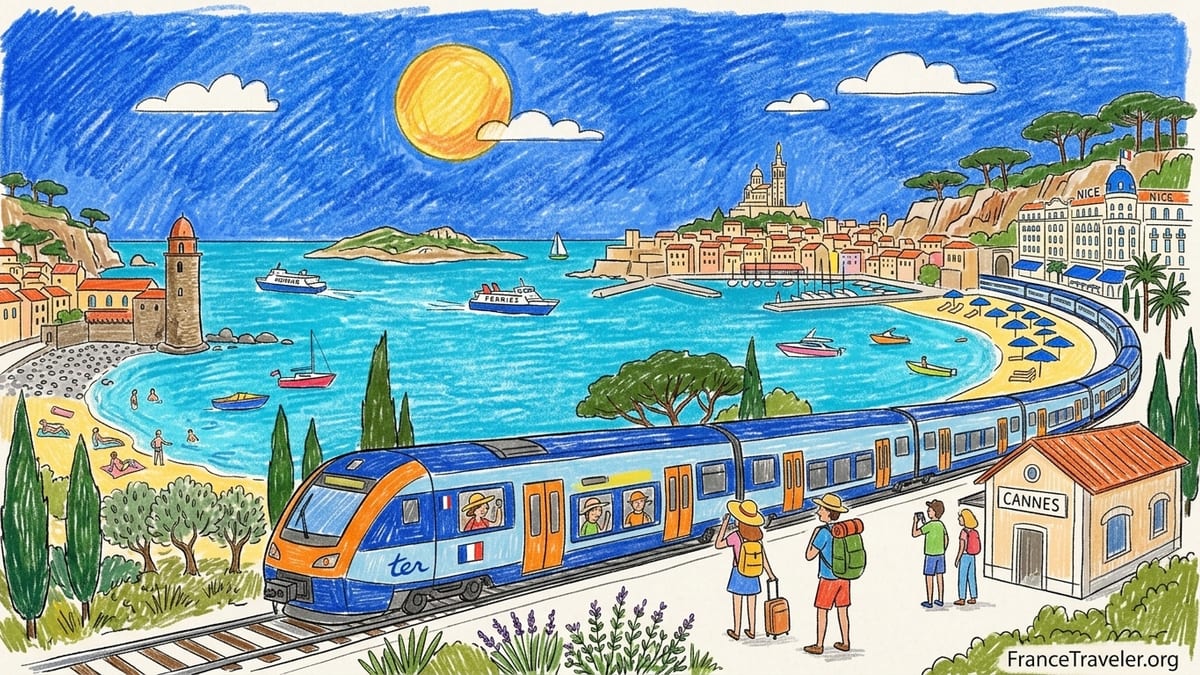
Travelling the French Mediterranean coast without a car is not only possible, it is one of the most rewarding ways to experience the region. A dense web of regional TER and Intercités trains links Collioure, Perpignan, Narbonne, Sète, Montpellier, Marseille, Toulon, Cannes, Antibes, Nice and Menton, while local buses and boats reach coves, islands and peninsulas the railway never touches. With a bit of planning, you can build realistic west, central and east coast itineraries that keep transfers manageable and journey times surprisingly short.
Understanding the Mediterranean Rail Corridor
The backbone of a car free trip along the French Mediterranean is the coastal railway that runs from the Spanish border near Cerbère and Collioure through Perpignan, Narbonne, Sète and Montpellier to Marseille, then continues east via Toulon, Saint Raphaël, Cannes, Antibes, Nice and Menton. This route is served primarily by TER regional trains and Intercités services such as the Bordeaux to Marseille daytime trains, which call at Narbonne, Béziers, Sète, Montpellier, Nîmes, Arles and Marseille. Trains are frequent on most sections, especially between Montpellier and Marseille and along the Riviera between Toulon and Menton.
For planning, it helps to remember that SNCF Connect currently shows typical daytime journeys of roughly four hours between Marseille and Collioure, with a connection at Narbonne or Perpignan, and around 2 hours 30 to 2 hours 40 between Marseille and Nice on the fastest TER or Intercités runs. These timings demonstrate that crossing large chunks of the coast in a single day is entirely practical. You might have breakfast near the Catalan-style harbor in Collioure and still reach Marseille in time for an evening stroll along the Vieux Port, or travel from Marseille to Nice in mid morning and be on the Promenade des Anglais by lunch.
On top of this main spine, several branches and secondary lines provide extra options. East of Nice, the same TER line continues to Menton and across the Italian border to Ventimiglia, opening up cross border day trips. From Marseille and Toulon, trains reach inland hubs like Les Arcs Draguignan, where buses fan out to coastal resorts that lack direct rail access. In the far west, local trains connect Perpignan with the smaller resort stations of Collioure, Port Vendres and Banyuls sur Mer.
Ticketing is straightforward. For most legs, especially between nearby cities such as Montpellier and Sète or Nice and Antibes, you can simply buy standard TER tickets on the day via SNCF Connect machines or ticket counters. On longer stretches like Bordeaux to Marseille or Paris to Montpellier, Intercités and high speed TGV services require advance-reservation tickets that are cheaper if booked weeks ahead. In peak July and August dates, booking seats in advance for key segments such as Marseille to Nice or Narbonne to Perpignan is strongly recommended.
Planning Realistic West, Central and East Coast Trips
Instead of trying to ride every kilometer of the coast in one go, it is more enjoyable to divide the Mediterranean into three broad zones and build focused itineraries: the western stretch around Collioure and the Occitan coast, the central arc around Marseille and the Provençal calanques, and the eastern Riviera from Cannes to Menton. This approach reduces backtracking and keeps daily journeys to two or three hours at most, leaving time for beaches and old towns.
A typical western itinerary might start in Barcelona or Toulouse, then use the cross-border rail link to reach Collioure via Cerbère and Portbou. After a couple of nights exploring Collioure’s pastel harbor and coastal paths, you could continue by TER to Perpignan, Narbonne and Sète. Each of these cities has a station close to the historic center, so it is feasible to spend two nights in Narbonne, take a day trip by train to Béziers, and then move on to stay in Sète with its canals, seafood restaurants and sandy beaches at Marseillan.
The central section works well as a Marseille based trip with side excursions. You might arrive in Marseille by Intercités from Bordeaux or by TGV from Paris, spend several days in the city itself, then add rail and bus day trips to Cassis, La Ciotat, Aix en Provence or Arles. Continuing east, a night or two in Toulon or nearby Sanary sur Mer breaks the journey before you ride on to the Riviera. Keeping this part of the itinerary to a rectangle such as Marseille, Cassis, Toulon and Hyères helps avoid overly long days on buses.
Finally, the eastern Riviera lends itself to a hub and spoke plan based in Nice, Antibes or Cannes. The TER line here runs every 30 to 60 minutes between Cannes and Menton, so you can base in Nice for five or six nights and rely on short train hops to visit Villefranche sur Mer, Beaulieu sur Mer, Monaco and Menton. For example, the ride from Nice to Antibes can be around 20 minutes by TER, while Nice to Menton often takes under 45 minutes. This density of service makes it easy to leave your suitcase in one hotel and travel light by daypack.
Western Coast by Train: Collioure, Perpignan, Narbonne and Sète
Collioure is one of the most atmospheric starting points for a car free Mediterranean holiday. The town’s small station sits on the main line between Perpignan and Cerbère, and TER trains typically take around 30 minutes from Perpignan. From the station, it is a short downhill walk to the waterfront, where a small pebble beach, pastel painted houses and the Château Royal cluster around a photogenic bay. This is a place where you can realistically arrive by train in the late afternoon and be swimming at sunset without ever needing a taxi.
From Collioure, the next logical jump is north to Perpignan and Narbonne. TER services usually run at least once an hour on this section, so you can time your departure to avoid rush hours and enjoy a relaxed mid morning train. In Perpignan, the station is close enough to walk into the center to see the Castillet and the riverside quarter. Continuing to Narbonne takes another 30 to 40 minutes. Narbonne’s station sits just across the canal from the old town, which makes it an easy overnight stop with minimal walking even if you are carrying luggage.
Farther north, Sète offers a distinctive canal city atmosphere and generous stretches of sand at the town beaches and the long strip toward Marseillan. Direct TER trains from Narbonne to Sète often take under one hour, and the station at Sète lies within walking distance of both the harborfront and several city beaches. This makes Sète an attractive base for travelers who want beach time and seafood but still need quick train access back to Montpellier or onward to Marseille and the Rhône valley.
Within this western section, nearly all of the major coastal stops are directly on the rail line. The exceptions are smaller pockets of coastline between Narbonne and Sète, such as Gruissan or the more remote parts of the Languedoc lagoons, which rely on regional buses. For example, from Narbonne, local buses reach Gruissan’s beaches and marina in roughly 20 to 30 minutes. In peak summer, these buses can be busy, so allowing some flexibility in your schedule is wise and checking the latest timetables on regional transport sites is essential.
Central Coast by Train: Montpellier, Marseille and the Calanques
The central Mediterranean coast around Montpellier and Marseille is where the railway pulls slightly back from the water yet still offers easy access to the sea. Montpellier’s Saint Roch station is a major hub, with frequent TER and Intercités services east to Nîmes and Marseille and west to Sète, Béziers and Narbonne. From Montpellier, you can be in Sète by train in well under 30 minutes or in Marseille in around 1 hour 45 minutes to 2 hours, depending on the stopping pattern. This makes Montpellier a viable base for travelers who want a lively university city with quick day trips in both directions.
Marseille Saint Charles sits at the heart of the central coast network. It is the main interchange between Intercités trains from Bordeaux and Toulouse, TGVs from Paris and Lyon, and TER services east to Toulon and Nice or west to Montpellier. From here, the journey to Collioure typically involves a TER or Intercités to Narbonne or Perpignan, then a connecting TER south along the coast. The roughly four hour duration highlights how realistic it is to move from the Catalan borderlands to Marseille’s large port within a half day.
Many of the most enticing stretches of central coastline are not right on the rail line but can still be reached by short bus hops. Cassis is the clearest example. The town has its own SNCF station on the Marseille to Toulon line, but the station lies inland on a hill. A local bus line usually connects the station with Cassis center, and the journey takes around 10 to 15 minutes. Once in Cassis, you can walk or take boats to access the Calanques National Park, with its steep limestone inlets and turquoise water, without needing a car at all.
Farther east, the islands of Porquerolles and Port Cros sit across a narrow strait from Hyères and the Giens peninsula. To reach them car free, you can take a train to Hyères or Toulon, then transfer to local buses that connect the rail stations with the harbors at Hyères or La Tour Fondue, where ferries run to the islands. For example, regional buses often link Hyères station with the Port Saint Pierre marina and with La Tour Fondue, which is the main departure point for Porquerolles. Ferries to the islands run more frequently in late spring and summer, when day trippers from Marseille and Toulon join overnight visitors for hiking and swimming.
Eastern Riviera by Train: Toulon, Cannes, Antibes, Nice and Menton
The eastern section from Toulon to Menton is the most intensively served part of the Mediterranean rail corridor. TER trains operated under the regional ZOU brand typically link Marseille, Toulon, Saint Raphaël, Cannes, Antibes and Nice at intervals of roughly 30 to 60 minutes during the day, with additional rush hour services. East of Nice, the same line continues through Villefranche sur Mer, Beaulieu sur Mer, Eze sur Mer, Monaco Monte Carlo and Menton, before crossing into Italy at Ventimiglia. This service pattern allows travelers to treat the train almost like a coastal metro.
For many visitors, Toulon or nearby Sanary sur Mer make good transition points between the more rugged central coast and the polished Riviera. Toulon’s station is a short walk from the ferry port and old town markets, and local buses serve the smaller beaches along the Rade de Toulon. Continuing east, Saint Raphaël Valescure is a key point where regional buses fan out into the Esterel hills and to resorts such as Fréjus. From here, the main railway hugs the shoreline toward Cannes and Antibes, often giving passing views of secluded coves and red rock cliffs.
Nice itself is the obvious base for an extended car free stay. The city has several rail stations, including Nice Ville in the center and Nice Saint Augustin near the airport, all served by regional TER trains. From Nice, you can reach Antibes or Cannes in under an hour, and Menton in under 45 minutes, which makes it easy to plan day trips. A practical pattern might be to spend a morning in Antibes’ old town and beaches, return to Nice for an evening on the Promenade des Anglais, then ride east the next day to Monte Carlo and Menton.
Beyond Menton, the TER line continues across the border to Ventimiglia, where Italian regional trains connect to Sanremo and Genoa. This cross border flexibility means that a French Riviera rail trip can easily expand into Liguria without adding a car rental. Conversely, Italian travelers often base in Ventimiglia or Sanremo and use the French TER services for day trips to Menton, Nice and Cannes, taking advantage of the integrated timetables and relatively short journey times.
Key Coastal Destinations That Need Buses or Boats
Although the main rail corridor reaches a long list of major resorts, several famous coastal destinations still require onward travel by bus or boat. Saint Tropez is the best known example. There is no train station in Saint Tropez itself. The nearest rail hubs are Saint Raphaël Valescure and Les Arcs Draguignan. From Saint Raphaël, a regional bus route typically runs along the coast to Saint Tropez in about one hour and 15 minutes, depending on summer traffic, while in season a number of boat companies operate ferry shuttles from ports such as Sainte Maxime and Saint Raphaël directly into the old harbor of Saint Tropez.
Similarly, parts of the Var coast between Toulon and Saint Raphaël, including Rayol Canadel sur Mer, Cavalaire sur Mer and Le Lavandou, are served mainly by regional buses that connect with the railway at Toulon, Hyères or Les Arcs Draguignan. Tourist offices in the Golfe de Saint Tropez actively promote car free arrival options by train and onwards travel by bus or summer shuttle services, highlighting that it is possible, though sometimes slower, to reach these beaches without a car. In practice, this may mean planning your arrival for a weekday morning rather than a Saturday afternoon in August, when roads and buses are busiest.
A different kind of transfer applies to island and calanque destinations. To visit the Calanques National Park from Cassis, trains bring you as far as Cassis station, then a local bus or 30 minute walk links the station with the port and the start of the hiking trails toward Port Miou. Once at the harbor, small boat operators run regular trips into the calanques during the main season, giving walkers the option to combine a short cruise with coastal hiking. The same pattern holds for the Îles d’Hyères. You ride the train to Hyères or Toulon, transfer to a bus for the harbor, then continue by ferry to Porquerolles, Port Cros or Île du Levant.
On the eastern Riviera, some of the prettiest capes and hill villages lie a short distance from the rail line and require local buses or walks. From Villefranche sur Mer or Beaulieu sur Mer stations, local buses and coastal paths reach Saint Jean Cap Ferrat and its network of seaside trails and small coves. Above the coast, hilltop villages such as Eze village and Saint Paul de Vence are accessible by bus from stations like Eze sur Mer or Cagnes sur Mer. These transfers are typically under 30 minutes, but timetables can vary by season, so checking current bus schedules once you arrive in Nice is essential.
Practical Tips for Car Free Route Planning
Building a smooth car free itinerary along the French Mediterranean is largely about sequencing your stops and leaving buffer time for transfers. A common pattern is to travel west to east or east to west in one direction only, without backtracking. For example, you might start in Barcelona, travel to Collioure and Sète, then continue to Marseille and Nice before flying out. Alternatively, you could arrive in Nice, work westward via Cannes, Toulon and Marseille, and end in Montpellier or Perpignan for onward trains to Paris or Spain. Choosing one direction reduces your total rail hours and simplifies ticketing.
Another practical strategy is to anchor your trip in two or three main bases rather than changing hotels every night. A three base plan could mean four nights in Collioure or Sète, four nights in Marseille, and five nights in Nice. From each base, you use the TER network for day trips: from Collioure to Perpignan or Banyuls sur Mer; from Marseille to Cassis and Aix en Provence; from Nice to Antibes, Monaco and Menton. This keeps travel days manageable and allows you to adapt to weather or unexpected events without losing prepaid reservations.
When it comes to fares, regional TER tickets are usually fixed price, so there is little advantage in booking months in advance, although promotional regional passes sometimes appear for summer. Intercités and TGV services, on the other hand, can be significantly cheaper when purchased early. For example, a high speed ticket from Paris to Marseille can cost far less if booked several weeks ahead than on the day of travel. Checking prices on SNCF Connect as soon as your dates are firm is therefore worthwhile, especially for long north south journeys that connect into your coastal itinerary.
Finally, consider seasonality. July and August bring the busiest crowds and the fullest trains along the coast, especially around Bastille Day and August holidays. In this period, reserving seat based services such as TGV and Intercités well ahead, traveling early in the morning, and allowing extra time for bus and boat queues near Saint Tropez, Cassis and Porquerolles will reduce stress. May, June and September often offer a sweet spot of warm sea temperatures, extended ferry and bus services and slightly calmer beaches, making them ideal months for a car free coastal route.
The Takeaway
The French Mediterranean coast is one of Europe’s easiest regions to explore without a car, provided you respect the difference between the well served rail corridor and the more secluded peninsulas and islands. TER and Intercités trains knit together Collioure, Perpignan, Narbonne, Sète, Montpellier, Marseille, Toulon, Cannes, Antibes, Nice and Menton with journey times that make cross coast travel genuinely practical. Buses and boats then complete the picture, linking Saint Tropez, Cassis, Porquerolles and other off line gems to the main network.
By dividing the coast into western, central and eastern segments, choosing a few well connected bases, and planning realistic day trips by rail with short onward transfers, you can enjoy harborfront dinners, sandy beaches and cliff top hikes without ever needing to drive. The reward is a slower, more grounded experience of the Mediterranean, where the rhythm of your trip follows the timetables of local trains and ferries rather than the search for parking spaces along crowded coastal roads.
FAQ
Q1. Is it realistic to visit the French Mediterranean coast without renting a car?
Yes. The main coastal rail line plus local buses and ferries make it entirely realistic to travel from Collioure to Menton without driving, especially if you focus on rail served hubs and accept short transfers to reach peninsulas and islands.
Q2. How long does it take by train from Marseille to Collioure and from Marseille to Nice?
SNCF timetables currently show typical daytime journeys of roughly four hours between Marseille and Collioure with a connection, and around 2 hours 30 to 2 hours 40 between Marseille and Nice on the fastest services.
Q3. Which towns make the best bases for a car free coastal trip?
Good bases include Collioure or Sète in the west, Marseille or Toulon in the central section, and Nice, Antibes or Cannes on the eastern Riviera. Each offers a station near the center and frequent TER services for day trips.
Q4. How can I reach Saint Tropez without a car?
You can take a train to Saint Raphaël Valescure or Les Arcs Draguignan, then continue by regional bus to Saint Tropez, or in season use boat shuttles from ports such as Saint Raphaël or Sainte Maxime that sail directly into the old harbor.
Q5. Is Cassis accessible by train?
Cassis has an SNCF station on the Marseille to Toulon line, but it is inland from the harbor. A local bus or a walk connects the station to Cassis town, from where you can reach the Calanques National Park on foot or by boat.
Q6. Do I need to book all my coastal trains in advance?
Regional TER tickets usually do not require advance booking and can be bought on the day. Intercités and TGV services, especially long north south routes into or out of the region, are cheaper and more secure if reserved weeks ahead.
Q7. What is the best time of year for a car free Mediterranean rail trip?
May, June and September often balance warm weather with manageable crowds and good transport frequency. July and August are busiest, so trains, buses and boats can be crowded and reservations more important.
Q8. Can I use Nice as a single base to visit the eastern Riviera?
Yes. From Nice Ville and other city stations, frequent TER trains reach Antibes, Cannes, Monaco and Menton, and local buses connect to capes and hill villages, making it practical to stay in one hotel and day trip along the coast.
Q9. How do I reach Porquerolles and Port Cros without driving?
Take a train to Hyères or Toulon, transfer to local buses that run to the appropriate harbor, such as La Tour Fondue for Porquerolles, then board a ferry to the islands. Services are more frequent in late spring and summer.
Q10. Are there coastal spots that are difficult to reach without a car?
Some smaller beaches and villages in the Var and Languedoc, as well as remote calanques and inland hilltops, may have infrequent buses or long walks from the nearest stop. If these are priorities, check local timetables carefully and consider adjusting your plans or visiting more accessible rail linked towns.