


The French Mediterranean coast is one of Europe’s classic camping playgrounds, combining soft sandy beaches, warm seas and a huge choice of holiday parks and quieter natural campgrounds. From the wide family beaches of Hérault and Pyrénées-Orientales to the glamorous coves of the Riviera and the wild lagoons of the Camargue, hundreds of campsites line the shore, many with direct beach access, large water parks and village-style facilities. This guide breaks down where to go, how the main regions differ and which types of camping – from beachfront pitches to mobile homes and full-scale resorts – fit different styles and budgets.
How the French Mediterranean camping scene is structured
Along the French Mediterranean, camping is big business and a mainstream way to holiday, not a niche choice. In regions such as Hérault and Pyrénées-Orientales in Occitanie and Var in Provence-Alpes-Côte d’Azur, camping and other open-air accommodation are among the dominant forms of lodging, with hundreds of classified campsites ranging from simple municipal grounds to five-star "villages de plein air" with spas and water parks. Many are run by specialist brands such as Yelloh! Village, Sandaya, Siblu or Eurocamp-style operators that focus heavily on family facilities and mobile homes.
The coastline itself is varied, and the camping offer reflects that. On the long, sandy stretches between Cap d’Agde and Argelès-sur-Mer you find dense clusters of large family holiday parks with slides, kids’ clubs and entertainment. Around the Camargue, sites are slightly more spaced out, often with a wilder feel near lagoons and salt flats. Farther east in Provence and the Var, space is tighter and land prices higher, so campsites tend to be terraced into hillsides or tucked behind beaches, often charging a premium but offering exceptional sea views.
Most bigger Mediterranean campsites now revolve around two main accommodation types: bare pitches (for tents, caravans and motorhomes) and ready-to-use rentals, usually mobile homes or chalets. In peak season, it is common for a single site to have several hundred mobile homes alongside a smaller number of traditional pitches. This shift means that even if you are not a camper in the classic sense, you can book a self-contained holiday base with bedrooms, a small kitchen, terrace and air conditioning, while still accessing all the shared pools and activities.
In pricing terms, the Mediterranean is one of France’s higher-cost camping regions, especially in July and August. However, even large resorts can work out considerably cheaper than equivalent hotels. A three-bedroom mobile home with air conditioning in high season on a major site might cost roughly what a mid-range hotel would charge per night for just one family room, yet it sleeps up to six people and includes pools, kids’ clubs and evening shows at no extra charge.
Occitanie: Hérault and Pyrénées-Orientales for classic family beach holidays
Hérault and Pyrénées-Orientales form the heartland of French Mediterranean camping. Long, gently shelving sandy beaches at Valras-Plage, Sérignan-Plage, Vias, Argelès-sur-Mer and Le Barcarès have attracted decades of development, and today these departments offer one of the highest concentrations of large holiday parks in France. Many have several hundred pitches and rentals, multiple pools and direct or very close access to the sea.
In Hérault, around Valras-Plage, sites such as Camping La Yole at Vendres-Plage illustrate the model: a five-star family resort with spacious mobile homes, large pool complexes, on-site restaurants, kids’ clubs and organised entertainment late into the evening. A standard two- or three-bedroom mobile home here in late July typically runs in the region of several hundred euros per night, but that cost often covers up to six people and full use of a large water park with slides, lazy rivers and splash areas. Cheaper alternatives exist a short drive inland, such as around the Étang de Thau near Mèze, where four-star campsites like Beau Rivage offer pools and kids’ activities with shorter drives to the beach and slightly lower rates.
Farther south in Pyrénées-Orientales, resorts like Argelès-sur-Mer, Saint-Cyprien, Canet-en-Roussillon and Le Barcarès are lined with high-density camping villages. Five-star parks such as Le Bois de Valmarie above Racou beach combine hillside terraces, sea-view pools and wellness areas with classic family features such as children’s clubs and water slides. Nearby, mid-sized sites like La Presqu’île at Le Barcarès offer heated pools, small slides, kids’ and teens’ clubs and evening entertainment, but with around 150 pitches rather than several hundred, which can feel more manageable with younger children.
For families, the appeal of this Occitanie strip lies in the balance: wide sandy beaches that are ideal for young swimmers, warm water in summer, and a density of campsites that makes it easy to compare prices and facilities. Operators regularly run early-booking discounts outside peak school holiday weeks in July and August. If you travel in June or early September, you may find a two-bedroom mobile home on a large park for a nightly rate that rivals a budget hotel room while enjoying access to elaborate water parks and a lower crowd level.
Camargue and western Provence: wilder landscapes and lagoon-backed beaches
Between Montpellier and Marseille, the coastline opens into the Camargue, a region of lagoons, salt marshes and wide, windswept beaches. Here, the camping scene is slightly less dense but still well developed, centred on resorts like La Grande-Motte, Le Grau-du-Roi and Saintes-Maries-de-la-Mer. Many campsites sit behind the dunes or on the edges of the wetlands, combining Mediterranean beach time with wildlife watching and horse riding.
Compared with Hérault and Pyrénées-Orientales, Camargue sites often feel a little less urbanised. While you can still find sizeable holiday parks with pools and kids’ clubs, there is a stronger presence of mid-sized and even rustic options where pitches are shaded by pines or tamarisks and activities focus on cycling, birdwatching and exploring nearby villages rather than nightly discos. Some campgrounds near Saintes-Maries-de-la-Mer, for instance, offer direct access to long natural beaches, but with simpler pools and less intensive animation programmes than the big resorts farther southwest.
Prices mirror this mix. A mobile home close to the beach in July at a larger Camargue site with a full water park will often be similar in cost to equivalent accommodation around Montpellier or Cap d’Agde. Yet you can still find more basic bungalows or shaded pitches on smaller, more natural sites at lower nightly rates, especially a few kilometres back from the sea. These quieter grounds appeal to couples and nature-focused travellers who want sea access but do not need extensive kids’ infrastructure.
Western Provence, particularly around Carry-le-Rouet or La Ciotat, features fewer big camping villages due to a rockier coast and greater urbanisation. Where campsites do exist, they tend to be smaller and tucked into coves or hillsides, with terraced pitches and excellent sea views but limited space for large-scale water parks. As a result, families seeking the full resort-style experience generally gravitate either west to Occitanie’s big parks or east into the Var.
Var and the Riviera: premium camping villages with sea views
The Var coastline, stretching from Bandol past Toulon and Hyères to Saint-Tropez and Fréjus, is one of France’s premier outdoor-holiday regions, and camping here is a major part of local tourism. The department is known nationally for its dense network of campsites, ranging from small traditional campgrounds to large four- and five-star villages. Many properties occupy prime hillside or beachfront locations, which can mean stunning views and direct sea access, but also higher prices than in Occitanie.
Beachfront or near-beach sites in the Var include big, long-established names such as Camp du Domaine at Bormes-les-Mimosas, where pitches and rentals spread over steep, wooded slopes tumbling down to a sandy bay. Here you can book shaded tent terraces with sea glimpses or modern mobile homes just above the beach itself. In peak summer, a sea-view pitch might cost as much as a mid-range hotel room, but you benefit from immediate access to the Mediterranean, a choice of water sports and an on-site atmosphere that feels like a self-contained village.
Around the Gulf of Saint-Tropez, large camping villages near Port Grimaud and Gassin offer mobile homes and bungalows in park-like grounds behind the beaches. Many have substantial pool areas, kids’ clubs and a wide spread of restaurants and bars. Compared with Hérault, where many campers drive in for budget-friendly holidays, the Riviera parks draw a mix of families seeking comfort and proximity to glamorous resorts like Saint-Tropez and Sainte-Maxime. Expect to pay a premium for that convenience, especially during August and local festival periods.
Farther east towards Fréjus, Saint-Raphaël and beyond, camping options multiply again, but plots are frequently more compact and terraced due to the rugged Esterel hills. Many sites here prioritise rental accommodation over bare pitches. If you want the Riviera experience without hotel-level prices, a two-bedroom mobile home on one of these parks can be a savvy choice, particularly for families or groups of four to six people. Even when rates approach several hundred euros per night in high season, splitting the cost between multiple people and factoring in the value of pool access and self-catering kitchens can make them more cost-effective than coastal hotels.
Types of campsites: from beachfront pitches to water-park resorts
Across Occitanie, Camargue, Provence and the Var, the main campsite categories repeat with regional variations. At one end, you have simple beachfront or beach-adjacent campgrounds with a strong focus on pitches for tents, caravans and motorhomes. These might offer clean sanitary blocks, a small pool or no pool at all, and perhaps a snack bar or bread service. They appeal to travellers who prioritise the sea, space and a traditional camping feel, often at lower prices than the big resorts.
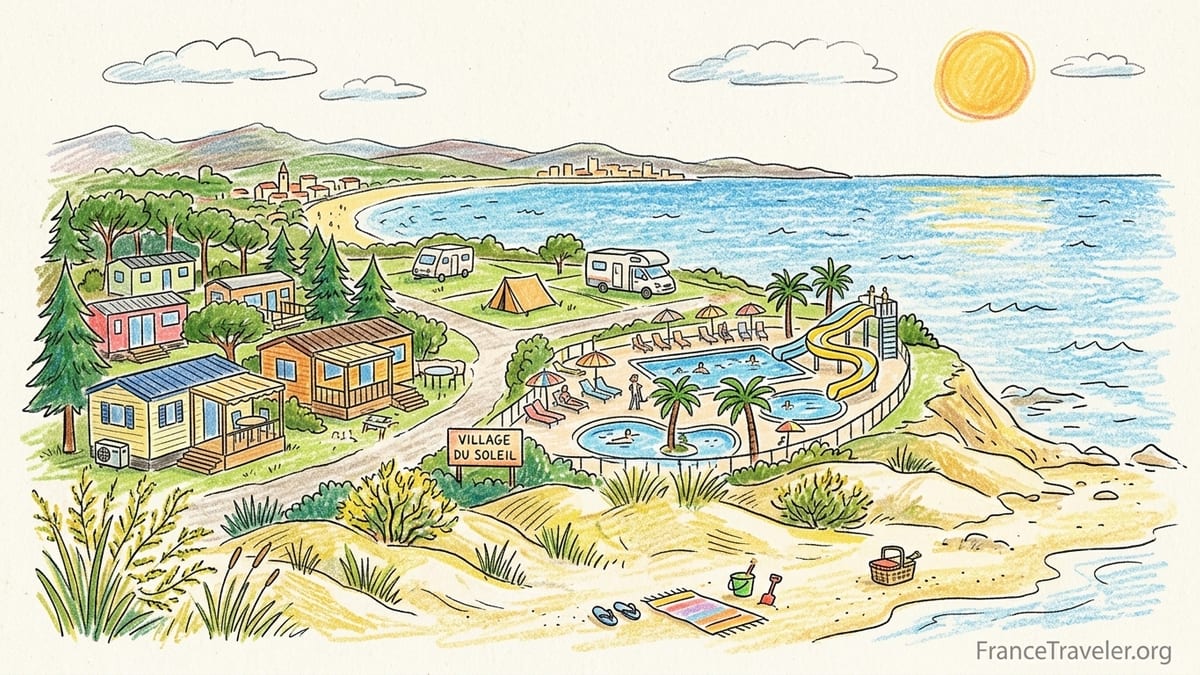
At the opposite extreme are large holiday villages with extensive water parks, entertainment teams and a majority of mobile homes. Many five-star sites in Hérault and Pyrénées-Orientales showcase multi-pool complexes with slides, paddling areas for toddlers, lazy rivers and lagoon-style basins surrounded by sun loungers and palm trees. Resorts aligned with brands like Yelloh! Village or Sandaya typically fall into this category. They are designed to keep families on-site for much of the stay, with restaurants, sports courts, mini-markets and evening shows.
Between these poles, there is a wide middle ground of mid-sized, family-focused properties. A typical four-star site on the Languedoc coast or near Perpignan might have 150 to 250 pitches and rentals, a good-sized heated pool with one or two slides, a kids’ club for peak-season weeks and a programme of evening activities two or three nights a week rather than nightly. These can be excellent value, with enough facilities to keep children happy but without the crowds and noise levels of the largest complexes.
Specialist platforms that aggregate campsite bookings now list hundreds of Mediterranean properties across these categories, and their search filters allow you to target specific features such as direct beach access, types of accommodation, pool configuration and kids’ clubs. In practice, this means you can choose anything from an adults-oriented naturist site hidden among dunes to a bustling, fully serviced village behind a busy family resort town.
Where to find direct beach access, kids’ clubs and hotel alternatives
If your priority is direct access to a sandy beach without crossing roads, focus on the stretches with proven clusters of seaside campsites. In Occitanie, the belt from Vias-Plage through Sérignan-Plage, Valras-Plage and Vendres-Plage offers multiple parks that back directly onto dunes or have gates leading to the sand. In Pyrénées-Orientales, many sites around Argelès-sur-Mer, Torreilles and Le Barcarès sit within a short walk of the sea, some with private paths over the dunes. In the Var, direct beach access is more limited but particularly prized; around Bormes-les-Mimosas, Hyères and certain corners of Saint-Raphaël and Saint-Tropez’s bay, a handful of campgrounds still occupy beachfront land.
For water parks and kids’ clubs, Hérault and Pyrénées-Orientales again stand out. Specialist directories list several dozen campsites with full water parks just along the Languedoc-Roussillon coast, a figure far higher here than in many inland French regions. Many of these sites run structured children’s clubs from roughly age 4 to 12, with teenagers’ activities in high season. Brands such as Siblu and Yelloh! Village often provide multilingual staff and daily entertainment programmes, making them attractive to international families.
As hotel alternatives, mobile homes and chalets shine in both Occitanie and the Var. A typical two-bedroom mobile home sleeping four to six people, with air conditioning and a terrace, often costs less than booking two separate hotel rooms in the same resort area at peak times. Self-catering facilities reduce meal costs, and included access to pools, playgrounds and kids’ clubs keeps daily spending on entertainment modest. In shoulder seasons like late May, June and September, these rentals can be particularly good value, with nightly prices dropping substantially compared with August while the sea remains warm enough for swimming.
Travellers on tighter budgets can look either at smaller independent campsites a short drive inland from the coast or at municipal sites near towns and lakes within 20 to 40 minutes of the sea. In Hérault, for example, staying near the Étang de Thau or in the hinterland villages cuts costs while still giving access to Mediterranean beaches for day trips. In the Var, camping a little inland among vineyards or in low foothills can offer quieter surroundings and lower nightly pitch rates, albeit with a car drive to the nearest beach.
Quieter, more natural campsites along the Med
While the big water-park resorts dominate marketing, many travellers seek a softer, more nature-based experience on the French Mediterranean. These guests may be happy with a simple pool or even no pool at all, provided they can walk or cycle to the sea and enjoy shade and space. Such sites are more common at the fringes of major resorts or a few kilometres inland along lagoons and estuaries.
In Occitanie, the zones behind the main beach strips often harbour smaller campgrounds among vineyards, orchards or on lagoon shores. Around the Étang de Thau, for example, some four-star sites blend a more relaxed atmosphere with decent pool complexes and direct access to the lagoon for water sports. Compared with the seafront giants, they have fewer pitches, quieter evenings and more local clientele. This suits couples, older travellers and families with very young children who are less interested in late-night shows.
In the Camargue, you can still find fairly rustic camping options near bird reserves and riding centres. Facilities may include simple pools or none at all, perhaps a basic snack bar and small playground. Night skies tend to be darker and surroundings more rural. For many, the trade-off of fewer on-site activities is rewarded with the chance to watch flamingos at sunrise, cycle along dykes and visit working salt pans and rice farms during the day.
The Var and Riviera, with their high land values, have fewer truly rustic coastal sites, but quieter options exist further back from the sea or in sheltered valleys. These might provide terraced pitches with views of wooded hills, a single pool and a family-run restaurant, plus car access to the coast within 20 or 30 minutes. If you prefer to spend days hiking, road-tripping or exploring hilltop villages rather than staying by the pool, these smaller campgrounds can offer an appealing and often more affordable base.
Practical tips for choosing and booking a Mediterranean campsite
The commercial campsite landscape on the French Mediterranean is competitive, and availability for high summer can shift quickly. To secure the best choice of pitches or mobile homes, aim to book several months ahead for stays in late July and August, especially in Hérault, Pyrénées-Orientales and the Var where demand is highest. Some larger brands open bookings nearly a year in advance and offer early-bird discounts or flexible cancellation policies outside peak dates.
When comparing options on specialist booking platforms, pay close attention to maps and campsite plans. "Beachfront" might mean direct access from the site to the sand, or it may indicate a short walk crossing a quiet road or promenade. Likewise, "water park" can range from a single pool with a slide to a sprawling complex of multiple basins and attractions. Scanning recent guest reviews can help clarify whether advertised features feel spacious or crowded in practice, and whether kids’ clubs operate daily or only in school holidays.
Consider your preferred balance between on-site facilities and local exploring. If you expect to spend most of your time on-site with children, invest in a resort with a well-developed pool area, multiple playgrounds and varied activities. For travellers planning day trips to nearby cities like Montpellier, Perpignan, Toulon or Nice, or into backcountry areas such as the Cévennes or Verdon, it may be wiser to choose a smaller, calmer campsite with easier road access and shorter check-in queues.
Finally, be mindful of extras that can affect the overall budget. Many Mediterranean campsites include pool and club access in the nightly rate, but charge additional fees for items like linen hire, final cleaning of mobile homes, air conditioning on older units, or renting fridges for bare pitches. Some also operate wristband systems or cashless cards for on-site bars and activities. Checking these details before you book helps avoid surprises and allows you to compare the real cost of different properties and regions.
The Takeaway
The French Mediterranean coast offers one of Europe’s richest selections of camping experiences, from simple beachfront pitches to high-end resorts with water parks, spas and village-style services. Occitanie’s Hérault and Pyrénées-Orientales stand out for their dense clusters of large, family-focused parks with direct or near-direct beach access, while the Camargue mixes sea and wetlands with a slightly quieter feel. Farther east, Provence and especially the Var and Riviera provide a more premium, view-driven camping environment where prices rise but settings can be spectacular.
For travellers used to hotels, mobile homes and chalets on these campsites can be a revelation: self-contained units with kitchens and terraces inside full-service holiday villages, often at a per-person price that compares favourably with resort hotels in the same areas. Families who want pools, slides and kids’ clubs will find abundant options in Hérault, Pyrénées-Orientales and the Var, while couples and nature lovers can pick smaller, more tranquil campgrounds near lagoons, vineyards or wooded hills.
By thinking carefully about which region’s character appeals most, how close you need to be to the beach and what level of activity you enjoy on-site, you can use specialist booking platforms to filter hundreds of French Mediterranean campsites down to a shortlist that genuinely fits your style and budget. Whether you arrive with a tent, a campervan or just a suitcase for a week in a mobile home, the combination of sea, sun and outdoor living makes this coast an enduring and versatile destination.
FAQ
Q1. Which parts of the French Mediterranean have the most large family campsites?
Hérault and Pyrénées-Orientales in Occitanie have some of the highest concentrations of large family-oriented campsites, especially around Valras-Plage, Vias, Sérignan, Argelès-sur-Mer and Le Barcarès, while the Var around Hyères, Bormes-les-Mimosas and Fréjus also has many sizeable holiday parks.
Q2. Where can I find campsites with direct access to sandy beaches?
Look along the Languedoc coast from Vias-Plage to Vendres-Plage and around Argelès-sur-Mer and Torreilles in Pyrénées-Orientales, plus selected spots in the Var such as Bormes-les-Mimosas and the Gulf of Saint-Tropez, where a limited number of long-established campgrounds sit directly behind the sand.
Q3. Are mobile homes cheaper than hotels on the French Mediterranean?
Per person, mobile homes are often cheaper than hotels, especially for families or groups of four to six people. Even in high season, a two- or three-bedroom mobile home on a large campsite can cost less than booking two hotel rooms, while including access to pools, kids’ clubs and self-catering facilities.
Q4. Which regions are best for quieter, more natural campsites?
Quieter options are easier to find on the fringes of major resorts, around the lagoons of the Camargue and Étang de Thau, and a little inland in both Occitanie and the Var. These sites usually have fewer pitches, simpler facilities and a stronger focus on nature and local exploration.
Q5. Do all large Mediterranean campsites have water parks and kids’ clubs?
Most big four- and five-star parks in Hérault, Pyrénées-Orientales and the Var offer at least one sizeable pool and a kids’ club in high season, but the scale varies. Some have full water parks with multiple slides, while others have more modest pools, so it is worth checking details before you book.
Q6. When is the best time to camp on the French Mediterranean coast?
July and August have the warmest sea and fullest activity programmes but are also the busiest and most expensive. June and September offer a good compromise, with milder temperatures, lower prices and fewer crowds, though some kids’ clubs and entertainment may run on a reduced schedule.
Q7. Can I camp without a car along the French Mediterranean?
It is possible but more limited. Some resorts near train or bus routes, such as around Argelès-sur-Mer or Valras-Plage, have campsites within walking or cycling distance of stations and supermarkets. However, having a car gives you far greater flexibility for shopping, day trips and reaching quieter beaches.
Q8. How far ahead should I book a mobile home or pitch?
For stays in late July and August, booking several months in advance is advisable, especially at popular seaside resorts in Hérault, Pyrénées-Orientales and the Var. For June, early July and September, you often have more flexibility, though the best sea-view pitches and newest mobile homes still sell first.
Q9. Are there budget-friendly alternatives near the Mediterranean if I avoid the seafront?
Yes. Municipal and independent campsites a short drive inland, such as around the Étang de Thau in Hérault or in vineyard and hillside areas of the Var, usually charge lower nightly rates than beachfront resorts while still allowing easy day trips to the sea.
Q10. What should I check in the small print before booking a campsite?
Look for details on what is included in the nightly rate, such as pool and club access, parking, taxes and Wi-Fi. Check extra charges for cleaning, bed linen, air conditioning, pets or on-site activities, and confirm whether facilities like water parks and kids’ clubs are fully open during your planned travel dates.