


After several trips to the Loire Valley, I have learned that where you sleep changes how you experience the region just as much as which châteaux you visit. I have stayed in simple central hotels in Tours, romantic rooms above the river in Amboise, and full château-style country estates surrounded by fields and vines. Some of these stays genuinely improved the trip, cutting down driving, adding atmosphere at night or making breakfast feel like part of the sightseeing. Others were pretty, but made dinners and day trips more complicated than they were worth. This guide focuses on the places where an actual overnight has earned a recommendation, with researched alternatives clearly labeled for comparison.
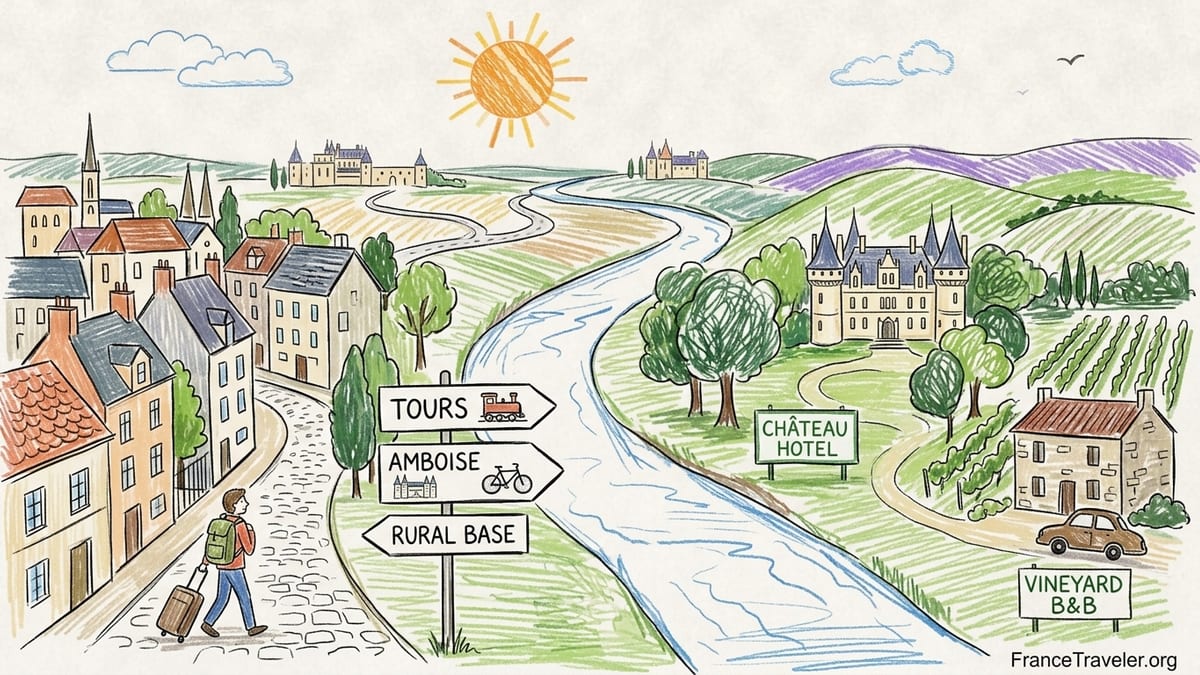
How to Choose Your Loire Valley Base
The Loire Valley stretches roughly 280 kilometers between Sully-sur-Loire and Chalonnes-sur-Loire, and it helps to remember that distances are real here, especially on slower departmental roads. Basing yourself smartly can mean two or three short hops of 25 to 40 minutes instead of a daily hour-plus slog across the map. On my last circuit, I split my time between central Tours, walkable Amboise and a countryside château hotel east of Blois, which together covered most of the classic castles and a good mix of wine country.
For first-time visitors, Tours works well as a practical hub for Chenonceau, Villandry and Azay-le-Rideau, with direct trains to and from Paris. Amboise then adds a smaller-town feel and easy access to Chaumont-sur-Loire, Chenonceau and the Vouvray vineyards. A final base near Chambord or Cheverny takes care of the eastern group of estates. This triangle kept most of my daily drives under 45 minutes, even in July traffic. When I tucked in a countryside château stay, it changed my evenings completely, trading restaurant-lined streets for long walks in parkland and quiet drinks under plane trees.
The big strategic question is whether you want to rely on a car every day. If you do, a rural château or vineyard base can be magical. If you prefer to sightsee by train or join day tours, you will be happier in Tours or Amboise, where you can walk to dinner and not think about dark country roads at the end of the night.
Staying Central in Tours: Practical Comfort Over Fantasy
In Tours, my base has been a small three-star property a few minutes’ walk from Tours train station and about ten minutes on foot from the medieval old town around Place Plumereau. The room I used in 2024 was on a higher floor at the back of the building. The bed was a standard European double with a firm mattress and decent linens, more functional than luxurious, but after full castle days it did its job well. The private bathroom had a modern cabin shower with good water pressure, a simple vanity and bright lighting. Towels were mid-weight, not spa-level, yet replaced promptly on request.
Breakfast was served in a ground-floor room near reception and offered a typical French buffet: croissants and baguette, a couple of pastries, boiled eggs, cold cuts, cheese, yogurt and fruit, plus coffee from a machine and tea. I found it good value compared with grabbing something at the station, especially before an early train or tour departure. Noise insulation was more than acceptable for a city-center hotel. Even facing the rear, I heard occasional hallway doors in the evening, but street noise was limited and there was no late bar scene beneath the windows.
The hotel had individual air-conditioning units in the rooms, crucial during a warm spell in late June when daytime temperatures nudged past 28 degrees Celsius. The unit cooled the space steadily, and a small radiator under the window handled chilly mornings. Parking is the main compromise here. The property relied on nearby public parking: a paid underground garage by the station and some on-street options. With luggage, I found it easiest to pull into the garage, wheel bags 5 to 7 minutes along level pavements and leave the car there overnight. For castle day trips, Tours proved central: about a 35-minute drive to Villandry, 45 minutes to Azay-le-Rideau and around 30 to 40 minutes to Amboise in regular traffic.
Did staying here improve my trip? Yes, in terms of logistics. After long drives and sightseeing, being able to walk to dozens of restaurants and bars in under ten minutes and catch early trains without taxis outweighed the lack of château ambience. For a first or short visit, I would still choose this kind of central Tours hotel as a base for its simplicity, especially if you are coming from Paris by rail.
Amboise on Foot: Sleeping Within Walking Distance of Town
Amboise feels more intimate than Tours and rewards travelers who want to stroll everywhere. I tried a small riverside guesthouse within about a ten-minute walk of the town center and Château d’Amboise. My room was on an upper floor under the eaves, with a queen bed, cotton sheets and a softer mattress than in Tours. The bathroom was compact, with a walk-in shower and a skylight. There was enough counter room for two toiletry bags, which is not always a given in older buildings. At night, shutters kept out both light and heat.
Breakfast here felt more personal than in a city hotel. It was served at a shared table in a ground-floor dining room with views of the Loire. There were still croissants, baguette and jam, but also homemade yogurt, fresh fruit and a plate of local goat cheeses. The owner offered to fry or scramble eggs on request. This slower, more home-like start to the day changed the overall rhythm of the trip. Noise levels were low, helped by thick stone walls and the fact that Amboise quiets early outside high summer weekends.
The room had AC provided by a wall-mounted unit. In April and October I mostly relied on the building’s heating and simply opened a window in the late afternoon, but in late summer the AC kept the room comfortable at night. Parking here was on a small private gravel area beside the house. Spaces were tight but manageable with a compact rental car. I never struggled to find a place, though on busy holidays you may need to shuffle cars to allow others to exit.
From Amboise, drive times were comfortable. Chenonceau was about 20 to 25 minutes away by car, Chaumont-sur-Loire about 25 to 30 minutes, and Blois around 40 minutes. Vouvray’s wine cellars started roughly 20 minutes to the west. Being able to walk back from dinner to the guesthouse in under fifteen minutes was a real advantage over rural château hotels. If you plan to enjoy wine with dinner, this alone can make Amboise a better choice, especially for shorter stays.
Château-Style Country Hotels: Atmosphere vs Driving
My most atmospheric stay was at a countryside château hotel set in its own parkland near the eastern Loire castles. The building dated from the 18th century, with tall windows overlooking lawns, mature trees and a small ornamental pond. My room was on the first floor in the main château, with high ceilings, a large double bed and period-style furniture. The mattress was comfortably firm with a mattress topper and thick duvet, and the linens felt a step up from my city hotels. The bathroom combined a modern walk-in rainfall shower and a freestanding tub, along with heated towel rails and high-quality toiletries.
Breakfast here moved the needle from “practical” to “memorable.” It was served in a wood-paneled dining room with views onto the gardens. There were local apple juices, several kinds of bread, pastries, farmhouse yogurts, fruit salad and regional cheeses and charcuterie. On one morning, a still-warm loaf appeared, and staff highlighted where the butter and honey were produced. Taken unhurriedly, breakfast almost felt like part of the sightseeing program, a gentle lesson in the valley’s food culture without leaving the grounds.
Parking was effortless, with a private gravel forecourt directly in front of the château and additional shaded spots near the outbuildings. The property was very quiet at night. Even in August, I mostly heard crickets and an occasional car on a distant road. Air-conditioning, however, was limited. My room had effective cross-ventilation and a fan, and the thick stone walls helped keep temperatures down, but during a hot spell it stayed warm until the small hours. In cooler months and shoulder seasons, radiators provided steady heat, and fireplaces in common areas added to the atmosphere.
From this countryside base, drives were slightly longer but scenic. Château de Chambord was roughly 25 to 30 minutes away, Cheverny around 30 minutes and Blois about 25 minutes. Chaumont-sur-Loire and its garden festival took around 40 minutes by car. There were a few nearby villages with small bistros within a 10 to 15 minute drive, but for a wider choice of restaurants we typically drove 25 minutes into a larger town and returned along unlit country roads. This made evenings feel more deliberate. When we booked dinner on site in the château’s own restaurant, the experience was superb and solved the driving issue completely, but this usually required advance reservation and added noticeably to the trip budget.
Did the château atmosphere justify needing a car and evening drives? For stays of two or three nights, yes. Waking up to mist over the lawns, having coffee under tall trees and wandering the grounds at sunset all delivered the romance travelers imagine when they picture the Loire. If it were my only base for a week, I would hesitate, since every excursion demands a car and every dinner decision involves either driving or pre-booking in-house dining. As part of an itinerary that also includes a couple of nights in Tours or Amboise, however, it felt like a highlight rather than an inconvenience.
Vineyard Accommodation: Sleeping Among the Vines
For wine-focused travelers, staying directly in the vineyards south of Saumur or around Vouvray offers a different kind of immersion. I booked two nights at a working wine estate with guest rooms tucked into traditional stone buildings. My room overlooked rows of vines and a courtyard. The bed was a standard double, on the firmer side, and dressed in simple but good-quality linen. The bathroom was modernized, with a tiled Italian-style shower, proper ventilation and a heated towel bar. It felt closer to an upscale rural B&B than a hotel.
Breakfast here was continental with a clear emphasis on local products. There were crusty loaves from the nearby village bakery, homemade jams, yogurts and often a cake baked that morning. Coffee was served at the table rather than from a machine. On both mornings, other guests stayed chatting with the hosts about the year’s harvest and local appellations. The only real noise came from machinery working in the vines in late afternoon and birds at dawn. Nights were strikingly quiet, and the sky dark enough for stargazing.
The guesthouse had modern heating, useful during an April visit when mornings were cold, but no full air-conditioning. Thick walls and small windows, along with fans, kept the room comfortable in spring, though I would expect it to get warmer in high summer. Parking was straightforward on a gravel area just outside the house and felt secure. A tasting of the estate’s wines was offered on site, which meant I could enjoy a full flight without worrying about driving afterward.
From this vineyard base near Saumur, driving times were moderate but not as central as Tours. Saumur town and its hilltop château were about 25 to 30 minutes away. The troglodyte caves and some sparkling wine houses on the Loire’s south bank could be reached in roughly 20 minutes. Chinon and its fortifications were closer to 45 minutes by car, and driving all the way to Chambord would have taken nearly two hours, which is why I paired this stay with other bases. Overall, the vineyard accommodation made the wine portion of the trip richer and more relaxed, but it is best suited to those comfortable with self-driving and willing to focus on a smaller slice of the valley.
Bases Near Chambord and Blois: For the Big-ticket Châteaux
The area around Chambord and Blois is where a countryside château stay has the strongest practical case. Chambord sits in a huge forested estate, so even the one hotel inside the domain still requires short drives or walks to get around. During one visit, I chose a small hotel in a village about 15 minutes’ drive from Chambord and 20 minutes from Blois, set in a converted manor house. My room had a comfortable queen bed with a good mattress and a desk, and the bathroom included a combined tub and shower with a glass screen. Not luxurious, but a clear notch above a basic roadside hotel.
Breakfast was served in a simple dining room overlooking a garden, with pastries, bread, cereal and some charcuterie. In good weather there were a few tables set outside. Parking was free in the hotel’s courtyard and along the quiet village street. There was minimal traffic noise, but the property did not have full AC; instead, rooms relied on thick stone walls, fans and the ability to open windows. During a cool May stay, this was fine. In mid-August, it might be less comfortable, so checking the forecast matters.
From this base, we could reach Chambord in around 15 minutes by car, arriving early enough to park close to the entrance before tour buses filled the lots. Blois was just under 20 minutes by a straightforward main road, Cheverny around 25 minutes and Chaumont-sur-Loire about 35 minutes. Even Chenonceau was manageable in just under an hour. However, dining options within walking distance were limited to one small restaurant and a bar-tabac. For variety, we often drove 20 to 25 minutes into Blois or another town for dinner, then navigated back along dark rural roads. Good headlights and keeping alcohol intake modest were essential.
This balance might not work for every traveler. If you prize having several restaurant options a short walk away and do not care whether you wake up in a château park, you may prefer to sleep in Blois itself. On a later trip I did just that, using a small central hotel opposite the station, with compact but air-conditioned rooms and easy access to the historic center. From there, Chambord was a roughly 25-minute drive, and Chaumont-sur-Loire about 30 to 35 minutes. Compared with the village hotel, I sacrificed some countryside calm but gained walkable dining and riverfront strolls after dark.
Researched Alternatives Worth Considering
Beyond the places I have actually slept, I have visited or closely researched several other properties as potential bases. These are not firsthand stays, but they are worth knowing about if they match your priorities. In the countryside near Tours, a recently highlighted estate offers château rooms, suites and small houses grouped on one property, with a pool and lawns that make it appealing for families or groups who want space as well as character. Marketing materials note it holds a four-star rating and positions itself as a complete domain where you could in theory spend a whole day by the pool and in the park between castle outings.
Closer to the eastern castles, a renovated inn near Candé-sur-Beuvron has drawn attention for combining 30 cozy rooms with both a bistro-style restaurant and a more gastronomic option. It sits within reasonable access of Chaumont-sur-Loire, Cheverny and Chambord, and promotes a warm, family-style welcome. For travelers nervous about driving long distances to dinner from a remote château, this kind of property can be a good compromise between countryside feel and on-site dining, though it usually lacks the grand architecture of a classic château hotel.
In the Vouvray area, several guesthouses and small estates advertise rooms with vineyard views and swimming pools, sometimes in former mills or manor houses. They typically highlight homemade breakfasts, tastings of local sparkling wines and easy access to the Loire à Vélo cycling routes. Official regional tourism materials also spotlight a number of vineyard accommodations in the Anjou area and around Saumur, from simple gîtes attached to wine cellars to more polished guesthouses with pools and landscaped gardens. Most of these will require a car and a comfort level with country driving.
If you are traveling in peak months such as July and August, or around French public holidays, booking early becomes essential for these smaller properties. Many operate with only a handful of rooms, and once filled, your remaining options may be either larger chain hotels by main roads or higher-priced luxury châteaux. When evaluating them, pay special attention to recent reviews that mention air-conditioning performance during heatwaves, Wi-Fi stability if you need to work, and any noise from nearby roads or event use, such as weddings.
The Takeaway: Is a Château Stay Really Worth It?
After rotating between city hotels, village guesthouses, vineyard stays and full château hotels, my conclusion is that the right answer is usually “one of each” rather than committing entirely to one style. A practical two- or three-night base in Tours or Amboise simplifies arrival, departures and dinners. You walk to restaurants, rely less heavily on your car and keep day-trip driving times reasonable. Then, adding one or two nights in a countryside château or on a vineyard estate gives you the romance and quiet that people dream about when they picture the Loire Valley, without subjecting you to long drives every single evening.
In concrete terms, sleeping in a château-style property did add enough atmosphere to justify the extra driving when I treated it as a special segment of the trip. Waking to birdsong instead of traffic, crossing a gravel courtyard under a starry sky and having breakfast in a panelled dining room overlooking parkland made those days feel distinct. The trade-offs were mostly practical: you must have or rent a car, you will probably drive 20 to 30 minutes to most dinners unless the property has a reliable on-site restaurant, and you need to be comfortable returning along unlit roads.
If your priority is squeezing in as many castles as possible in three or four days, you may be better off focusing on central, walkable bases. But if you have five or more nights to play with, I recommend splitting your time along this pattern: a central Tours hotel for orientation and train access, a walkable stay in or near Amboise, and a final night or two at a country château or vineyard guesthouse near Chambord or Saumur. That combination gave me efficient sightseeing, relaxed evenings and at least a couple of mornings when simply looking out of the window felt like part of what I had come to the Loire to experience.
FAQ
Q1. Do I really need a car to enjoy a château hotel in the Loire Valley?
For countryside château and vineyard properties, having a car is extremely helpful. Most are several kilometers from the nearest village, and public transport drops you in larger hubs such as Tours or Blois rather than at rural gates. Without your own vehicle, you will end up relying on expensive taxis or limiting evening outings. For central hotels in Tours or Amboise, you can manage without a car by joining organized day tours or using trains and local buses.
Q2. How many nights should I spend in the Loire Valley for a first visit?
A minimum of three nights gives you time for two full days of sightseeing, but five to six nights lets you balance big-name châteaux with vineyards and slow mornings. With five nights, you can divide your stay between a central base such as Tours or Amboise and a countryside château or vineyard, experiencing both practical convenience and rural atmosphere without rushing.
Q3. Is it better to stay in Tours or Amboise as a main base?
Tours is more practical if you are arriving by train from Paris and want lots of restaurant options, a compact city center and easy onward rail connections. Amboise is smaller and more romantic, with the river and château dominating the town, and it works very well if you prefer to walk everywhere and focus on Chenonceau, Chaumont-sur-Loire and nearby vineyards. For many visitors, a few nights in each provides the ideal balance.
Q4. How far are the main castles from typical central bases?
From central Tours, expect around 35 minutes by car to Villandry, 45 minutes to Azay-le-Rideau and 30 to 40 minutes to Amboise. From Amboise, Chenonceau is about 20 to 25 minutes away, Chaumont-sur-Loire around 25 to 30 minutes and Blois roughly 40 minutes. From a base near Chambord, you can usually reach Chambord itself in 15 to 30 minutes, Cheverny in 25 to 30 minutes and Chaumont-sur-Loire in about 35 to 40 minutes, depending on the exact village.
Q5. Are Loire Valley hotels and château stays usually air-conditioned?
Air-conditioning is common in modern city hotels in Tours and in many recently renovated guesthouses, but it is not guaranteed in all older properties or rural châteaux. Some rely on thick stone walls, fans and nighttime ventilation instead. If you are traveling in July or August, check room descriptions and recent guest feedback specifically for AC performance, as heatwaves in central France have become more frequent.
Q6. What can I expect at breakfast in small hotels and guesthouses?
Most Loire Valley accommodations provide a continental-style breakfast. This usually includes bread, croissants, pastries, butter and jam, with yogurt, fruit and sometimes cheese and cold cuts. In more upscale guesthouses and château hotels, you may find local specialties, homemade cakes and eggs prepared to order. Village and vineyard stays often highlight regional products and can feel more like a hosted meal than a buffet.
Q7. Is parking difficult at central hotels in Tours and Amboise?
In Tours, many small central hotels rely on nearby public car parks and street parking. You may need to park in an underground garage by the station and walk 5 to 10 minutes with luggage, which is generally manageable. In Amboise, riverside and in-town guesthouses may have small private parking areas or direct street parking. Countryside château hotels almost always have ample free parking on site, which removes that concern entirely.
Q8. How noisy are typical accommodations in the Loire?
Countryside château and vineyard stays are usually very quiet at night, with sound limited to wildlife and occasional distant traffic. Central city hotels in Tours can have some street and hallway noise, but upper-floor rooms at the back of buildings tend to be calmer. In Amboise and small towns around Blois, noise levels drop quickly after dinner hours, especially outside peak holiday weekends.
Q9. When is the best time of year to stay on a vineyard estate?
Spring and early autumn work particularly well for vineyard stays. In April and May, you see new growth on the vines and enjoy cooler temperatures for sleeping without full air-conditioning. September and early October bring harvest activity and changing colors in the vineyards, though some estates may be busier with work and tastings. High summer offers long evenings outdoors but can be warm in rooms without strong AC.
Q10. How far in advance should I book popular château or vineyard hotels?
For travel in high season, especially from late June through August or around long weekends and school holidays, it is safest to book château and vineyard stays several months in advance. Many of the most charming properties have only a handful of rooms and fill quickly. In shoulder seasons such as April, May, September and October, you may find more flexibility, but booking key nights early still gives you better choice of room types and rates.