

I did not fully understand how different Tours, Amboise and Blois feel as bases until I slept in all three. Over several trips between 2018 and 2024, I split stays between a studio near Tours’ Place Plumereau, a guesthouse under the château walls in Amboise, and a hillside hotel above the old town in Blois. I arrived by TGV, TER and rental car, dragged a suitcase across cobbles, hunted for dinner after 9 p.m., and pedalled along the Loire à Vélo with tired legs. This article is written from that firsthand experience, and wherever I mention current train patterns, shuttle services or cycling routes beyond what I personally used, I flag that as researched information based on recent regional and tourism sources.
First Impressions: Three Very Different Bases
My first Loire base was Tours, where I stepped off a late-afternoon TGV from Paris Montparnasse into a proper small city. The forecourt outside Tours station felt busy but manageable, with taxis waiting and a tram gliding past. A ten-minute walk brought me to a tiny rental apartment just behind Place Plumereau. The old town’s half-timbered houses, cafés packed with students and the low hum of conversation gave Tours an immediately lived-in feel. It was clear that this was not a château village built around visitors but a regional capital that also happens to sit among the castles.
Amboise, which I tried next on a spring cycling trip, felt completely different on arrival. My TER rolled into the modest station on the north bank, and I wheeled my bike across the bridge with the château lit gold above the river. The walk into town took about 20 minutes with panniers, yet that crossing became one of my favourite moments of the whole valley: the Loire wide and shallow, sandbanks catching the evening light, and the outline of the royal château and church stacked above the rooftops.
Blois joined the comparison on a later autumn trip focused on Chambord and Cheverny. The train pulled directly into Blois–Chambord station, a short uphill walk from the stone-and-slate hillside town. In drizzle, the old quarter felt more intimate than Tours but more urban than Amboise, with narrow lanes winding steeply up to the château. By the time I had checked into my hotel halfway up the hill and gone back out for a glass of wine, it was clear Blois would work very differently as a base, especially for travellers focused on the eastern châteaux.
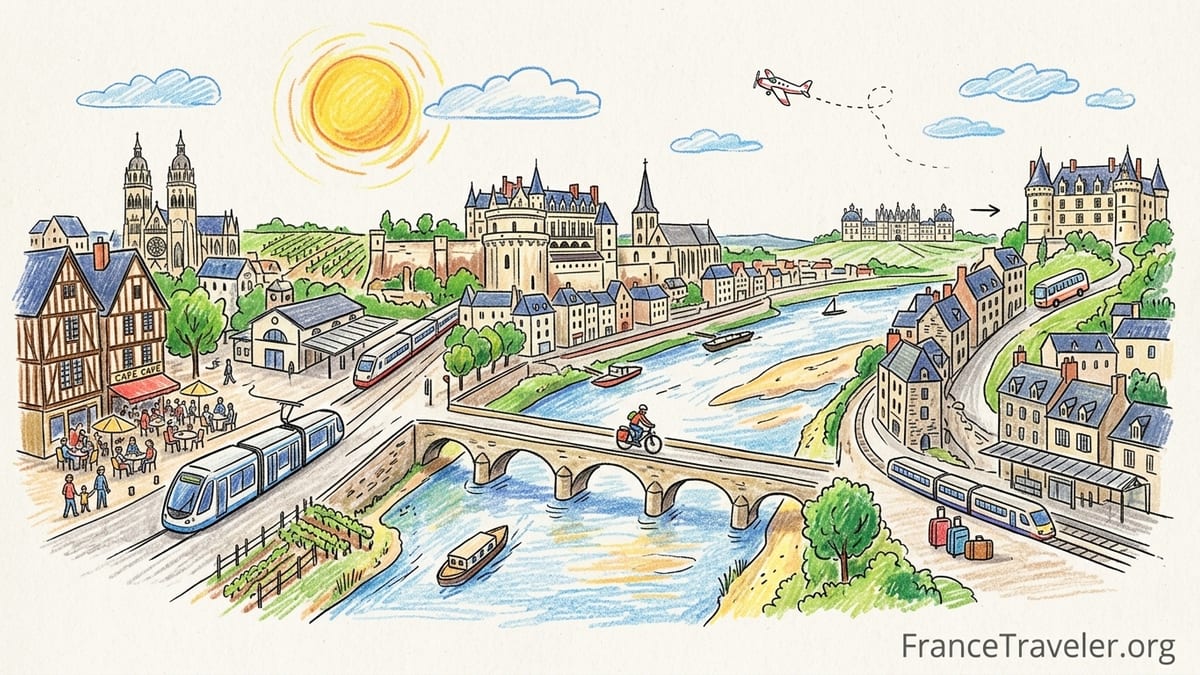
From those stays, I came to see France’s own description of the region play out on the ground: Tours as an established château-tour base with big-city services, Amboise embedded in the heart of cycling and heritage routes, and Blois as a compact rail hub pointing efficiently toward Chambord, Cheverny and the eastern stretch of the Loire.
Accommodation on the Ground: What It Actually Feels Like
In Tours, my base was a compact studio close to Place Plumereau, booked for around 80 to 100 euros per night in shoulder season. Walking home after dinner, I always passed locals chatting under medieval façades and students spilling out of bars. Noise was a trade-off: on Friday, the square stayed lively until past midnight, which may bother light sleepers. On another visit I stayed near Tours’ cathedral in a midrange chain hotel. That area felt quieter while still being an easy tram ride or 15-minute walk from the station, and it underlined how Tours can feel like several different towns depending on where you sleep.
Amboise’s accommodation instantly felt more intimate. My favourite stay there was in a stone guesthouse just below the château ramparts, where breakfast was yogurt, croissants and slices of Saint-Maure goat cheese served in a little courtyard. The price was similar to Tours for a nicer room, roughly 100 to 120 euros per night in late May, but the atmosphere was closer to a village inn than city apartment. On another trip I tried a simple two-star hotel near the river, handy for rolling a bike into the courtyard and for the quick walk to the evening market stalls along the quay in summer.
Blois sat somewhere between the two. My hillside hotel, about ten minutes on foot from the station and five from the château, had a slightly faded grand-hotel lobby and small but comfortable rooms. Rates hovered around 90 to 110 euros when I visited in October, with breakfast an optional add-on. What I remember most is waking up to a view over the tiled roofs and mist hanging above the Loire. Closer to the station there are business-style hotels that feel more anonymous but are efficient if you are catching early TER trains to Chambord or back to Paris.
From these stays, my rule of thumb became: choose Tours if you want maximum accommodation choice and late-night city energy, Amboise if you prefer a smaller-scale place where most things are walkable in ten minutes and the château dominates your window view, and Blois if you want a compromise between town atmosphere and quick access to specific eastern châteaux.
Eating and Evenings After the Day-Trippers Leave
Evenings were where the three towns separated most sharply. In Tours, dinner never felt like a problem. Around Place Plumereau and Rue Colbert, I could decide at 8:30 or even 9 p.m. and still find open kitchens ranging from crêperies and wine bars to bistros offering menus around 25 to 35 euros. One night I ate a simple steak frites on Rue Colbert, then wandered over to a wine bar for a glass of Vouvray; even on a Tuesday the terraces were half-full, mostly with locals. Tours also gave me options for a late, informal meal after returning from a château day trip, something that felt much less guaranteed in smaller towns.
Amboise, in contrast, emptied dramatically after bus tours departed, yet never felt dead. On my first stay I sat on the terrace of a restaurant just off the main square at 8 p.m., looking up at the château walls. The set menu ran about 30 euros for three courses, with local wines by the glass around 5 to 7 euros. By 10 p.m., the restaurant had mostly cleared and the streets were near silent. For me, that quietness made early morning walks particularly rewarding: I could wander along the riverfront with a takeaway coffee and watch the light hit the château before crowds arrived.
In Blois, evenings felt more local than in Amboise. Around Rue du Puits Châtel and the streets climbing toward the château, small bistros and wine bars stayed open reasonably late, but there was little of the loud, student-heavy nightlife I saw in Tours. One night I ate a plate of rillettes and a salad at a casual wine bar, then strolled to the château square, where a projection show on the castle façade drew a mix of tourists and residents. By 11 p.m. the upper town was quiet, with only a few people heading to parked cars along the river.
For couples or anyone who values an atmospheric evening stroll more than nightlife, I found Amboise magical once the tour buses had left. For solo travellers who like a buzzier scene, or for longer stays where dining variety matters over a week, Tours clearly won, with Blois offering a middle path of modest but authentic evening life without the big-city crowd.
Getting In and Around Without a Car
On my car-free trips, train logistics decided more about my days than any château opening time. Tours worked best as an arrival and departure hub. From Paris, I used both the TGV into Saint-Pierre-des-Corps and the Intercités or TER into central Tours, all taking roughly 1 hour 15 to 1 hour 40 depending on the train. From there, regional TER services fanned out along the Loire and Cher lines. I rode a morning train from Tours to Chenonceaux, walking the five minutes from the station to the gates of Château de Chenonceau, something regional tourism sources highlight as one of the easiest car-free castle visits in France.
For Amboise, I usually travelled via Tours, catching a TER that took about 20 minutes. The station lies on the north bank of the river, with the town and château on the south bank. With a suitcase, the walk over the bridge took me around 20 minutes; with just a daypack, it felt more like a scenic prelude than a chore. Trains continued along the same line to Blois and Orléans, and regional information shows that these river-line services now pattern much of what is realistically reachable by train, including the Interloire trains that link Orléans, Blois, Amboise and Saint-Pierre-des-Corps in season.
Blois–Chambord station, as its name hints, doubles as a launch point for Chambord. During my autumn stay, I confirmed at the tourism office that shuttle buses to Chambord and sometimes Cheverny operate seasonally from near the station, which matched what recent car-free itineraries describe: Blois plus shuttle on day one, then continuing by train to Amboise and Chenonceaux. I did not ride the shuttle myself, but several fellow guests at my hotel had, and their reports lined up with the official information that these services are designed expressly for visitors without cars.
In practice, I found Tours most forgiving if trains were delayed or cancelled, simply because there were more services to choose from and more alternative activities in town. Amboise and Blois both worked well for point-to-point hops, but missing a specific shuttle or an off-peak TER could mean a long coffee in a station café. For travellers planning a web of day trips by rail alone, stacking the odds in favour of Tours or a split stay between Tours and either Amboise or Blois felt sensible.
Cycling and the Loire à Vélo Experience
Several of my stays in all three towns revolved around cycling, often using the Loire à Vélo route. Between Tours and Amboise, I followed dedicated riverside paths for most of the 25 to 30 kilometre ride, passing wine villages like Rochecorbon and Montlouis-sur-Loire. I had rented a hybrid bike from a shop near Tours station for about 20 to 25 euros per day, with panniers extra. The path quality on that stretch was mostly paved, with only short sections on compacted gravel, and cafés in riverside villages made it easy to break the ride into short hops.
Amboise felt like the most natural cycling base of the three. On one trip I stayed three nights and used day rides to reach Chenonceau, Chaumont-sur-Loire and small wine hamlets south of the river. The ride to Chenonceaux village took me along quiet lanes signposted toward the château, roughly 20 kilometres one way. Regional cycling maps and the local tourist office now promote this exact route, including loops through vineyards and toward the Pagoda of Chanteloup. Even with casual fitness, I could comfortably ride to Chenonceau in the morning, spend several hours exploring the château and gardens, and roll back to Amboise by early evening.
From Blois, my favourite ride followed the Loire à Vélo westward toward Chaumont-sur-Loire and eventually Amboise, a route now packaged by cycling tour operators as a classic three-day escape. The section between Blois and Chaumont ran close to the river on marked cycle paths and low-traffic roads, giving views of sandbanks and herons. I noticed more families with children on this stretch, probably because the gradients felt gentler than some inland loops around Amboise.
Tours also sits at a crossroads of cycling itineraries, including the Loire à Vélo, the Scandibérique and routes further inland. Yet when I tested half-day rides from Tours itself, I found the first kilometres slightly more urban, mixing tram tracks, bridges and city traffic before reaching the calm of the riverbanks. For that reason, when friends ask where to base themselves for cycling-heavy trips, I usually point them to Amboise or a split between Blois and Amboise, using Tours more as a start or finish point than as the core cycling base.
Château Access: Matching Each Base to a Style of Trip
Across my different trips, I visited many of the big-name châteaux from each base and gradually saw patterns emerge. From Tours, Chenonceau and Azay-le-Rideau were my easiest hits. Chenonceau, as mentioned, practically sits on its station, so a simple morning TER from Tours, a day at the château and gardens, and an evening return made sense. For Azay-le-Rideau and Villandry I used a mix of regional buses and one guided minivan tour. Several local operators run day excursions from Tours that bundle multiple châteaux, something regional guides still note as a strength of Tours as a base.
From Amboise, I made the most of what I could reach on foot and by short bike rides. The Royal Château of Amboise and Clos Lucé, Leonardo da Vinci’s last home, became almost extensions of the town for me. One drizzly afternoon I walked the 10 minutes from my guesthouse to Clos Lucé, lingered over the models and gardens, then ducked back into town for a hot chocolate within another 10 minutes. On a dry day, the ride to Chenonceau gave me a satisfying sense that I was linking three major sites under my own power. Official itineraries now even suggest pairing a car-free day of Chenonceau by train with an afternoon and evening in Amboise and Clos Lucé.
Blois anchored my trips to Chambord and Cheverny. I visited the Château de Blois itself on arrival day, taking in its layered architecture and the views back over town, then joined a shuttle bus to Chambord the next morning. The bus ride through forest and farmland took under an hour. Coming back, I found it easy to fit in a relaxed riverside walk in Blois before dinner. On another trip, I used a combination of shuttle and organised excursion from Blois to reach both Chambord and Cheverny in a single day, trading complete independence for guaranteed connections.
If your goal is a château-heavy itinerary by public transport, my experience was that no single base covers everything gracefully. Instead, I would match bases to clusters: Tours for Chenonceau, Azay-le-Rideau and Villandry; Amboise for its own château, Clos Lucé and a bike-or-train link to Chenonceau; and Blois for a trio of Blois, Chambord and Cheverny. For travellers comfortable changing bases once, a night or two in each of Tours and either Amboise or Blois felt less rushed than trying to do everything from just one town.
Which Base Worked Best for Different Kinds of Trips
Over time, I noticed that each town shone in a different scenario rather than there being a universal winner. For car-free exploration, especially on a first visit, Tours made my logistics easiest. Arriving from Paris by TGV or Intercités, I did not have to change trains at smaller stations, and I had a dense web of TER services at my disposal for châteaux and other towns. When a late-afternoon train from Chenonceaux ran behind schedule one day, I simply caught the next connection back into Tours and still had several dinner options open when I arrived.
For couples looking for a romantic but not isolated base, Amboise came out on top. Staying under the château walls, strolling the riverfront after dinner and watching the lights come on across the bridge created the kind of atmosphere that felt special without being staged. The town is small enough that you run into the same bakery and wine bar staff over several days, which gave our stay a more personal feel than in larger Tours.
For château-heavy trips focused on Chambord and Cheverny, particularly outside peak summer when some services reduce, Blois felt the most efficient base. Having the station, old town and château within a compact area saved time every morning, and the presence of official shuttles and guided day trips aimed specifically at these two châteaux simplified planning. The atmosphere was less picture-perfect than Amboise but more authentically workaday, something I grew to appreciate over a four-night stay.
For longer stays of a week or more, I would personally choose Tours or a split between Tours and Amboise. Tours offered more variety in restaurants, markets and rainy-day museums, which matters once you move beyond a long weekend. At the same time, I found that three or four consecutive nights in Amboise gave me deeper immersion in the river landscape and cycling routes than staying entirely in Tours. Blois, while charming, felt best to me as a three- or four-night base tied to specific eastern château goals rather than as a long-stay town.
The Takeaway
Looking back across several years of trips, I do not see a single “best” base in the Loire Valley. Instead, I remember how each of Tours, Amboise and Blois matched a particular way of travelling. Tours worked when I wanted a forgiving car-free hub with city-level dining and nightlife, where a missed train was an annoyance rather than a minor crisis. Amboise worked when I wanted château views from my pillow, quiet evenings and direct access to cycling routes and nearby Chenonceau. Blois worked when I set my sights on Chambord and Cheverny and wanted to minimise time in buses and shuttles.
If I had to choose only one for a first, car-free visit focused on a mix of castles, food and easy logistics, I would lean slightly toward Tours, perhaps with a one-night detour in Amboise. For a couple’s trip where atmosphere matters more than choice, I would book Amboise without hesitation. For a return visit centred on exploring Chambord’s forests and the Cheverny estate, I would base myself again in Blois and accept its more subdued evenings as part of the rhythm.
Whichever base you pick, the real joy of the Loire Valley begins after the day-trippers have gone home and the river settles into its evening light. In those quiet hours, with château silhouettes reflecting in the water and a glass of local wine in hand, the difference between Tours, Amboise and Blois becomes less about logistics and more about mood. Matching that mood to your own style of travel is, in the end, the key choice.
FAQ
Q1. Is Tours, Amboise or Blois best if I am travelling completely without a car?
From my own trips, Tours worked best purely for car-free logistics, thanks to its direct TGV or Intercités services from Paris and more frequent regional TER trains for day trips. Amboise and Blois are both manageable, but a delayed or cancelled train can have a bigger impact on your plans.
Q2. Which town feels most romantic for a couple’s long weekend?
For atmosphere, I personally found Amboise the most romantic, with its compact old town, river views and château looming above the streets. Evening walks along the bridge and quiet dinners under the ramparts made it feel more intimate than either Tours or Blois.
Q3. Where should I stay if my priority is seeing Chambord and Cheverny?
Based on my own stay, Blois is the most efficient base for Chambord and Cheverny, thanks to its rail connections and seasonal shuttle buses and excursions that link the town with both estates. You can visit the Château de Blois itself on arrival day, then dedicate full days to Chambord and Cheverny.
Q4. Which town worked best for cycling the Loire à Vélo?
Amboise gave me the best cycling experience, because it sits right on key stretches of the Loire à Vélo and on signed routes to Chenonceau and Chaumont-sur-Loire. I also enjoyed riding between Tours and Amboise, but Tours felt more like a starting or finishing point than a pure cycling base.
Q5. Is Tours too big and busy to feel like a Loire Valley getaway?
Tours is a real city, but staying near the old town around Place Plumereau or near the cathedral still felt distinctly historic and walkable. For me, the advantage was having more restaurants, markets and rainy-day options without losing the sense of being in château country.
Q6. How did you find restaurant and evening options in Amboise and Blois?
In Amboise, evenings were quiet but charming, with enough bistros and wine bars for a three or four-night stay, though kitchens often closed earlier than in Tours. Blois had a slightly more local, lived-in evening scene, with several good spots around the upper town but less variety overall than Tours.
Q7. If I only have three nights, should I change bases or stay in one town?
Personally, with only three nights I would stay in a single base to avoid losing time to packing and transfers. For a first visit without a car, I would choose Tours, then day trip to at least one château such as Chenonceau and perhaps spend a day in Amboise or Blois before returning to sleep in Tours.
Q8. Which town is best suited to a week-long stay?
For a full week, I found Tours or a split between Tours and Amboise most comfortable. Tours offers more dining and cultural variety over several evenings, while Amboise provides a more scenic, small-town feel. Blois worked better for me as a three or four-night base tied to specific eastern château visits.
Q9. How practical is it to move between Tours, Amboise and Blois by train?
On my trips, moving between the three towns by TER was straightforward, with typical journey times of around 20 minutes between Tours and Amboise and a similar hop between Amboise and Blois. I often treated them as stepping stones, arriving via Tours and then continuing to Amboise or Blois for shorter stays.
Q10. If I want lively nightlife as well as daytime château visits, where should I base myself?
In my experience, Tours is the only one of the three that consistently offers a lively nightlife scene, especially around Place Plumereau and Rue Colbert. Amboise and Blois become quiet by late evening, which suits travellers seeking calm but not those looking for bars and music after dark.