


On paper, my plan sounded modest: a couple of days riding the Loire à Vélo from Amboise, linking Tours and Chenonceau on the so‑called Royal Loop of about 45 kilometers. In reality, the combination of detours to châteaux, tasting rooms, riverside picnics and a fully loaded bike turned those “easy” distances into a full, unforgettable adventure that taught me exactly how this famous French cycle route feels from the saddle.
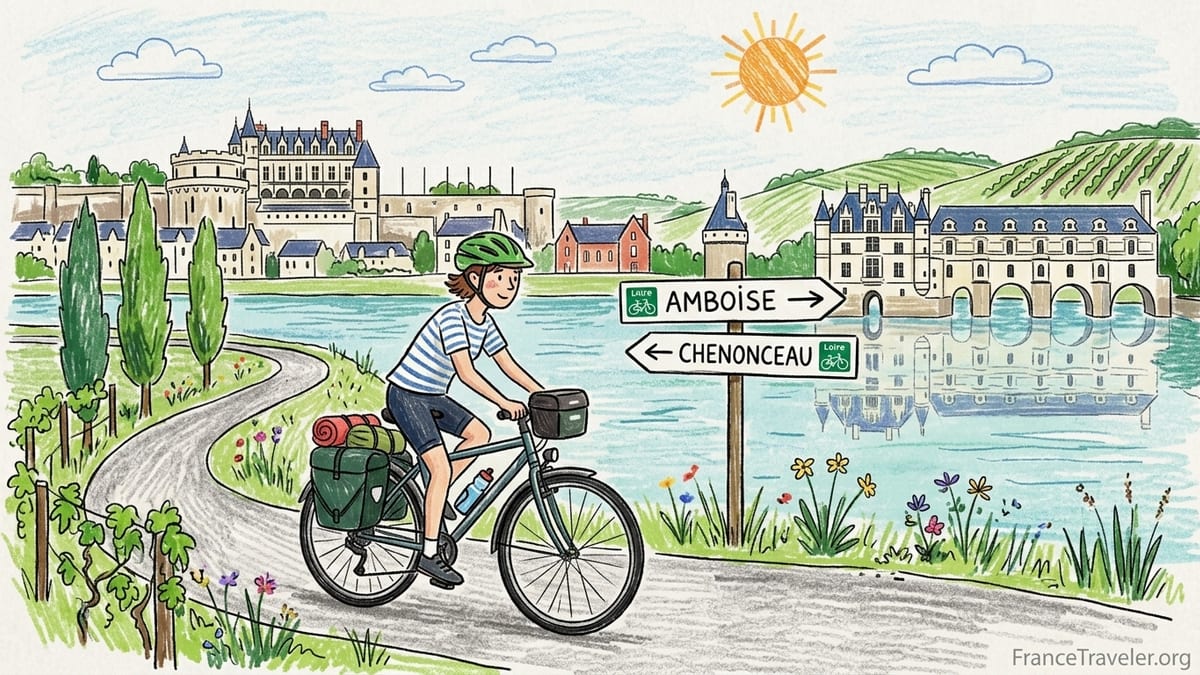
Choosing the Royal Loop Around Amboise
I based myself in Amboise, a compact riverside town with a royal château, Leonardo da Vinci’s last home at Clos Lucé, and a tourist office that has leaned fully into cycling. Local information panels and brochures confirm what Amboise tourism now states: the Loire à Vélo itinerary runs for close to 800 to 900 kilometers in total, but the signed options around town are much shorter. Amboise to Tours is about 25 to 27 kilometers by the main Loire à Vélo line along the river, while Amboise to Chenonceau is about 20 kilometers on a signed link into the Cher Valley. Stitch them together, with a return via different lanes, and you get the roughly 45‑kilometer “Royal Loop” that connects Loire and Cher landscapes around Chenonceau.
I planned two riding days, with an overnight in Tours in between. Day one would follow the Loire west from Amboise to Tours, mostly on dedicated riverbank paths and levee roads. Day two would use the Cher‑side route toward Chenonceau, then climb back toward Amboise on a mix of quiet backroads and waymarked cycle itineraries. On the map, the distances looked manageable even for someone who cycles regularly but is not a racer. What I underestimated was how much time château visits, vineyard stops and weather breaks add to your day when every minute is linked to the rhythm of your pedals.
The decision to ride a loop instead of a point‑to‑point section also meant I could leave heavier luggage in my Amboise guesthouse and travel with panniers rather than full touring bags. That single choice shaped the whole feel of the trip, from how nimble the bike felt on short climbs to how relaxed I was about locking it up outside a boulangerie in a small village.
Renting a Bike or E‑Bike in Amboise
Amboise has several rental outfits that have embraced the Loire à Vélo market. I booked in advance with a shop near the river that appears in the official Loire à Vélo partner listings, offering both standard trekking bikes and e‑bikes. For 2026, their advertised rates for a well‑maintained hybrid were around 20 to 25 euros per day, with e‑bikes from roughly 35 to 45 euros depending on season and model, including a lock and basic repair kit. Helmet rental was offered separately for a small fee, although many French riders still bring their own.
I opted for a modern trekking bike with 28‑inch wheels, 32 mm tires, a rear rack and 27 gears. The shop set it up with a kickstand and small handlebar bag as standard, and I added a pair of waterproof rear panniers for a few extra euros per day. E‑bikes in the same shop were mostly mid‑drive models with Bosch or similar systems, 400 to 500 Wh batteries and a quoted range of 70 to 120 kilometers in eco modes. Talking with the mechanic while he adjusted my saddle height, he mentioned that many visitors who rent e‑bikes are surprised at how little battery they use between Amboise and Tours, or even on a full Amboise–Chenonceau day with some exploration around the château.
For this particular loop, a conventional bike was enough for me, but I watched plenty of riders in their sixties and seventies glide past happily on e‑bikes with side panniers and handlebar rolls. If you are unsure, consider renting an e‑bike for peace of mind, especially if you want to add detours to hilltop viewpoints, or if you are riding in summer heat or shoulder‑season winds. The price difference over two or three days is usually less than a château admission ticket and can make the entire route feel comfortable rather than punishing.
Saddle, Panniers and Helmet: Small Choices, Big Impact
The Loire à Vélo is famously flat, but hours in the saddle still reveal any weak point in your setup. My rental bike came with a relatively wide, padded trekking saddle. On a shop test spin it felt plush, but by the end of day one my sit bones disagreed. The lesson was simple: if you have a saddle your body already knows, such as a well‑broken‑in touring or road model, bring it with you. Most rental shops are happy to swap saddles at the start of your hire if the rails are compatible.
Panniers made a bigger difference than I expected. I used two 20‑liter waterproof rear panniers for clothing, rain gear, camera and picnic supplies. With the weight low and to the back, the bike remained stable on packed gravel and on the occasional short descent on a country lane. Friends I met along the way had strapped large duffel bags to rear racks with bungee cords. They complained of “wagging” when cornering and of constantly needing to resecure shifting loads, particularly after buying wine in Montlouis or Vouvray. On the Royal Loop, where short but punchy rises lead away from the river, balanced panniers are worth the small rental cost.
Helmet culture on the Loire à Vélo varies. Legally, adults in France are not required to wear helmets, although children under 12 must. Around Amboise and Tours I saw everything from local commuters bare‑headed on city bikes to fully kitted tourers. I wore a lightweight, well‑ventilated helmet throughout. Afternoon crosswinds on the levees and the occasional interaction with local traffic on shared roads convinced me this was the right call, particularly on damp mornings when fallen chestnut leaves turned shaded bends into slick patches.
Signposting, Surfaces and Shared Sections
One of the joys of the Loire à Vélo is how easy the navigation feels most of the time. Official information confirms that the entire itinerary, variants and connectors included, is fully converted and signposted, with the green Loire à Vélo logo marking turns in both directions. On the ground between Amboise and Tours that meant I could stash my phone in a pannier and follow a near‑continuous string of direction panels along the riverbanks, through vineyards and into town centers.
The route west from Amboise to Tours largely follows the south bank of the Loire, passing through villages like Lussault‑sur‑Loire, Rochecorbon and Montlouis‑sur‑Loire. Much of this stretch uses traffic‑calmed roads on the levee, where cars are allowed but through‑traffic is discouraged and cyclists greatly outnumber vehicles. There are also long runs of smooth, purpose‑built cycle path set slightly back from the river. Official route descriptions for this section, and for the Loire à Vélo as a whole, emphasize that surfaces are mostly asphalt, with some sections of compacted stabilized gravel suitable for touring and city bikes with tires of 28 mm or more.
The signed link from Amboise to Chenonceau is more mixed. Leaving the Loire behind, I picked up signs for Chenonceaux in town, then followed quiet departmental roads like the D81 and D40 that climb gently through woodland and past small hamlets toward Civray‑de‑Touraine and the château. Traffic remained light, but these are normal roads without curbs or separation, so you need to ride single file, stay visible and be comfortable with the occasional passing car. The payoff is arriving at Chenonceau along the Cher River, with its iconic arches reflected in the water, knowing you rolled here entirely under your own power.
When planning your distances, remember that signposted distances are often for the most direct line. Short diversions to river viewpoints, troglodyte wine cellars or bakeries a few blocks off the main path can easily add another five to ten kilometers by the end of the day. I learned this the slow way when a morning of relaxed photo stops turned what should have been a three‑hour spin into a five‑hour ride to Tours.
Wind, Rain and the Reality of “Flat” Riding
The Loire à Vélo is marketed as accessible, almost leisurely, and the profile between Amboise, Tours and Chenonceau is indeed mostly flat with only gentle inclines away from the river. What the profile does not show is the effect of wind. On my first day, a headwind blew steadily from the west along the Loire. The river surface ruffled in small whitecaps, flags at château entrances snapped taut, and every exposed kilometre on the levee felt like riding uphill in a low gear, despite the road being dead flat.
Weather in the Loire Valley can be changeable from spring to early autumn. Forecasts for my days in the saddle mentioned scattered showers, and they arrived right on cue. A light but persistent rain set in shortly after leaving Montlouis. Because the trail surface here is mostly tarmac, grip remained good, but the fine spray from my front wheel reminded me why full‑length mudguards are such a worthwhile addition for multi‑day rides. The rental bike had them, and arriving in Tours without a soaked back was a small but real victory.
Rain also affects how you experience the landscape. Vineyards recede behind low clouds, and distant church spires vanish into the haze, but the scents of wet earth and crushed grape skins in harvest season intensify. I took an unscheduled warm‑up break at a café in Rochecorbon, joining other cycle tourists nursing hot chocolate and drying helmets on chair backs. This is where underestimated distances become obvious. By the time the rain eased, it was already mid‑afternoon, and the final run into Tours required a steady pace rather than more exploratory loops.
Compared with my day to Tours, the ride out to Chenonceau felt calmer but a little hillier, with gentle rollers on the approach to the Cher. A tailwind on the return section toward Amboise demonstrated the opposite side of the Loire coin. With the wind at my back, the same levee roads that had felt tough the previous day turned into smooth, almost effortless lanes where the bike seemed to float past poplar groves and sunflower stubble fields.
Food Stops, Markets and Riverbank Picnics
One of the best parts of riding the Loire à Vélo is how easy it is to refuel. Almost every village on the main line has at least a boulangerie and café, and larger towns like Amboise and Tours have abundant options for sit‑down lunches or meals on the go. Before leaving Amboise, I visited the covered market area near the river to pick up picnic supplies: a still‑warm baguette, local goat cheese, slices of rillettes and a small bag of strawberries in season. These fitted neatly into one pannier alongside a light rain jacket.
On the run toward Tours, Lussault‑sur‑Loire and Montlouis provided natural pauses. In Montlouis, a winegrower’s cave advertised tastings of local white wines made from Chenin Blanc, a reminder that the vineyards on the slopes above the path are living landscapes, not museum backdrops. I stopped for a short tasting, keeping portions modest since I still had riding ahead. Over two small pours and some conversation about harvest dates and recent summers, half an hour slipped by. Multiply that by similar temptations at troglodyte cellars in Rochecorbon or riverside guinguettes and you can see how a short stage expands.
Tours itself offers a different kind of food stop. Arriving in late afternoon, I rolled straight to the old town near Place Plumereau, locked the bike in a designated rack and joined the locals for a menu of the day at a small bistro. The next morning, heading back toward Chenonceau, breakfast was a simple espresso and croissant at a bar near the station, surrounded by commuters and a few other cycle tourists studying paper maps. Being able to carry snacks, fruit and a spare bottle of water in panniers meant that between villages I was never stressed about bonking, even when headwinds slowed progress.
Near Chenonceau, several snack stands and simple eateries cluster around the château parking and ticket area, with typical offerings like crêpes, sandwiches and coffee. Prices here reflect the site’s popularity, so if you are budget‑conscious, consider picking up provisions in Amboise, Bléré or Civray‑de‑Touraine and using the shaded picnic areas along the Cher. Secure your bike and panniers where you can see them, especially on busy days when tour buses arrive in waves.
Underestimating Distance and Was an E‑Bike Worth It?
Looking back, I clearly underestimated how demanding even 30 to 45 kilometers can feel when you ride them as part of a full sightseeing day rather than as a pure athletic outing. On my first day, I planned to leave Amboise around 9:00 a.m., reach Tours by lunch and spend the afternoon visiting the cathedral and museums on foot. Instead, between late departure, vineyard photo stops, a rain break and a detour into Rochecorbon’s side streets, I rolled into Tours closer to 4:00 p.m., pleasantly tired but with far less time for urban exploration than expected.
On the Royal Loop day that connected Tours, Chenonceau and back to Amboise, distance crept up again. The signed figures say roughly 20 kilometers from Amboise to Chenonceau and similar numbers between Tours and the Cher route, but by adding the ride from my accommodation, small navigational hesitations in town, and loops through château grounds, my GPS showed closer to 60 kilometers of pedaling by evening. It remained comfortable, but I would not have wanted to push much further with the same relaxed pace at stops.
Would an e‑bike have changed things? For a reasonably fit rider carrying light panniers, the physical effort on this loop is not extreme, but an e‑bike would smooth out headwinds, reduce the impact of short climbs away from the river and keep average speeds higher if you are short on time. I met a Dutch couple in their late fifties at a viewpoint above the Loire who had rented e‑trekking bikes in Amboise. With two full panniers each and a few bottles of wine lashed to the racks, they still arrived in Tours with energy to spare. They told me their battery use from Amboise to Tours in eco mode was under half a charge, leaving ample reserve for detours that they would have skipped on normal bikes.
In my case, the choice not to use an e‑bike forced me to slow down, accept that I would not see every château in a day and treat the river itself as the main attraction. If you have knee issues, are new to cycling or know you will be heavily loaded with luggage and souvenirs, an e‑bike is genuinely worthwhile in this region. If you enjoy the feeling of earning each viewpoint and are traveling with only small panniers, a conventional bike still suits the Royal Loop very well.
Luggage, Transfers and Riding Light
Because I used Amboise as both starting and finishing point, I could leave my main bag at the guesthouse and set out with just the two panniers. Inside I packed a change of clothes, lightweight sneakers for evenings, toiletries, a compact camera, a small lock, a multi‑tool and a basic first‑aid kit. Total extra weight was perhaps seven or eight kilograms, which the bike carried without complaint. The difference this made to the ride compared with a full touring load was striking. Climbing from the river up toward the plateau near Civray‑de‑Touraine, I could stay seated and spin an easy gear without feeling dragged down.
Along the Loire à Vélo as a whole, several luggage‑transfer services operate in partnership with accommodations. They typically charge a per‑stage fee to move bags between hotels or guesthouses so you can ride with only a daypack. Around Amboise and Tours in 2026, published brochures list prices in the ballpark of 25 to 40 euros per transfer, depending on distance and number of bags. For solo riders or couples, this can feel like a splurge, but for families or small groups it quickly becomes good value and transforms the ride experience. I met a family of four outside the Amboise tourist office waiting for their luggage van, each with just a handlebar bag and a single rear pannier for the day.
Even if you are carrying your own gear, it helps to be honest about what you really need. On my first packing attempt I included an extra pair of jeans and a thick sweater. Spreading everything out on the bed in Amboise, it became clear how much volume those unnecessary items took. They stayed behind, replaced by quicker‑drying layers and a packable gilet. Over two days, I was glad of every gram I left in the room when pushing into a headwind or lifting the bike up a short flight of steps to reach a riverfront promenade.
The Takeaway
Cycling the Loire à Vélo between Amboise, Tours and Chenonceau is often described as an easy introduction to multi‑day riding, and that is largely true. The route is well signposted, the gradients are gentle, surfaces are mostly smooth and bike services from rentals to repairs are widely available. At the same time, wind, weather, sightseeing stops and the subtle accumulation of kilometres can turn “just 40 kilometers” into a full‑body day out, especially if you underestimate how much time you will spend at châteaux and in vineyards.
From this short Royal Loop I learned several practical lessons. Book your bike or e‑bike in advance in Amboise, and consider upgrading to an e‑bike if you are unsure about your fitness or are traveling with a heavy load. Pay attention to the saddle and do not hesitate to ask for adjustments or bring your own. Use proper panniers so your luggage sits low and stable, and keep your overall kit lean if you are not using a luggage‑transfer service. Accept that food, markets and tastings are part of the experience and build generous time buffers into each day.
Most of all, remember that the joy of the Loire à Vélo is not in ticking off as many châteaux as possible. It is in the quiet moments of rolling along a levee as swallows skim the river, in tasting a glass of Chenin Blanc within sight of the vineyard where it was grown, and in the satisfaction of arriving at a place as storied as Chenonceau or Tours under your own power. Whether you ride on a classic trekking bike or an e‑bike, light or fully loaded, the section around Amboise offers a concentrated, very human‑scale version of what makes this route one of Europe’s cycling classics.
FAQ
Q1. How long does it take to cycle from Amboise to Tours on the Loire à Vélo?
Most riders take 2 to 3 hours of pedaling for the 25 to 27 kilometers between Amboise and Tours, but sightseeing and café stops can easily extend this to a full half‑day.
Q2. Is the route between Amboise and Chenonceau suitable for beginners?
The roughly 20‑kilometer link uses quiet country roads and gentle hills and is manageable for beginners who are confident in light traffic and comfortable riding 2 to 3 hours.
Q3. Do I really need an e‑bike for the Royal Loop around Amboise?
Fit riders with light panniers manage well on regular bikes, but an e‑bike helps in headwinds, on short climbs and if you are carrying heavier luggage or have joint issues.
Q4. What type of bike tires are best for this section of the Loire à Vélo?
Most of the route is on asphalt or smooth stabilized paths, so hybrid or touring tires around 32 to 40 mm wide offer a good balance of comfort, grip and low rolling resistance.
Q5. Are helmets mandatory on the Loire à Vélo?
In France, helmets are compulsory for children under 12 but not for adults. Even so, wearing a lightweight, ventilated helmet is strongly recommended on shared‑road sections.
Q6. How often will I find food and water along the route?
Between Amboise, Tours and Chenonceau you pass villages with bakeries, cafés or bars every 10 to 15 kilometers, so it is easy to refill bottles and buy snacks during the day.
Q7. Can I store my main luggage and ride with just day bags?
Yes. Many accommodations in Amboise and Tours will hold bags between stays, and regional luggage‑transfer services can move suitcases between overnight stops for a fee.
Q8. What happens if it rains while I am on the trail?
Most surfaces remain rideable in rain, but you will appreciate mudguards, a waterproof jacket and gloves. Villages along the way offer cafés where you can wait out heavier showers.
Q9. Is it easy to follow the Loire à Vélo signs, or do I need GPS?
The entire itinerary is fully signposted, and between Amboise, Tours and Chenonceau the green Loire à Vélo signs are frequent enough that most riders manage without GPS.
Q10. Are there trains that can help shorten a cycling day if I get tired?
Yes. Regional TER trains between towns such as Tours, Amboise and further along the Loire usually carry bikes, sometimes for a small fee, allowing you to skip or shorten stages if needed.