


I spent a full day at Château de Chambord in summer 2026, determined to understand how the new ticket prices, extras and on-site logistics actually feel when you are the one queueing, climbing staircases and hunting for lunch. What follows is exactly how my day went, what I paid, what was worth it and what I would skip next time.
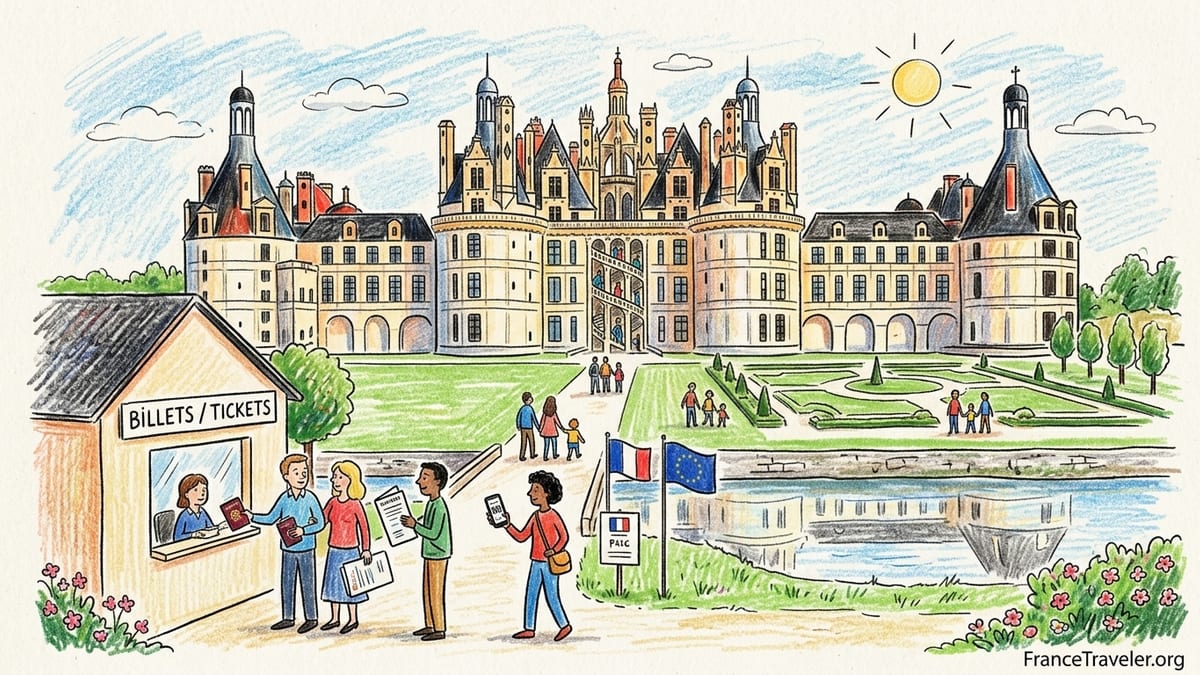
Booking Chambord Tickets Under the 2026 Pricing System
I visited Chambord in July 2026, a few months after the estate introduced its new experimental pricing structure. As of 2026, the standard château and French formal gardens ticket is officially set at 31 euros, with a preferential rate of 21 euros reserved for visitors who are citizens or legal residents of a European Economic Area country and can prove it with ID. At the ticket counter this difference is not theoretical. The cashier specifically asked which country I lived in and then requested to see proof before applying the lower 21 euro rate. In my case, as a US resident, I paid the full 31 euros for château and gardens entry.
I bought my ticket online the evening before after seeing signs on the official site warning of busy days during school holidays and summer weekends. The online system only sold full price individual tickets and timed entries for the château and gardens plus some add-ons. Reduced and free tickets, such as for European Union citizens under 26, had to be collected on-site on presentation of documentation. That mattered for the French family in front of me the next morning, whose 20 year old daughter used her EU ID card to obtain free entry while her parents each paid the 21 euro EEA rate at the ticket window.
Because of the new price gap between EEA and non-EEA visitors, the lines in front of the ticket windows occasionally slowed as people dug out passports, residence permits or digital cards. At one point, a couple from Brazil ahead of me were asked to step aside briefly while they found their documents in backpacks. If you qualify for the 21 euro rate, it is well worth having your ID ready in your hand before you reach the counter, otherwise you risk mild but unnecessary delays.
The online ticket spared me from that particular wait. With the e-ticket on my phone, I could use a separate fast-moving line at the entrance pavilion, where staff simply scanned the barcode. I would strongly recommend purchasing online if you are visiting in high season, especially on weekends between late March and late October when the château is open from 9:00 to 18:00 and coach groups arrive steadily throughout the morning.
Arrival, Parking and First Impressions of the Estate
I drove in from Blois on the D33 and reached the Chambord estate slightly before 9:00. From the forest road, the château suddenly appears across the canal, an eruption of spires and chimneys above the tree line. The approach road is straightforward, with clear signs for the main car parks. I chose the large P0 lot, which is roughly 600 meters from the château and is designed for day visitors arriving by car. Parking prices are posted at the pay machines. In recent years the estate has adjusted them occasionally, but on my visit the daily rate for a regular car at the main lot was still a single digit amount for the day, and I paid at the terminal on my walk back in the late afternoon.
From P0 it took me about eight minutes to walk to the visitor reception area at a relaxed pace. The path is flat and stroller friendly, but there is very little shade in the last stretch, so on a hot summer morning the sun feels intense. If you are arriving with small children or older relatives, it is wise to carry water from the car rather than assuming you will immediately find fountains. The estate grounds themselves are accessible without a ticket, so even before entering the château I had time to wander along the canal and enjoy the view of the facades reflecting in the water.
Travelers arriving by public transport tend to come via Blois-Chambord station and then use the Rémi shuttle buses that run on specific days. On the morning I visited, a group stepped off one of these buses around 9:15 and followed the same flow toward the central reception hall where the ticket offices, information desk, lockers and restrooms are located. Whatever your transport mode, this hall is effectively the real starting point of the visit, and it is where many people decide which extras they want to add.
Inside, I noticed signs advertising the 2026 “Passport” bundles, which combine château and gardens admission with several optional services such as the HistoPad tablet, an equestrian and birds of prey show ticket, and a discount on one of the leisure activities like bike or boat rental. The details of these packages change from year to year, but the concept is consistent: you pay a bit more upfront in exchange for a structured day. I decided not to take a full bundle because I wanted the flexibility to see how tired I felt as the day progressed, but if you are visiting as a family on a Saturday in peak season, a pre-arranged passport can be both economical and reassuring.
Queues, Security and Entering the Château
From the reception hall I followed the signs across the main forecourt to the château entrance. By 9:30, a short queue had already formed for security, a simple bag check and scan, followed by ticket control. Electronic tickets and printed tickets are handled in the same way, and staff were efficient. It took me less than 10 minutes to pass through the entire process. Visitors who had yet to purchase a ticket were directed to return to the ticket desks in the reception building, which is a good reminder to buy before walking all the way to the château doors.
Immediately inside the entrance hall, Chambord offers the HistoPad, a digital tablet guide that uses geolocation and augmented reality to show reconstructions of rooms as they might have looked in the 16th century. In 2026, the HistoPad was priced at a small additional charge per person. I decided to rent one partly out of curiosity and partly because I had read that the physical signage inside the château can be sparse in certain rooms. The process was quick. Staff took a small deposit in the form of scanning my ticket, handed me a tablet and a light lanyard-style strap, showed me the basic controls and sent me off toward the central courtyard.
As I crossed the courtyard, a large group visit in French had just begun, led by an official château guide. Later I learned that standard one hour English guided tours are usually offered at set times in peak season and are charged in addition to the base ticket, at around 7 euros per adult. On that day the English tour was scheduled for late morning, but I preferred to move at my own pace and use the HistoPad instead. If you like stories, context and being able to ask questions, the guided visit is likely worth that modest supplement, especially if you are not already familiar with French Renaissance history.
Before climbing the famous staircase, I recommend spending a few minutes in the cross-shaped central hall to orient yourself. The HistoPad invited me to scan a marker on the floor, which triggered a 3D reconstruction of the space in the time of François I, complete with sounds of court life. It was a helpful way to connect the now-empty stone rooms with the very busy human scenes that once unfolded there.
The Double-Helix Staircase and How Tiring the Château Becomes
The heart of Chambord is its extraordinary double-helix staircase, often attributed to Leonardo da Vinci. In reality, it is the effect of using it with hundreds of other visitors that makes you appreciate the design. There are two intertwined staircases that never meet, so you can ascend on one while another person advances on the other, visible through openings but never crossing paths. On a busy summer day this means the streams of people are naturally separated, which keeps things moving and avoids the stop-and-start congestion typical in other famous European castles.
I chose one side of the helix and began climbing. Each “flight” feels manageable at first, with broad steps and moderate height, but the overall vertical gain by the time you reach the terraces is substantial. I am reasonably fit and wore proper walking shoes, yet by late morning, after exploring multiple levels and climbing the helix several times to backtrack to rooms I had missed, my legs began to protest. Chambord’s interiors are not a quick stroll. If you intend to see both the royal apartments, the exhibition spaces and the terraces, expect several hours of slow walking and stair climbing on stone, with very limited seating except in a few designated rest areas.
The HistoPad subtly encourages you to cover more ground. It proposes a recommended route and occasionally notifies you of “nearby points of interest” on different floors. I found myself taking extra staircases to reach digital experiences such as a reconstruction of the royal hunting parties or a virtual furnishing of the king’s bedroom. This kept me engaged but also added to the physical strain. If mobility is a concern or you are traveling with someone who tires easily, it may be better to prioritize only a few key spaces and avoid the temptation to chase every digital icon.
By about 11:30, the density of visitors on the staircase increased significantly as late morning coach groups converged. The two intertwined flights helped a lot, but the landing spaces between levels still grew crowded. I learned that stepping aside into side rooms every so often helped break the ascent into phases. It is also a good way to rediscover quieter corners of the château that many people hurry past in their hurry to reach the roof.
Rooftop Terraces, Views and the Formal Gardens
Reaching the rooftop terraces around midday was the visual high point of my visit. You emerge among a forest of chimneys, lanterns and turrets, with the slate roofs curving around you and the symmetrical wings of the château unfolding toward the canal. The HistoPad again prompted me to scan markers that overlaid information on the skyline, pointing out features such as the fleur-de-lis crest or the royal salamander emblem carved into stone. The wind on the roof was strong that day, and the sun intense, but it felt like a reward after the staircase workout.
Time-wise, I reached the terraces about two hours after my initial entry, including many stops in furnished rooms and chapel spaces. For those with limited time, it is perfectly possible to accelerate and reach the rooftop in less than an hour, but you will then be choosing height over historical depth. From the roof I saw families using the terraces as a rest stop, sitting on low walls or leaning against the parapet to snack and rehydrate. There are no food stands up there, so you need to arrive prepared with water.
After descending, I exited toward the French formal gardens, which are included in the standard château and gardens ticket. The parterres stretch directly in front of the north facade, with geometrical lawns, low hedges and gravel paths. The gardens close about thirty minutes before the château itself, which matters if you are visiting at the end of the day. I walked them early afternoon when the light was harsh but the flower beds were bright. Benches along the alleys offered a chance to sit in partial shade and give my feet a break before considering any additional activities such as boat or bike rental.
Looking back at the château from the far end of the parterres gave me a sense of its improbable scale, especially the roofline. From that distance, the tourists and guided groups appear like tiny moving dots circling one enormous architectural sculpture. It was at this point, roughly four hours into my visit, that fatigue set in fully and I became grateful I had not also booked a tight schedule of extras in the early afternoon.
Food, Breaks and On-Site Services
Chambord’s central area around the château and canal has several food options ranging from takeaway stands to sit-down restaurants. By 13:30, most terraces were full, and walk-up service slowed as lunch peak hit. I chose a casual brasserie-style venue near the reception hall which offered typical French lunch fare such as salads, croque-monsieur and daily specials. Prices were in line with other major tourist sites in France, with main dishes typically in the low- to mid-twenties in euros. As a solo traveler I secured a table quickly, but families of four or more were sometimes told of short waits.
For those on stricter budgets, the estate provides picnic areas outside the immediate château forecourt. I saw several French families who had clearly brought their own baguettes, cheese and fruit, then purchased only drinks and ice creams on-site. This is a perfectly acceptable strategy and probably the most efficient way to manage both cost and time, especially with children who may not have the patience for a restaurant meal in the middle of a packed day.
Restrooms are distributed between the reception buildings, the château interior and near certain activity hubs like the boat dock, and were generally clean on my visit. There is also at least one cash machine near the main hall, and the estate’s shops sell a mix of regional products, books and design items. I used a short mid-afternoon break in the shop to escape the heat and browse local biscuits and wine. While the boutique is visually attractive, it can also be a time trap, so if your schedule is tight, it is better to leave souvenir shopping for the last half hour before departure.
One of the more thoughtful services I noticed was the availability of wheelchairs on request near the entrance for those who need them. However, due to the historic nature of the building, many upper levels remain accessible only by stairs. If full accessibility is essential, it is worth contacting the estate in advance to check exactly which parts of the château you will be able to visit comfortably.
Extras I Tried: HistoPad, Guided Tours, Boats and Shows
The HistoPad was the main extra I tested during my visit and, overall, I felt it was worth the modest additional fee. The device was responsive, the battery easily lasted the entire day, and the reconstructions were engaging without sliding into gimmickry. I particularly appreciated standing in an almost empty stone hall while the tablet showed me a banquet scene, complete with tapestries, tables and courtiers. For first-time visitors with limited background in French history, the HistoPad makes Chambord less abstract and helps explain why certain huge rooms exist even though they were rarely used.
What I would change next time is how intensively I used it. Early in the visit I tried to unlock almost every piece of content, scanning markers in side corridors and minor rooms. By mid-afternoon, that level of engagement became tiring and slightly distracting. If I returned, I would still rent the HistoPad but follow only the main curated route and ignore some of the optional stops so that I could spend more time looking directly at the architecture instead of down at a screen.
Although I did not take a guided tour on this particular day, I spoke with two British couples over lunch who had joined the morning English-language tour. They paid the extra fee per adult on top of their admission and described the one hour as “dense but very helpful.” According to them, the guide focused on the political context of François I, the influence of Italian Renaissance design and the symbolic aspects of the double-helix staircase. They also appreciated being shown small details in carvings and graffiti they would have missed alone. Based on their reactions, I would suggest the guided tour as a worthwhile extra for travelers who prefer a narrative framework or are visiting in cooler months when outdoor activities are less attractive.
In the afternoon I walked down to the canal where small rowing boats and electric boats could be rented. The rental hut advertised short sessions that let you circle the château from the water side, a perspective that photographs extremely well. Prices depend on the type of boat and duration, but they are distinctly an optional luxury and not necessary to enjoy the estate. Since my legs were already tired from the château interior, I chose to sit on a bench and simply watch others paddle by instead of renting a craft myself. It looked peaceful, but under the full sun some families with young children finished their rides looking more flushed than relaxed.
As for the equestrian and birds of prey show staged in the stables area, I deliberately chose to skip it. The show is ticketed separately, with specific performance dates between spring and autumn, and is often included in special day-pass bundles. The idea of sitting through a performance in the middle of the hottest part of the afternoon, then returning to the château or gardens afterward, did not appeal to me personally on such a warm day. If you are visiting in spring or early autumn and particularly enjoy horses or falconry, I can see this being a highlight, but in summer my priority was to pace my energy rather than add more structured commitments.
How Long I Actually Needed at Chambord
I entered the château just after 9:15 and left the estate parking around 17:30. That made my visit just over eight hours including lunch and breaks. Within that timeframe, I spent roughly three and a half hours inside the château itself, another hour between the rooftop terraces and formal gardens, around one hour eating and the rest simply wandering, taking photographs, sitting by the canal and exploring the shops and reception area.
If you are short on time, Chambord can be compressed into about four hours on-site. With disciplined pacing you could arrive at 9:00, visit the main interiors, climb to the roof, make a quick pass through the gardens and still leave by 13:00. However, that schedule leaves little room for queues, photo stops, rest breaks or unexpected closures of certain rooms for maintenance. It also means skipping most extras such as boat rental, guided tours or the equestrian show.
For a comfortable and satisfying experience, I would recommend planning at least six hours on the estate. That gives you time for a mid-morning arrival from nearby towns like Blois or Tours, a full visit of the château with HistoPad or a guided tour, a relaxed lunch break, an unhurried walk through the gardens and at least a short stroll along the canal or into the surrounding park. Families with young children may even want longer so that kids can expend energy outside after the more constrained indoor visit.
One unexpected factor that added to my overall fatigue was the sheer size of the surrounding park. Although access to the park and the area immediately around the château is free, the visual scale encourages you to walk “just a little farther” to see a perspective or path, which quickly turns into several additional kilometers on your step counter. By the time I retrieved my car in the early evening, I was glad I had not booked a long drive that same night and instead returned to Blois for a simple dinner and early sleep.
The Takeaway
Spending a full day at Château de Chambord in 2026 gave me a clear sense of how the new pricing, on-site logistics and optional extras collide with the physical reality of the place. The château and gardens ticket, now 31 euros for non-EEA visitors and 21 euros for EEA citizens and residents with proof, remains a solid value for one of the Loire Valley’s most emblematic monuments, but it is no longer an impulse purchase for many travelers. Planning ahead, both financially and logistically, makes an enormous difference to how relaxed your day feels.
From my own experience, three choices shaped the success of the visit. First, buying the base ticket online saved me time and minor stress at the ticket counters, which were slowed intermittently by the need to check EEA eligibility. Second, renting the HistoPad, while not perfect, gave me enough context to make sense of the vast interiors and turned otherwise empty rooms into memorable spaces. Third, resisting the temptation to book too many extras in advance kept my schedule flexible, which mattered once fatigue from the double-helix staircase and rooftop exploration kicked in.
If I were advising a friend planning a 2027 trip based on my 2026 day, I would tell them to arrive early, wear proper walking shoes, bring water and some snacks, budget at least six hours on-site and choose only one major extra, either the HistoPad or a guided tour, not both. I would also suggest treating boat rentals and shows as “nice if we still have energy” rather than fixed obligations. Chambord is as much about atmosphere and the slow appreciation of its improbable roofline as it is about ticking boxes of attractions.
Finally, it is worth remembering that the estate continues to experiment with its offerings and prices. Before your own visit, check the official information for up-to-date details about timetables, bundles and any special events that might affect crowds or access. With a bit of preparation and realistic expectations about how physically demanding the château can be, a day at Chambord is still one of the most memorable experiences in the Loire Valley.
FAQ
Q1. How much do tickets for Château de Chambord cost in 2026?
The standard château and French formal gardens ticket is set at 31 euros, with a preferential 21 euro rate for eligible EEA citizens and residents who present valid proof at the ticket office or entrance.
Q2. Do I need to buy Chambord tickets in advance or can I just show up?
You can buy tickets on-site, but in busy periods it is much smoother to purchase online in advance so you can use the faster e-ticket line and avoid queues at the ticket counters.
Q3. What documents do I need to get the 21 euro EEA rate?
You need proof that you are a citizen or legal resident of a European Economic Area country, such as a passport, national ID card or residence permit, and staff may ask to see it before applying the reduced price.
Q4. How long should I plan for a visit to Château de Chambord?
Based on my experience, you can just about see the essentials in four hours, but six to eight hours on-site allows for a relaxed château visit, rooftop terraces, gardens, lunch and a short walk by the canal.
Q5. Is the HistoPad worth paying extra for?
Yes, if you enjoy historical context and interactive reconstructions. It added meaning to many otherwise empty rooms, though I would recommend following the main route and not trying to unlock every single optional stop.
Q6. Should I choose a guided tour instead of the HistoPad?
If you prefer a human guide and the chance to ask questions, the paid guided tours are a good investment. If you value independence and flexible pacing, the HistoPad or a well-prepared self-guided visit may suit you better.
Q7. How tiring is visiting Chambord and its famous staircase?
The visit is more physically demanding than it first appears, with many stone staircases, including the double-helix, and long walks through the park and gardens, so comfortable shoes and occasional rest breaks are important.
Q8. Are there good food options on-site or should I bring my own lunch?
The estate has several cafés and restaurants serving typical French dishes, but they can be busy and relatively expensive, so many visitors combine on-site drinks and treats with picnics they bring themselves.
Q9. What extras would you skip if time or budget is tight?
I would prioritize the château, roof terraces and gardens, possibly plus one extra like the HistoPad or a guided tour, and treat boat rentals and the equestrian show as optional if energy or funds are limited.
Q10. Is Château de Chambord suitable for visitors with limited mobility?
The grounds, reception areas and parts of the lower levels are reasonably accessible, but many upper floors and the terraces require stairs, so visitors with mobility challenges should contact the estate in advance to plan appropriately.