


I went to the Loire Valley to “do the castles.” I even had a spreadsheet. Chambord at 10:00, Blois after lunch, Chenonceau the next day, Villandry at golden hour. It took less than 24 hours on the ground for that plan to fall apart, and I am glad it did. What surprised me, once I stopped treating the Loire as a castle checklist, was how much more the region made sense as a lived-in landscape of riverside towns, gardens and vineyards, stitched together by slow trains, small roads and long evenings over local wine.
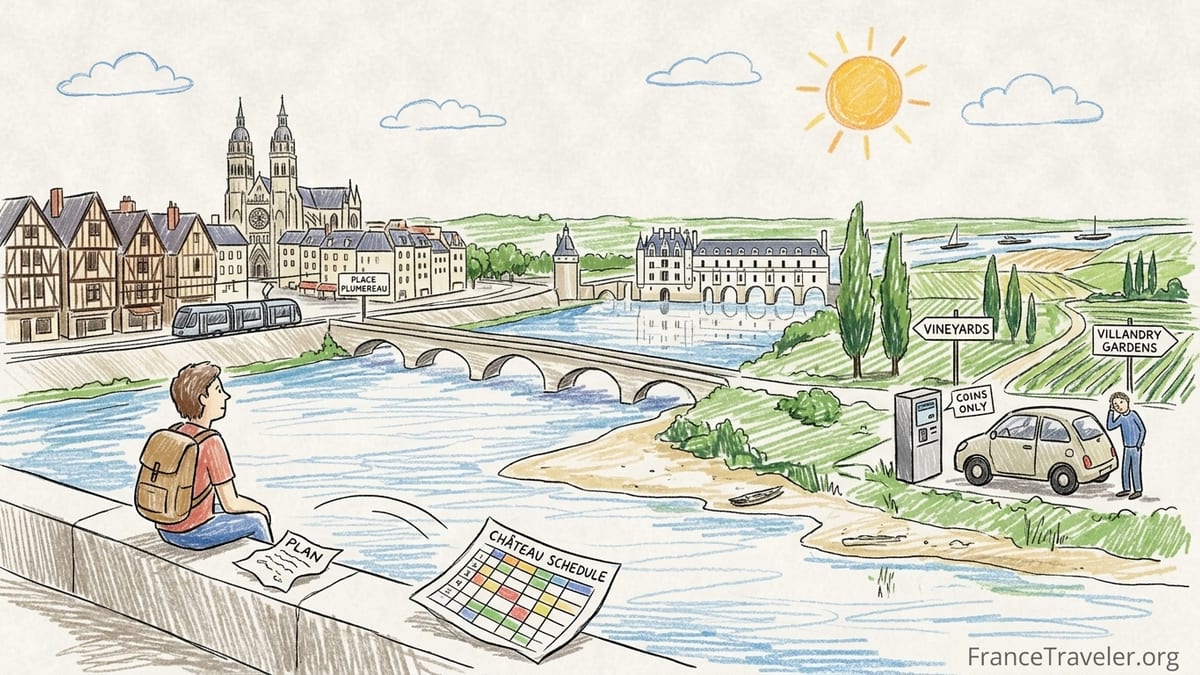
Arriving in Tours and Abandoning the Spreadsheet
I started in Tours, arriving from Paris on a late-morning train from Montparnasse. Fast TGV services cover the trip in about an hour with a change at Saint-Pierre-des-Corps, while slower direct TER regional trains from Paris Austerlitz take around two hours and stop at Blois and Amboise along the way. I chose a midrange TER with my bags tucked above my seat and a coffee from the station kiosk, thinking I would use the time to refine my château schedule. Instead, watching the landscape flatten into wide fields, poplars and the first glimpses of the Loire, I found myself closing the laptop and just looking out the window.
In Tours I checked into a modest hotel a few minutes’ walk from the station and the tram, the kind of three-star place with thin carpets, practical furniture and a breakfast room that smells of coffee and croissants from 7:00. I picked it mostly because it sat between the train lines and the historic center, so I could arrive without a car and still reach Place Plumereau on foot in ten minutes. The receptionist circled the pedestrian lanes on a paper map and, when I rattled off my list of planned château visits, simply raised an eyebrow and said, “You will be tired.”
That first afternoon I did not go to a château at all. I wandered instead through the old quarter of Tours, where half-timbered houses lean above the cobbles and students crowd the café terraces. I walked down to the Loire itself, wide and shallow here, crossed by low bridges and lined with sandbanks. Locals were sitting on the steps with takeaway coffees, facing the river like it was a stage. It was my first hint that the UNESCO designation for the Loire is not just about palaces, but about 280 kilometers of lived-in river landscape stretching between Sully-sur-Loire and the lower reaches near Angers.
Only that evening, over a glass of dry Vouvray in a wine bar near Place Plumereau, did I admit to myself that my color-coded castle plan was unrealistic. I could feel the temptation to tick them off, but already the town itself, with its tram rattling past the cathedral and the wide river at dusk, felt as important as any single monument.
Driving, Parking and Learning to Slow the Pace
I picked up a rental car the next morning from a depot beside Tours station, after realizing how much easier it would be to move between villages on my own schedule. The agent handed over a compact hatchback and warned me about narrow village lanes and parking machines that can be confusing for foreign cards. I scribbled “pay in coins” on my map and headed out on the D952, the road that broadly shadows the Loire west and east of Tours.
The driving distances looked short on paper. Tours to Amboise is about 25 kilometers, around 30 minutes by local road if you are not stuck behind a tractor. Amboise to Chenonceaux is about another 15 kilometers. But what the map does not show is how easy it is to lose time to river views, random signposts to vineyards, and the practicalities of parking and walking into each site. My first morning I aimed to combine Amboise and Chenonceau before lunch. I barely managed Amboise properly.
Parking varied more than I expected. In Amboise I found a free space along the riverbank below the château, a five-minute walk uphill to the entrance. At Chenonceau later in the trip, I used the large official car park, a shaded lot of gravel and trees set a short walk from the ticket office. It was free to leave the car there, but arriving mid-morning meant joining a slow stream of coaches and hire cars, and just getting from the road to a parking space took ten minutes. At Chambord, the parking is more structured, with signed lots set a few hundred meters from the walls and a daily fee collected by machine.
What surprised me most was how the time inside the attractions compared to the time between them. On the busiest day of my original plan, I would have spent under two hours in each château but over three hours cumulatively driving, parking, queuing and walking to and from the entrances. Once I recognized that imbalance, I started cutting stops and letting the days open up. The practical bits still mattered, but they stopped dictating the shape of the trip.
Amboise, Chenonceau and the First Signs of Castle Fatigue
Amboise was my first full château visit, and it set a pattern for both what worked and what did not. I bought a ticket at the entrance in the late morning, when queues for independent travellers were short, and followed the ramparts up into the gardens. From the upper terraces the Loire curves away beneath you, the town stretching along one bank with its church towers and small stone houses. I realized I spent almost as long leaning on the wall looking at the river and the bridge as I did examining the interiors and the chapel where Leonardo da Vinci is buried.
That afternoon I drove to Chenonceaux village, following small departmental roads through fields of sunflowers and vines. I parked in the official lot around 15:00 and joined a visible stream of visitors heading toward the long plane-tree avenue. By that point I was already feeling what I came to call “castle fatigue”: a kind of architectural overload where yet another grand staircase or tapestry starts to blur into the last one. Chenonceau, with its graceful arches over the Cher, deserved more attention than my tired brain was giving it.
At Chenonceau I bought a regular adult ticket at the walk-up price advertised at the estate that year and opted for the basic guide leaflet rather than an audioguide. The estate is open every day of the year, with extended hours in summer. I spent about an hour and a half inside the building itself, moving slowly through the kitchens, the gallery over the river and Catherine de Medici’s rooms, and about another hour in the gardens. Yet when I looked at my notes later, I had logged nearly the same amount of time just walking from the car, standing in line for tickets and an ice cream, and stopping for photos at the riverbank.
What I underestimated was how satisfying it is to simply sit in the gardens once you have seen the interiors. I grabbed a bench in Diane de Poitiers’ garden with a takeaway drink and watched groups pose for photos on the gravel paths. The water reflected the white stone arches, and for the first time that day I felt my shoulders drop. I left close to closing time, walking back along the nearly empty avenue, and realized that trying to “add” another château after Chenonceau would have diluted both experiences.
Blois, Chambord and the Day I Tried to Do Too Much
My most instructive mistake came on the day I combined Blois and Chambord. I drove from Tours to Blois on the TER route’s rough parallel by car, arriving in under an hour and using a paid underground car park near the old town to avoid circling. The Château de Blois rises right out of the streets, layers of medieval, Gothic and Renaissance wings over a central courtyard. I bought my ticket mid-morning, explored the courtyard and the royal apartments, and then realized I had spent longer than planned in the on-site exhibition on royal daily life.
I gave Blois about two and a half hours in total, including a coffee at a café on the square outside the château exit. It felt about right until I checked the time and saw that my self-imposed schedule gave me little margin to reach Chambord, park, buy a ticket and still see the famous double-helix staircase before closing. I drove south through the Sologne forest, reached Chambord’s signposted access road, and joined a queue of cars for the main parking areas.
At Chambord the entry process is more formal. I paid for a day of parking at a machine, walked the few hundred meters toward the entrance and bought a combined ticket at the official price for access to the château and the French formal gardens. From January 2026, the estate introduced a new pricing structure for standard tickets, and by the time I visited the adult rate to see the château and gardens had risen compared with earlier years. Once inside, I followed the flow to the central staircase, a spiral of stone where two separate flights coil without crossing. It is impressive, but the sheer number of people meant I spent more time waiting on landings than gazing at the architectural details.
Looking back, I would have split Blois and Chambord across two days, or at least stayed overnight nearby instead of driving back to Tours in the evening. On that day I spent less than 90 minutes actually inside Chambord, with another hour walking the immediate grounds, against close to three hours moving between parking, queues and the road. The vast park, which covers thousands of hectares of forest and meadows, remained largely a green shape on my car GPS instead of somewhere I walked or cycled. It was the clearest example of how chasing an extra big-name château can shrink your sense of the surrounding landscape.
Finding Balance in Villandry, Azay-le-Rideau and Chinon
After the overambitious Blois and Chambord day, I reoriented my trip west of Tours, where distances are shorter and the rhythm gentler. I based myself for two nights in a small guesthouse on the edge of the historic center of Azay-le-Rideau, with on-street parking and a short walk to both the château and the village restaurants. The owner served homemade jam at breakfast and gave brutally honest advice: “Two major places a day is already a lot. One with a good lunch is better.”
Villandry, famous for its terraced Renaissance gardens, is only about 15 kilometers from Tours and slightly less from Azay-le-Rideau. I drove there mid-morning, parked in a signed lot along the street a short walk from the entrance and bought a ticket that covered both the château and gardens. What surprised me was how the gardens dominated my memory. I spent almost two hours wandering the boxwood patterns, kitchen plots, water garden and belvedere, and barely 45 minutes inside the house. The benches above the ornamental plots became my office for the day as I watched gardeners trimming hedges and families following the map through the different themed sections.
Back in Azay-le-Rideau later that day, I walked from my guesthouse to the château in the late afternoon, buying a ticket at the official rate listed on the site. The building floats on the Indre, a compact jewel of early French Renaissance architecture. Here I found the opposite balance from Villandry: I spent just over an hour inside, climbing the grand staircase, checking the period rooms and taking in the reflections of the turrets in the water, but only about half an hour strolling the small island park. It worked because I did not have another château pressed up against it in the schedule. Afterward I sat on a terrace in the village with a glass of local white, watching the evening dog-walkers and cyclists pass on the main street.
Chinon turned out to be the missing piece that tied the trip together. The ruined fortress looms above a town strung along the Vienne river, which joins the Loire a little downstream. I visited by car, parking in a riverside lot and taking a lift up from the lower town to the fortress entrance, which saved my legs and underlined how the medieval defensive site dominated both the valley and the wine trade that made the town’s name. I spent longer than expected in Chinon, about three hours between the ramparts, the visitor center and the café terrace with its view over slate roofs and vineyards, and almost another hour tasting the local Cabernet Franc at a small bar in the lower town.
Evenings in the Towns and the Importance of Doing Less
The biggest surprise of the Loire once I gave up the checklist was how much I came to value the evenings in the towns. In Tours I returned more than once to Place Plumereau, where restaurants and bars line a square of half-timbered facades. Most nights I chose a simple set menu, often under 25 euros for three courses, featuring goat cheese from the region, rillettes and fish from the Loire. The house wines were usually local, with Vouvray whites and Chinon reds offered by the glass or carafe.
In Amboise, where I spent one night in a small family-run hotel a few streets back from the river, the evening rhythm revolved around the château’s floodlit walls. After a day at Chenonceau, I skipped any additional sightseeing and simply walked the river promenade as the sun went down, watching the reflection of the bridge and castle in the water. I ate at a casual brasserie with outdoor tables, where the owner recommended a glass of Montlouis-sur-Loire to go with a plate of grilled fish. It felt like a local evening rather than a rushed stop between monuments.
Even in tiny Chenonceaux village, which is physically close to the château but has a different pace once the day-trippers depart, an overnight stay would have changed my relationship with the place. I did not sleep there on this trip, but walking back to my car near closing time, passing shuttered souvenir stands and hearing only the sound of the river, I understood why many travellers now choose to stay near one or two châteaux rather than in a larger hub like Tours.
The pattern repeated in Azay-le-Rideau and Chinon: the moments that stay with me are not the individual fireplaces or portraits, but the time spent lingering over dinner on village squares, talking with hosts about harvest dates, or watching locals cast fishing lines into the river at dusk. The châteaux provided the hooks that brought me to each town, but the evenings gave the trip its shape.
Tickets, Opening Days and How Much to Book in Advance
Practical systems across the Loire have shifted in recent years, and some planning does help. The major estates such as Chenonceau and Chambord now publish detailed 2026 opening hours and ticket prices on their official sites. Chenonceau is open every day of the year, with hours that stretch from morning into late afternoon or evening depending on the season, and a standard adult ticket that, in 2026, is advertised in the high teens of euros for basic entry with a leaflet, with supplements for audioguides. Chambord operates with a different pricing structure, where from early 2026 the combined château and formal gardens ticket for adults has increased compared with earlier years, reflecting the scale of the estate and its restoration work.
I found that for visits in shoulder seasons it was feasible to buy tickets on arrival for almost all the sites, as long as I avoided the late morning peak when tour buses show up. The only place where I seriously considered advance booking was Chenonceau, particularly on weekend days, because its popularity and relatively compact footprint mean the ticket office and gate can feel crowded. Even there, though, arrival just after opening or in the late afternoon eased the experience. At Blois, Villandry, Azay-le-Rideau and Chinon I purchased tickets at the entrance on the day without trouble.
Transport tickets also played a role in how flexible I could be. On an earlier Loire trip I had used a regional rail pass sold by the local operator for Centre-Val de Loire, which allowed unlimited TER travel over two or three days for a fixed price for up to five people. That kind of pass pairs well with a slower, town-based itinerary. On this more recent journey I focused on the car, but still kept an eye on train timetables for the return to Paris. Direct TER trains from Tours back to Paris Austerlitz take around two hours and do not require seat reservations, while TGV trains from Saint-Pierre-des-Corps to Paris Montparnasse need advance booking but are faster.
What I would change next time is to pick one or two anchor towns for multiple nights and use public transport more between them, renting a car only for specific days like Chambord or Villandry where the sites sit further from rail stations. That shift would reduce parking worries and allow me to enjoy more glasses of local wine with dinner without calculating blood alcohol limits for night driving on unfamiliar rural roads.
The Loire as a Living Landscape, Not a Tally of Châteaux
Somewhere between a second glass of Chinon red and a walk along the Loire in Tours at sunset, the region stopped feeling like a list of buildings and more like a coherent place. The UNESCO designation covers around 280 kilometers of the middle Loire and its banks, but on the ground that translates into patterns repeated from town to town: levees holding back the river, flat-bottomed boats pulled up on sandbanks, stone houses with slate roofs, and rows of Cabernet Franc or Chenin Blanc vines rising up behind them.
Once I paid attention to those patterns, my days shifted. Instead of asking which famous room I would see next, I started asking where the river would appear in my day, whether I would cross it on an old stone bridge, follow it on a bike path, or see it at breakfast from a hotel window. I slowed down enough to notice how the light changed on the water, how locals used the towpaths for running in the morning and for picnics in the evening, and how the châteaux themselves often turned their most elaborate facades toward the river rather than the road.
I also began to connect the dots between plate and landscape. In Chinon and Bourgueil I tasted reds that came from vineyards I had driven past earlier that same afternoon. In Vouvray I tried sparkling wines made in cellars carved into the tuffeau cliffs above the Loire. Menus in small restaurants highlighted goat cheeses and river fish, and shop windows displayed jars of rillettes and local honey. These details grounded the grand architecture in a daily economy and culture that still feels tied to the river, not just to tourism.
If you arrive in the Loire with only the castles in mind, you will of course see remarkable buildings. But the region makes far more sense, and offers a deeper kind of pleasure, when you treat those châteaux as part of a wider ensemble that includes modest market squares, towpaths, vineyards and bridges. My main realization was simple: every time I dropped one château from the list, I gained an evening, a river walk or a slow meal that lodged in my memory longer than any single gallery of portraits.
The Takeaway
By the end of my trip, I had visited fewer big-name châteaux than I planned and enjoyed the Loire Valley more than I expected. I slept in practical hotels in Tours and Amboise and a homely guesthouse in Azay-le-Rideau. I took regional trains and local roads, fed parking meters and found free riverbank spaces. I queued at ticket offices and walked up long drives. But I also sat in gardens at Villandry until the light turned soft, watched the Cher slide under Chenonceau after most visitors had gone, and leaned on fortress walls in Chinon with a view that explained centuries of history in a single glance.
If I were planning the trip again, I would give myself at least three full days, ideally four or five, with no more than one major château and one small site per day. I would center the itinerary on two or three towns, for example Tours, Amboise and Chinon or Azay-le-Rideau, and deliberately build in time for markets, wine bars and river walks. I would still visit Chambord and Chenonceau, but I would resist the temptation to add “just one more” palace to every day.
Most of all, I would remember that the Loire is not a theme park of individual attractions but a continuous cultural landscape, where the line between heritage and everyday life remains pleasingly blurred. The castles gave me the reason to come. The towns, the river and the wine are what will bring me back.
FAQ
Q1. How many days do you really need in the Loire Valley?
For a first trip that balances castles with towns and river time, I found three to five full days ideal, with travel days on either side.
Q2. Is it better to stay in Tours or in smaller towns like Amboise or Azay-le-Rideau?
Tours works well as a transport hub with lots of dining options, while smaller towns such as Amboise or Azay-le-Rideau offer quieter evenings and easier access to nearby châteaux.
Q3. Do you need a car to explore the Loire Valley?
You can reach major towns like Tours, Blois, Amboise and Chinon by train, but a car gives more flexibility for sites like Chambord and Villandry that sit away from rail stations.
Q4. How many châteaux should you plan to see in one day?
From experience, one major château and perhaps one smaller site per day is a comfortable maximum if you also want time for meals, towns and the river.
Q5. Are tickets for the big châteaux like Chambord and Chenonceau better booked in advance?
In busy seasons or on weekends, prebooking can shorten queues at places like Chenonceau and Chambord, but outside peak times I was able to buy tickets on the day.
Q6. How expensive are château tickets in the Loire Valley?
When I visited, adult tickets for major sites such as Chambord and Chenonceau were in the high teens to low twenties of euros, with smaller châteaux a bit less.
Q7. What was your biggest planning mistake on this trip?
Trying to combine Blois and Chambord in the same day left too little time for Chambord and turned what should have been a highlight into a rushed box-tick.
Q8. Which château or town surprised you the most?
Chinon surprised me with its combination of hilltop fortress, riverside town and nearby vineyards, which together gave a stronger sense of place than any single building.
Q9. When is the best time of day to visit popular châteaux?
Early morning at opening and late afternoon toward closing were the calmest times during my trip, especially at Chenonceau and Villandry.
Q10. How did you handle meals while moving between sites?
I often scheduled a sit-down lunch in a nearby town and kept dinners for my base, which meant fewer rushed snacks and more relaxed evenings on village squares.