


I have based myself in Tours, Amboise and Blois on different Loire Valley trips, sometimes with a rental car and sometimes relying on trains and shuttle buses. Each town gave me a very different experience. Your choice of base will quietly shape everything from how early you manage to reach the châteaux to whether you are circling for parking at 8 p.m. or already sitting with a glass of Vouvray. This is a practical look at how the three main bases really work on the ground.
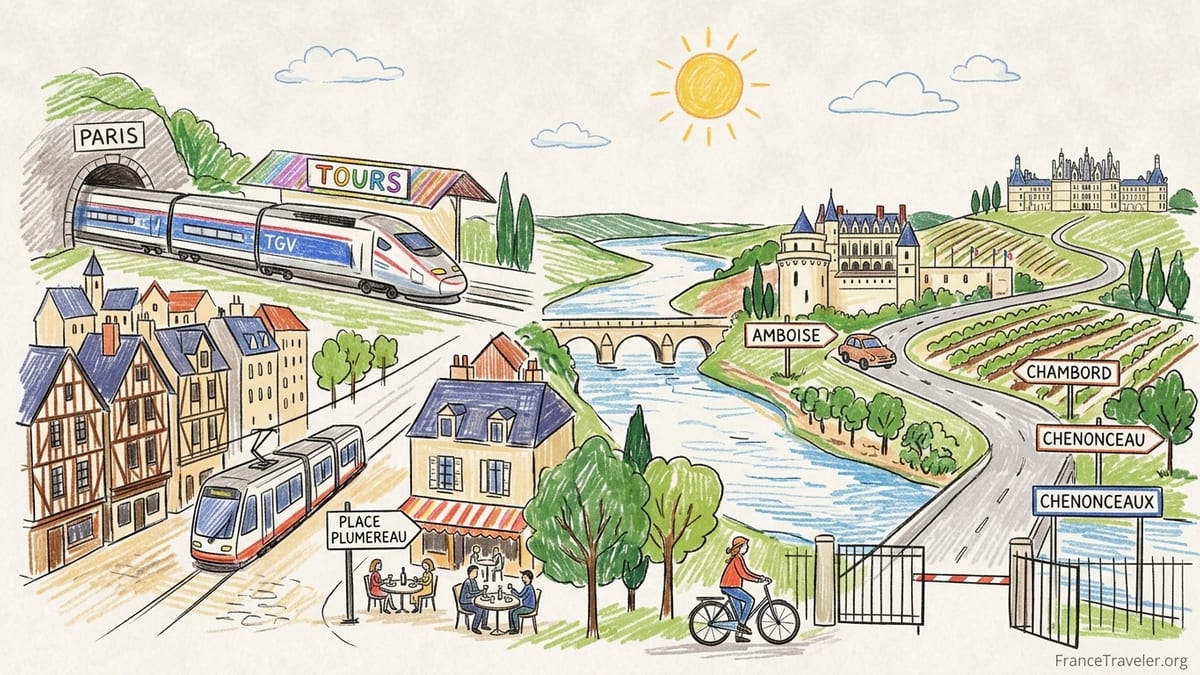
Tours: Rail Hub and Big-City Evenings
Arriving in the Loire Valley without a car, Tours immediately feels like the logical hub. High speed TGV trains from Paris reach nearby Saint-Pierre-des-Corps in around an hour, with frequent connections into central Tours, which makes it the officially promoted “capital” and classic departure point for exploring the châteaux. The main station sits right at the edge of the compact center, so on trips when I arrived with a suitcase I was walking to my hotel or tram in under ten minutes rather than hunting for a taxi queue.
Without a car, that rail connectivity matters every single day. Regional TER services link Tours to Amboise, Blois, Chenonceaux and Azay-le-Rideau, and local tourism authorities explicitly recommend basing here for car-free itineraries that combine trains and bikes. From Tours I have left on a morning TER that put me at Chenonceaux station directly across from the gates of Château de Chenonceau in roughly 35 minutes, then continued by train later in the day to Amboise for dinner, all without opening a timetable app more than once.
The city itself gives you an urban evening that neither Amboise nor Blois can match. Around Place Plumereau in the Vieux Tours quarter, restaurants and wine bars line timbered medieval houses, and on a summer evening tables spill into the square. I have wandered out at 9:30 p.m. on a Tuesday and still had a choice of bistros serving full menus, along with late-opening crêperies and ice cream stands. That density of dining options means you rarely need to reserve far ahead outside peak weekends, and you almost always find something within a five to ten minute walk of a central hotel or apartment.
With a car, Tours works differently. The central streets are busy and one-way, and while there are several underground car parks near the old town, you pay city-center rates by the hour or day. On one trip I stayed a ten minute walk from the station and kept the car in a covered car park under a shopping center. It was convenient for day trips out to Villandry and Langeais, but I always had to factor in the time to retrieve the car from a multi-story garage and navigate out through traffic lights, which did not feel very “château weekend.” Tours is ideal when trains are your backbone, but if you plan to drive every day, that same urban density can start to feel like friction.
Amboise: Storybook Riverside Base Near Major Sights
Amboise is where my perception of the Loire Valley clicked into the image many people carry in their head. The town curls along a bend in the Loire, watched over by the Château Royal d’Amboise and, a few minutes inland, the Château du Clos Lucé where Leonardo da Vinci spent his final years. The Clos Lucé sits right in the town center, about 500 meters from the royal château, and the local tourist office notes a paid car park on site and free spaces at the Tanneurs lot just a short walk away. In practice that means you can leave your car once at the edge of the old town and visit both houses entirely on foot, then continue through the lanes for dinner.
Parking and walking to dinner in Amboise are part of the rhythm. On one summer stay I parked in the riverside lot near the Île d’Or. I would cross the bridge on foot, climb gently into the historic streets and be at a restaurant table on Rue Nationale in under ten minutes. Even when I returned close to 11 p.m., I felt comfortable making that walk back under the floodlit château. The town is used to overnight visitors, with additional parking areas, including campervan spaces, clearly signed near the center and cycling route. That setup made it easy to forget the car after a day of driving to Chenonceau or Chaumont-sur-Loire.
Reaching Amboise by train is straightforward but slightly less seamless than Tours. The railway station is set back from the river, roughly a 15 to 20 minute walk to the old town according to local walking maps. Several times I have arrived on a TER from Tours with a small bag and simply walked, but it is worth knowing that taxis are not always waiting outside, especially later in the evening. If you are catching an early morning departure, for instance towards Blois or back to Paris, you may prefer to stay closer to the uphill road leading to the station rather than right on the riverfront.
As a base for nearby sights, Amboise punches well above its size. You can easily pair the in-town royal château and Clos Lucé with a short drive to Chenonceau, often reached in under 30 minutes by car, or continue slightly farther to Chaumont-sur-Loire and its respected garden festival. Several wineries in Vouvray and Montlouis are within an easy drive or guided-tasting transfer as well. For me, this combination of walkable historic center, two major attractions on the doorstep and a cluster of others within a short drive made Amboise the most relaxed base when I wanted a “Loire Valley holiday” feeling rather than just a transport hub.
Blois: Gateway to Chambord, Cheverny and the Eastern Cluster
Blois is where the map of the eastern Loire Valley suddenly makes sense. The town sits along the Loire with its own impressive château in the center, but what makes it stand out as a base is its position relative to Chambord, Cheverny, Chaumont-sur-Loire and the smaller estates tucked into the Sologne forests. Local tourist materials highlight four of the greatest châteaux in this area: Chambord, Cheverny, Blois itself and Chaumont-sur-Loire, all within a short driving radius.
By car, the distances are exactly what you hope for on a château-focused weekend. Chambord lies roughly 20 kilometers from Blois, and under good conditions I have driven from a parking garage in the upper town to the edge of the Chambord estate in about 25 minutes. Cheverny is slightly closer in the opposite direction. Because these routes avoid major urban traffic once you have cleared the Blois riverfront, you are able to leave after breakfast and arrive at opening time without setting an alarm at dawn. It is entirely feasible to visit, for example, Chambord in the morning, drive back towards Blois, stop at a small estate such as Beauregard or Troussay in mid-afternoon, and be back in town in time to shower before dinner.
Blois also works well if you want to keep using the train. The station is named Blois–Chambord and sits close to the center, on the main line between Paris and the southwest. Walking between the station and the old town has taken me roughly ten minutes at a moderate pace, up a short but noticeable slope. From Blois station, a seasonal “châteaux shuttle” bus serves Chambord, Cheverny and Beauregard between about April and early November, coordinated with trains from Paris and Orléans. On one trip I booked accommodation near the château and was able to make a car-free day visiting both Chambord and Cheverny, returning on the shuttle in the late afternoon and strolling straight into town for dinner.
The trade-off compared with Tours is evenings. Blois has good restaurants, especially in the streets rising behind the château, and I have enjoyed meals with local game and Sologne wines, but the scene feels more small-town than city. After 10 p.m. options thin out, and midweek in shoulder season I was glad I had reserved ahead at one of the more popular bistros. On the other hand, parking is generally simpler than in Tours. Several surface and structured car parks are spread around the center, and outside peak festival weekends I have usually found a spot within a short walk of the old town, then left the car there for the evening.
Morning Departures, Parking Realities and Walking Back From Dinner
When you compare the three bases in terms of logistics, the picture sharpens. In Tours, early morning departures are easiest if you are going by train. A 7 a.m. or 8 a.m. TER to Chenonceaux or Amboise means simply walking from your hotel to the station in 10 to 15 minutes, grabbing a coffee in the concourse and boarding. With a car, leaving Tours at 8 a.m. for somewhere like Villandry or Azay-le-Rideau has usually meant at least a few traffic lights and roundabouts before you reach faster roads, so I tend to allow an extra 20 to 30 minutes beyond pure driving time.
From Amboise, heading out by car for the day is easier, but very early train departures are less convenient. Driving to Chenonceau or Chaumont has usually been quick and almost entirely on secondary roads through fields and vineyards. On one spring morning, I left a guesthouse on the hill at 8:30 a.m. and was parking under the trees on the approach to Chenonceau by 9:00 a.m. For train journeys, that 15 to 20 minute walk to the station becomes a factor. Catching a 7 a.m. TER to Tours or Blois with luggage meant setting off in the dark along a mostly quiet road, something solo travelers might prefer to avoid.
Blois offers a compromise. If you are using the shuttle bus to Chambord or Cheverny, you need to pay close attention to the timetable, because the first departures are scheduled to match mid-morning train arrivals. That means you rarely need to be at the station at sunrise, which is a relief, but it also means that trying to squeeze in three major châteaux in a single day without a car can become stressful. Driving yourself solves that, and the exit routes from central Blois towards Chambord or Sologne open up quickly once you cross the river or climb out of the valley.
Walking back from dinner feels slightly different in each place. In Tours, the old town streets remain lively late into the evening, with students and locals spilling out of bars around Place Plumereau, so I have never felt isolated walking 10 or 15 minutes home. In Amboise, nights are quieter, but the core between the bridge and the château stays gently animated while restaurants are open, and the compact size means your accommodation is likely within a short, well-lit walk. Blois sits somewhere between the two: the slopes and staircases around the château feel atmospheric rather than crowded after dark, and I have sometimes chosen my restaurant based partly on avoiding a very steep climb back to a top-of-town hotel.
Did Staying Centrally Really Reduce Driving?
One of the main reasons travelers obsess about their Loire Valley base is the hope that the “right” town will greatly reduce the amount of driving each day. In my experience, staying centrally in Tours, Amboise or Blois changed the feel of the trip more than the actual distances driven. The big châteaux are spread along a wide valley, and no single base will put you within ten minutes of all your targets.
From Tours, I logged the fewest driving kilometers on trips where I leaned heavily on the train. Chenonceau is essentially a rail-side château, with the station gate opposite the entrance, and Amboise and Blois are on the same rail corridor. On one car-free stay I used the TER for three successive days: Chenonceau, then Amboise, then Blois, and only rented a bike locally for side trips along the river. That felt like the least tiring itinerary, because I did not have to think about parking at all.
In Amboise, staying close to the river and château did not reduce driving to other sites by much, but it transformed the way my days started and ended. I still drove out to Chenonceau and Chaumont in the mornings, but once I returned and parked for the evening, everything I wanted was within five or ten minutes on foot. That “park once per day” rhythm made the town feel like a holiday base rather than a series of logistics problems. The same applied when I visited wineries in nearby Vouvray and Montlouis: I was back in town before dinner, with the car off my mind.
Blois offered the biggest time savings for a very specific type of trip. When I planned a weekend focused on Chambord and Cheverny, basing in Blois genuinely cut out at least an hour of total driving per day compared with a previous stay in Tours. I could visit Chambord in the morning and Cheverny in the afternoon, with a brief return to Blois in between if I wanted a break. However, if I added western sights such as Amboise or Azay-le-Rideau, the extra distance quickly ate into those gains. The reality is that “central” in the Loire Valley is as much about being central to your own wish list as it is about geography on a map.
Which Base for Different Types of Trip?
For a car-free trip, I now consistently recommend Tours as the most practical base, and it is the one I would choose for myself. The combination of frequent TGVs from Paris, regional trains along the Loire corridor and the presence of services like dedicated cycling routes and guided day tours from the city give you flexibility. Tourism bodies actively describe Tours as the rail hub for a “Loire Valley without a car,” with explicit mentions of direct TER connections to Chenonceaux and other château towns. From a traveler’s viewpoint, that translates into being able to decide after breakfast whether to catch a late-morning train to Amboise or simply wander the city itself.
For a château-focused weekend by car, I would base in Blois. Its position relative to Chambord, Cheverny and Chaumont-sur-Loire makes it easy to build one or two dense sightseeing days without long highway stretches. You can leave after a reasonable breakfast, be on site at opening time, and still have energy for a walk around the old town in the evening. The existence of the Blois–Chambord station and coordinated château shuttle also gives you the option of leaving the car parked for a day if you prefer.
For a wine-oriented trip that blends tastings with a sense of place, I lean towards Amboise. The town sits between the vineyards of Vouvray and Montlouis, close enough that organized tastings and transfers are common, yet it retains a village feel that makes it enjoyable to stroll after a day in cellars. I have returned from afternoon tastings in Vouvray, parked once near the river and spent the rest of the day on foot between the château, Clos Lucé and restaurants on Rue Nationale, without once thinking about driving again.
For a first visit to the Loire Valley, my personal choice would depend on how much time I had. With only two or three nights, I would probably base in Amboise, because it delivers the postcard mix of river, château skyline and a couple of world-class sights within walking distance, while still allowing short drives to Chenonceau and perhaps one more estate. With four nights or more, I would consider splitting the stay between Tours and Blois, using Tours at the start for car-free rail-based exploration and its lively evenings, then picking up a car and moving to Blois for an eastern château cluster. Importantly, I do not see a single universal “winner” among the three; each town excels for a different kind of trip.
The Takeaway
Choosing between Tours, Amboise and Blois is really about matching the town to the shape of your days. Tours offers the smoothest arrivals and departures by rail and the richest restaurant and bar scene, and I have valued that whenever I traveled without a car or wanted city energy after dark. Amboise wraps major historic sights into a compact riverside setting where you can park once and live on foot, making it ideal for a romantic first visit or a relaxed wine-centered stay.
Blois, quieter in the evenings but superbly placed for Chambord, Cheverny and the eastern castles, has given me the most efficient château weekends by car, as well as a surprisingly workable base for public transport days using the coordinated shuttles. Whichever base you choose, it is worth planning your château list first, then looking at maps, train timetables and driving times, so that your days flow naturally from breakfast to last glass of Loire wine rather than bouncing back and forth across the valley.
France’s rail network and regional planning make it perfectly realistic to connect these three bases within a single journey. I have started in Tours, continued by train to Amboise and finished in Blois without any car at all, simply using the TER line that links them. Thinking of the Loire Valley as one coherent region, with different “chapters” based in Tours, Amboise and Blois, can sometimes be more rewarding than searching for a single perfect town. In the end, the best base is the one that lets you spend more time in château gardens and riverside squares, and less time checking parking meters and departure boards.
FAQ
Q1. Is Tours, Amboise or Blois best if I am arriving by train from Paris?
Tours is usually the most convenient if you are coming straight from Paris by rail, because high speed and regional trains feed directly into its main station and nearby Saint-Pierre-des-Corps, and it is officially promoted as the primary rail gateway to the Loire Valley.
Q2. Which town works best without renting a car at all?
For a completely car-free trip, Tours is generally the most practical base, with frequent regional trains along the Loire corridor to places such as Amboise, Blois and Chenonceaux, plus organized day tours that pick up in the city center.
Q3. How far are the train stations from the historic centers?
In Tours the main station is right at the edge of the center, about a ten minute walk from many hotels; in Amboise the station is roughly a 15 to 20 minute walk from the old town; and in Blois the Blois–Chambord station sits about a ten minute walk uphill from the central château area.
Q4. Is parking easier in Tours, Amboise or Blois?
Parking in Tours is mostly in underground or structured garages with city-center pricing, Amboise relies on signed surface lots around the river and old town, while Blois offers a mix of surface and covered car parks that are usually less busy than those in Tours outside peak periods.
Q5. Which base is best for visiting Chambord and Cheverny?
Blois is usually the most convenient base for visiting Chambord and Cheverny, as both lie within a short drive and there is also a seasonal shuttle bus linking the Blois–Chambord station with major nearby châteaux.
Q6. Where should I stay for a wine-focused trip?
For a wine-oriented stay, Amboise works very well because it sits between the vineyards of Vouvray and Montlouis and combines easy access to tastings with a compact, walkable center for evenings.
Q7. Which town has the best evening atmosphere and restaurant choice?
Tours has the liveliest evening scene and widest choice of restaurants and bars, especially around Place Plumereau, while Amboise offers a more intimate riverside atmosphere and Blois feels quieter and more traditional after dark.
Q8. Will staying centrally actually reduce how much I drive?
Staying centrally mostly reduces the need to drive in the evening and simplifies parking, but it does not eliminate daytime driving between widely spaced châteaux, so picking a base close to the specific sites you want matters more than finding the geographic center of the region.
Q9. Is it realistic to split my stay between two of these bases?
Yes, many travelers split their time, for example starting in Tours for car-free rail-based sightseeing and then moving to Blois or Amboise with a rental car, and regional trains link all three towns if you prefer not to drive between them.
Q10. Which base would you choose for a first short visit?
For a first stay of only two or three nights, I would personally choose Amboise, because it combines a classic Loire riverside setting with two major sights in town and several other key châteaux within a short drive.