

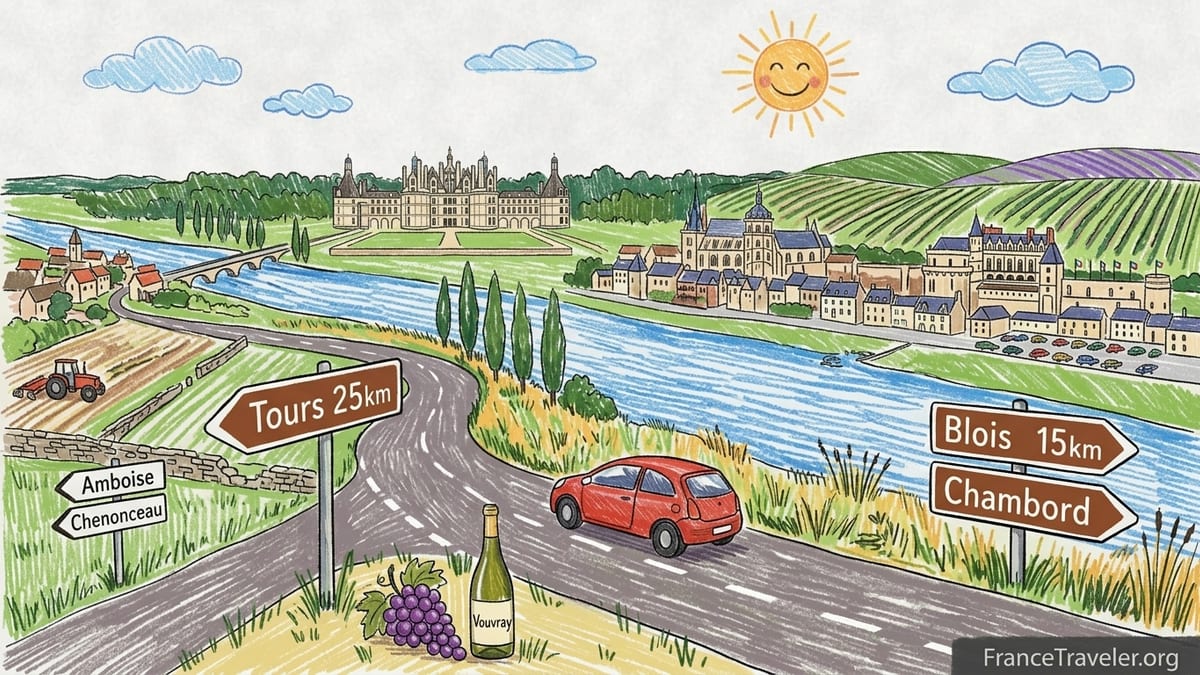
I still remember the moment the D-road narrowed to a single lane between stone farm walls and the GPS calmly insisted I was on the “fastest route” to Chenonceau. My Loire Valley road trip was not a theoretical itinerary drawn on a map but a sequence of very real drives and decisions: where to rent the car, which villages to brave in a compact hatchback, when to stop for fuel, and when to admit that one more château would simply be too much. Over several days I traced the river and its tributaries from Blois and Chambord through Amboise and Chenonceau, then west via Tours and Vouvray to Villandry, Azay-le-Rideau and Chinon, learning on the road how this landscape really works by car.
Picking Up the Car in Tours and Heading for Blois
I based my rental in Tours, which functions as a practical gateway to the Loire Valley. Trains from Paris arrive at Tours and Saint-Pierre-des-Corps, and both stations have desks from familiar international brands, plus French chains that often price competitively. On the September weekday I started my trip, compact manual cars at the station were advertised in the 40 to 60 euro per day range with basic insurance if booked a few weeks ahead, lower than high-summer rates that local guides now quote at two or three times that level in August. I chose a small petrol hatchback, specifically because I knew I would be threading through medieval streets and tight hotel courtyards rather than cruising motorways all week.
Leaving Tours north toward Blois was my first lesson in how close the Loire sites really are once you have a car. I took the A10 briefly, then shifted to local D-roads that shadow the river. Allow about one hour from Tours to Blois in normal traffic, slightly less if you stay on the autoroute and accept the toll. The contrast between the relaxed pace of the river and the efficiency of French road engineering struck me immediately. Even minor departmental roads are well surfaced, clearly signed and lit enough around junctions that I felt comfortable driving them at dusk on later days.
In Blois I parked in a paid underground lot near the historic center. As of 2026, central municipal garages in mid-size cities like Tours and Blois generally charge between 1.50 and 2.20 euros per hour and roughly 10 to 14 euros for a full 24 hours, which matched what I paid that evening. The walk from the car park to the town’s château and restaurants was less than ten minutes, and my compact car fit easily into the standard French spaces that can feel tight if you are used to North American widths.
Staying the night in Blois before driving to Chambord proved crucial later. It meant I could reach Chambord shortly after opening without backtracking from farther west, and it kept my first day’s driving from Paris to Tours to Blois manageable instead of pushing straight on to the countryside while jet-lagged.
Driving Blois to Chambord and Back Along the Forest Roads
The drive from Blois to Chambord is one of the most forgiving and atmospheric segments of the whole itinerary. From central Blois I followed the signs for Chambord and was quickly on a two-lane departmental road that becomes more wooded as it approaches the estate. The distance is about 20 kilometers, and in light morning traffic I covered it in just under 30 minutes, slowed only by a few tractors and roundabouts serving small villages.
Chambord’s signage for drivers is excellent. Large brown tourist signs appear well before the turnoffs, and once inside the estate’s boundary, dedicated roads funnel you toward parking areas graded by distance and price. The château’s own information makes clear that standard visitor parking is in surface lots near the main entrance, and on the day I visited one of the main lots was charging a flat day rate of a little over 6 euros for cars. Payment machines accepted cards without fuss, including foreign credit cards with chip and PIN.
Parking at Chambord feels like arriving at a small airport. The lot is wide, open, and easy for nervous drivers to maneuver. From my space it was a five to eight minute walk to the château itself, with clear pedestrian paths and views of the massive hunting lodge emerging over the trees. Even in shoulder season I was glad I had arrived just after opening; by late morning, arriving buses and tour groups were filling the outer rows, which would have meant a longer walk back to the car in the midday sun.
After visiting the château and its terraces, I returned to Blois using the same route. The afternoon drive took marginally longer, around 35 minutes, thanks to slower traffic behind a delivery truck through one of the villages. This was my first taste of how real-world journey times in the Loire can stretch beyond what a navigation app suggests. On paper the drive is short, but between farm vehicles, occasional roadworks and photo stops, adding 10 to 15 minutes to any estimate quickly becomes second nature.
From Blois to Amboise and the Realities of Parking Under the Castle
Leaving Blois for Amboise the next morning, I followed river-hugging D-roads again rather than the autoroute. The distance along the Loire is roughly 40 kilometers, but with speed limits changing through each riverside town and a pause in Chaumont-sur-Loire for a coffee, the journey took close to an hour and a quarter. This was one of the most scenic stretches I drove, with long views of sandbanks, poplars and the occasional hot-air balloon basket skimming the horizon.
Arriving in Amboise is where the romance of riverside driving collides with very practical parking concerns. The town funnels traffic under and around the Château Royal d’Amboise, perched directly above the Loire. Directional signs divide you toward riverside parking, town-center spaces under the château itself, and overspill lots farther out. On my visit, I ignored the first small lot I passed along the river because it already looked close to full, opting instead to follow the signs that climb around the château’s base to the terrace-level parking area.
Amboise’s official visitor information notes that vehicles can park on the château terrace, which gives step-free access for visitors. In practice, that terrace parking works best if you arrive before late morning. I pulled in just before 10 a.m. on a weekday and found a space without much drama, but by lunchtime cars were circling and several drivers were attempting tight parallel maneuvers against stone walls. The terrace itself felt snug for larger vehicles. I was glad again to have chosen a compact hatchback rather than a crossover or SUV, and I would not recommend bringing anything much larger than a mid-size car into this particular lot unless you are confident reversing between close stone pillars.
From a pacing perspective, I found that combining Blois, Chambord and Amboise over two nights prevented needless doubling back. Had I tried to return all the way to Tours each evening, I would have spent more than an hour each day simply retracing the same east-west corridor. Sleeping in Blois, then moving to Amboise, meant each drive was fresh and directional, and it set me up for a much shorter hop to Chenonceau the following day.
Amboise to Chenonceau: Narrow Lanes and Managing Ambition
The route from Amboise to Chenonceau was the first time my navigation app sent me onto genuinely narrow rural lanes. The headline distance between the two is only about 15 to 20 kilometers, depending on your chosen road, and the official landmarks quote journey times of around 30 minutes from one to the other. My reality was closer to 40 minutes, because I consciously chose to avoid the main D-road for part of the way, following a signed scenic route that cut through vineyards and pastures.
On that segment, the road narrowed to a single paved lane with only occasional passing bays. High hedges and stone field walls limited forward visibility, and I quickly adopted a slower, more cautious style of driving than on the wider routes between towns. Meeting another car head-on required brief negotiations of who would reverse to the nearest wide spot. For anyone unused to this, it is worth remembering that French drivers in the countryside are generally patient, but they do expect you to move decisively once you have chosen who will back up.
Arriving at Chenonceau itself felt comparatively straightforward. The château has substantial visitor parking in a wooded area set back from the main entrance. When I visited, a large signboard indicated that car parking for individual visitors was free, with separate zones marked for coaches. Even arriving late morning, I found a space within a five-minute walk of the gate, and the shaded lot meant the car did not become uncomfortably hot while I explored the galleries and arches over the Cher River.
It was at Chenonceau that I realized the temptation to stack too many major sites into one day. Several bus tours that day were attempting Chambord and Chenonceau in a single long circuit from Tours or even Paris. Talking with a couple in the parking lot who had just done that combination, it was clear their day had turned into more windscreen time than château time. From my own driving, I would not personally pair Chambord and Chenonceau as self-drive visits in one day unless I was prepared for more than three hours behind the wheel, not counting any detours or lunch stops. Adding Amboise or Villandry on top of that would tip the day from enjoyable to exhausting.
Tours and Vouvray: Fuel Stops, Wine Caves and City Driving
From Chenonceau I drove west to Tours, where I dropped my bags at a central hotel and used the city as a hub for wine country and gardens. The drive Chenonceau to Tours took just under an hour using a mix of local roads and the D943, which felt more like a regional highway than a village lane. Fuel prices at stations along this corridor in early autumn 2025 were hovering around 1.80 to 1.95 euros per liter for standard unleaded. I refueled at a supermarket station on the edge of Tours rather than at the motorway services, saving around 10 to 15 euro cents per liter compared with pump prices I had seen closer to the A10.
Driving within Tours itself was less intimidating than I had feared. The city does not currently operate a permanent low-emission zone, and there is no need to purchase an additional Crit’Air emissions sticker for local driving beyond the one already on the rental car’s windscreen. Traffic moves along a ring road system, and clear signs point you toward central parking garages. I used a covered lot near the old town with prices aligned to the typical 1.80 euro per hour and 12 euros per 24 hours range that local guides reference for 2026.
With a base in Tours, I took a half-day to explore Vouvray, the white wine appellation on the north bank of the Loire. The drive from central Tours to the first cave entrances in Vouvray took barely 20 minutes, even with a pause to photograph the river from a bridge. Here the roads are a mix of village main streets and short climbs into the tuffeau cliffs, where wine producers carve long cellars. Many estates have small parking courtyards directly outside their tasting rooms. I visited a family-run winery that welcomed walk-ins for a tasting flight of sparkling and still Vouvray wines at around 8 to 10 euros per person, refundable against a purchase. Having the car allowed me to carry a couple of bottles back to Tours easily, but it also required discipline; I limited myself to small pours and left with enough time before driving back into the city.
Staying multiple nights in Tours significantly reduced backtracking. Instead of checking in and out of hotels in every small town, I could reach Vouvray, Villandry and Azay-le-Rideau as spokes from a central hub. The furthest of these drives, to Chinon, still felt like a purposeful day trip rather than a relocation stage.
Villandry and Azay-le-Rideau: Garden Parking and Short Hops
The road from Tours to Villandry may be the most immediately rewarding in terms of effort versus payoff. Villandry lies only about 18 kilometers west of Tours, and the signed route along the D7 and D7.1 took me roughly 25 minutes each way. Pulling into Villandry’s village, clear signage marked the château and its famous gardens, as well as a large free parking area dedicated to visitors. Official information from the château confirms that car and bus parking is provided free of charge near the gardens, which matched my experience. Even late morning in peak season, there were still spaces available, and turning circles were wide enough that nervous drivers could adjust their approach without blocking the lane.
The parking lot surface is a mix of gravel and compacted earth, which means some dust in dry weather and puddles after rain, but it felt completely manageable in a small car. From my space the walk to the ticket office was no more than five minutes, passing local cafés and small shops along the way. Returning to the car after several hours in the geometric kitchen gardens and water terraces felt simple and unhurried, which matters when you still face another drive that day.
From Villandry to Azay-le-Rideau, I stayed mostly on local D-roads again rather than returning to the main highway. The distance between the two is around 15 kilometers, and my journey time was just under 20 minutes in light afternoon traffic. This was one of the easiest transitions of the entire trip, a reminder of how densely clustered some of the western Loire sites are around Tours. When the road opened out, vineyards replaced gardens, and the spire of Azay’s church gave a first hint of the village.
Azay-le-Rideau provides dedicated château parking slightly outside the tightest part of the center. Regional tourist information highlights the “Parking du château,” which allows visitors to leave cars and walk directly toward the moated Renaissance building. I parked there, paying a modest hourly fee at a meter that accepted card payments. While the parking is close, the final approach to the château on foot crosses narrow lanes where vehicles and pedestrians share space. Driving any closer than the official lot would mean negotiating medieval alleys not designed for cars, so I was grateful that the signed parking kept the most sensitive streets clear of through traffic.
Chinon and the Wine Country: Climbing Streets and Fortress Views
The longest single day-drive I undertook from Tours was the loop to Chinon. The town sits about 50 kilometers to the southwest, and I allowed an hour each way from central Tours. In practice, with a short detour into open countryside for photographs of the river and vines, each leg took closer to 70 minutes. The route shifts gradually from flat river valley to rolling hills, and the traffic thins the further you travel from Tours, leaving you with long, straight sections interspersed with gentle curves.
Chinon itself demands a different driving mindset. The medieval core rises steeply from the river, crowned by the fortress. Approaching from the north, I crossed the Vienne River bridge and immediately found myself in a tangle of stone houses, one-way streets and angled parking bays. I chose to park in a riverside lot at the base of the old town rather than attempt the steep streets up to the fortress walls. The lot charged by the hour at rates comparable to Tours, and from there I climbed on foot through staircases and narrow lanes to reach the château entrance.
For wine travelers, Chinon offers a compact concentration of tasting rooms and nearby estates focused on Cabernet Franc reds and some rosés. Several producers have cellars either within walking distance of the town center or a short drive into the vineyards above. I booked a late-afternoon tasting at a domain just outside town that provided its own small parking area off the main road. Tasting fees were in the same general band as Vouvray, around 8 to 12 euros for a selection of wines, with the expectation that visitors who can will purchase bottles afterward. Leaving Chinon after sunset reminded me that rural French roads can be very dark once you exit the villages, with minimal street lighting between settlements, so I drove back to Tours conservatively, using full beams where appropriate and taking extra care at unlit roundabouts.
Looking back, I was glad I had not attempted to combine Chinon with another major château visit that day. The fortress itself, lunch in town and a tasting already filled the daylight hours, and adding Villandry or Azay on the return would have turned an already full day into a rushed checklist.
What I Learned About Pacing, Navigation and French Driving
Over the course of this route from Blois and Chambord through Amboise, Chenonceau, Tours, Vouvray, Villandry, Azay-le-Rideau and Chinon, several practical themes emerged that shaped my experience. The first is that navigation apps consistently underestimate travel times once you are on smaller D-roads between villages. Where my phone suggested 25 minutes, the combination of farm traffic, photo stops, slower entries to roundabouts and occasional missed turns meant reality was often 35 or 40 minutes. Building a 20 to 30 percent buffer into any planned drive made the days feel humane instead of hurried.
Second, parking at the main châteaux is generally well organized, but town-center parking in places like Amboise and Chinon can be tight. Large official lots at Chambord, Chenonceau, Villandry and Azay-le-Rideau felt straightforward, with clear payment machines and walking paths. By contrast, terrace-level parking in Amboise and riverside bays in Chinon required more confidence in close-quarters maneuvering. A compact car genuinely makes life easier here. I saw several drivers in larger vehicles hesitate or give up on certain spaces entirely.
Third, the French driving experience in the Loire is defined less by speed and more by rhythm. Outside the cities, speed limits often rise to 80 or 90 kilometers per hour, but you will rarely sustain that for long as you pass through 50 kilometer per hour stretches in each village. Roundabouts rather than traffic lights manage most junctions, and priority rules at unmarked intersections in small hamlets can surprise visitors used to four-way stops. I quickly adopted the habit of approaching every village and junction cautiously, checking both signage and road markings before assuming I had the right of way.
Finally, staying multiple nights in a central base reduced both backtracking and decision fatigue. One night in Blois, one in Amboise, and then several in Tours created a gentle westward progression without ever forcing a scramble to pack the car every morning. It allowed me to pair sites sensibly: Chambord with Blois, Amboise on its own, Chenonceau with an afternoon return to Tours, Villandry with Azay-le-Rideau, and Chinon as a standalone excursion. The castles that felt too much to combine in one day were the “big three” of Chambord, Chenonceau and Amboise, each of which rewards at least half a day on site when travel time and meals are included.
The Takeaway
Driving the Loire Valley between Chambord, Amboise, Chenonceau and the wine country around Tours proved less about racking up châteaux and more about learning the tempo of a region stretched along rivers rather than clustered in a single city. Picking up a compact car in Tours made both the western gardens and the eastern royal estates feasible without wrestling Paris traffic, and staying successive nights in Blois, Amboise and Tours reduced backtracking to a minimum. Real-world journey times ran longer than the apps suggested, but the trade-off was an intimacy with vineyards, villages and side roads that no coach tour from Paris could match.
I found that each major stop deserved its own breathing space. Chambord worked naturally with Blois and the surrounding forest roads. Amboise thrived as a morning into lunch before a short shuffle toward Chenonceau the following day. Tours, with its parking garages and tram lines, anchored forays into Vouvray, Villandry and Azay-le-Rideau, while Chinon, with its fortress and Cabernet Franc, rightly occupied almost an entire day. Along the way, practical questions about fuel, parking meters, narrow lanes and evening returns in the dark became part of the narrative rather than obstacles.
If you are planning your own Loire Valley road trip, the most honest advice from the driver’s seat is simple. Accept that the region stretches like a ribbon, not a circle. Choose a small car you feel comfortable placing between stone walls. Build slack into your timings, and do not be afraid to let a château wait for another trip if squeezing it in would mean nothing but glances from the parking lot. The Loire reveals itself most fully when you let its roads, rivers and wines dictate the pace, one manageable segment at a time.
FAQ
Q1. Is it better to rent a car in Paris or in the Loire Valley for this route?
For this specific route it is more relaxing to take the train to Tours or Blois and rent there. You avoid Paris ring-road traffic, and the local rental desks at the train stations are set up for travelers heading directly to the châteaux.
Q2. What type of car is most practical for driving between these châteaux?
A small or compact hatchback is ideal. It fits comfortably into tight parking at Amboise and in village streets like Chinon, uses less fuel, and feels easier to place on narrow D-roads and one-lane country lanes.
Q3. How much driving should I realistically plan per day on this itinerary?
Plan for one to two hours of total driving on light days and up to three on heavier days. Even short distances can stretch once you factor in village speed limits, tractors, and photo stops along the river.
Q4. Are the châteaux parkings easy to use for foreign drivers?
Yes. Chambord, Chenonceau, Villandry and Azay-le-Rideau all have clearly signed visitor lots. Payment machines are straightforward and accept bank cards, and walking paths guide you directly to the entrances.
Q5. Do I need any special emissions sticker or permit to drive in the Loire Valley?
As of 2026 there is no permanent low-emission zone covering Tours or the surrounding Loire countryside. Rental cars already carry a Crit’Air sticker, and no additional permit is required for the routes described.
Q6. How expensive is fuel along this route?
Recent petrol prices in the Loire Valley have hovered around the high 1.80 to low 1.90 euros per liter for unleaded at supermarket stations, with motorway and village pumps usually slightly higher. One full tank was enough for several days of local touring in a compact car.
Q7. Can I visit Chambord, Amboise and Chenonceau all in one day by car?
It is physically possible but not pleasant. From experience, each of these châteaux merits at least half a day with travel and meals, and combining all three would turn the trip into a rushed drive with very limited time at each site.
Q8. Is it difficult to drive on French rural roads if I am used to wider highways?
The main D-roads between towns are comfortable two-lane routes, but many scenic cut-throughs narrow to one lane with passing spots. Taking them slowly, using pullouts, and choosing a small car make the experience manageable even for first-time visitors.
Q9. Where is the best base town to reduce backtracking on this itinerary?
Using Blois for the Chambord area, then Amboise for the transition east to Chenonceau, and finally Tours for Villandry, Azay-le-Rideau, Vouvray and Chinon kept my driving directional and avoided repeating the same stretches day after day.
Q10. Are wine tastings in Vouvray and Chinon compatible with self-driving?
They can be if you plan carefully. Many estates offer modest tasting pours for a small fee, and it is wise to limit the number of stops, drink plenty of water, and allow time between tasting and driving. If you plan a full day of visits, consider arranging a taxi or guided driver from your base instead of using your own car.