


I arrived in the Loire Valley determined not to rent a car. France’s official tourism sites promised a neat rail line from Orléans to Tours and an elegant mesh of bike paths linking the main châteaux. On paper it looked simple. On the ground it was a patchwork of smooth train rides, sleepy halts, hurried platform changes, dirt-splattered bike paths and the occasional expensive taxi when the public-transport map quietly stopped. This is what I actually learned trying to explore the Loire châteaux using only trains, buses and bicycles.
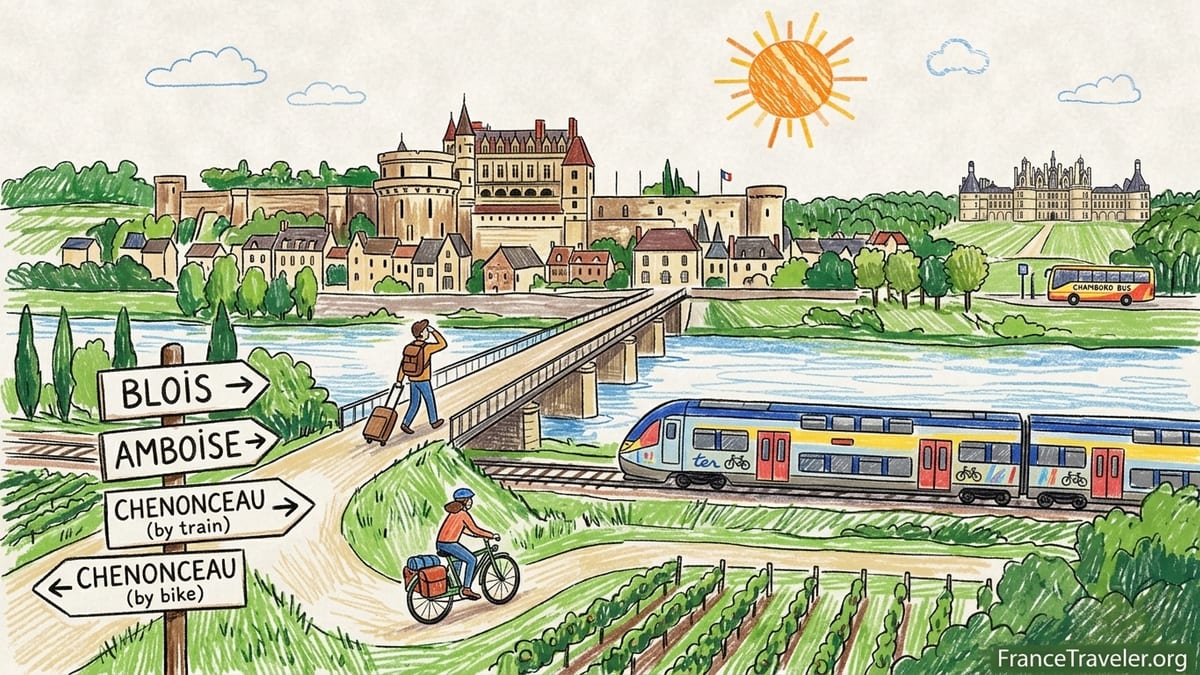
Starting on the Rail Spine: Orléans, Blois, Amboise and Tours
The backbone of a car-free Loire trip is the classic railway line that runs south-west from Orléans through Blois and Amboise to Tours. It is not a high-speed line but a regional TER service with modern double-decker trains, bike spaces at the carriage ends and air conditioning that matters on hot summer days. I bought all my tickets through the SNCF Connect app, loading them onto my phone as QR codes, but every station I used also still had at least one ticket machine that accepted credit cards. Buying on the app meant I could wait to see if a strike or engineering work appeared before committing to specific departure times.
From Paris I first took a mainline train to Orléans, then changed to a TER towards Tours. The Orléans station is compact and clearly signed; there is one main concourse with electronic boards and you simply follow the stairs down to the underpass and up to your platform. With a small wheeled suitcase and a backpack I had no trouble moving between trains, but there are lifts if you have heavier luggage. The train to Blois took about forty minutes, with the Loire appearing and disappearing alongside the track.
Blois-Chambord station is the sort of stop that rewards car-free travellers. It sits a short walk from the old town, and I was across the main road and climbing toward the Château de Blois in roughly fifteen minutes at a relaxed pace. The station has a staffed ticket office during the day, toilets inside the main hall and several bike racks outside the entrance. There is no need for a taxi here; you can comfortably walk with luggage if you have booked a hotel in central Blois.
Continuing along the same railway line, Amboise and Tours are even easier. TER trains run between Blois, Amboise and Tours many times per day in both directions, though not every hour on the minute. To keep planning realistic I checked the live timetable in the morning and chose trains that left at roughly 9:00, 12:00 or 16:00, allowing for leisurely château visits in between. The ride from Blois to Amboise took about twenty minutes, and from Amboise to Tours another twenty. None of these segments required a reservation; you simply validate your ticket in the app or scan the QR code on board when the conductor passes.
Living Car-Free in Blois and Reaching Chambord
Blois was my first base, and it worked well without a car. The walk from the station to the old town climbs gently but is not punishing, and the Château de Blois rises directly above a central square with cafes and a small supermarket. I stayed in a guesthouse five minutes from the château, so I could stroll back at midday to drop off a jacket or pick up a water bottle before continuing. For everyday logistics like food shopping, Blois’s compact center is incidentally perfect when you are on foot.
Chambord, however, is where the gap between brochures and reality starts. The castle stands in a former royal hunting forest about sixteen kilometres from Blois with no railway station of its own. In season a dedicated Rémi shuttle bus runs from the forecourt of Blois-Chambord station to Chambord and Cheverny. I used that bus in late spring. Tickets were sold through the regional Rémi website and at the small bus kiosk outside the station; I paid a modest return fare in cash directly to the driver and kept the paper ticket for the ride back. We left from a clearly marked coach bay beside the main bus stops, and the journey took around thirty to forty minutes through flat countryside.
The bus dropped us at the main Chambord car park, about a five-minute walk from the château entrance. The last return to Blois in late afternoon mattered, because missing it would have meant either an expensive taxi ride or a long, rather dangerous bike ride on roads not designed for casual cycling. Outside the shuttle’s season, which roughly covers spring to early autumn, there is no regular bus that lines up neatly with tourist visiting hours, and at that point a taxi becomes the only sensible car-free link. I spoke to a couple who had done exactly that; they had pre-booked a taxi from Blois for the morning and arranged a fixed-time pick-up in the late afternoon. They were happy with the convenience but less enthusiastic about the price.
In Blois itself, I managed entirely on foot. The only time I felt the lack of a car was when looking at side-trip ideas such as Cheverny, which sits another twenty minutes beyond Chambord by road. There are periods when the shuttle covers both Chambord and Cheverny on the same loop, but the timetable makes it hard to give each château more than a rushed visit in a single day. Standing at the bus stop comparing schedules, I quietly accepted that I would see Chambord properly and leave Cheverny to a future trip with more flexible transport.
Amboise on Foot: A True Car-Free Hub
My next base was Amboise, reached by a short and scenic TER journey from Blois. Amboise station is on the north bank of the Loire, a modest building with two platforms, a couple of ticket machines and a small waiting room. There was no taxi rank when I arrived in the late morning and no ride-hailing cars available in the app. Fortunately the walk into town, over the bridge toward the château, took only about twenty minutes even with a suitcase in tow. The pavement is broad, the traffic light, and the view of the Château d’Amboise perched above the river is one of the most satisfying arrivals I have experienced without a car anywhere in France.
Once checked into a small hotel near the river, I did not touch motorised transport inside Amboise again. The royal château stands at the top of the town, reached by a short but steep lane, and the Clos Lucé, Leonardo da Vinci’s last residence, is a few minutes further on foot along quiet residential streets. In practice you can visit both on the same day since they are less than fifteen minutes’ walk apart. This made Amboise the most comfortable car-free base of my trip: there was no question of waiting for a bus or timing a train. I simply walked between castle, bakery, bike shop and riverfront.
For luggage logistics Amboise is forgiving. On the day I changed bases again, from Amboise to Tours, I checked out in the morning, left my suitcase in the hotel’s luggage room, and spent several hours wandering the château and town before collecting my bag and walking back to the station for an afternoon train. If your hotel does not offer storage, the station itself is small and informal enough that I saw travellers sitting with their bags on benches between trains without feeling they were in anybody’s way, although there are no formal left-luggage lockers.
The main limitation in Amboise without a car is that public transport stops at the edge of town. If you want to go further afield, for example to Chaumont-sur-Loire or smaller villages in the vineyards, you quickly move from trains and buses into the world of bikes. That shift defined the second half of my car-free experiment.
Cycling from Amboise to Chenonceau and Along the Loire
Amboise brands itself enthusiastically as a cycling hub, and this part of the promise absolutely matched my experience. I rented a hybrid touring bike from a shop a short walk from the château. The rental included a lock, helmet, pannier rack and basic repair kit; I added a handlebar bag for easy access to my phone and snacks. Hiring the bike for a single long day cost significantly less than a round-trip taxi to any château, and with good weather the choice felt obvious.
My main objective was the Château de Chenonceau. In theory I could have taken a TER train from Tours to Chenonceaux station and walked five minutes up the lane to the château gate, which is often praised as the most train-friendly château in France. But based in Amboise, I wanted to test the much-advertised cycle route that local tourism materials describe as a direct, mostly segregated path of about twenty kilometres. In practice I found clear green-and-white signposts pointing “Chenonceaux” from the center of Amboise and quickly joined a mixture of quiet departmental roads and dedicated Loire à Vélo tracks.
The ride itself was manageable for anyone used to cycling city streets: gentle undulations, a few short climbs, and long stretches shaded by trees or lined with vineyards. There were occasional rough patches of gravel but nothing that required a mountain bike. On an upright hybrid with 35-millimetre tyres I never felt out of my depth. Traffic was light, and car drivers in this part of France are generally used to sharing the road with cyclists, especially in summer when the Loire à Vélo itinerary is busy.
Reaching Chenonceaux village, the last-mile problem essentially disappeared. You roll past a cluster of houses and small hotels, cross the railway line, and arrive at the main visitor car park. There are bike racks near the entrance, and the staff had no objection to me securing my bike and pannier there for several hours. The sense of arriving under your own power, then stepping almost straight into the château grounds, is one of the reasons Chenonceau is so often recommended to car-free travellers. I could have done the same journey in twenty-five minutes by train from Tours, but riding in gave the day a more relaxed rhythm.
On the way back I experimented with a partial loop, following signposts towards Bléré before curving north again to Amboise. This diverted me onto slightly busier roads near the Cher River but still felt safe, and I arrived back in town tired yet satisfied. What mattered most was that I never once felt stranded between station and château. If anything, the bike allowed me to forget train times for a day and treat the countryside itself as the attraction instead of viewing it through a carriage window.
Using Tours as a Rail Hub and Where the Network Stops
Tours was my final base and the place where the car-free reality became clearest. Saint-Pierre-des-Corps, the technical rail hub for TGVs, sits just outside the city, but for everyday movement I used Tours’ central station with its ornate glass-and-iron hall and easy tram connection. From here, frequent TER trains run east to Amboise and Blois and south along the River Cher to Chenonceaux and Saint-Aignan. I used Tours as a launchpad for a second visit to Chenonceau, this time testing the clearest-cut rail itinerary.
I bought a same-day return ticket on the SNCF app for a mid-morning train to Chenonceaux. The journey took around thirty minutes with a handful of stops. Chenonceaux station itself is little more than a single platform with a shelter, ticket machines and simple signage, but that is part of its charm. The château entrance lies just across the road; I could see the tree-lined drive as I stepped off the train. With roll-aboard luggage this would still be manageable if you planned to spend the night in the village. I saw travellers doing exactly that, wheeling medium suitcases up the lane to small guesthouses a few minutes away.
From Tours I also looked closely at visiting Villandry, famous for its formal gardens, and Azay-le-Rideau, which does have a small station. This is where the limits of car-free access become apparent. Reaching Azay-le-Rideau by train requires careful attention to a timetable with fewer departures, and once there you still walk a good thirty minutes from the station to the château. Villandry, by contrast, has no station and relies on a seasonal shuttle bus that operates daily only in the core summer months. Outside that window your realistic options are a taxi from Tours, which quickly adds up, or a fairly long bike ride along local roads.
After several days of comparing options, I chose not to force Villandry into this car-free itinerary. The combination of infrequent shuttles, the need to be back in Tours for a specific train, and the desire to actually enjoy the gardens instead of clock-watching convinced me that this was a château better saved for a future trip with a car or an organized day tour. That decision underlined a simple truth: the Loire rail spine makes some destinations easy, but it does not turn the entire valley into a seamless car-free playground.
I did manage one more short bike outing from Tours itself, renting a city bike from a local shop by the station and following signposts west along the Loire toward small riverside villages. The dedicated Loire à Vélo tracks here are broad and well-signposted, but once you leave them to chase a particular château that is not on the trail, you feel the absence of integrated last-mile solutions. The further you leave the main line, the more the Loire becomes a region where having your own wheels is not a luxury but a practical requirement.
Tickets, Luggage and Dealing With Delays
Across Orléans, Blois, Amboise and Tours, buying train tickets was the least of my worries. The SNCF Connect app allowed me to search by town names instead of station codes, filter for TER services where reservations were unnecessary, and pay by card in a couple of taps. On the ground, I saw plenty of travellers still preferring the yellow ticket machines at each station, which accept major cards and offer an English-language option. At smaller halts like Chenonceaux there is typically no staffed ticket office, only machines, so having the app already set up before you arrive in the Loire makes life easier.
Luggage is another area where the car-free experience is less romantic than the brochures suggest but still manageable if you pack with the trains in mind. TER carriages have generous overhead racks and some open floor space near the doors. With a cabin-sized suitcase and a backpack, I could always find space without blocking anyone. On the one occasion I shared the carriage with a large group of cyclists, the bike hooks filled quickly, but we worked together to angle frames and panniers so that everyone could board. If you travel with very large suitcases, you may find yourself dragging them through underpasses and up steps at smaller stations without lifts, which makes a strong case for packing lighter.
As for delays, I experienced one noticeable issue: a late-afternoon TER from Tours to Amboise that ran about twenty minutes behind schedule due to earlier congestion on the line. The platform screens and the SNCF app both updated in real time, and the delay mattered more for my dinner reservation than for any connection. Still, it reinforced the point that building tight cross-platform transfers into a sightseeing day is risky. When the line functions smoothly, a fifteen-minute change in Blois or Tours is enough. When something goes wrong, you are happier knowing there is another train an hour later and that your château visit is not dependent on making a single precarious connection.
On the buses, punctuality felt more approximate. The Rémi shuttle to Chambord left Blois reasonably on time but came back a little late as it collected visitors from different stops. This did not threaten any onward train, but if you are planning a same-day return to Paris from Blois after Chambord, you want to give yourself more than the minimum margin. That slight unpredictability is another argument for keeping your daily ambitions modest when moving around the Loire without a car.
Where Car-Free Travel Works and Where It Does Not
By the end of the trip, I had a clear mental map of the châteaux that genuinely work without a car and those that are best considered aspirations for another time. On the positive side, Blois and its château are easy, with the station practically in town and everything walkable. Amboise and Clos Lucé are likewise effortless once you accept the one-off twenty-minute walk over the bridge from the station. Chenonceau, whether reached by train from Tours or by dedicated cycle route from Amboise, is arguably the star of the car-free Loire, its station and château gate facing one another across a country lane.
Chambord sits in a second category: possible but conditional. When the seasonal shuttle from Blois is running, the journey is straightforward and atmospheric. Outside that period, you either charter a taxi or turn to a long bike ride on roads that are less pleasant than the riverside cycle paths closer to Amboise. Cheverny, Chaumont-sur-Loire, Azay-le-Rideau and Villandry push things even further. Each has its charms, but reaching them relies on a mixture of less frequent trains, long walks from rural stations, occasional local buses whose timetables are aimed at commuters rather than tourists, or transfers that add complexity to already full days.
Seen through a car-free lens, the Loire Valley is not a single, easily navigable playground but a set of overlapping zones anchored to the rail line. If you choose one base, such as Amboise, and accept a limited radius, you will have a rich and enjoyable trip without ever missing a car. If you try to stitch together an itinerary that includes every famous château scattered from Orléans to Angers, you quickly hit the limits of the network. That is not a failure of French public transport so much as a reminder that many of these estates were built as retreats in the countryside, not as urban palaces on tram lines.
For me, the most satisfying compromise was to treat the rail-connected châteaux as a self-contained trip. Blois, Amboise, Clos Lucé and Chenonceau formed an elegant arc linked by frequent TER trains and safe cycling routes. I came away feeling that I had experienced a coherent slice of the Loire instead of a blurred checklist. The castles I did not reach became a reason to return, perhaps with a small rental car for two days or as part of a guided tour using minibuses to bridge the gaps that trains and bikes cannot.
The Takeaway
Traveling the Loire Valley without a car taught me two useful lessons. The first is that the railway between Orléans, Blois, Amboise and Tours is a genuine asset, not just a line on a tourist map. It offers frequent, relatively inexpensive trains that carry both you and your bike, with enough flexibility to adjust plans when the weather changes or a château visit runs longer than expected. For a traveller used to driving everywhere, the sensation of simply walking off a platform and into a medieval town is deeply satisfying.
The second lesson is that marketing language about a valley “easily explored by train and bike” glosses over real gaps. Some celebrated châteaux are exquisitely car-free, with stations at the gate or cycle paths leading straight to the entrance. Others hide behind seasonal buses, long rural walks and timetables written for schoolchildren rather than visitors. Steering your plans toward the first group and being honest with yourself about the second will do more for your enjoyment than any list of “top ten castles” detached from how you actually reach them.
If you love trains and bikes, or simply prefer not to drive, the Loire Valley rewards you handsomely when you pick your bases carefully. Anchor yourself in towns like Blois, Amboise or Tours, build your days around the reliable rail spine, and lean on cycle routes for the last mile instead of expecting buses to deliver you to every gate. You will still miss a few châteaux, but you will gain something more important: days shaped by slow approaches, riverside horizons and the quiet satisfaction of arriving at a Renaissance palace on two feet or two wheels instead of out of a parking lot.
FAQ
Q1. Can I visit the Loire Valley châteaux from Paris without renting a car?
Yes, if you focus on rail-connected towns such as Blois, Amboise and Tours. From Paris you can reach these by direct or one-change trains, then explore local châteaux on foot, by bike or with seasonal shuttles.
Q2. Which château is the easiest to reach without a car?
The Château de Chenonceau is arguably the easiest, as Chenonceaux station sits just across a small road from the entrance. A regional train from Tours takes around half an hour, and the walk from platform to gate is only a few minutes.
Q3. Is Amboise a good base if I am traveling only by train and bike?
Yes. Amboise offers a walkable historic center, a fifteen to twenty minute walk from the station to town, direct access to the Château d’Amboise and Clos Lucé, and clear cycle routes toward Chenonceau and along the Loire.
Q4. How do I get from Blois to Chambord without a car?
In the main visiting season a regional shuttle bus runs between Blois-Chambord station and the Château de Chambord, with tickets available locally. Outside that period you will need to arrange a taxi or be prepared for a long bike ride on rural roads.
Q5. Do I need to reserve seats on TER regional trains in the Loire Valley?
No, TER regional trains on the Orléans–Tours line operate without compulsory reservations. You can buy tickets shortly before travel through the SNCF Connect app or at station machines and board any compatible train.
Q6. Is it practical to carry luggage on Loire Valley trains if I am changing bases?
Yes, as long as you pack reasonably light. TER trains have overhead racks and open floor space near doors. With a cabin-sized suitcase and backpack I had no trouble stowing luggage and moving between platforms during base changes.
Q7. Can I rely on bikes instead of buses for the last mile to the châteaux?
For some routes, especially from Amboise to Chenonceau and along the Loire à Vélo paths, bikes are an excellent last-mile solution. For more remote châteaux set away from riverside tracks, roads may be busier and less comfortable for casual cyclists.
Q8. Are all major Loire châteaux realistically reachable without a car?
No. Blois, Amboise, Clos Lucé and Chenonceau are very manageable by train and bike. Chambord is feasible with a seasonal shuttle or taxi. Others, such as Villandry or Cheverny, become awkward or time-consuming without some form of private transport.
Q9. How should I plan around possible train delays?
Allow generous buffers between château closing times and your return trains, and avoid itineraries that depend on tight cross-platform connections. Checking live updates in the SNCF app helps you adjust on the day if delays appear.
Q10. If I only have two days, what car-free itinerary would you recommend?
One realistic option is to base yourself in Amboise, visit the Château d’Amboise and Clos Lucé on day one, then take a train or cycle to Chenonceau on day two. This focuses on places that work smoothly without a car and keeps travel times short.