


Lorraine covers a big chunk of northeastern France, but most trips only scratch Paris-bound highlights or a single battlefield stop. After several circuits through the region by both car and train, I have ended up returning to the same handful of places, while others, although famous, did not need as much time as I once thought. This is not a directory of everywhere you could go in Lorraine. It is a personal, selective ranking of where I would actually spend my limited days, based only on towns and landscapes where I have genuinely lingered, slept, eaten and tried to park a car.
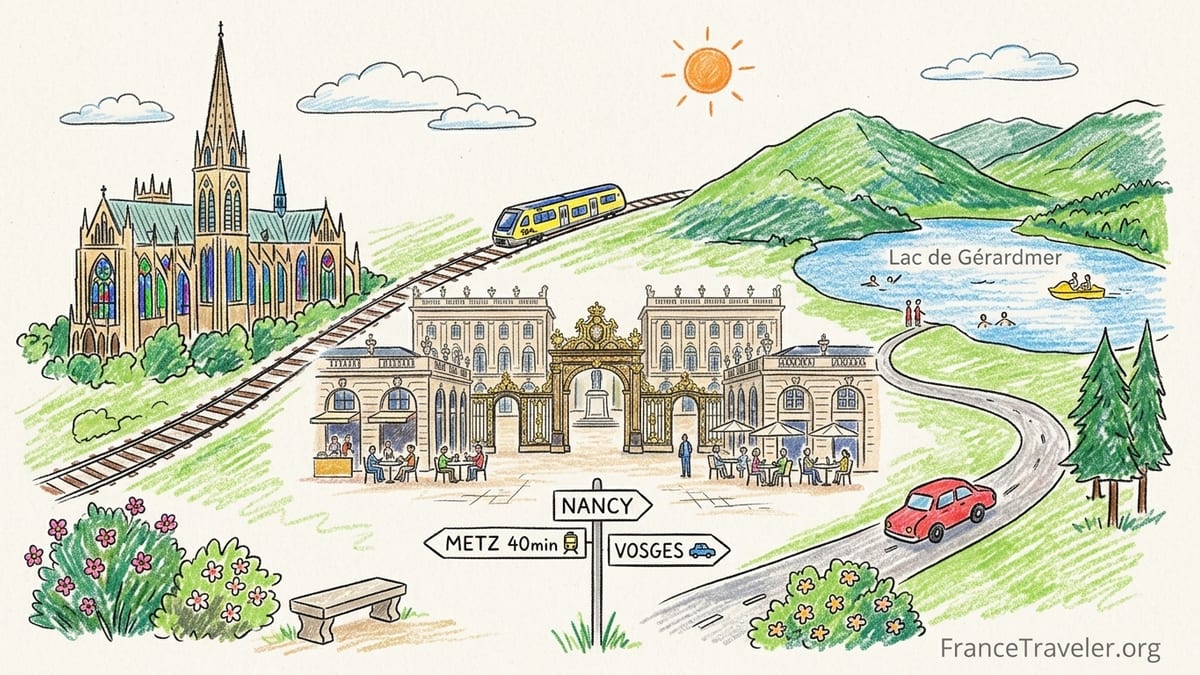
Nancy: My First Base in Lorraine
If I had to choose one place in Lorraine to use as a base, it would still be Nancy. The city feels big enough for varied food and culture, but compact enough that you can cross the historic center on foot in 15 minutes. Trains fan out from Nancy-Ville to Metz, Épinal, Lunéville, Bar-le-Duc and Verdun via regional TER Grand Est services, which makes it unusually practical if you are traveling without a car and want to see more than one town in the region.
Place Stanislas is the obvious magnet, and there is a reason for that. The square really does feel like an open-air drawing room, with its pale stone, gilded gates and constant hum of café terraces. Since traffic was completely pushed out and it became a full pedestrian space in the mid-2000s, it has turned into a genuinely pleasant place to linger rather than just something you photograph and leave. I have sat here on summer evenings when the façades light up and again on frosty December afternoons with a hot chocolate, and both times it felt like the right place to be.
Nancy also rewards anyone interested in Art Nouveau. Walking from the station toward the Parc Sainte-Marie and the Musée de l’École de Nancy, you can pick out sinuous balconies, floral stained glass and carved wooden doors on what still function as normal apartment blocks. On one trip I spent most of a rainy day doing nothing more structured than tracing these façades street by street, with a short tram ride out to the museum to see the furniture and glass in context. It was one of those rare city days where the architecture itself becomes the attraction without needing a checklist of “sights.”
On a practical level, Nancy is somewhere I happily stay overnight. The area between the station and Place Stanislas has a dense mix of mid-range hotels and small apartment rentals, and even arriving by car has been manageable. Underground parking options sit just off the pedestrian core, so I have been able to leave the car and forget about it for a full weekend while moving around on foot or by tram. In the evenings, the streets between Place Stanislas and the Vieille Ville stay busy late enough that you can finish dinner at 10 p.m. and still feel the city around you instead of walking back through empty streets.
Metz: Cathedral Light, Riverside Walks and Modern Art
Metz is the place in Lorraine that surprised me most visually. The first time I arrived by train and walked out toward the cathedral, the yellow Jaumont stone and the height of the nave caught me off guard. Inside, the flood of colored glass, including panels by Marc Chagall, makes the cathedral far brighter than the typical gray interiors many travelers associate with Gothic churches. I ended up visiting twice in two days: once mid-morning to explore the details and again around late afternoon when the low sun pushed the greens and blues across the floor.
Only a short walk away but in a completely different register, the Centre Pompidou-Metz gives Lorraine a serious contemporary-art anchor. The building itself, with its sweeping roofline and white volumes, feels light and open. With a single ticket you can access the current temporary exhibitions, so I have learned to plan at least half a day there rather than rushing through between trains. Visitor information from the museum notes that it is open every day except Tuesday and 1 May, with longer hours on certain days, which fits well with a flexible itinerary that also includes time in the old town nearby.
I rank Metz just behind Nancy as a base because of its mix of riverfront and streetscape. One of my favorite travel days in Lorraine was very simple: morning in the cathedral, lunch in the old central market hall, then a slow walk along the Moselle past the Temple Neuf and back through the Imperial Quarter near the station. None of these require tickets, and if you are arriving from Paris by TGV they are all within a 20-minute walk of Metz-Ville station. I have stayed in small hotels both near the station and closer to the center and found that, like Nancy, Metz feels walkable at night with plenty of relaxed restaurant options.
In terms of logistics, Metz also works well as a hop from Nancy. Regular TER Grand Est trains connect the two in around 35 to 45 minutes, and some services continue on to Verdun, so it is entirely realistic to spend several nights in Nancy, dedicate one full day to Metz and still feel that you have scratched more than the surface. If you are driving, there is structured parking near the center and along the river, though I found it marginally more congested than Nancy at weekday rush hour. Even so, Metz remains in my top tier of Lorraine stops for anyone interested in combining historic architecture, river scenery and contemporary culture.
Verdun: War Memory That Deserves a Full Day
Verdun is not a city I would choose as a long urban stay, but it is absolutely a place where I commit a full day and often a night for the World War I sites. On my first visit I made the mistake of trying to rush in from Metz by train, see the battlefield and return the same day. I spent more time waiting for buses and connections than at the memorials themselves. On a later trip with a car and a hotel booked in town, Verdun finally clicked into place as one of Lorraine’s most powerful experiences.
The core sites the Douaumont Ossuary, the neighboring national cemetery, the remains of Fort Douaumont and the destroyed village of Fleury form a compact but emotionally heavy circuit. It is very different from standing in a conventional museum: here you get the rows of white crosses outside, the piles of bones visible through the windows of the ossuary, and the pitted landscapes left by shells. Rather than counting attractions, I now plan Verdun around these few locations and accept that they can easily fill four to six hours when you include quiet walking and pauses.
Staying overnight in Verdun itself has proven worthwhile, particularly if you are driving. You can check into a small hotel or guesthouse in town, then head out to the battlefield near closing time when group tours thin out and the light softens over the cemetery. Back in town, the riverside area along the Meuse has enough cafés and restaurants for a simple dinner, and walking across the bridges in the evening offers a calm reset after a day of heavy history. The town center is small, so you do not spend time on complex navigation.
Verdun is also one of the few places in Lorraine where I think a car adds significantly to the experience. While regional trains link Metz to Verdun, frequencies are limited and the battlefield sites sit several kilometers outside the center. I have tried both the official shuttle services in season and a taxi arranged from town; they work, but the waiting and timing constraints can chip away at your day. With a car, you can move from the ossuary to the forts and the memorial museum at your own pace, and still be back in Verdun in time for dinner on the riverfront. For me that flexibility was crucial to giving Verdun the unhurried, reflective time it deserves.
Gérardmer and the Vosges: Nature Break Worth More Time
When I need a break from stone squares and stained glass, I go up into the Vosges. Gérardmer has become my preferred base, partly because it combines a proper lake, immediate access to trails and a town large enough to find a decent dinner without driving at night. The first time I arrived, after a night in Nancy, I was struck by how quickly the atmosphere shifted from regional city to mountain resort: timbered balconies, gear shops on the main street and a cool, pine-scented breeze even in July.
The lakefront in Gérardmer is the obvious starter. I have walked the full path around the water at a leisurely pace in a couple of hours, stopping at small jetties and viewpoints. In warmer months there are rental kiosks for pedal boats and kayaks on the town side of the shore, and swimming areas roped off with lifeguard supervision near the central beach area. None of this requires advanced booking, which makes it easy to keep the day flexible. At the height of summer, parking along the lake itself can be tight in the late morning, so on my last trip I used one of the lots slightly uphill from the center and walked down in ten minutes, avoiding the worst congestion.
Gérardmer also works as a hub for short drives to nearby Vosges passes and additional lakes. I have used it as a base for a loop taking in Col de la Schlucht and Lac de Longemer, where you can combine short forest walks with views back over the ridges of the Vosges. In autumn, the beech and fir forests around these routes turn into a dense mix of gold and deep green, which made even simple roadside picnic stops feel memorable. Compared to the intense emotion of Verdun or the dense architecture of Nancy and Metz, the Vosges allow for quieter, slower days that still feel like you are making the most of the region.
In terms of overnights, Gérardmer is somewhere I actively plan at least two nights when I can. The town center has a cluster of small hotels and apartments within walking distance of the lake, and an evening stroll along the shore after dinner is one of the most relaxing routines I have found in Lorraine. Street lighting is adequate, and even though the town quiets down early outside peak holiday periods, I have never felt isolated or uneasy walking back to my accommodation. If your itinerary allows for three or four nights in Lorraine, setting two of them in Gérardmer and the rest in Nancy or Metz makes for a balanced mix of culture and nature.
Épinal: A Less Obvious Stop I Would Prioritize Again
Épinal tends to sit below the radar of international visitors, but after spending time here I would absolutely prioritize it over a repeat trip to some more famous names. Reached by regular TER trains from Nancy in around 45 minutes, the town offers a very different feel from both Nancy and Metz. The Moselle river here is narrower, the scale of the streets more intimate, and the atmosphere somewhere between small city and large town.
The main reason Épinal earned a place in my personal ranking is the way it blends its imagery heritage with a lived-in center. The town is known across France for its historic image works and colorful prints, and you can still see references to this on murals and signage around the old town. On my last visit I spent a long afternoon walking from the riverside up to the remains of the medieval château on the hill, stopping for coffee on a square where locals seemed genuinely surprised to hear foreign accents. It felt like a place that exists first for its residents, then for visitors.
Practicalities also work in Épinal’s favor. Trains from Nancy are frequent enough that a day trip is easy, yet I have also stayed overnight and found the evening atmosphere pleasant, especially along the riverfront. Accommodation options are fewer than in Nancy, but there are enough small hotels near the station and the center to keep things simple. Driving in is straightforward as well, with surface parking lots near the old town that did not feel overwhelmed even on a Saturday morning.
If you are trying to decide how to allocate limited days in Lorraine, Épinal is the less obvious stop I would now choose ahead of a repeat full day in a place like Bar-le-Duc. You get a strong sense of local identity, easy access from Nancy by train, and a mixture of gentle sightseeing and walks that can fill a very satisfying 24 hours without the intensity or crowds of the larger cities.
Lunéville: A Half-Day That Was Enough
Lunéville was one of the places I was most curious about before I finally made it there. The town often appears in regional tourism materials because of its château sometimes called the "Versailles of Lorraine" and its traditions of ceramics and embroidery. I visited by regional train from Nancy, a short ride that makes it an easy excursion, and walked from the small station straight down to the château and formal gardens.
The château itself, rebuilt after a major fire in the early 2000s, is impressive in outline, with long wings and a formal parterre stretching out behind. The park is freely accessible and pleasant for a stroll, and there are interpretive panels about the Dukes of Lorraine and the history of the site. I enjoyed an hour or two walking the grounds and sitting on a bench overlooking the canalized river, and a short wander through the streets nearby revealed a few handsome façades and quiet squares.
What I did not find in Lunéville, however, was enough variety to justify an overnight stay on that particular trip. After visiting the château, having lunch on a terrace in the center and making a brief stop at a local pâtisserie, I felt that I had seen the parts of Lunéville that most interested me. The town center was calm, almost sleepy, by late afternoon, and the evening options for dining and strolling seemed limited compared with Nancy or even Épinal.
As a result, Lunéville is my example of a well-known site in Lorraine that ultimately needed less time than I had once imagined. I now see it as a solid half-day trip from Nancy, especially for those intrigued by ducal history, rather than as a base. The train connections back to Nancy are straightforward, the walk to and from the station is easy, and there is no practical downside to keeping your overnight in a larger city where you have more flexibility with restaurants and evening atmosphere.
The One Famous Stop I Shortened: Bar-le-Duc
Bar-le-Duc has a distinguished place in French history and is highlighted in many references to Lorraine for its upper town and Renaissance façades. It also sits on important rail lines between Nancy, Paris and other Grand Est cities. Because of that reputation, I scheduled a generous amount of time there on one trip, arriving from Nancy by train on a clear spring morning and planning to stay into the evening.
The upper town, reached by climbing or driving up from the lower streets near the river, certainly has charm. There are fine stone houses, the church with its artworks, and viewpoints back over the roofs of the lower town. I appreciated the quiet, and I spent a good couple of hours photographing details on doorways and balconies. Lunch in a small restaurant in the lower town introduced me to the local confectionery for which Bar-le-Duc is known, which made for a pleasant culinary interlude.
By mid-afternoon, however, I realized I had run out of things that felt essential. The town center is compact, and while the architecture is undeniably handsome, there was less variety in terms of museums, riverside promenades or lively cafés than in Nancy or Metz. The train timetable back to Nancy offered several options in the late afternoon, and I eventually decided to return earlier than planned, glad to have seen Bar-le-Duc but not feeling the need to stretch the visit into the night.
For future trips, I still see Bar-le-Duc as a worthwhile stop, especially for travelers who enjoy quiet historic streets and have an interest in the region’s role in both early modern and World War I history. However, I would now frame it as a half-day add-on, perhaps combined with travel days between Lorraine and Paris, rather than allocating one of my limited full days there. The rail connections via TER and intercity services make that kind of flexible, shorter stop entirely realistic.
The Takeaway
Looking back over several journeys through Lorraine, what stands out most clearly is how differently places feel once you have actually spent time in them. Famous names like Verdun and Bar-le-Duc are important to visit, but not always in the way I first expected. Verdun demands unhurried emotional space rather than a checklist of attractions, while Bar-le-Duc lends itself to a concentrated, contemplative half-day rather than a long stay.
The places that have drawn me back are those that combine atmosphere, practicality and variety. Nancy and Metz work brilliantly as bases because their historic centers remain lively into the evening, and because rail links make it simple to move around the wider region without a car. Gérardmer and the surrounding Vosges offer a genuine change of pace, with lakes, forests and mountain roads that reward slow travel and at least a couple of nights away from city noise.
Smaller or less internationally known towns like Épinal and Lunéville then become questions of personal priority. For my own future trips, Épinal has earned a firm place near the top of the list, while Lunéville is one I am glad to have seen but comfortable keeping as a shorter, targeted revisit if the opportunity arises. The key lesson is that Lorraine is not just a detour on the way to somewhere else. With a bit of selective planning based on real, on-the-ground experience, it can become the quiet centerpiece of a very rewarding trip.
FAQ
Q1. Is it better to base in Nancy or Metz for exploring Lorraine?
Nancy works slightly better for me as a base because of its compact center, strong evening atmosphere around Place Stanislas and frequent train links to Metz, Épinal, Bar-le-Duc and Lunéville. Metz is an excellent alternative if you prefer a riverfront setting and want to prioritize the cathedral and Centre Pompidou-Metz.
Q2. Do I need a car to visit Verdun’s World War I sites?
You can reach Verdun by regional train from Metz, but the main battlefield sites lie several kilometers from town and public transport is limited. I have found that having a car, even for just a day, makes it much easier to visit the ossuary, forts and destroyed villages at your own pace without losing time to shuttles or taxis.
Q3. How many days should I spend in Nancy?
From personal experience, two nights in Nancy works well. It gives you a full day to enjoy Place Stanislas, the old town and Art Nouveau neighborhoods, plus time for at least one half-day or day trip by train to somewhere like Lunéville or Metz without feeling rushed.
Q4. Is Gérardmer worth visiting outside summer?
Yes. I have enjoyed Gérardmer in both late spring and early autumn, when the trails are quieter and the forests around the lake and nearby passes show strong seasonal colors. Many accommodations and restaurants stay open beyond the peak summer season, and parking and lake access are generally easier outside school holidays.
Q5. Can I visit Metz and Nancy in one day from Paris?
It is technically possible to reach either Metz or Nancy by high-speed train from Paris for a day trip, but combining both cities in a single day leaves very little time on the ground. I prefer to focus on one city per day, staying overnight in Lorraine when I can, so that I can enjoy the cathedral, riverside or evening cafés without clock-watching.
Q6. Is Épinal a good choice if I only have three days in Lorraine?
If you have three days and enjoy smaller towns, I would consider spending one of them in Épinal. With the remaining days based in Nancy or Metz, Épinal adds a different scale and a more local feel without requiring complex transfers, since regional trains connect it directly with Nancy.
Q7. How much time should I allow for Lunéville?
On my visit, a half-day was enough to see the château, walk the gardens and have a relaxed lunch before returning to Nancy. Unless you have a special interest in its history or crafts, I would not prioritize an overnight stay there over extra time in Nancy, Metz or the Vosges.
Q8. Is parking difficult in Lorraine’s main cities?
In Nancy and Metz I have consistently found structured parking near the center, including underground garages a short walk from the main squares. Spaces can be tighter at weekday rush hours, but with a bit of patience it has always been possible to park and then continue on foot. In smaller towns like Verdun and Épinal, I have usually been able to use surface lots close to the center or riverfront.
Q9. Are evening streets lively and safe in these destinations?
In my stays, the centers of Nancy and Metz have felt lively and comfortable to walk through in the evening, especially around their main squares and riverside areas. Smaller places like Verdun, Épinal, Gérardmer and Lunéville become quieter earlier at night, but I have still felt at ease walking back to accommodation after dinner along lit main streets.
Q10. How should I split my time between cities and the Vosges?
For a four or five night trip that I have repeated variations of, I like to spend two or three nights in Nancy or Metz for urban sights and day trips, then two nights in Gérardmer or another Vosges base for lakes and forest walks. That balance gives both cultural depth and genuine downtime without too many hotel changes.