


Lorraine sits in the northeastern corner of France, between Paris and the German border, and offers very different trips depending on when you go. Nancy and Metz work as year-round city breaks, Verdun is one of Europe’s most important First World War sites, and the Vosges mountains bring lakes, forests, spa towns and winter sports. Weather, daylight, crowds and seasonal events all shape how Lorraine feels in practice, so choosing the right time to visit matters more here than simply picking “summer in France.”
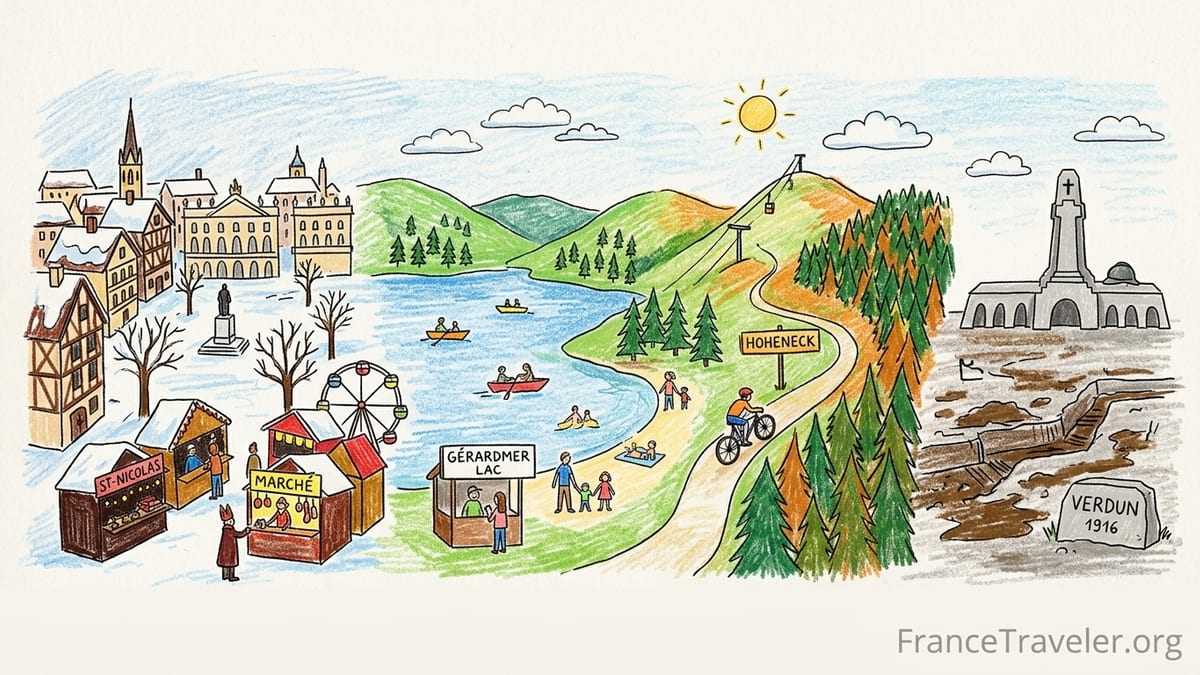
How Seasons Shape a Trip to Lorraine
Lorraine has a temperate continental climate, with cool, often damp winters and pleasantly warm summers. In practice this means grey, misty days are common in late autumn and winter, while July and August bring the brightest skies and longest daylight. That pattern affects each type of trip differently. A rainy afternoon is easy to handle in Nancy, with its museums and cafes, but it can make walking a forest trail above Gérardmer far less appealing.
Most travelers experience Lorraine in one of a few ways: a cultural city break in Nancy or Metz, a visit to Verdun and surrounding First World War battlefields, an active escape in the Vosges mountains around Gérardmer and La Bresse, time in spa towns such as Vittel or Contrexéville, a cycling-focused holiday, or a winter trip for skiing and Christmas or Saint-Nicolas festivities. The best season for each of these does not fully overlap, so planning around your priorities is key.
Spring and autumn tend to be sweet spots for city-focused and heritage travel, with lighter crowds and lower accommodation prices than the school-holiday peaks. Summer is ideal for lake swimming, sailing and high-level hiking in the Vosges, and it is also the time when many family attractions run at full capacity. Winter is far from a dead season. December in particular is one of the most atmospheric times to be in Lorraine, especially Nancy, which extends its Saint-Nicolas festivities over several weeks with markets, illuminations, a big parade and a Ferris wheel on its historic squares.
Because this is a large and varied region, you may well combine several themes in one itinerary. A common combination is two days in Nancy or Metz, a day trip to Verdun by car, and then a few days in the Vosges for fresh air and lakeside landscapes. Understanding how each place responds to weather and seasonal operations helps you decide whether to plan that trip for late May, high summer, October or early December.
Nancy and Metz City Breaks Through the Year
Nancy and Metz are the most flexible destinations in Lorraine, largely because you can enjoy them in almost any weather. Both cities have compact historic centers, major museums and plenty of covered or indoor spaces, from Art Nouveau cafes to covered markets. Destination Nancy’s official tourism information emphasizes that the city can be visited "all year" and highlights different moods in each season, from springtime parks to winter cocooning with shows and the Saint-Nicolas festivities. That reflects the reality visitors experience on the ground.
Spring, from April to early June, is a comfortable time for a first city break. Daytime temperatures are usually mild, and public gardens such as Parc de la Pépinière in Nancy and the riverside promenades in Metz begin to feel lively. Outdoor cafe terraces appear even when temperatures are still cool. Hotel rates on central squares like Place Stanislas in Nancy or near Metz’s cathedral often stay below peak summer prices, especially midweek. Rain showers are frequent, so packing a light waterproof layer and planning at least one museum per day is a good idea.
Summer in Nancy and Metz brings long evenings and a busier feel, especially during French school holidays in July and August. This is when outdoor events flourish. Nancy, for example, schedules open-air guinguettes, temporary bars and food stands along its parks and rivers, and video mapping shows projected on key facades. Metz hosts cultural events around the Centre Pompidou-Metz and by the Moselle river. Terrace seating around Place Stanislas or in Metz’s old town fills up on warm evenings, but outside a few festival weekends you can usually still find a table with a bit of patience.
Autumn and winter city trips trade greenery for atmosphere. September and early October can be ideal, with crisp air and lower hotel prices after the summer peak. Late autumn often turns grey and damp, yet this hardly disrupts a program built around museums such as the Musée de l’École de Nancy or the Museum of the Cour d’Or in Metz, plus long lunches and patisserie stops. In winter, Nancy in particular leans into a cozy feel with theatre schedules, concerts and winter lighting. The city’s tourism board points to an "art of cocooning" during this season, so even a cold, rainy weekend can be rewarding, provided you do not plan to spend it mainly outdoors.
Verdun and First World War Heritage in Different Conditions
Verdun is one of the most emotionally powerful sites in Europe for First World War history. The town and surrounding hills include the Verdun Memorial museum, Fort Douaumont, Fort Vaux, the Ossuary at Douaumont and the devastated villages that were never rebuilt. These sites can be visited year-round, but the type of experience you have changes dramatically with the season, especially because so much time is spent outside or in unheated forts.
From late April to October, daylight and temperatures are generally favorable for exploring several sites in one day. Paths around the trenches and shell craters are usually less muddy, and it is more pleasant to walk between the cemetery at Douaumont and the Ossuary when you are not battling wind-driven rain. Many travelers choose to visit in late spring or early autumn to avoid both the winter chill and the high summer heat that can occasionally affect this inland region.
Winter visits are entirely possible and can be deeply affecting but require preparation. Cold, damp conditions amplify the somber atmosphere of the battlefields. The concrete corridors of Fort Douaumont, for example, feel very raw when you can see your breath and water drips from the ceiling. Outside, fields can turn to sticky mud, and low cloud or fog may obscure viewpoints. Some smaller outdoor or volunteer-run sites reduce opening hours in the low season or close on certain weekdays, so checking current timetables before driving out from Verdun or Metz is essential.
Because the area is relatively quiet outside school holidays, crowd levels tend to be manageable most of the year. Significant anniversaries, such as the centenary ceremonies held in 2016, are exceptions; but in a typical year, the main pinch points are holiday weekends in May and June, and the peak of French summer holidays. If you hope to move at a reflective pace with minimal background noise, a weekday visit in May, June, September or October strikes a good balance between daylight, weather and tranquility.
Vosges Lakes, Gérardmer and Mountain Weather by Season
The Vosges mountains offer a very different Lorraine experience. Around Gérardmer, Xonrupt-Longemer and La Bresse you will find glacial lakes, dense forests and rounded summits known as "ballons." Summer here is dedicated to outdoor activities. Gérardmer’s official tourist information and the wider Vosges tourism board explicitly promote swimming, sailing, pedal-boat rental and other water sports on the lake in the warmer months, alongside hiking and cycling in the hills above. In July and August, beach-style bases along the shore open with supervised swimming zones, snack kiosks and rental stands for kayaks or electric boats.
Local regulations in Gérardmer underline that swimming is only authorized on designated developed beaches and highlight rules for lifejackets and launch zones for sailboats and boards. The existence of such detailed rules is a reminder that this is an actively used lake environment rather than a remote mountain tarn. In high summer you can expect lifeguards on the main municipal beach, families picnicking on the grass and queues at popular ice-cream stands. There is usually paid access to the primary beach area, while informal grassy sections where bathing is tolerated remain simpler and unsupervised.
Mountain weather, however, can shift quickly even in July. A hot morning at lake level can turn into a cool, breezy afternoon on the ridgeline of the Route des Crêtes. Storms often bubble up on humid days, and heavy showers pass over rapidly. For hikers planning a full-day circuit around lakes such as Lac de Longemer or up to viewpoints like the Hohneck area, carrying layers and watching local forecasts matters just as much as it would in the Alps. By late September, daytime temperatures drop noticeably, and forest trails are carpeted with leaves and can become slippery after rain.
From late October through March, the Vosges shift into their winter profile. Many lakeside kiosks close, rental stands are stored, and the overall feel is quieter and more residential. That does not make the region off-limits, but it changes what you can expect. If your goal is long, leisurely swims and boat rentals in Gérardmer, a winter trip will disappoint. On the other hand, if you enjoy fog over the lake, empty paths and the possibility of snow on the surrounding slopes, late autumn and winter can feel atmospheric. Daylight is limited, and low cloud is common, so building in spare time for weather-affected days is sensible.
Spa Towns, Cycling Holidays and Shoulder Seasons
Lorraine’s spa towns, particularly Vittel and Contrexéville, along with smaller destinations like Bains-les-Bains, have long attracted visitors for thermal treatments and calm parklands. Many of the spa facilities and hotels operate year-round, but the towns feel liveliest from late spring to early autumn when their surrounding parks, casino terraces and cafe streets are in full use. For travelers less interested in strict medical cure programs and more in a few days of gentle walks, pool sessions and relaxed dining, May, June and September often combine fair weather with moderate prices.
Cycling is a growing reason to visit Lorraine. The region offers long-distance itineraries along river valleys and canals, plus hilly routes in the Vosges for road cyclists and mountain bikers. The voie verte along the Moselle and stretches of the EuroVelo routes that pass through Grand Est are popular in late spring and autumn when temperatures are suitable for long rides and there is less competition for accommodation in small towns. High summer brings more family cyclists, and some canal paths can feel busier around popular mooring spots, but outside a few sections you are still unlikely to encounter heavy crowding.
Shoulder seasons also work well for travelers who want flexibility. In April, May, late September and October, hotel availability tends to be better across Lorraine’s mid-range segment, from chain properties near Nancy’s main station to family-run hotels around Verdun. Car rental prices from regional gateways like Metz-Nancy-Lorraine airport or the TGV stations are often lower outside school holidays, which matters for itineraries that link city and countryside. The compromise is accepting changeable weather. On a one-week trip in April, you might experience everything from bright, cool sun in Metz to sleet on the Route des Crêtes and rain at Verdun.
For cyclists and spa visitors alike, shorter days in late autumn and winter mean you must plan activities more carefully. A thermal afternoon in Vittel in November can feel very relaxing, but you might emerge from the pools into darkness and drizzle rather than evening sunshine. Conversely, midsummer days make it realistic to combine a half-day ride along the Moselle with an evening swim at a local outdoor pool or natural lake, something far more difficult in April when temperatures drop after sunset.
Winter in the Vosges: Skiing, Nordic Sports and Quiet Villages
Winter in Lorraine’s Vosges is defined by snow rather than by cities. Downhill ski areas such as Gérardmer La Mauselaine and La Bresse Hohneck operate typical French mid-mountain winter seasons, usually opening in December when snow conditions allow and aiming to run through March. Recent seasons have seen some variability due to weather, but the published season-end data for Vosges resorts shows that these ski hills often try to remain open into late March in good snow years. The vertical drop and number of runs are modest by Alpine standards, yet they offer accessible skiing within a few hours’ drive of major cities.
Beyond downhill slopes, the Vosges are strong in Nordic activities. Cross-country trails, snowshoe circuits and winter walking routes weave through forests and along ridgelines. Around Gérardmer, La Bresse and smaller centers, local authorities mark loops of varying difficulty and maintain them when snow depth allows. Equipment rental shops in resort villages supply cross-country skis, snowshoes and sleds at daily rates that are often lower than in the Alps, though prices depend on the shop and current demand. Families from nearby regions like Lorraine itself, Alsace and Luxembourg often come for weekend breaks to let children play in the snow without undertaking a long journey.
Mountain weather dictates how enjoyable this is in practice. December and January can be cold and dark, with short days and the possibility of freezing rain at lower elevations if snowlines are high. Fog can limit visibility on ridges, and rapid thaw-freeze cycles sometimes turn tracks icy. On the positive side, outside Christmas and New Year holiday weeks, slopes and trails are quieter than more famous French resorts. Accommodation in villages such as Gérardmer, La Bresse or Xonrupt-Longemer often has availability for short stays, which suits travelers combining a few ski days with time in Nancy or Metz.
It is important not to assume that every winter day will be skiable. Climate variations mean that some weeks lean more towards brown hillsides with patches of snow suitable mainly for walking, while others deliver full winter conditions. If skiing or Nordic sports are your main aim, planning for January or February, when cumulative snow depth is usually greatest, increases your odds compared with early December or late March. Keeping flexible plans, such as booking accommodation with free cancellation or mixing in non-snow-dependent activities, reduces frustration if the weather does not cooperate.
December in Lorraine: Saint-Nicolas, Markets and Festive Atmosphere
December deserves special attention in Lorraine. Saint Nicolas is the patron saint of the region, and his feast on 6 December remains a major cultural moment. In practice, celebrations extend well beyond a single day. Nancy in particular has built an extended festival season around Saint-Nicolas that is now the city’s biggest annual tourist event. Official information from the city describes around 40 to 45 days of festivities between late November and early January, including markets, illuminations, a Ferris wheel, video mapping on Place Stanislas and a grand night-time parade on the first Saint-Nicolas weekend.
The city center transforms during this period. Wooden chalets serving mulled wine and local products cluster on squares, decorative lights link the 18th-century architecture, and a large Christmas tree typically anchors Place Stanislas. Crowds swell noticeably on Friday evenings and weekends when families from the wider Grand Est region come to see the parade or visit the markets. Hotels overlooking Place Stanislas or close to the main squares often sell out for the parade weekend in early December and may apply higher rates then compared with mid-November or late January.
Elsewhere in Lorraine, Saint-Nicolas events and Christmas markets also animate towns and villages. In Meurthe-et-Moselle, the departmental tourism information highlights large celebrations in several towns, with parades, fireworks and street performances. The atmosphere is closer to a regional winter festival season than to a single religious commemoration. For travelers, this offers rich opportunities for photography, local food and encounters with regional folklore, but it also means accepting larger crowds and the probability of cold, damp weather. Daylight in early December is short, yet evening is precisely when most events come alive.
Verdun and the Vosges have a quieter December compared to Nancy, but they still feel distinctly seasonal. In Verdun, memorial sites take on a stark tone under bare trees and low winter light. Snow is not guaranteed but is possible. In the Vosges, the ski season is often starting or building momentum, and some villages install small markets or lights around their churches. Combining Nancy for Saint-Nicolas festivities with two or three nights in the Vosges to seek early-season snow can make for a varied December trip, though transport logistics, especially in wintry driving conditions, should be part of your planning.
Choosing Your Season by Trip Type
Instead of searching for a single “best month,” it is more useful to match seasons to the kind of Lorraine trip you want. For a first-time visitor focused mainly on cities, late April to June and September to early November are strong choices. During these periods, Nancy and Metz offer comfortable temperatures for walking between squares, parks and museums, yet are less crowded and sometimes less expensive than in late July or early August. Even if you catch rain showers, cafes, covered markets and galleries provide easy fallbacks.
Travelers primarily interested in Verdun and First World War heritage often favor late spring and early autumn. These months provide a compromise between the mud and cold of winter and the heat and insect activity of high summer. You can move between the Verdun Memorial, Fort Douaumont and the Ossuary with enough daylight for reflection without feeling rushed. If your schedule forces a winter visit, packing warm, waterproof clothing and planning for shorter days will help turn harsh conditions into part of the experience rather than a frustration.
For hiking and lake-centered trips around Gérardmer and other Vosges lakes, late June to early September is the most suitable window. This is when supervised swimming areas operate, sailing clubs and rental bases are fully open, and mountain trails are generally free of snow. Families can combine time on the lake with easy forest walks and perhaps a drive along the Route des Crêtes. Weekends in late July and early August are the busiest, so booking self-catering apartments or campsites well in advance is wise if you want lakeside positions.
Winter and early December come into their own for specific interests. If you are drawn to Christmas markets and the Saint-Nicolas tradition, plan for late November through the first half of December in Nancy, when parades, markets and illuminations run at full strength. If your priority is skiing or Nordic sports, target January or February in the Vosges, building in flexibility for snow conditions. Those aiming to avoid peak crowds altogether might consider March, April or late October. While weather is more unpredictable, crowd levels in both cities and mountains are lower, and you can often secure attractive rates on accommodation and transport.
FAQ
Q1. When is the best time for a first trip to Lorraine focused on cities?
For a primarily urban trip to Nancy and Metz, late April to June and September to early November work well. You get mild temperatures, long-enough days to explore on foot and fewer crowds than in the July and August school holidays, while still finding an active cultural calendar and open cafes and restaurants.
Q2. What months are ideal for visiting Verdun and the First World War sites?
Late April to June and September to October are usually the most comfortable for Verdun. Paths are less muddy than in winter, temperatures are moderate for walking around forts and cemeteries, and opening hours at museums and memorials tend to be generous. Winter visits are possible but feel colder, wetter and more physically demanding.
Q3. When should I visit Gérardmer and the Vosges lakes for swimming and boating?
Plan for late June through early September if you want supervised swimming areas, boat and pedal-boat rentals, and the full range of water activities promoted by local tourism boards. July and August are the liveliest, particularly for families, with lakeside snack bars and rental stands operating full days.
Q4. What is the best period for hiking and cycling in the Vosges mountains?
For hiking and road cycling in the Vosges, May to October is the main window, with late June to September offering the most reliable conditions on higher trails. In spring and late autumn you can still hike and ride lower routes, but you should be prepared for rain, fog and occasional cold snaps on the ridges.
Q5. When do the Saint-Nicolas festivities take place in Nancy?
Nancy’s Saint-Nicolas season typically runs from late November to early January, with markets, illuminations and entertainment spread over roughly six weeks. The highlight is the main Saint-Nicolas weekend in early December, featuring a large night-time parade and fireworks that attract big crowds to the historic center.
Q6. Is Lorraine a good winter sports destination?
Yes, for modest-scale winter sports. Ski areas such as Gérardmer La Mauselaine and La Bresse Hohneck offer downhill runs, while the wider Vosges provide extensive cross-country skiing and snowshoeing. The season usually runs from December to March depending on snow, with the best chances for good coverage in January and February.
Q7. Are Nancy and Metz enjoyable in bad weather?
Both cities handle poor weather well because much of what makes them attractive is indoors or sheltered. You can shift an itinerary toward museums, Art Nouveau interiors, covered markets, cafes and restaurants without feeling that you are missing the point of the destination, which is not the case for lake or hiking-focused trips.
Q8. When are crowds heaviest in Lorraine’s main destinations?
Crowds increase during French school holidays, especially late July and August at the Vosges lakes and in family-oriented resorts, and during the Saint-Nicolas and Christmas period in December in Nancy. Verdun sees more visitors on spring public-holiday weekends and in high summer, but is still less crowded than major coastal or Alpine destinations.
Q9. What is the best time for a family holiday in Lorraine?
Families who want lakes and outdoor activities usually do best from July to late August, when supervised beaches, boat rentals and many seasonal attractions are open. Those with school flexibility might prefer late June or early September, which are calmer but still offer warm weather and most services in the Vosges and spa towns.
Q10. Which season is best if I want to avoid peak crowds in Lorraine?
To avoid peak crowds, consider late March to early June, excluding Easter and public-holiday weekends, or late September to early November. During these shoulder seasons, you can explore Nancy, Metz, Verdun and even lower Vosges trails with fewer people around, though you must accept more variable weather and shorter opening hours in some tourist facilities.