


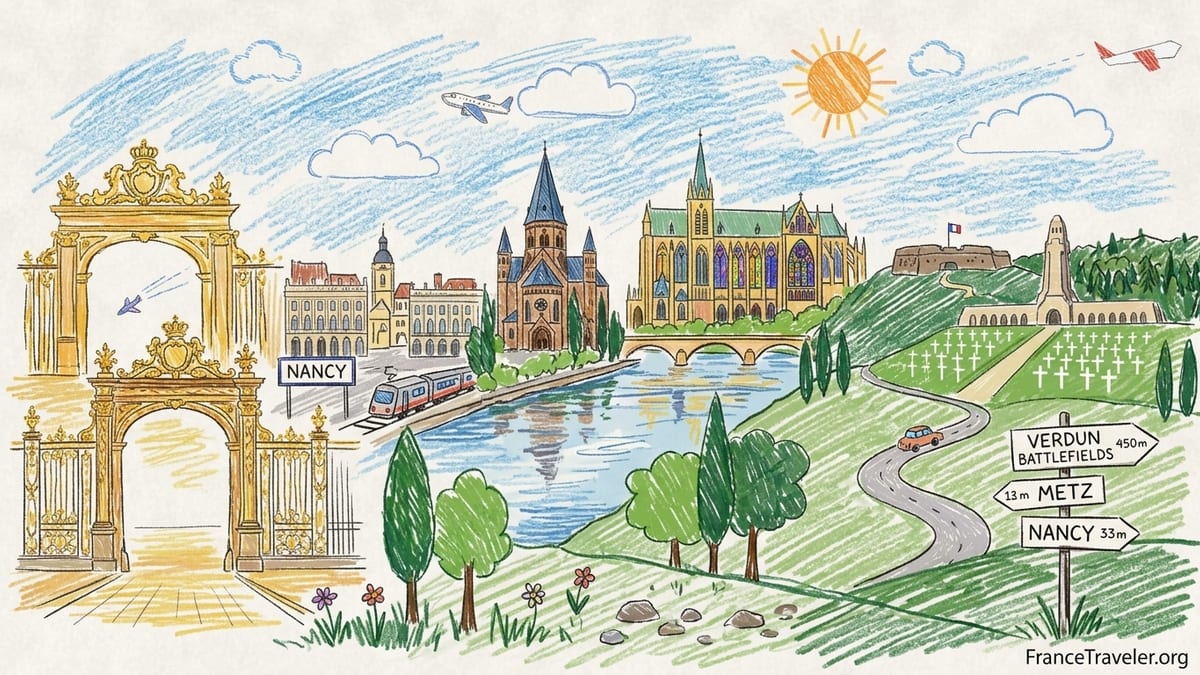
I went to Lorraine chasing a very specific image of France. I imagined drifting between gilded squares and storybook villages, with quick hops by train to World War I sites and forested hills. Names like Nancy, Metz and Verdun evoked art nouveau balconies, riverside promenades and solemn memorials. What I actually found was still rewarding, but it was also more spread out, quieter and logistically trickier than I expected. Lorraine turned out to be a region that demanded planning, patience and a willingness to sit with its history, not a ready-made highlight reel.
What Drew Me To Lorraine In The First Place
Before my trip, Lorraine sounded almost too perfect on paper. Nancy’s UNESCO-listed Place Stanislas, Metz’s cathedral with its Chagall windows, and the legendary battlefields around Verdun all sat neatly on the map within the same historical region in northeastern France. Travel articles and brochures spoke of an easy combination of culture, gastronomy and remembrance. From Paris, high-speed trains reach Lorraine TGV station near Metz in about 1 hour and 15 minutes, and regular TER regional trains link Paris to Nancy in roughly 1 hour and 30 minutes, which made the region feel nicely accessible without a car.
On top of that, Lorraine’s reputation as less touristed than Alsace or Burgundy appealed to me. I liked the idea of a place where café terraces were filled mostly with locals, not large tour groups, and where hotel rates remained relatively modest even in summer. I pictured myself using Nancy as a flexible base, jumping on regional trains to explore medieval towns, vineyards and war memorials by day, and returning each night to lively streets and glowing façades.
The reality was not a disaster. I found much of what I hoped for: the Maison des Sœurs Macarons in Nancy serving delicate macarons, evening strolls around Metz’s Temple Neuf reflected in the Moselle, and the sobering whiteness of the Douaumont Ossuary near Verdun. But I also ran into a series of practical frustrations that changed the feel of the trip. None of them would have kept me from visiting Lorraine, but I wish someone had warned me so I could plan around them.
Underestimating Distances: My Over-Ambitious Nancy Base
My first miscalculation was using Nancy as a base for too many day trips. Nancy itself is compact and walkable, with the train station only about a 10-minute stroll from Place Stanislas. That gave me a false sense that everything in Lorraine was conveniently close. On my second full day, I decided I could do a “quick” trip from Nancy to Verdun to see the World War I sites, then be back in time for an early evening apéro on the square.
The plan looked simple: Nancy to Verdun by TER regional train. On paper, the journey is around 1 hour and 15 minutes to 1 hour and 40 minutes depending on the departure, often with a change in Metz or another small station. The issue was frequency. When I checked schedules on SNCF Connect, I found that direct options were limited, and many services involved awkward gaps. The train I ended up on left Nancy mid-morning and arrived in Verdun just before lunchtime. The next reasonable return option in the late afternoon would get me back to Nancy in the evening, which left only a narrow window on the ground.
In practice, almost three and a half hours of my day evaporated into transfers and waiting on platforms. By the time I walked from Verdun’s station into the center, it was already lunchtime. I grabbed a quick meal on the main street, watching the clock and trying to calculate how much I could fit in before the return train. My assumption that Verdun would be a simple day trip from Nancy ended up meaning I saw little of Nancy that day and still barely scratched Verdun’s surface.
If I could redo it, I would either rent a car in Nancy and accept the 100-kilometer drive to Verdun on the A4, or I would plan at least one overnight in Verdun itself to minimize back-and-forth. For travelers, the lesson is to treat Lorraine less as a single compact destination and more as a region with meaningful distances between hubs. Plot not just the kilometers but the actual train times and frequencies, and be realistic about how much of your day will disappear into travel.
Verdun Without A Car: A Battlefield That Is Much Bigger Than It Looks On The Map
My second major surprise came when I tried to see Verdun’s battlefield sites without a car. I had looked at online maps and assumed that the main sites were bunched together just outside town. I thought I could arrive at Verdun station, maybe grab a local bus or taxi, and string together a circuit of the Verdun Memorial Museum, Douaumont Ossuary and at least one of the major forts such as Douaumont or Vaux.
What the map did not fully convey was scale. The Verdun Memorial Museum stands near Fleury-devant-Douaumont, roughly 8 to 9 kilometers from Verdun town center. Douaumont Ossuary sits about 1.5 kilometers further along, and Fort Douaumont and Fort Vaux are scattered in the surrounding forest another several kilometers apart along minor roads. Driving between them, these distances feel short. On foot, or while hunting for irregular bus services, they stretch into something else entirely.
I arrived at Verdun station shortly after noon. At the tourist office in town, staff explained that there was no all-day, hop-on hop-off shuttle during the shoulder season. A seasonal “Battlefield Tour” bus operates limited days, focused on key spots like Fort Douaumont, the ossuary and a destroyed village, but on my particular weekday it was not running. Taxi services existed, but several drivers were already booked for private tours. One could take me from town to the ossuary for around 25 to 30 euros one way, but could not wait to shuttle me between all the sites.
By the time I had arranged a one-way taxi to Douaumont Ossuary, visited its tower and crypt, and walked up the road to the Verdun Memorial Museum, I had already spent more than I expected and was nervously watching the clock for the last train back to Nancy. The museum itself deserves at least two hours to absorb its exhibits on trench life, artillery and the French and German experience of the battle, and I rushed through it in a little over one hour. I never made it to Fort Vaux at all. The battlefield that had seemed compact on a map turned into a patchwork of sites spread across kilometers of forest and fields, most easily seen by car.
For future visitors, the key is to decide early whether Verdun is a core focus of your trip. If it is, strongly consider renting a car either in Metz, Nancy or Verdun itself. Alternatively, time your visit around the organized battlefield tours operated through the Verdun tourist office, which group major sites into a single half-day excursion and handle transport between them. If you rely solely on trains and irregular local buses, assume you will see far fewer sites, and choose one or two that matter most rather than trying to cover everything.
Restricted Opening Hours And Museums That Demand More Time
Lorraine’s museums and memorials are often excellent, but I underestimated how opening hours and the depth of the exhibits would affect my days. On the Verdun battlefield, the Verdun Memorial Museum, the Douaumont Ossuary and the major forts typically operate on seasonal schedules. In 2026, for example, the Verdun Memorial and the forts have shorter low-season hours, such as 9:30 a.m. to 5:30 p.m. with last entry 30 to 45 minutes before closing, and slightly longer high-season hours to 6:30 p.m. That may sound generous, but once you factor in travel time from town and between sites, the window narrows fast.
One specific issue arose when I tried to pair the Verdun Memorial Museum with an afternoon visit to the underground Citadel of Verdun in town. I arrived at the museum just before 2 p.m., delighted to find it relatively uncrowded. Once inside, however, the sheer amount of material made it clear that anything less than two hours would feel rushed. Original uniforms, artillery pieces, film clips and personal testimonies filled several levels. By the time I emerged, the afternoon had nearly slipped away. When I reached the underground Citadel, I learned that its last departures for the small automated cars that take visitors through the galleries are typically 1 hour and 30 minutes before the posted closing time.
Because I had not checked that detail, I missed the last departure by about 10 minutes. The staff politely turned me away, and I walked back along the Meuse feeling vaguely foolish. In a big city, missing a final entrance slot is annoying but rarely trip-defining, because there are always other museums open late. In Verdun, with fewer options and limited evening activity, that mishap left my late afternoon a bit empty.
The lesson, which applies across Lorraine’s smaller cities and towns, is to look carefully at not only opening hours but also last-admission times, which are often significantly earlier. For historically dense museums such as the Verdun Memorial or the World Center for Peace in Verdun’s former bishop’s palace, plan at least two hours each. Stack fewer sites per day, but give them the attention they deserve. If something is truly important to you, like touring the underground Citadel or climbing Metz’s cathedral tower, visit it earlier in the day rather than assuming you can squeeze it in at the end.
Quiet Evenings Beyond Nancy And Metz
I enjoyed the atmosphere in Nancy and Metz on weekend evenings, but I overestimated how lively things would remain during the week and in smaller towns. In Nancy, Place Stanislas and the surrounding streets near Rue des Maréchaux were busy on Friday and Saturday nights, with brasseries serving late and students filling bars. On a Monday and Tuesday, however, the mood shifted noticeably. Several restaurants closed outright at the start of the week, and terraces emptied much earlier, particularly outside peak summer months.
The contrast was even sharper when I spent a night in Verdun. I arrived on a Sunday evening expecting at least a small riverside promenade scene. The Meuse riverfront is attractive, with views of the citadel and bridges, but when I went out around 8 p.m., only a handful of places remained open. One pizzeria had stopped serving food, and a couple of brasseries were already winding down. By 9:30 p.m., the streets felt very quiet. It was not unsafe, just subdued in a way that surprised me after time in Paris and Strasbourg earlier in the trip.
This quietness has advantages. In places like Verdun or smaller Meuse valley towns, you feel close to local life. Evening walks are peaceful, hotel nights are silent and you can actually hear the river. But if you are expecting a buzzing restaurant scene every night, Lorraine outside the largest cities may feel sleepy. On grey or rainy evenings, which are common in this northeastern region, the mood can tilt from calm to slightly melancholy.
Travelers who value nightlife should concentrate their evenings in Nancy and Metz, and check opening days for specific bars or restaurants in advance. In smaller towns, eat dinner earlier. I learned to aim for a table by 7:30 p.m., especially on Sundays and Mondays, and to carry simple picnic supplies from supermarkets or bakeries in case options were thin. Embracing the early evening quiet as part of Lorraine’s character made my later nights in Verdun and Bar-le-Duc more enjoyable rather than disappointing.
Rural Public Transport And The Limits Of Car-Free Travel
Before arriving, I spent time studying Lorraine’s train map and concluded that the region was reasonably friendly to car-free travelers. Metz and Nancy are well linked by rail, with frequent TER trains taking roughly 35 to 45 minutes between the two. Some Vosges towns and Bar-le-Duc also appear on the network. What the maps did not show as clearly was how limited public transport becomes once you step away from these main corridors, especially on weekends and in off-peak seasons.
One example occurred when I tried to reach a small Meuse village south of Verdun to visit a rural cemetery and local museum. On the departmental tourist site, the distance looked trivial: around 30 kilometers. I assumed there would be at least a couple of daily bus connections. At Verdun’s bus station, however, staff explained that the interurban bus serving that route operated mainly on school days. On the Saturday I had planned, there was just one morning departure out and no convenient return. There were also no ride-share options listed for that day.
Without a car, I had to abandon the plan, and I spent the day walking in the forested heights near Verdun instead, which turned out to be pleasant but different from what I intended. The experience repeated in another form near the Vosges foothills, where weekday buses connected some villages to Epinal or Saint-Dié-des-Vosges, but weekend services were extremely sparse. The presence of networks like Le Met in Metz or Stan in Nancy does not extend far into the countryside, and “regional” bus systems often prioritize student and commuter flows rather than tourists.
If your vision of Lorraine includes exploring rural churches, tiny war cemeteries or quiet wine villages without driving, you will need to be strategic. Base yourself longer in a single city and focus on places reachable by direct train, such as Metz, Nancy, Bar-le-Duc or Epinal, using guided excursions for harder-to-reach areas. Alternatively, plan to rent a car for at least part of your trip. When checking bus routes, do not rely solely on a map or a generic journey planner. Look directly at the timetable PDFs provided by local transport authorities to confirm which days and months a service actually runs.
When Grey Weather Makes Small Towns Feel Flat
Lorraine’s climate came as another mild shock. Coming from a sunnier part of Europe and remembering marketing photos taken in high summer, I underestimated how much grey and rainy weather would shape my days. In spring and autumn, it is common to encounter long stretches of overcast skies and showers. During my week, I had only one fully blue-sky day. The rest ranged from misty mornings over the Meuse to steady rain that lasted through the afternoon.
In the larger cities, the weather mattered less. Nancy’s Place Stanislas feels impressive even under a low ceiling of clouds, and Metz’s cathedral interior is dramatic regardless of conditions outside. But in smaller towns renowned more for atmosphere than for blockbuster sights, such as some Meuse valley villages or lesser-known wine towns on the Moselle, the grey skies lent everything a slightly washed-out feel. Stone façades that might glow warmly in late-afternoon sun instead looked muted. Riverfront walks became quick, practical strolls punctuated by dashes into cafés.
One afternoon in Bar-le-Duc made this especially clear. The upper town has Renaissance façades and carved stone houses that photos had led me to imagine basking in golden light. I arrived under a persistent drizzle. The fine details of the buildings were still there if I looked closely, but the empty streets and flat light drained some magic from the scene. I ended up spending more time than planned indoors at the local museum and a tiny church simply because the outdoor ambiance felt bleak.
Rather than counting on sunny terrace afternoons, build an itinerary for Lorraine that works in grey weather. Identify museums, covered markets, churches and memorials that you would be happy to explore on rainy days: the Verdun Memorial Museum, the World Center for Peace in Verdun, Nancy’s Musée des Beaux-Arts or Metz’s Centre Pompidou-Metz. Pack proper rain gear and shoes you can walk in on wet cobblestones. When the sun does appear, be flexible enough to swap plans and head straight for outdoor spots like the Parc de la Pépinière in Nancy or the riverside promenades in Metz.
Less “Postcard France” Than Alsace Or Burgundy
Perhaps my most subtle disappointment, and the one I hesitate to call a “problem,” was aesthetic. Having spent time in Alsace and Burgundy on earlier trips, I expected Lorraine to offer a similar density of instantly photogenic towns. Alsace has rows of half-timbered houses in places like Colmar and Riquewihr, and Burgundy is dotted with wine villages surrounded by neatly striped vineyards. Lorraine can certainly be beautiful, especially in the rolling hills around the Meuse and Moselle rivers and the forests near the Vosges, but its beauty is quieter and often more industrial or military in flavor.
In Metz, the contrast sits inside one city. The old town around the cathedral and along the Moselle is lovely, with honey-colored Jaumont stone façades and leafy squares. A short walk away, the new districts around the station and shopping centers feel more utilitarian. Nancy’s historic core is elegant, but step into some outer neighborhoods and you quickly encounter functional postwar apartment blocks. In Verdun, the central square has charming fronts, yet many side streets bear scars of 20th-century rebuilding, and the town’s identity is inseparable from its fortifications and memorials.
One specific moment brought this home when I detoured to a small town I had seen in a brochure as a “village of character” along the Meuse. In the carefully framed photograph, a church tower rose above red roofs and lush greenery. Arriving in person on a cloudy day, I discovered that the picturesque angle was taken from a narrow stretch of riverbank. Just behind me, barely out of frame in the brochure, sat a busy departmental road and a row of plain modern houses. The village was pleasant to walk through, but it did not match the all-over charm of somewhere like Eguisheim in Alsace.
Rather than expecting Lorraine to deliver nonstop postcard views, it helps to approach it with a historian’s eye. Notice how Metz’s grand railway station reflects the German imperial period, or how Nancy’s art nouveau villas speak to early 20th-century prosperity. On the Verdun battlefield, the beauty lies less in tidy streets than in the way forests have grown over shell craters. If you want pure storybook scenery, you might pair a few days in Lorraine with time in neighboring Alsace, using high-speed or regional trains to shift between the two.
The Takeaway
Looking back, the frustrations I encountered in Lorraine all stemmed from mismatched expectations rather than inherent flaws in the region. I expected compact distances, frequent public transport, lively evenings in every town, flexible museum hours, reliable sunshine and movie-set villages. What I actually found was a place where history looms larger than tourism, where cities and battlefields dominate more than wine villages, and where logistics require a little more homework.
Yet despite the missteps, I am glad I went. Standing in the quiet interior of Douaumont Ossuary and seeing the thousands of names etched in stone, or watching light shift across the gilded gates of Place Stanislas, I felt connected to layers of European history that are harder to grasp in more polished destinations. The very fact that Lorraine is not saturated with visitors means that conversations with hoteliers, café owners and museum staff feel more genuine, and that you can linger at major sites without jostling for space.
If you approach Lorraine as a region to be learned rather than consumed, it rewards you. Give Verdun and its surroundings the time and transport they truly require. Let Nancy and Metz anchor your evenings while you use days to explore outwards. Embrace the grey skies as part of the mood rather than a spoiler. Above all, trade the idea of a nonstop postcard circuit for an itinerary that makes room for contemplation. Lorraine may not always be pretty in the obvious way, but it has a gravity and authenticity that stay with you long after you leave.
FAQ
Q1. Is it realistic to visit Verdun as a day trip from Nancy or Metz without a car?
It is technically possible by regional train, but travel times and limited connections mean you will have only a few hours on the ground and will struggle to see more than one or two battlefield sites without expensive taxis or an organized tour.
Q2. Do I need to rent a car to explore Lorraine properly?
You can see Nancy, Metz, Verdun town and some larger hubs by train, but a car makes a big difference for reaching rural villages, scattered memorials and parts of the Vosges and Meuse countryside that have little or no weekend bus service.
Q3. How much time should I allow to visit the main Verdun battlefield sites?
For the Verdun Memorial Museum, Douaumont Ossuary and at least one major fort, plan a full day if you have a car or are on a guided tour, and at least two days if you are relying on limited local transport.
Q4. Are museums and memorials in Lorraine open year-round?
Most major sites such as the Verdun Memorial and Douaumont Ossuary are open most of the year, but hours shorten in low season and last admission can be well before closing time, so always check the current schedule before you go.
Q5. What is evening life like in smaller Lorraine towns?
Outside Nancy and Metz, evenings are usually quiet, especially on Sundays and early in the week, with fewer restaurants open and little nightlife, so it is wise to eat earlier and not count on a late bar scene.
Q6. When is the best time of year to visit Lorraine for good weather?
Late spring and early autumn often bring mild temperatures but can still be cloudy or rainy; for the best chance of longer sunny spells, many travelers aim for mid to late summer, while knowing that showers remain possible.
Q7. How does Lorraine compare visually to Alsace or Burgundy?
Lorraine has attractive cities and landscapes, but fewer uniformly picturesque villages; its appeal often lies more in its history, forests and river valleys than in rows of half-timbered houses or vineyard postcards.
Q8. Is Lorraine a good destination for travelers without much interest in military history?
Yes, if you focus on Nancy, Metz, local gastronomy and art, but a large part of the region’s identity is tied to World War I and border history, so appreciating that context will deepen your experience.
Q9. How many days should I spend in Lorraine on a first trip?
Allow at least four to five days to visit Nancy and Metz and either Verdun or a slice of the Vosges; a week gives you time to add smaller towns or extra battlefield exploration without rushing.
Q10. What is the single most important planning tip for visiting Lorraine?
Decide early which places are non-negotiable for you, then check real transport times and opening hours around them, building a slower, more focused itinerary rather than assuming you can cover the whole region with spontaneous day trips.