

I first went to Lorraine with a historian’s curiosity and a rental car, convinced that a few nights in Nancy would be enough to “do” the region. On paper my plan looked efficient: tight day trips, museum passes, a neatly color-coded schedule. On the ground it felt like a slog of early alarms, motorway exits and museum fatigue, with the Vosges forests and spa towns reduced to names on roadside signs. This is not a disaster story so much as a case study in planning the right region in the wrong way, and what I learned from treating Lorraine as a checklist of cities and battlefields instead of a landscape to inhabit.
Staying Only in Nancy and Commuting Everywhere
My central mistake began with a seemingly sensible idea: book one base in Nancy and fan out across Lorraine by car. High speed trains reach Nancy from Paris in around 1 hour 30 minutes, so it felt like a natural hub, with Place Stanislas, Art Nouveau townhouses and café terraces right on my doorstep. I booked five nights in a mid-range hotel near the old town, thinking I would save the hassle of packing and unpacking and “wasting time” on hotel check-ins in other cities.
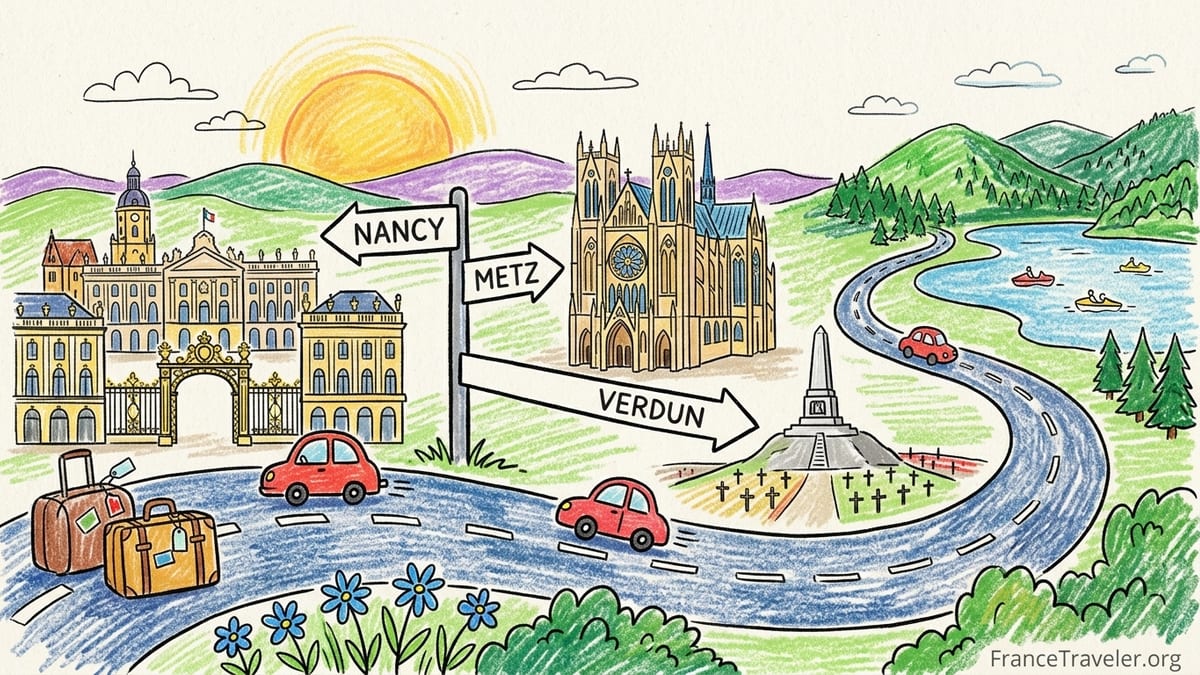
In practice, my Nancy-centric strategy turned every major sight into a commute. Nancy to Metz is roughly 60 kilometers by road and takes about 45 to 50 minutes on the A31 in light traffic, but with morning congestion leaving the city and evening traffic coming back, each “simple” day trip cost closer to 2 hours behind the wheel. Driving to Verdun for the World War I memorials added another 1 hour 40 minutes each way from Nancy, around 120 kilometers of autoroute and national road. Even shorter runs like Nancy to Toul or Pont-à-Mousson became half days once I factored in parking, navigation and the inevitable wrong turns following brown tourist signs.
The problem was not just the kilometers, it was the mental load. Instead of wandering Nancy’s streets in the evening, I spent my nights checking opening hours, calculating departure times and searching for parking garages in Metz or Verdun. On the Verdun day I clocked nearly 260 kilometers of driving there and back plus local shuttling between forts and memorials. By the time I rolled back into Nancy, Place Stanislas was glowing in the night and every terrace was buzzing, but I was too tired to do more than grab a takeaway quiche and sit on the hotel bed.
Looking back, the mistake was treating a compact region as if it were a single city suburb. Lorraine’s distances are manageable by European standards, but piling them up day after day drains time and attention that could go to actually being in a place. I “saved” an hour of packing by staying in one hotel and lost at least 8 to 10 hours over the week inside the car. Next time I would treat Nancy as a two-night opening chapter, not a forever base: arrive by train, spend one full relaxed day on Place Stanislas and the Art Nouveau trail, then pick up a car and move my suitcase with me as I move through the region.
Treating Metz as a Half-Day Detour
Because Nancy had become my immovable base, Metz was demoted to a box to tick on the way to Verdun. My plan read like a logistics puzzle: leave Nancy around 8:00, reach Metz by 9:00, see the cathedral and Centre Pompidou-Metz before lunch, then continue to Verdun in the afternoon. On the map this seemed reasonable. The A31 links Nancy and Metz in under an hour, and Metz to Verdun is about another hour on the A4. I imagined myself strolling under the stained glass of the cathedral by mid-morning and standing on the Verdun battlefield by late afternoon, efficient and satisfied.
What happened instead was a breathless four-hour race through a city that deserved at least an overnight stay. I found underground parking near the historic center close to 9:30, walked up into the light and immediately realized I had underestimated Metz. The cathedral alone, famed for having one of the largest stained-glass surfaces in France, could easily hold a curious visitor for one or two hours, especially if you want time to admire the Chagall windows and simply sit in the nave. I gave it 45 minutes and left frustrated, half of my thoughts on the clock and the looming Verdun drive.
I then headed towards Centre Pompidou-Metz, a major art museum in its own right rather than a satellite you can “pop into.” Inside, the exhibitions were extensive and clearly designed for lingering: large contemporary installations, video rooms, and spaces where you need time to let the art sink in. A comfortable visit would have taken two or three hours. I gave it barely 90 minutes, including buying tickets and navigating between floors. I left exhibits halfway through, skipped entire wings and barely looked at the museum garden, all because I had promised Verdun to myself later that day.
The mistake here was conceptual as much as practical. I had slotted Metz into my itinerary as “the other Lorraine city” to contrast with Nancy, rather than as a cultural destination with its own rhythm and nightlife. By treating it as a half-day, I effectively compressed what could have been a relaxed 24 to 36 hours of cathedral visits, river walks along the Moselle, and evening terraces into a frantic sprint. Next time I would plan at least one or two nights in Metz, arriving in the afternoon, checking into a hotel within walking distance of the cathedral, and letting the evening unfold: first the golden stone of the old town at dusk, then a full unhurried morning at Centre Pompidou-Metz, with time in the café to process what I saw instead of glancing at my watch.
Stacking Verdun After Another Museum-Heavy Day
If there is one decision I regret most acutely, it was scheduling Verdun immediately after another full museum day. I spent the day before at museums in Nancy and Metz, absorbing Art Nouveau collections, decorative arts and modern installations with the help of audio guides. By evening my feet hurt and the stories in my head were already dense. Yet my itinerary insisted that the next morning would be devoted to Verdun, Memorial and battlefields included, before another late drive back to Nancy.
Verdun is not just another cultural stop. The Memorial, ossuary and forts around the city present a concentrated emotional weight, from trenches and shell craters to bone-filled ossuaries and cemetery rows that extend to the horizon. A thoughtful visit to the Memorial alone, with its multimedia displays and testimonies, takes around two hours if you actually read panels and watch videos. The Douaumont Ossuary and cemetery can easily add another 60 to 90 minutes, and each fort visit requires more driving, parking and walking. It is entirely possible to spend six or seven hours on site without feeling like you have seen everything.
I arrived with barely that much time in my schedule and almost no mental space left. The day before, I had spent around five hours combined in museums, and my capacity for reading and absorbing complex historical narratives was already worn thin. In Verdun I found myself skimming panels that deserved slow reading, walking past exhibits that deserved attention and cutting short my time in the cemetery because I was calculating driving time back to Nancy and the risk of arriving after dark. The result was that I covered the ground physically but felt I had grieved and understood less than I hoped.
This was a mistake born of treating history as quantity instead of depth. Verdun asks for a clear day in the itinerary and a clear head. Next time I would either sleep in Verdun itself or nearby and devote one full day to the battlefields, with a lighter activity the day before: perhaps a walk along the Moselle, a short local museum, or simply café time in Nancy or Metz. I would leave space in the evening for quiet, not another long drive. Verdun does not belong as an afterthought tacked onto a museum marathon. It belongs as a centerpiece of a trip that also includes rest and nature to balance its intensity.
Assuming Lorraine Was “Mainly History” and Neglecting the Vosges
Before my trip, whenever I thought of Lorraine I pictured Place Stanislas, the Metz cathedral windows and the trenches of Verdun. I knew vaguely that there were mountains nearby but in my mind they belonged to Alsace rather than Lorraine. The Massif des Vosges, with its lakes, forests and hiking trails, appeared on maps as a sort of green margin that I assumed would be better visited “another time” on a dedicated nature trip. I built my Lorraine itinerary almost entirely around cities and memorials, with the Vosges relegated to the status of a possible day trip if there happened to be a spare slot.
On the ground, this blind spot became obvious every time I drove west or south out of Nancy and saw the silhouette of the Vosges on the horizon. Lorraine’s share of the Massif des Vosges is heavily forested, with some of the highest woodland coverage in the region, and it is threaded with hiking paths, lakes and viewpoints that are destinations in themselves. Gérardmer, sometimes called the “Pearl of the Vosges,” offers a large glacial lake ringed by hills, beaches and boat rentals. Towns like Vittel and Contrexéville are known for their thermal spas and landscaped parks, part of a broader spa culture that stretches back to the nineteenth century.
By focusing almost exclusively on monuments and museums, I built a trip that left me overstimulated indoors and underexposed to the landscapes that give Lorraine its character. My days became lists of rooms visited and plaques read, while the forests and lakes I crossed by car blurred into anonymous green. When I finally looked up more detailed information about the Vosges during the trip, I realized just how much I was ignoring: long-distance cycling routes through valleys, family-friendly lakes with supervised swimming in summer, and spa complexes where you can spend half a day alternating between thermal pools, saunas and relaxation rooms.
In hindsight, this was not just a missed opportunity; it was a planning error that affected the whole tone of the trip. Nature time might have offset the weight of Verdun or the intensity of museum visits, giving my mind and body a break. Instead I came home with a head full of dates and exhibits but only fragmentary impressions of the Vosges from car windows. If I were planning again, I would block at least two nights in the Vosges themselves, perhaps basing myself in Gérardmer or another lake town, and design those days around walks in the forest, time on the water and perhaps a half day at a spa in Vittel or Contrexéville on the way.
Trying to Squeeze Gérardmer into a Rushed Day Trip
Late in the itinerary, guilt about my neglect of nature pushed me to “fit in” Gérardmer as a final flourish. My schedule read like a dare: leave Nancy after breakfast, reach Gérardmer by late morning, walk around the lake, rent a boat if possible, have a quick lunch, then drive back to Nancy in time for a last evening stroll. On paper the route seemed simple. Nancy to Gérardmer is roughly 110 kilometers, and routes through the Vosges can take about 1 hour 45 minutes to 2 hours depending on traffic and weather.
The reality of mountain roads and summer crowds turned this into another day centered more on the car than on the lake. I arrived near midday, lost 20 minutes circling for parking near the shore, and finally stepped out into the sunlight knowing that I had at most three hours before I needed to start back. The lake was busy with stand up paddle boards, pedal boats and small motorboats. Rental signs advertised hour-long slots, but the queues meant that by the time I could actually get on the water I would be able to enjoy perhaps 30 or 40 minutes before watching the clock again.
I settled for a shoreline walk and a quick sandwich on a bench, managing perhaps one and a half hours actually near the water. There was no time to take one of the marked forest paths that climb away from the lake, no detour to neighboring lakes, no slow coffee in town. In total I drove for around 3 hours 30 minutes that day and spent less than half that time near the very landscape I had come to see. Gérardmer was not a destination so much as a backdrop glimpsed between concerns about the return drive.
The mistake was imagining that a lake resort town can be “done” as if it were a small museum. Gérardmer is designed for slow days: mornings hiking or cycling in the surrounding hills, afternoons swimming or boating, and evenings watching the light fade over the water from a terrace. Trying to compress this into a rushed afternoon visit stripped it of exactly what makes it appealing. If I were planning again, I would give Gérardmer at least one full day framed by an overnight stay, ideally two nights. I would arrive in the late afternoon, check into a lakeside or in-town hotel, walk the promenade at sunset, then devote the next day entirely to outdoor activities without the pressure of a long drive on either side.
Overlooking Cycling and Spa Experiences
One of the quiet luxuries of Lorraine is the way it combines active travel and relaxation: cycling routes that follow rivers and forest roads, spa towns where thermal water is part of daily life, and gentle landscapes that invite exploration at a slower pace. I knew this abstractly but still built an itinerary almost entirely around static visits. The bikes stayed in the rental shop and the spas remained names on a brochure, while I accumulated museum tickets and motorway receipts.
During my drives I often saw signs for véloroutes and cycle paths, including routes that link towns across the Vosges and follow valleys like the upper Vologne near Gérardmer. Tourist information from the region highlights thousands of kilometers of marked paths for walking and cycling, with varying difficulty and plenty of small towns and farm inns along the way. Yet I had scheduled no time to rent a bike, no half day to follow a river path, and no flexibility to let weather decide between a ride and an extra museum.
The same was true of the spa culture. Towns like Vittel and Contrexéville in the Vosges are built around thermal parks, grand halls and dedicated spa complexes where visitors book half-day or full-day programs of pools, saunas and treatments. Regional tourism materials emphasize these as pillars of local identity, alongside cities like Nancy and Metz and historical sites like Verdun. I drove past turnoffs to these spa towns more than once and thought, “next time,” even though I had unused hours in my evenings that could have supported at least a short visit.
By neglecting these dimensions, I accidentally designed a trip that was intellectually rich but physically flat: my legs walked museum floors instead of forest paths, and my shoulders never fully relaxed into warm mineral water. Next time I would rebalance the ratio deliberately. In the Vosges I would plan one full day for cycling or hiking, starting early, breaking for lunch in a farm inn that serves local cheeses and smoked meats, then continuing along a loop trail or cycle route. I would also schedule a specific half day at a spa in Vittel or Contrexéville on my way into or out of the mountains, booking access to thermal pools in advance and treating that time as non-negotiable, just as I did for museum tickets.
The Lorraine Trip I Would Plan Now
If I could redraw my map of Lorraine, it would be shorter in kilometers but deeper in experience. I would stop trying to conquer the region from a single base and instead build a simple line of stays that move with the landscape: city to city to mountains, with deliberate breathing spaces in between the heaviest historical moments. The core of that revised itinerary would be about six or seven nights, which many travelers can reasonably carve out, but even four or five nights could follow the same structure on a smaller scale.
I would begin with two nights in Nancy, arriving by high speed train from Paris in the afternoon. That first evening would be for Place Stanislas, lit up after dark, and a relaxed dinner on a side street rather than a frantic museum dash. The full day would include one or two focused visits such as the Musée des Beaux-Arts or the museum devoted to the École de Nancy Art Nouveau movement, plus time simply to wander the old town and perhaps sit in a café on Place d’Alliance. There would be no long drives, just local tram or walking.
From there I would either pick up a rental car or take a short train to Metz for one or two nights. Metz would no longer be a half-day stop but a mini city break inside the trip: one half day and evening for the cathedral, riverfront and old town, and one half day for Centre Pompidou-Metz, with room in the schedule for a long lunch and a stroll through a park. With one or two nights here, I could actually see the city lights reflecting on the Moselle, rather than watching them fade in my rear-view mirror.
Next I would choose between basing myself in Verdun for a night or two, or visiting Verdun as a full day trip from Metz with an early start and a leisurely return. In either case Verdun would have its own dedicated day, separated from other museum-heavy days by at least one lighter one. The goal would be to spend unhurried time at the Memorial, ossuary and selected forts, leaving space for reflection and avoiding long drives at both ends of the experience.
The final movement of the trip would be into the Vosges for at least two nights. I would base myself in a place like Gérardmer or another lake town, choose one day for structured activity such as a signed hiking route or a rental bike circuit through surrounding forests and lakes, and one day for a slower mix of lake time, a local viewpoint drive and perhaps a small museum or village visit. On the way to or from the mountains I would plan a three or four hour stop in a spa town like Vittel or Contrexéville, pre-booking a half day in a thermal complex. The result would not be a checklist of everything in Lorraine but a mix of history, city life and outdoors that respects the region’s variety instead of flattening it into “Nancy plus day trips.”
The Takeaway
The mistakes I made in Lorraine were not what most travelers fear. I did not miss trains or get locked out of my hotel. I did not arrive at closed museums or lose my wallet. My errors were quieter and more insidious: overestimating what could fit into a day, underestimating places like Metz and Gérardmer, and ignoring the physical and emotional toll of stacking dense historical visits back to back. I came home with a camera full of cathedral ceilings and battlefield monuments but too few memories of forest paths, lake reflections or steam rising off a spa pool at dusk.
Lorraine rewards a traveler who is willing to slow down, shift bases and let the geography lead: from the stone and light of Nancy and Metz to the scars and memorials of Verdun, then onward to the green folds of the Vosges and the calm routines of spa towns. Planning errors like mine compress these layers into a blur, turning what could be a varied journey into a sequence of car rides and museum tickets. The good news is that they are easy to fix on a second visit, and even easier to avoid on a first if you recognize the warning signs of an over-ambitious, under-balanced plan.
If I had understood from the beginning that Lorraine is as much about lakes and forests as it is about plazas and plaques, my days would have looked very different. I would have spent fewer hours counting kilometers and more hours watching the light change on Lake Gérardmer or the Moselle. In revisiting the region on paper, I see not just the mistakes I made, but the trip that still waits: one of shorter drives, deeper stays and a steadier rhythm between past and present, effort and ease.
FAQ
Q1. How many days do I need to get a good feel for Lorraine?
For a balanced trip mixing cities, history and nature, plan at least six or seven nights, with time in Nancy, Metz or Verdun, and two nights in the Vosges.
Q2. Is it realistic to use Nancy as a base for all major sights?
You can, but it leads to long days. Nancy to Metz and Verdun involves several hours of combined driving, so splitting your stay between cities reduces time on the road.
Q3. Should I stay overnight in Metz or is a day trip enough?
A day trip covers highlights, but one or two nights let you enjoy the cathedral, Centre Pompidou-Metz and evening atmosphere without rushing between them.
Q4. How much time should I allow for Verdun and its battlefields?
Plan a full day for the Memorial, ossuary and at least one or two forts. Many travelers appreciate an overnight nearby to avoid a long return drive after an intense visit.
Q5. Is Gérardmer worth more than a short stop?
Yes. The lake, nearby trails and surrounding hills justify at least one full day and ideally two nights if you want to combine hiking or cycling with time on the water.
Q6. Do I need a car to explore Lorraine properly?
Trains connect major cities like Nancy and Metz, but a car gives you far more flexibility for Verdun, Vosges hikes, lakes like Gérardmer and spa towns such as Vittel.
Q7. How can I avoid “museum fatigue” in Lorraine?
Alternate dense museum or memorial days with lighter ones focused on walking, cycling, lake time or spa visits so that you have space to process what you have seen.
Q8. When is a good season to enjoy nature in the Vosges part of Lorraine?
Late spring to early autumn is ideal for hiking, cycling and lake activities, while winter offers lower-key snow experiences in the Vosges without major resort crowds.
Q9. Where should I stay if I want both Verdun and the Vosges in one trip?
Combine short stays: a couple of nights in Nancy or Metz, one in or near Verdun, and at least two in a Vosges base such as Gérardmer or another lake town.
Q10. How can I build more relaxation into a history-focused Lorraine itinerary?
Include spa time in towns like Vittel or Contrexéville, choose accommodations with easy access to parks or lakes, and intentionally limit yourself to one major museum or memorial per day.