


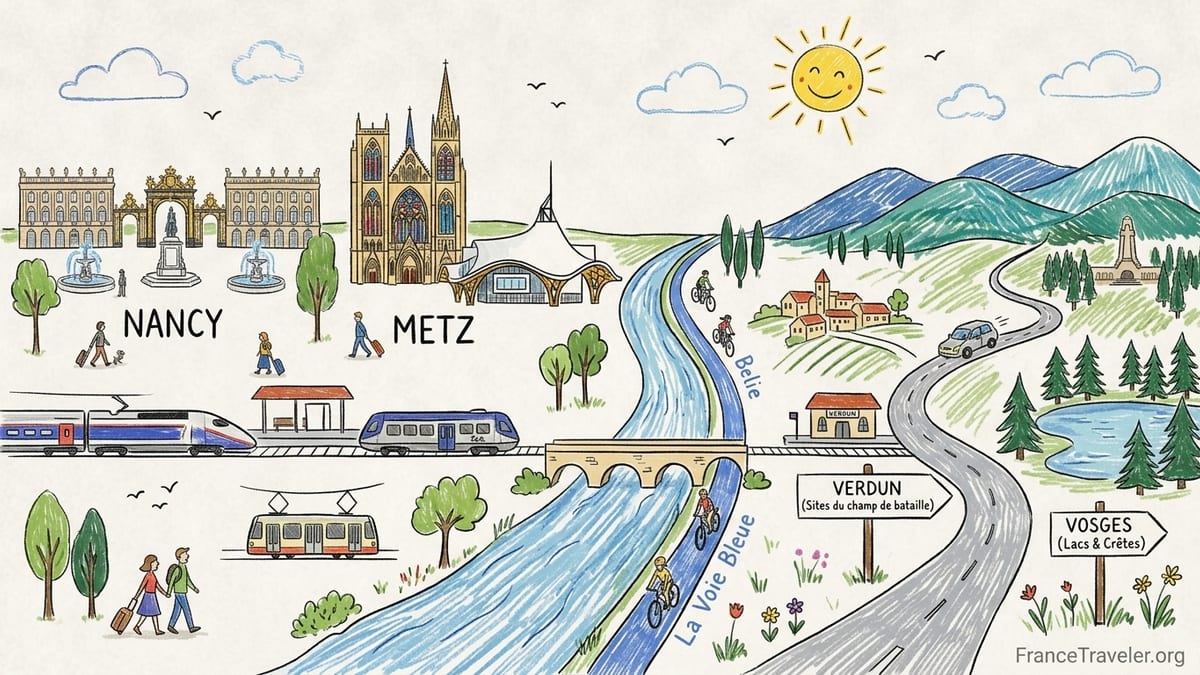
Lorraine rewards visitors who think carefully about how they move. High-speed trains make Nancy and Metz easy city breaks from Paris, while the region’s lakes, mountain viewpoints and scattered First World War sites are much less straightforward without a car. This guide compares rail and road in real travel scenarios so you can decide what works best for Nancy, Metz, Verdun and the Vosges.
Why Rail Works So Well for Nancy and Metz
The strongest argument for rail in Lorraine is how easily it delivers you into the heart of Nancy and Metz. Nancy is connected to Paris Est by TGV services that cover the roughly 350 kilometre journey in about 1 hour 30 to 1 hour 40 on the fastest trains, with around ten departures a day according to current SNCF schedules. You step off at Nancy-Ville, a central station that is a short walk or tram ride from Place Stanislas, the old town and the main hotel districts. For a weekend city break from Paris, this is hard to beat in terms of speed and simplicity.
Metz enjoys similar advantages. Direct trains from Paris Est typically reach Metz-Ville in roughly 1 hour 20 to 1 hour 30, again without the stress of highway traffic or urban parking. Metz-Ville station itself is an attraction, a vast early 20th century building just a 10 to 15 minute walk from the cathedral and the Centre Pompidou-Metz. For travellers basing themselves in Paris, it is entirely realistic to leave after breakfast and be on the Moselle riverfront promenade by late morning.
Nancy and Metz are also linked by frequent regional TER Grand Est services, which generally take under 40 minutes and run through the day. This makes it easy to stay in one city and day-trip to the other by train. A visitor staying three nights in Nancy, for example, can devote one full day to Metz without touching a car: a morning TER to Metz-Ville, a day between the cathedral quarter and the modern art galleries, and an evening train home.
On top of regular rail, Lorraine is investing in slower, car-free routes such as the Voie Bleue cycling itinerary. Official route information highlights a roughly 68 kilometre section along the Moselle between Metz and Nancy, weaving past Pont-à-Mousson and other river towns. This confirms that the region is not only built around motorways. Travellers can combine trains with sections of this riverside cycleway for a low-carbon itinerary, for instance by renting bikes near Metz, riding part of the route and returning to Nancy by TER.
When a Car Starts to Matter: Verdun, Vosges and Small Towns
Move away from the main Nancy–Metz axis and the balance shifts. Verdun, the most famous name on the Western Front, does have a station on the regional TER Grand Est network with direct or one-change services from Metz and Nancy. Schedules show several trains a day taking roughly 1 hour to 1 hour 30 from Metz and similar from Nancy. On paper this makes Verdun accessible by public transport, especially for travellers who prefer not to drive.
The challenge is that Verdun station is not on the battlefield itself. The core sites that most visitors come to see, such as Fort Douaumont, the Douaumont Ossuary, the destroyed villages and the Verdun Memorial Museum, sit in wooded hills north and north-east of town. Road signage and official directions emphasise access by car from the A4 motorway or from Verdun centre, and shuttle options are limited and often seasonal. If you step off a train in Verdun without a car, you still face a complicated patchwork of local buses, taxis and sometimes private tours to string the sites together efficiently.
The same pattern repeats in the Vosges. Regional trains link Nancy with gateway towns such as Saint-Dié-des-Vosges and Épinal, and there are bus services up some valleys to ski areas and lakes. Yet many popular spots, including smaller lakes, high passes and spa villages, are not directly on rail lines. Reaching the shore of Lac de Gérardmer at sunrise, or a trailhead above La Bresse, is far easier by car than by coordinating several infrequent buses. In winter, when some high roads can be snow-covered or see chain requirements, services may be further reduced.
Smaller Lorraine towns also highlight the limits of public transport for flexible touring. Places like Pont-à-Mousson on the Moselle or rural Meuse villages associated with First World War history can have limited bus frequencies, especially on Sundays and public holidays. Taxis exist, but in many villages you need to reserve well in advance and journeys of 15 to 30 kilometres quickly add up in cost. For a traveller with specific out-of-town goals or a tight schedule, hiring a car from Nancy, Metz or even Meuse TGV station becomes increasingly attractive.
Scenario 1: Nancy and Metz as a Rail-First City Break
Consider a long weekend where your priority is architecture, museums and café culture in Nancy and Metz. You fly into Paris or arrive on Eurostar, then take a high-speed TGV from Paris Est directly to Nancy-Ville in about an hour and a half. The station sits at the edge of the city centre. You can roll your suitcase to a hotel near Place Stanislas in 10 to 15 minutes or use the local tram and bus network without needing a taxi.
For two full days you explore on foot and by tram: the UNESCO-listed 18th century squares in Nancy, the Art Nouveau district, riverfront walks and museums. On day two or three, you stroll back to Nancy-Ville and catch a TER Grand Est train to Metz. Depending on the time of day, you are in Metz-Ville in well under 40 minutes. From there, you can walk to the cathedral, known for its stained glass, and the Centre Pompidou-Metz for contemporary art, then take an evening train back to Nancy.
In this scenario, a car adds little. Parking garages in both city centres are widely available but not free, and historic cores in Nancy and Metz have pedestrian or limited-traffic zones where driving is more trouble than it is worth. Hotels near the stations frequently advertise the fact that you can arrive by rail and walk everywhere. For luggage, French intercity trains accommodate standard suitcases in overhead racks and dedicated luggage spaces, so there is no strong advantage to having a car simply to carry bags.
Rail also simplifies evenings. You can enjoy local Riesling or Moselle wines with dinner without designating a driver, and there is no need to navigate unfamiliar ring roads after dark. For most travellers whose plans do not extend beyond the cities or the nearby Voie Bleue cycleway, the combination of TGV and TER is the most efficient, low-stress choice.
Scenario 2: Verdun and the Battlefields in Depth
A Verdun-focused trip looks different. Imagine you are passionate about First World War history and want to visit the major sites in a single intensive day. You might take a morning TER from Metz or Nancy to Verdun, arriving around mid-morning. From Verdun station you can walk into town in around 15 minutes, but the battlefield area that includes Fort Douaumont, the Douaumont Ossuary, the destroyed village of Fleury-devant-Douaumont and the Verdun Memorial lies roughly 10 to 15 kilometres away by road.
Local information from the Verdun Memorial stresses car access to the site from the A4 motorway or Verdun town, and notes that visitors arriving by train often continue by hire car, taxi or pre-arranged shuttle. Shuttles, when offered, may only run in peak season and on limited timetables. If you rely on ad hoc taxis from Verdun, you may find that several are based in town rather than waiting at the station, and a return journey that stops at several sites can involve significant waiting or multiple separate fares.
Travellers who want to see more scattered locations, such as the Meuse-Argonne American Cemetery, further complicate the picture. These sites lie deep in the countryside with no rail access and very limited, sometimes school-oriented bus services. Reaching them in a single day without a car often means joining a specialist guided tour or arranging a private driver for several hours. Some regional operators offer full-day battlefield excursions from larger cities in the Grand Est region, but departures may require a minimum number of participants and advance booking.
With a rental car, the experience is very different. You could collect a car from Metz, Nancy or even Meuse TGV station, drive to Verdun in around an hour from Metz via the A4, and then follow clearly signposted battlefield routes between the main memorials. Parking at major sites such as the ossuary or the memorial museum is typically in large outdoor car parks with no complex restrictions, which makes multiple short stops straightforward even in high season. For a Verdun trip centred on specific sites rather than the town itself, a car or an organized battlefield tour is usually the most efficient choice.
Scenario 3: Vosges Lakes, Viewpoints and Outdoor Time
A third scenario is an outdoor-oriented holiday in the Vosges. From Lorraine, many visitors begin in Nancy, taking advantage of its rail connections before heading south or southeast toward the mountains. Regional TER services link Nancy with Épinal and Saint-Dié-des-Vosges, which act as gateways to higher ground. From there, bus lines serve some resorts and lakes, especially in summer and winter sports seasons.
However, the most rewarding parts of the Vosges often lie beyond the last bus stop. Lakes such as Gérardmer and Longemer, viewpoints on the Route des Crêtes and smaller spa villages are connected by winding mountain roads. Driving times between them may be only 20 to 40 minutes, but attempting the same journey by public transport can involve infrequent rural buses that do not line up well with hiking plans. If you want to watch sunrise over a ridge, picnic at a lakeside beach and then soak in a spa in the evening, relying only on fixed bus timetables can become frustrating.
Winter raises extra considerations. Mountain roads in the Vosges can see snow, ice and fog, and some sections may require winter tyres or snow chains. Rental agencies in Lorraine’s larger cities can advise and often supply cars equipped for winter, but not all small local operators do. If you are uncomfortable with mountain driving in winter conditions, an alternative is to reach a resort town such as Gérardmer by train-and-bus combination and then stay car-free, relying on local shuttle buses or walking to lifts and trails. This works well for travellers who want a single base rather than a multi-stop itinerary.
Luggage is part of the calculation. Outdoor trips often involve hiking gear, boots and sometimes winter equipment. Trains handle this kind of luggage reasonably well, but transfers between stations and rural accommodation can be awkward without a car, particularly if you are travelling as a family or group. A compact rental car from Metz-Nancy-Lorraine Airport, Nancy-Ville or Metz-Ville allows you to load everything once and keep it with you as you move between valleys.
Scenario 4: A Seven-Day Lorraine Loop
Many travellers want a bit of everything: one or two cities, time at Verdun and a few days in the Vosges. For such a seven-day loop, a hybrid approach combining trains and a rental car tends to work best. One common pattern is to begin by rail, then switch to a car part-way through the trip when the itinerary becomes more rural.
For example, you could start with three nights in Nancy without a car. Arrive from Paris Est by TGV in about 1 hour 30, enjoy the city centre on foot, and perhaps take a TER day trip to Metz. During this phase, you avoid parking costs, do not need to navigate urban one-way systems, and can rely entirely on frequent trains between the two main cities.
On day four, you might pick up a rental car in Nancy and drive to Verdun, stopping in smaller Meurthe-et-Moselle or Meuse towns along the way. After a night or two in or near Verdun with a full day devoted to the battlefield, you continue south-east toward the Vosges, basing yourself around Épinal or a lakeside town for hiking or lake activities. On day seven, you drive back to Nancy or Metz, return the car and connect by TGV back to Paris or beyond.
This structure keeps car rental costs and highway tolls confined to the days when you genuinely need the flexibility of a vehicle, while allowing you to lean on France’s high-speed and regional rail for busy corridors. It also simplifies parking: in Nancy and Metz you use hotels within walking distance of the station during the car-free portion, then switch to accommodations with on-site or nearby parking once you leave the main rail lines.
Practicalities: Parking, Winter Driving and Rural Transport
Parking in Nancy and Metz is relatively straightforward if you do choose to drive, but it rarely feels as convenient as arriving by train. Both cities operate underground and multi-storey car parks close to the centres, generally with hourly and daily rates rather than free long-stay options. Street parking tends to be limited or time-restricted, especially near historic squares and commercial streets. If your itinerary is city-heavy, these costs and minor hassles often outweigh any benefit of having a car.
Out in the countryside, parking is usually easier and often free. The Verdun Memorial, Douaumont Ossuary and major battlefield sites provide large surface car parks so visitors can come and go throughout the day. In the Vosges, lakeside and trailhead car parks vary more: some are free, while others charge modest day rates in peak season. In smaller spa towns and villages, car parks can fill on busy weekends, but you rarely face the dense traffic of a major city.
Winter driving in Lorraine is normally manageable on major roads, which are well maintained, but conditions can be more demanding in the Vosges mountains and on smaller departmental roads. Renting a car from a provider in Nancy, Metz or at Metz-Nancy-Lorraine Airport enables you to request winter tyres where available and confirm policies regarding snow chains. If forecasts show heavy snow or ice and you are not confident in those conditions, you might postpone mountain segments or switch to a rail-and-bus itinerary that keeps you on cleared main routes.
Rural bus networks deserve careful attention. Towns like Verdun are served by local networks, but frequencies outside peak commuting times can be low, especially on weekends and public holidays. Buses may run only a few times a day to smaller villages or battlefields, which can leave large gaps in a sightseeing schedule. Taxi services exist, yet in many smaller communities vehicles are based out of town and reservations are strongly recommended. It is unwise to assume that you can always find a taxi spontaneously at a remote memorial or mountain viewpoint.
Choosing Between Train, Car and Hybrid Strategies
For travellers focused on Nancy and Metz, rail is the clear winner. TGV connections from Paris Est keep journey times around 90 minutes to each city, and frequent regional trains between Nancy and Metz make day trips easy. Both city centres are compact, with the main attractions, restaurants and hotels clustered within a walkable radius of the station. Here, a car mostly introduces parking fees and navigation headaches without meaningful gains in freedom.
For Verdun and its battlefield sites, the picture is more nuanced. It is entirely possible to reach Verdun by train from Metz or Nancy, and budget-conscious travellers who are content with seeing a subset of sites close together may manage with a mix of local buses, taxis and walking. However, anyone who wants to cover multiple forts, cemeteries and memorials spread across the hills in a single day will find a car or a well-organised tour much more efficient. In this context, the difference between “getting to Verdun station” and “visiting Verdun’s battlefields” is significant.
For the Vosges, the decision turns on how wide-ranging and time-sensitive your plans are. If your goal is a single resort or spa town where you will stay put for most of the trip, arriving by train and connecting bus can work very well, especially in high season when shuttles run more frequently. But if you dream of linking lakes, ridges and viewpoints in a flexible way, a car offers a level of spontaneity and reach that public transport does not yet match in this mountainous region.
Hybrid strategies let you capture the best of both worlds. Many travellers will be happiest arriving in Lorraine’s cities by train, enjoying their first few days car-free, then renting a car only for the Verdun and Vosges segments before returning it and leaving the region again by rail. This approach aligns neatly with Lorraine’s mix of high-speed rail corridors and more remote countryside attractions, while also supporting lower-carbon travel on the busiest stretches.
The Takeaway
Deciding between train and car in Lorraine is really about matching your transport to your priorities. Nancy and Metz are textbook examples of rail-friendly cities, with fast TGV links to Paris, good regional connections and compact centres that reward walking and tram travel. Here, buying TGV and TER tickets and keeping your hands off a steering wheel will usually give you a smoother, more relaxing trip.
Once you look at Verdun’s battlefields, the rural Meuse and the high Vosges, a car becomes more compelling. Tracks, memorials and lookouts rarely align neatly with train lines or even frequent bus routes, and taxi or shuttle options, while present, often work best when pre-arranged or bundled into tours. The convenience of being able to drive directly from Verdun Memorial to Fort Douaumont, then on to smaller cemeteries or villages, is hard for public transport to match.
For many visitors, the best answer is not “train or car” but “train then car.” Start and finish your journey on high-speed rail, spending a few nights in Nancy or Metz with no parking to worry about, then rent a car only for the days when you are in the countryside or mountains. In doing so, you align your transport with the strengths of each mode: trains for fast intercity links and easy city breaks, cars or organised transport for battlefield circuits, lakes, spa towns and high viewpoints.
However you choose to travel, planning ahead is essential. Check the latest TGV and TER timetables, confirm rural bus services if you intend to rely on them, and clarify rental car conditions for winter driving if you are heading into the Vosges in the colder months. With realistic expectations and a transport plan tailored to your itinerary, Lorraine becomes a region where both rails and roads can work in your favour.
FAQ
Q1. Is it realistic to visit both Nancy and Metz in one weekend by train?
Yes. Fast TGV services from Paris bring you to Nancy or Metz in around 90 minutes, and frequent regional TER trains connect the two cities in under 40 minutes, making a two-city weekend feasible without a car.
Q2. Can I visit Verdun’s main battlefield sites without renting a car?
You can reach Verdun by train and then use a mix of local buses, taxis and possibly seasonal shuttles, but seeing multiple dispersed sites in a single day is easier with a rental car or an organised battlefield tour.
Q3. How difficult is parking in Nancy and Metz for drivers?
Both cities offer plenty of underground and multi-storey car parks near the centre, usually with paid hourly or daily rates. It is manageable, but you will face costs and may find navigating one-way streets less convenient than arriving by train.
Q4. Are winter driving conditions in the Vosges a serious concern for visitors?
Major roads are generally well maintained, but higher passes and minor roads can be snowy or icy. If you plan winter trips to lakes or ski areas, consider renting a car equipped for winter and be prepared to adjust plans in bad weather.
Q5. How often do trains run between Nancy and Metz?
Regional TER Grand Est services run several times a day between Nancy and Metz, typically with journey times under 40 minutes, which makes day trips in either direction straightforward.
Q6. What is the Voie Bleue and how can I use it on a car-free trip?
The Voie Bleue is a long-distance cycling route following rivers including the Moselle, with a section of roughly 68 kilometres between Metz and Nancy. Travellers can combine trains with bike rental along this stretch for a low-carbon way to explore between the two cities.
Q7. Is it better to pick up a rental car in Paris or in Lorraine?
For a Lorraine-focused trip, many travellers find it easier to take a TGV from Paris to Nancy or Metz, then rent a car locally for Verdun and the Vosges. This avoids driving out of Paris and limits rental days to when a car is really needed.
Q8. Are rural buses around Verdun and in the Vosges reliable enough for tight schedules?
Rural buses do run but often with limited frequencies, especially on weekends and public holidays. They are fine if you plan around the timetable, but not ideal if you want spontaneous multi-stop days or must keep to a tight schedule.
Q9. How should I handle luggage if I travel mostly by train?
French TGV and TER trains have spaces for standard suitcases and overhead racks. Choose accommodation within walking distance of stations in Nancy and Metz, or use short taxi rides from the station if you prefer not to wheel bags through town.
Q10. What is the best overall strategy for a week-long Lorraine trip?
A practical approach is to arrive by TGV, spend a few days car-free in Nancy and Metz, then rent a car for three or four days to cover Verdun’s battlefields and the Vosges before returning the car and leaving by train again.