


I arrived in Verdun thinking I was well prepared. I had read about the Battle of Verdun, booked a rental car, and circled the major memorials on a map. On paper it was just another ambitious day of battlefield sightseeing. In reality it became one of the most emotionally and physically difficult travel days I have ever had in France, not because the sites were poorly managed or too sombre, but because I underestimated the distances, the density of information, and the emotional weight of trying to take in too much of Verdun in too little time.
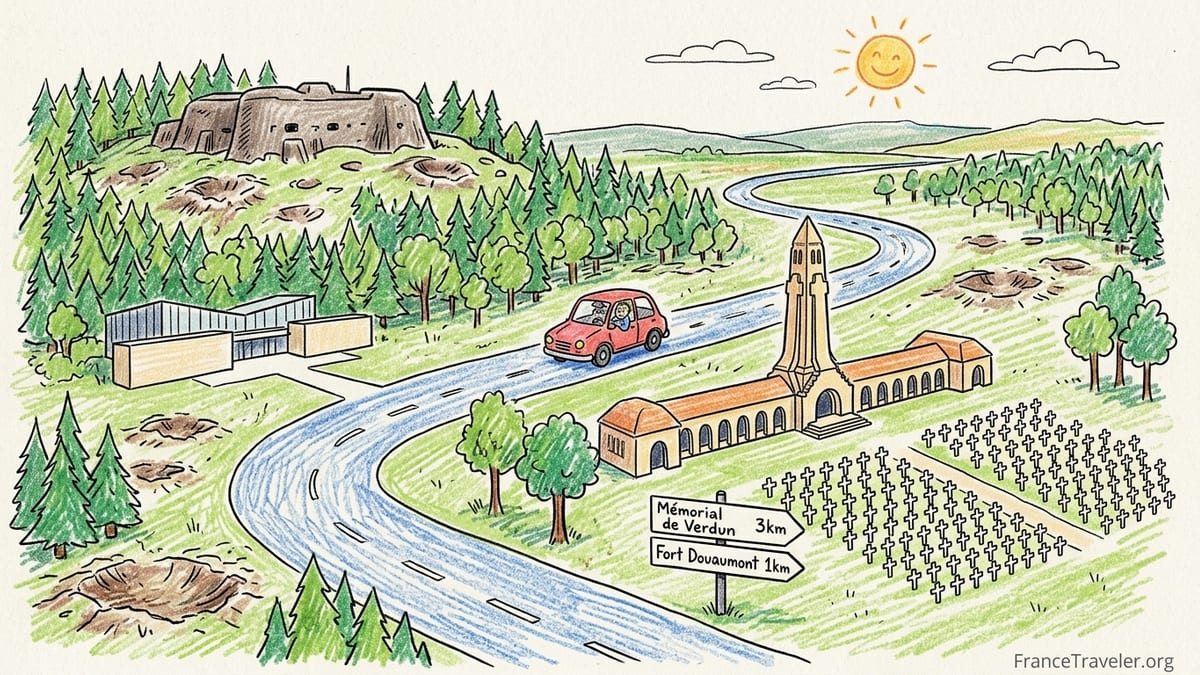
Verdun Is Not One Stop: How I Misjudged the Battlefield
Before I went, I casually referred to “the museum at Verdun,” as if Verdun were a single site where the entire story was told. Official tourism materials and France’s national tourism portal make clear that Verdun is in fact an entire battlefield region, dotted with major locations such as the Verdun Memorial museum, the Douaumont Ossuary, the Underground Citadel and the Centre Mondial de la Paix, along with forts like Douaumont and Vaux and several destroyed villages. Together they spread over a broad rural area north and east of the town of Verdun rather than clustering around one central plaza.
My mistake was planning Verdun like a compact city museum day. On a single day in mid season I attempted to visit six different sites: first the Verdun Memorial, then Fort Douaumont, the Douaumont Ossuary, Fort Vaux, the destroyed village of Fleury-devant-Douaumont and finally the Underground Citadel back in town. Distances between individual stops were usually only a few kilometers, but each leg required leaving a site, navigating narrow forested roads, finding parking again and mentally resetting to absorb a new layer of history. The battlefield may look close on a map, yet on the ground it feels much larger.
The practical information backs that up. In 2026 the Verdun Memorial, Fort Douaumont and Fort Vaux generally operate with shared opening hours, from around 9:30 a.m. to either 5:30 p.m. or 6:30 p.m. depending on the season, with last entry at the museum 45 minutes before closing and slightly earlier cutoffs at the forts. That seems generous until you start adding up drive times and visit durations: the Memorial alone suggests one and a half to two hours for a full visit, and the Underground Citadel tour runs about 90 minutes. Trying to squeeze six sites into a single day left almost no margin for slowness, reflection or fatigue.
By lunchtime I realized I had confused the idea of seeing Verdun with the act of collecting Verdun locations. None of the individual museums or memorials encouraged rushing. The pressure came from my own itinerary, which treated a vast and complex landscape of memory as if it were a theme park one could cover by moving fast and ticking boxes.
Information Overload and Emotional Whiplash
Verdun is one of the most carefully interpreted battlefields in Europe, and that is part of what makes a visit so demanding. At the Verdun Memorial, detailed exhibits explain the 1916 battle from multiple perspectives with weapons, uniforms, personal objects, maps and large-scale multimedia displays. Panels describe artillery barrages, logistics, and the daily life of soldiers in ways that invite you to slow down and imagine the experience. Spending less than 90 minutes inside feels like skimming a book that deserves to be read line by line.
From there I drove directly to Fort Douaumont, where the atmosphere changes from museum calm to damp stone corridors and the echo of heavy doors. Information panels on site, combined with audio guides, focus on the fort’s capture, recapture and the explosion that killed hundreds of soldiers inside. The sensory jump from glass cases in climate-controlled galleries to dim passageways with dripping ceilings might be one of Verdun’s strengths, but it was also jarring. I had not given myself time to digest what I had just seen at the Memorial before confronting the claustrophobic reality of the fort.
After Fort Douaumont came the Douaumont Ossuary and the adjoining military cemetery. The Ossuary is explicitly designed as a place of mourning and reflection, not as a museum. Inside are the remains of tens of thousands of unidentified French and German soldiers, visible through lower windows around the building. The site’s rules are clear: no eating, drinking, shouting, photography or phone use inside the monument, and visitors are asked to dress respectfully. The quiet is absolute. Stepping into that silence so soon after the bustle of the Memorial and the narrow corridors of the fort produced a kind of emotional whiplash that I had not anticipated.
By mid afternoon I found myself reading fewer panels, skipping over timelines and barely glancing at archival photos that deserved my full attention. The World Peace Center in Verdun’s former episcopal palace, which explores Franco German history and European reconciliation, ideally needs a fresh mind and at least an hour or two. When I walked through its exhibitions at the end of the day, I was simply too saturated to engage properly with the complex political and social narratives on display. Verdun had not become repetitive. I had simply overloaded my own capacity to process it.
When Fatigue Hit: Exact Breaking Point on a Packed Itinerary
The turning point came around 2:30 p.m., midway through my visit to Fort Vaux, the fourth major site of the day. I had started at the Verdun Memorial when it opened at 9:30 a.m., spent almost two hours there, then driven to Fort Douaumont for another ninety minutes including time to walk to and from the parking area. I arrived at the Ossuary around 1:00 p.m., spent close to an hour between the monument and the military cemetery, and grabbed a quick sandwich from the small snack counter by the parking lot.
By the time I reached Fort Vaux, I had already been immersed in Verdun’s history for over four hours with only ten minutes of sitting down to eat. The fort itself is powerful and presents a different angle on the battle, especially the desperate French defense and hand to hand combat in underground galleries. Yet I caught myself rushing through galleries, glancing at captions without fully reading them, and ignoring optional detours inside the fort simply because my legs were tired and my concentration was fading.
Looking back at my notes, I realize that Fort Vaux suffered the most from my overambitious plan. It deserved another forty five minutes at least. The signage there is dense and often detailed, and the audio guide adds important layers, but I cut both short because I was already mentally calculating driving time back to Verdun for my late afternoon slot at the Underground Citadel. Fatigue did not just make me slower; it made me impatient with exactly the kind of close attention that sites like Vaux require to make sense.
The lesson was simple but painful. Verdun is not the place to “power through” in order to hit a target number of attractions. Once tiredness sets in, usually sometime after your third major stop, the quality of your engagement begins to fall off sharply. I left the battlefield with the uncomfortable sense that I had touched many places but truly understood fewer than I hoped.
Weather, Walking and the Quiet Difficulty of Distances
I visited in early summer on a gray, humid day with intermittent drizzle. At first this seemed atmospheric, almost appropriate to the subject matter. Verdun under soft rain and low cloud has a somber beauty that photographs well. Yet after several hours of walking across damp gravel parking lots and along muddy paths between shell holes, the weather became another layer of effort that I had not factored in when planning my schedule.
The main battlefield sites are served by parking areas, but they still demand walking. From the parking lot up to Fort Douaumont you follow a slightly uphill path through trees and across uneven ground that can be slippery after rain. Around the Ossuary, if you want to explore the cemetery properly, you cross wet grass and move along rows of white headstones in open exposure to sun, wind or drizzle. Fort Vaux also involves outdoor segments between the car park, entrance and surrounding landscape. None of these distances are long, yet over the course of the day they add up, especially if you are carrying a small backpack and wearing clothes that are damp at the edges.
Inside the Underground Citadel, the challenge flips: regardless of the weather outside, temperatures in the galleries hover around 8 degrees Celsius. The site itself recommends wearing warm clothing, and the one and a half hour tour duration is long enough that you feel the chill. I went in still carrying the humidity of the day and came out tired from the cold and the sensory immersion of augmented reality headsets and moving wagons in the dark. If you are sensitive to temperature shifts, the combination of damp forests, open cemeteries and deep cold underground can be exhausting.
Distances also matter at the scale of the entire day. Verdun is reachable by train from Paris in roughly an hour to nearby Meuse TGV station followed by a local connection or bus, and it sits a short drive from Metz and Reims. That makes a day trip look feasible. What those numbers do not reveal is the cumulative fatigue of driving from town to the Memorial, then to the forts, then back to town along quiet roads where concentration cannot lapse. Even if each hop is only ten or fifteen minutes, the need to stay alert on rural roads at the end of an emotionally heavy day is another form of difficulty that many travelers underestimate.
Rushing Meals and Skipping Breaks: How Hunger Shortened My Patience
One of my most avoidable mistakes at Verdun was not planning food breaks with the same seriousness as entry times. The battlefield sites offer a mix of simple snack options and, in some seasons, cafeteria style dining, but these are often geared to quick refueling rather than lingering meals. I grabbed a coffee and pastry in Verdun town before driving out to the Memorial for opening time, assuming I would find a relaxed sit down lunch later.
Instead I ended up eating a basic pre made sandwich standing near the Douaumont Ossuary car park, watching a coach group file toward the monument in silence. It did the job in terms of calories but did nothing to slow my pace or reset my mind. By the time I reached Fort Vaux I was not so much hungry as under-nourished in terms of energy and focus. Everyone processes these days differently, yet my own experience makes me think that a proper midday pause in Verdun town, with a plate of hot food and thirty minutes off your feet, is not an indulgence but an essential part of visiting responsibly.
Prices in Verdun’s cafés and brasseries fall in the range you would expect for a small French town. A lunch formula with a main course and dessert or coffee can often be found for a moderate amount, with simpler options like quiche or salad at similar levels. The difference between that and a rushed cold sandwich from a site kiosk is not only about quality; it is about giving yourself permission to recover. Verdun asks a lot of your attention and emotions. Meeting that with low blood sugar and a racing schedule is not respectful to you or to the stories the sites are trying to tell.
On a second visit I would structure the entire day around a real lunch break back in town between the late morning at the Memorial and an afternoon among the battlefield sites. It might mean “losing” an hour and a half of sightseeing time, but in practice it would probably unlock more meaningful concentration and patience for the remainder of the day.
What Felt Repetitive, What Felt Essential
After a full day, some parts of Verdun began to blur. Artillery pieces displayed outside multiple sites, for example, started to look similar to my tired eyes by late afternoon. Certain types of trench reconstructions and cratered landscapes also repeated the message of devastation that I had already absorbed at earlier stops. This is not a criticism of any single location but a reflection of how human attention works. At some point, another field of shell holes no longer adds depth if you are already saturated.
Other elements never felt redundant. The Douaumont Ossuary and its cemetery are irreplaceable, precisely because they concentrate the human cost of Verdun in a way that no text panel can. The Verdun Memorial, with its carefully curated artifacts and clear contextual narratives, is the intellectual anchor of the battlefield. Without it I would have struggled to make sense of what I later saw at the forts and in the landscape. Fort Douaumont and Fort Vaux, in different ways, also felt essential, since they put body and movement into the images and numbers the Memorial provides.
The Underground Citadel and the Centre Mondial de la Paix I now see as best appreciated when you have both time and spare emotional capacity. The Citadel’s underground journey, enhanced by audio and visual storytelling, can feel overwhelming if you do it at the end of a long day, particularly since the site suggests that children under eight do not participate and cautions visitors with claustrophobia or heart issues. The World Peace Center’s focus on reconciliation, human rights and European construction deserves engaged reading and conversation, not weary glances at yet another display.
If I had to categorize the day in hindsight, I would say that trying to fit six significant Verdun sites into roughly nine opening hours turned necessary repetition into counterproductive repetition. The essentials became less vivid because I insisted on pairing them with extra stops that I could no longer truly absorb.
Why You Need a Car or a Tour to See the Whole Picture
I visited Verdun with a rental car picked up the day before in Metz, and I am glad I did. While it is technically possible to reach Verdun itself by train and rely on occasional local buses or taxis, the main battlefield sites like the Memorial, Douaumont Ossuary, Fort Douaumont and Fort Vaux are spread across countryside that is not well served by frequent public transport. Timetables focus on school days and local commuters rather than visitors who want to move between several rural stops in one or two days.
Driving allowed me to improvise and fit more into a single day, but it also made me the planner, navigator and driver on roads I did not know. For some travelers, especially solo visitors, that can add an extra layer of stress. An alternative is to join an organized battlefield tour, either from Verdun itself or with a specialist company based in nearby cities like Metz or Reims. Some operators concentrate on Verdun over one or two days, with small group vans and a guide who handles logistics, entry timing and overall narrative.
Sample itineraries for these tours often include the same key sites I visited: Verdun Memorial, Douaumont Ossuary, Fort Douaumont, Fort Vaux and sometimes the Underground Citadel. The difference is that a guide can choose a logical order, adjust time at each stop based on group energy, and provide continuous explanation on the road that connects the dots between scattered places. Rather than reading every panel in every museum, you can listen while looking out the window at the forested slopes where the front lines once ran.
If I returned without renting a car, I would strongly consider booking at least one full day guided tour from Verdun’s tourist office or a battlefield specialist. Even if the upfront cost feels significant, the value in reduced stress, deeper understanding and not having to drive back to town at the end of a heavy day is real. Verdun is one of those destinations where professional guiding can turn a fragmented series of visits into a coherent experience.
How I Would Plan a Second Visit
My first visit to Verdun left me moved but unsatisfied, aware that I had skimmed where I wanted to go deep. If I had the chance to return, I would treat the battlefield not as a box to tick in a single day trip but as a destination that deserves at least a full day and preferably an overnight stay. That extra night in Verdun town would let me spread the sites out over two calmer days or at least avoid a late evening drive or train journey after an intense day of remembrance.
On day one I would dedicate the entire morning to the Verdun Memorial, arriving close to opening and giving myself a full two hours for the exhibitions plus a short walk in the surrounding landscape. I would then drive back into Verdun for a proper sit down lunch, perhaps at a brasserie on or near the Meuse riverfront, and use the early afternoon for a quieter site such as the Centre Mondial de la Paix. That evening could then be free for a simple walk through Verdun’s streets and an early night.
Day two would focus on the battlefield north of town. I would start with the Douaumont Ossuary and cemetery, then move to Fort Douaumont and, if energy allowed, Fort Vaux. I would aim for no more than three major stops, with time built in for pauses and coffee breaks. The Underground Citadel could be scheduled either on the first afternoon or at the start of the second day, but never as the very last event when fatigue is highest and the cold underground environment can feel hardest.
Crucially, I would do more historical homework before returning. That might include reading a focused history of the 1916 battle, looking at period maps of the sectors I plan to visit, and reviewing basic French phrases connected with remembrance and respect. Arriving with a stronger mental framework would reduce the temptation to read every line of every panel in search of foundations that a book could provide more calmly at home.
The Takeaway
Verdun challenged me in ways I did not anticipate. The difficulty did not come from logistics problems or unwelcoming sites. On the contrary, the museums and memorials are well organized, with clear opening hours, signposted access roads and combined ticket options that encourage deeper exploration. The real challenge was the internal one: managing my own energy, emotions and expectations in the face of a battlefield that refuses to be compressed into a quick visit.
If you are planning your first trip to Verdun, consider building in more time than you think you need, and plan for fewer sites, not more. Accept that you may not see everything, and instead aim to experience a handful of places with full attention: the Verdun Memorial to understand, the Ossuary to mourn, one or two forts to feel the physical reality of the battle, and perhaps one site focused on peace and reconciliation to look beyond 1916. Give yourself a proper lunch, real pauses and an evening to decompress.
On a second visit, that is the Verdun I hope to meet. Not a frantic circuit of six major sites in a single day, but a layered encounter over a full day or overnight stay, with space for both history and humanity. With a more modest itinerary, a guided tour or car used thoughtfully, and an honest respect for one’s own limits, Verdun can be not only a place of sorrow but also a place of understanding, however incomplete that understanding must always remain.
FAQ
Q1. Can I visit Verdun as a day trip from Paris?
Yes, it is possible to visit Verdun as a day trip by taking a morning train toward Meuse or Verdun and renting a car or joining a local tour, but it will be a long and demanding day. For a less rushed experience, staying one night in Verdun or a nearby town is more comfortable.
Q2. How many Verdun sites can I realistically see in one day?
If you want time to reflect, most visitors can meaningfully handle about three major sites in one day, for example the Verdun Memorial, the Douaumont Ossuary and either Fort Douaumont or the Underground Citadel, with a real lunch break between them.
Q3. Do I need a car to visit the Verdun battlefield?
A car is not absolutely required, but it is very helpful because the main sites are spread across rural roads with limited public transport. Without a car, booking an organized battlefield tour from Verdun or a nearby city is usually the most practical way to see several locations in a structured way.
Q4. Is Verdun suitable for sensitive travelers or children?
Verdun’s sites can be emotionally heavy, with graphic historical information and very solemn memorials. Some locations, such as the Underground Citadel, do not accept young children and may not suit people with claustrophobia. Sensitive travelers and families should plan shorter days, choose a subset of sites and be ready to step outside if feelings become overwhelming.
Q5. What should I wear for a day at Verdun?
Wear comfortable walking shoes and bring layers. You will move between damp forests, open cemeteries and, in the Underground Citadel, galleries around 8 degrees Celsius. A light rain jacket and warm layer are useful even in summer, and darker, respectful clothing fits the tone of the memorials.
Q6. Are there places to eat on the battlefield itself?
There are some snack bars or simple cafés at certain sites, but they may offer only quick options like sandwiches and drinks. For a proper meal and a chance to rest, it is best to plan lunch in Verdun town, where you can sit down in a brasserie or café for hot food and a longer break.
Q7. How long should I plan for the Verdun Memorial museum?
Most visitors should plan at least one and a half to two hours for the Verdun Memorial, more if they like to read panels carefully or use audio guides. The museum is dense with artifacts and explanations, and rushing through in under an hour usually feels unsatisfying.
Q8. Is it possible to walk between the main Verdun sites?
Some sites are only a few kilometers apart, but walking between them would take significant time along roads not designed as pedestrian routes. Short walks around each site are important, yet moving between major locations is better done by car, bicycle or with a tour vehicle.
Q9. Do I need to book tickets in advance?
For popular sites such as the Verdun Memorial, Underground Citadel and major forts, advance booking is recommended during busy periods, especially for specific time slots. The Douaumont Ossuary generally does not require reservations for individual visitors, although groups follow different procedures.
Q10. What is the best way to prepare emotionally and historically for Verdun?
Reading a concise history of the Battle of Verdun and looking at basic maps before you travel will help you place each site in context. Emotionally, it helps to accept in advance that you will not “understand everything” in one visit and to build in time for breaks, quiet reflection and possibly conversations with travel companions after leaving each major memorial.