


I went to Lorraine with a list of classics in my notebook and a stubborn rule for myself: nothing would go into this guide unless I had actually sat down, paid for it, eaten it and thought seriously about whether I would order it again. Names like quiche Lorraine, mirabelle plums, Commercy madeleines, Nancy macarons, bergamote sweets, baba au rhum, Munster-Géromé and local wines came straight from official tourism materials, but what follows is my own fork-in-hand account of how those things taste in the wild, from bakery counters in Nancy’s Marché Central to white tablecloths looking onto Place Stanislas.
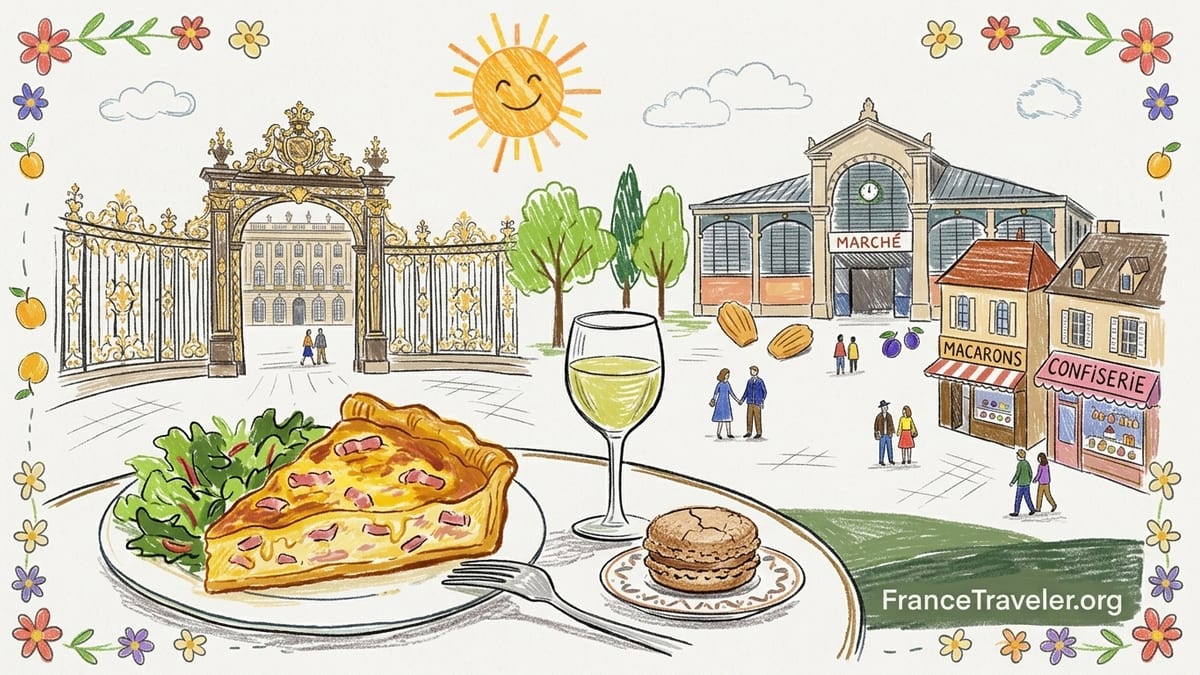
Starting Strong with Quiche Lorraine in Nancy
My first real encounter with quiche Lorraine in its home region was at Brasserie Stanislas, just across from Nancy’s train station, on a grey Tuesday lunch service. I ordered the traditional quiche Lorraine listed as a main course at 17.50 euros, which arrived as a generous wedge on warm porcelain with a simple green salad on the side. The slice was nearly thumb-thick, the top blistered and deeply golden, the filling trembling slightly when I nudged it with my knife. The texture fell between custard and set cream, rich with smoky lardons and nutty Gruyère, and the shortcrust base stayed impressively crisp right to the tip. I had grown used to pale, timid quiches in cafés elsewhere in France; this one was unapologetically rich, the kind of dish that makes you slow down because every bite counts. I would absolutely order this again, ideally shared, because finishing the whole plate at midday left me content but moving a little slower for the rest of the afternoon.
To balance that restaurant experience, I tried a more casual slice the next day at a stall inside Nancy’s Marché Central. Here the quiche was sold by weight; my piece, cut from a large rectangular tray and slipped into a cardboard tray, came to 4.80 euros. The serving style was closer to street food than brasserie dining, and I ate it standing at a high communal table between shoppers filling baskets with vegetables and cheese. The texture was firmer and cooler, the flavors more straightforward, with less cream and a leaner hand on the bacon. It was still satisfying but closer to an everyday lunch option than a destination dish. If I were catching a train or building a picnic, I would buy that market slice again, but if you only have one quiche Lorraine in Nancy, I would send you to a sit-down brasserie where the custard can be baked and served at its best.
Quiche Lorraine was the one regional classic that fully met the mental image I had carried for years. It tasted familiar yet more serious, more anchored to place. The combination of eggs, cream, cured pork and cheese is not subtle, and on a hot summer day it might feel too heavy, but in the cool shoulder seasons that frame most trips to Lorraine it makes immediate climatic sense. It also set a pattern for the rest of my eating: order the classic in a restaurant once, then chase a second, cheaper version at a bakery or market to see how the dish lives in daily life.
Commercy and the Reality of Madeleines
Official brochures talk reverently about madeleines de Commercy, and in Lorraine they are not theoretical. I bought my first box in Nancy at a city-center boulangerie that stocked wrapped, branded Commercy madeleines near the counter. The box of a dozen small, individually wrapped cakes cost just under 7 euros, and I opened it in my hotel room later that afternoon. These madeleines were uniform and neat, with the familiar shell pattern on one side and a modest bump on the other. The texture surprised me: soft and slightly elastic, not dry at all, with a mild butter and vanilla scent. They went well with tea, and the individually wrapped format made them practical for train snacks. I finished the box over two days and could imagine buying them again for convenience.
Still, I wanted to taste a fresher, less packaged version, so I bought two plain madeleines from an artisan bakery counter at Marché Central for about 1.20 euros each. They were sold loose, slipped into a paper bag while still faintly warm. Here the contrast was sharper: the crust was delicately crisp at the edges and the interior crumb was light but richer, with a clearer taste of browned butter. There was no industrial vanilla aroma, just simple egg and sugar. With a coffee at the market bar, this felt like a small but real Lorraine moment. If I return, this is the style I would seek out again, preferably early in the day while the batch is fresh.
That said, I will admit that madeleines are not as emotionally gripping as some of Lorraine’s other sweets. After a few days, I realized that I rarely craved them in the way I craved a second macaron or another taste of mirabelle. Among the region’s specialties, I would rank them as pleasant and comforting rather than essential. If your luggage space is limited, a box of Commercy madeleines is a nice souvenir for office colleagues or family, but if you are looking for the most vivid flavors of Lorraine, other products impressed me more.
Nancy Macarons: Rustic, Intense and Worth the Pilgrimage
Macarons in Nancy are not the pastel sandwich cookies you may know from Paris. The traditional Nancy macaron is a small, irregular almond biscuit that looks almost rustic compared with its capital-city cousins. I made a point of visiting a historic shop near Place Stanislas, where a dozen traditional macarons were boxed for around 11 euros. The staff packaged them in a compact cardboard box lined with simple tissue, a far cry from elaborate gift tins. I ate the first one standing just outside, as people streamed past toward the square. The surface gave way with a delicate crispness, and the interior was dense, chewy and deeply almond-forward, with an intensity closer to marzipan than to a light meringue. There was no filling, no colored shells, just the pure flavor of almonds, sugar and egg whites.
Those macarons were rich enough that I never wanted more than two or three at a time, but they were memorable. The texture is not airy; it sits between candy and pastry, and the sweetness is pronounced yet balanced by the nutty depth. They also keep well, which explains why shops and tourism materials emphasize them as souvenirs. Nancy’s tourism office highlights macarons among the city’s emblematic sweets, and walking around the center you see them in multiple patisserie windows, often alongside bergamotes and mirabelle confections. Among everything I tasted in Lorraine, traditional Nancy macarons were one of the few things I went back to buy again before leaving.
To compare, I picked up a small bag of similar almond cookies from a stand at Marché Central, sold loose by weight. The price came to just under 6 euros for about eight pieces. These market macarons were slightly more rustic in appearance, with more variation in size and browning. They were also marginally drier and sweeter, with less pronounced almond flavor. Eaten with coffee, they were still pleasant, but side by side the historic shop’s version had more character and better balance. If you are on a budget, the market option scratches the itch, but if you care about texture and flavor, the extra few euros for the well-known house are worth it. This is one regional specialty I would unequivocally recommend seeking out in its best form.
Bergamote Sweets and Why Nancy Leans So Hard Into Confectionery
Before this trip, bergamot for me meant tea and perfume. In Nancy, it also means a translucent, amber-colored boiled sweet known as the Bergamote de Nancy, with protected geographic status that local tourism materials are understandably proud of. I first encountered them at a traditional confiserie in the old town, where a 150-gram box cost around 7 euros. Inside, the candies were individually wrapped in clear paper. I unwrapped one on the spot: the square lozenge had sharp edges and a glassy sheen. On the tongue, it dissolved slowly with a bright, slightly floral citrus flavor, more complex and adult than a lemon drop yet without bitterness. The sweetness was present but not cloying, and the overall effect felt strangely refined for something so simple.
Later, at another Nancy patisserie, I tried a small bergamot-flavored cake and a crème brûlée scented with bergamot on a dessert menu. In the cake, the aroma played a supporting role to butter and almond. In the crème brûlée, it rose out of the caramelized top in the first spoonful, adding a perfumed lift without overwhelming the custard. These experiences made it clear why the city leans into bergamot as part of its identity. Local press kits and tourism brochures group bergamotes with macarons and babas under a label dedicated to Nancy’s sweet specialities, and several shops display that label prominently. When you walk the streets around Place Stanislas, you can see boxes of bergamotes stacked in windows, often next to visual references to the city’s gilded gates and Art Nouveau motifs.
There is, however, a limit to how many bergamot candies one person needs. A few days into my trip, I realized that while I appreciated their flavor, a small box would have sufficed. Larger souvenir tins that tempt you at 15 or 20 euros risk outstaying their welcome in your suitcase and at home. Individually, I would absolutely buy a modest box of Bergamote de Nancy again and enjoy them over a month. As a traveler, though, I would spend most of my confectionery budget on items with a more interesting texture, such as Nancy macarons or mirabelle-based cakes. Bergamotes are a taste and a story, but not the most versatile treat.
Mirabelle Plums, Baba and When Lorraine Sweets Become Too Much
Mirabelle plums are another star of Lorraine’s official gastronomy, and they were the ingredient that quietly stole the show for me. fresh fruit is seasonal, but mirabelle flavors appear year-round in jams, tarts and spirits. I first tasted them as a mirabelle tartlet from a pastry counter near Place Stanislas, where individual tartlets were priced around 4.50 euros. The serving style was simple: a thin, buttery crust filled with halved plums that had collapsed into a jammy layer during baking, with just a light glaze on top. The texture combined crisp base and soft fruit, and the flavor was concentrated and slightly tangy, like apricot with a more floral, honeyed note. It was rich but less heavy than chocolate-based pastries, and I finished it easily alongside a coffee.
In another café, I ordered a mirabelle clafoutis from the daily dessert board, at 6 euros. This arrived warm in a shallow dish, with sunken plums suspended in a custardy batter, dusted with powdered sugar. The texture here was softer and more pudding-like, and the mirabelle pieces were softer and more integrated into the batter than in the tart. This version felt like comfort food, something you could imagine being served in a family kitchen. Between the two, I would order the tartlet again for its contrast of textures, but both convinced me that mirabelle deserves its regional fame. If you see it on a dessert menu in Lorraine, it is worth ordering at least once.
Baba au rhum, another specialty promoted in Nancy’s tourism dossiers, was where I personally hit my limit. At a respected patisserie in Nancy, I ordered an individual baba displayed prominently in the case, price around 5.50 euros to take away. The cake was shaped like a small cylinder, already soaked in syrup, and served plain without extra whipped cream. The first bite was delightful: the dough was airy and springy, saturated with rum-scented syrup that dripped slightly when cut. The flavor was unapologetically alcoholic, with a good burn at the back of the throat. By the third bite, however, the combination of sugar and rum started to feel heavy. The last third of the cake required persistence rather than enthusiasm. For me, this made baba the most overrated of Lorraine’s highlighted sweets. I appreciate the technique and history, and I would share one again at a table, but I would not order a full individual baba for myself in the future.
This experience shaped my view of Lorraine pâtisserie more broadly. Between mirabelle, macarons, bergamotes, madeleines and baba, there is a real risk of sugar fatigue if you try to tick all the boxes in a short visit. My advice is to pace yourself, share desserts and focus on items with distinct textures and flavors. Mirabelle dishes and Nancy macarons brought me the most pleasure; baba was instructive but ultimately too intense to justify a repeat order.
Munster-Géromé, Toul Wines and Salty Relief
After several days of sweet tasting, I went looking for relief in the form of cheese and wine. Lorraine official materials often mention regional cheeses alongside wines from Toul and Moselle, and in practice you find them most easily on restaurant cheese boards and at cheese stalls in the markets. At a brasserie off Place Stanislas, I ordered a cheese plate featuring three regional cheeses sourced from a respected affineur, priced at 12 euros. One wedge was Munster-Géromé, a washed-rind cheese with a soft, oozing interior and a famously assertive aroma. It arrived at cool room temperature, with a little condensation on the surface and a faint orange rind.
The flavor of the Munster-Géromé was strong but more nuanced than its smell suggested. The paste was creamy and slightly elastic, spreading easily on bread. The taste combined lactic sweetness with a pronounced barnyard note and a hint of bitterness near the rind. Paired with slices of local bread and a glass of Auxerrois from the Côtes de Toul at around 6 euros by the glass, it made instant sense. The wine was pale, gently aromatic, and brought acidity to cut through the richness of the cheese. This was one of the most satisfying combinations of the trip, in part because it contrasted so sharply with the confections I had been tasting earlier in the day. I would order Munster-Géromé again without hesitation, particularly at a place that takes care over ripeness.
At Marché Central, I bought a small piece of Munster from a cheesemonger to compare the experience at home. The price was roughly 3.50 euros for a modest portion, wrapped in paper and starting to perfume my bag on the tram ride back. Eaten at my accommodation with a simple baguette and supermarket-bought Moselle white wine in the 8 to 9 euro range, the cheese felt a little rougher around the edges, saltier and slightly firmer. It was still enjoyable, but the brasserie version had been more carefully matured. The takeaway is simple: if you are curious about Munster-Géromé but nervous about its reputation, order it first as part of a curated restaurant plate, ideally with a suggested local wine. Once you know your comfort level, you can buy a smaller piece from the market for picnics or casual evenings.
Toul and Moselle wines themselves are not as globally famous as those from neighboring Champagne or Alsace, but on local lists they hold their own. By the glass, in Nancy, I consistently saw prices in the 5 to 7 euro range for regional whites and rosés, which makes them an accessible way to drink locally without committing to a full bottle. In terms of taste, the whites tended to be fresh, light and food-friendly rather than showy. They worked particularly well with quiche Lorraine, ham and cheese plates, and even as a counterpoint to richer pastries when ordered as an afternoon glass. I would not fly to Lorraine solely for its wines, but as part of an overall tasting itinerary, Toul and Moselle glasses are worth choosing when you see them on a menu.
Why Nancy Excels at Sweets
After several days eating across Nancy, a pattern emerged. Restaurants and markets across Lorraine serve quiche, cheese and regional wines, but Nancy in particular leans into its confectionery identity. City tourism materials highlight bergamotes, traditional macarons, babas, signature cakes and other sweets under a dedicated label that celebrates both heritage and artisanal quality. On the ground, you feel this in the concentration of patisseries and confiseries in the city center, each displaying boxes of Nancy macarons, bergamote candies and mirabelle cakes in carefully lit windows. Some shops reference historic monastic origins; others emphasize awards and labels that certify their products’ authenticity and craftsmanship.
What sets Nancy apart is not simply that these sweets exist but that there is a living ecosystem around them. In a few streets you can move from a historic macaron house, where the recipe is tied to the city’s story, to a modern patisserie reimagining bergamot in custards and tarts, then to a confiserie specializing in gift boxes aimed at visitors. The result is that as a traveler you can taste both the austere, traditional side of Lorraine sweets and their more contemporary expressions without walking more than ten minutes. At the same time, labels and press materials ensure that these products are not treated as generic candies but as part of Nancy’s cultural identity, much like its UNESCO-listed architecture.
That said, the city’s strength in sweets can also be overwhelming. It is easy to bounce from one boutique to the next, accumulating boxes that look beautiful on the shelf but may be too intense or too sugary to enjoy once you leave. My strongest recommendation is to treat Nancy like a tasting room rather than a supermarket. Buy small quantities, eat them within a day or two, and then decide which items deserve suitcase space. For me, that short list included Nancy macarons from a historic shop, a modest box of Bergamote de Nancy, and one or two mirabelle items. Baba, while omnipresent in brochures and well executed in the patisseries I tried, did not earn a place in my luggage.
A First-Timer’s Ideal Lorraine Tasting List
After a week of tasting across Nancy and shopping with an eye on trains and luggage weight, I came away with a clear sense of what I would repeat on a future trip and what I would leave for others. At the savory end, a properly made quiche Lorraine in a Nancy brasserie would be non-negotiable, ideally served as a main with salad at around 17 euros. I would follow that with a cheese plate including Munster-Géromé and a glass of Toul or Moselle white wine in the early evening. That trio covers the salty core of Lorraine’s gastronomic identity while giving you a break from sugar.
For sweets, my essential list is shorter than the brochures might suggest. I would seek out a box of traditional Nancy macarons from a recognized macaron house, accepting the slightly higher price compared with market versions in exchange for better texture and almond intensity. I would buy a small box of Bergamote de Nancy candies, not for volume but to bring home a transportable taste and story of the city. I would make time for at least one mirabelle tart or clafoutis, adjusting the format to the season and café offerings. Finally, I would buy individual fresh madeleines from a bakery or market stall for breakfast or snacks, leaving the larger industrial boxes to chance purchases if luggage space allows.
What I would not repeat for myself is an entire individual baba au rhum. Tasted once, it validated its reputation: airy dough, powerful syrup, distinct rum character. Yet it also confirmed that my palate prefers intensity in smaller doses. If you are a fan of syrup-soaked cakes or enjoy desserts with a noticeable alcoholic edge, baba in Nancy may delight you. For me, it sits firmly in the “shared dessert” category, not on any personal must-repeat list. A guide grounded in personal experience has to admit that not every official specialty will suit every traveler equally.
Your own tasting path through Lorraine will depend on your preferences and tolerance for richness, but going in with a clear sense of priorities helps. Use Nancy as a base for sweets, let the markets provide contrasting casual experiences alongside restaurant dishes, and do not be afraid to declare a much-lauded specialty too sweet or too heavy for your taste. Lorraine’s gastronomic culture is robust enough to handle honesty, and your own memories will be stronger for it.
The Takeaway
Eating across Lorraine as a first-time visitor, I found that the region’s reputation for hearty savory dishes and serious sweets is well deserved. Quiche Lorraine, when ordered as a main course in a Nancy brasserie, earned its fame with a custard that was richer and more satisfying than any version I had tried elsewhere. Macarons de Nancy, in their traditional, almond-heavy form, turned out to be one of the most distinctive and travel-worthy products, with an intensity that rewards slow, deliberate tasting. Mirabelle plums, whether in tarts or soft baked desserts, provided a brighter, more nuanced sweetness that I would happily seek out again.
At the same time, some celebrated items proved less aligned with my personal preferences. Packaged Commercy madeleines were pleasant and practical but rarely thrilling, while baba au rhum was technically impressive yet ultimately too sweet and heavy to finish alone. Bergamote candies delighted me in small numbers but did not need to dominate my suitcase. Munster-Géromé and regional wines, which sometimes sit quietly in the background of tourism brochures, delivered some of the most satisfying moments, especially when used to punctuate or counterbalance days spent tasting confections.
If you are planning a first trip to Lorraine and want to build an eating itinerary, start with a sit-down quiche Lorraine, plan at least one focused visit to a historic Nancy macaron house, and leave room for an impromptu mirabelle dessert when you see it on a chalkboard. Buy small quantities of sweets, favor fresh, bakery-made versions over industrial boxes, and remember that you are allowed to decide that a classic is not for you. Lorraine’s food traditions are rich, but they are also varied. The goal is not to tick every box but to find the few dishes and products that you would, quite simply, order again.
FAQ
Q1. Is it worth trying quiche Lorraine in Lorraine if I have had it elsewhere in France?
Yes, ordering quiche Lorraine in its home region is worthwhile. In Nancy brasseries I found it richer, thicker and more carefully baked than many café versions elsewhere, and the contrast between a restaurant slice and a market or bakery slice gives you a fuller picture of how locals actually eat it.
Q2. Are traditional Nancy macarons very different from Parisian macarons?
They are quite different. Nancy macarons are single rustic-looking almond biscuits without filling, with a crisp surface and a dense, chewy interior. They taste more intensely of almonds and less of sugar and color, and are usually sold by the dozen in simple boxes rather than as colorful assortments.
Q3. Where is the best place to buy Nancy macarons, a patisserie or the market?
Both options are good for different reasons. Historic macaron houses in the center offer more refined texture and deeper almond flavor at a slightly higher price, while market stalls sell looser, often sweeter versions that are fine for casual snacking. If you only buy one box to take home, I would choose a recognized macaron house.
Q4. Are bergamote candies very sweet, and how many should I buy?
Bergamote candies are sweet but lifted by a distinctive citrus and floral note, so they feel more aromatic than sugary at first. That said, they are intense, and a small box is usually enough for one person. Larger gift tins are attractive but may be more than you will realistically eat.
Q5. Are Commercy madeleines better from a box or fresh from a bakery?
Boxed Commercy madeleines are soft, convenient and travel well, which makes them good souvenirs, but fresh bakery or market madeleines have a lighter crumb, a touch of crispness at the edges and a clearer butter flavor. If you can, taste both styles to see which you prefer.
Q6. Is baba au rhum in Nancy very alcoholic?
In my experience, yes. Individual babas I tried were soaked generously in rum-scented syrup, and the alcohol presence was obvious from the first bite. Fans of boozy desserts will enjoy this, but if you are sensitive to alcohol or heavy sweets, consider sharing one rather than ordering a full portion for yourself.
Q7. How strong is Munster-Géromé cheese, and should I be nervous to try it?
Munster-Géromé can smell strong, but when properly ripened and served at the right temperature its flavor is complex rather than overwhelmingly pungent. A good way to try it is on a restaurant cheese plate with bread and a local white wine, which lets you experience its richness in a balanced setting.
Q8. Are Toul and Moselle wines easy to find in Nancy restaurants?
Yes, many Nancy restaurants and wine bars list at least one or two wines from Toul or Moselle by the glass, often in the 5 to 7 euro range. They are generally fresh, light and well suited to regional dishes like quiche and cheese, and choosing them is an accessible way to drink locally.
Q9. What is the best way to avoid sugar fatigue while tasting Lorraine specialties?
Pace yourself and mix sweet and savory stops. Share desserts when possible, favor smaller portions or individual pieces over large boxes, and consciously schedule savory dishes like quiche, charcuterie and cheese boards between confectionery tastings so your palate does not tire.
Q10. If I have time for only three Lorraine specialties, which should I prioritize?
Based on what I actually tasted and would repeat, I would prioritize a sit-down quiche Lorraine in Nancy, a box of traditional Nancy macarons from a historic shop, and at least one mirabelle-based dessert. Together they give you a balanced snapshot of Lorraine’s savory comfort food and its distinctive sweet side.